Mission 1. Pompeii: First Contact¶
1. Episode Overview¶
Essential Question
Who were the Romans?
ACTFL Proficiency Benchmarks — Novice
- Interpretive: I can identify the general topic and some basic information in both very familiar and everyday contexts by recognizing practiced or memorized words, phrases, and simple sentences in texts that are spoken, written, or signed.
- Cultural Investigation: In my own and other cultures I can identify products and practices to help me understand perspectives.
Cultural & Historical Learning Targets — student-facing
- Analyze Roman naming conventions and construct a Roman greeting.
- Identify the geography of the Bay of Naples and Mount Vesuvius.
- Examine the layout of the Roman house.
- Identify, describe, and use the customs of the Roman cēna.
- Distinguish the real Lucius Caecilius Iucundus from his role in the story.
Grammatical Learning Objectives — teacher-facing
- Introduction to Latin syntax and word order.
- Nominative-case nouns and the verb est.
- Prepositional phrases, with in foregrounded.
- Third-person present verbs and basic adjectives with est (1.1).
- Accusative nouns and superlative adjectives (1.2).
- The standard Roman self-introduction, mihi nōmen est.
Lapis thread
No direct Lapis movement this episode. Mission 1 establishes the setting (Pompeii, summer 79 CE), the two factions (the Milites Lapidis and the Societas Potentium), and the team's first mortal ally, Tiberius. The Lapis itself is only named as the thing Marcus is hunting.
Instructor background — withheld from students
The Lapis was cut from the stone swallowed by Saturn, taken by Neptune and built into the walls of Troy, demanded by Hercules and refused (causing the first sack of Troy), sought by Agamemnon as the real object of the Achaean expedition, carried from Troy by Aeneas and hidden by Ascanius at Alba Longa, found by Romulus and set in the first walls of Rome, then known only to the kings until Tarquin revealed it to Lucretia and Lucretia to Brutus. Most of this is dramatized from Mission 2 on. The deeper plot, withheld until the end of the operation: the Societas Potentium are not simply seizing the Lapis, they are baiting the Milites Lapidis into over-playing their hand so the SP can persuade the emperor to entrust the Lapis to them. Marcus leaving the map in 1.1 is the first move of that trap.
2. Shared CODEX Backbone¶
Each approach works from the same CODEX pages. For what the sections contain and how students reach them, see The CODEX. Each episode's ATTUNEMENT set closes with an inline Memorātiō.
CODEX pages: CODEX 1.1 · CODEX 1.2 · CODEX 1.3
KEY-TEXTs
- 1.1: a short orientation passage: where the team is (Pompeii, below Vesuvius) and whom they have met (Marcus, and Tiberius in the tree). Read after 1.1.a.
- 1.2: dē Marcō Sextōque and dē Tiberiō, each with a Visual Walkthrough.
- 1.3: a dinner-day passage and in agrīs.
Informational Texts
- 1.1: the tria nōmina; the geography of the Bay of Naples.
- 1.2: the Roman house in Domus Rōmāna.
- 1.3: the Roman cēna in Cēna Rōmāna.
GRAMMATICA
- 1.1: endings change and carry meaning; adjective agreement; the third-person -t.
- 1.2: nominative versus accusative; the object-marking -m.
- 1.3: flexible word order; the preposition-plus-noun unit; superlative forms, previewed for recognition.
VERBA
- 1.1: est, in, nōn, ad, nōmen.
- 1.2: tū, dat, per, venit, agit.
- 1.3: ego, magnus, dīcit, pater, quoque.
CULTURALIA
- 1.1: Roman naming conventions and greetings.
- 1.2: the Roman house, its atrium, larārium, and lectus geniālis, set in the real House of Menander.
- 1.3: the banker Caecilius, his wax-tablet archive and what it reveals about Pompeii; the three courses of the cēna.
ATTUNEMENT
- 1.1: a set that builds from recognition to production. A sentence-to-image match and a word sort prime the pattern, then a build-a-sentence task has students produce subject + est + prepositional phrase of their own; CULTURALIA and KEY-TEXT comprehension questions run alongside.
- 1.2: exercises turning on the nominative-versus-accusative contrast. A forced-choice form task and a sort-by-ending task drill the endings, while a vocabulary-in-context task and a fact-extraction task put them to work in reading, with KEY-TEXT and CULTURALIA comprehension questions alongside.
- 1.3: exercises anchored in the Roman cēna. A sort-the-courses task organizes the meal's vocabulary, a complete-and-translate task builds prepositional phrases with the ablative after in, and a compare-the-meals chart sets the Roman dinner against the student's own, with CULTURALIA and KEY-TEXT comprehension questions alongside.
3. Episodes¶
The story beats are the same across all tracks. Track-specific links and running notes are in §4.
Numbering map (Episode 1): 1.1 (Boy in the Tree) = prompts 1.1.a / 1.1.b / 1.1.c; 1.2 (House of Sextus) = 1.2.a / 1.2.b; 1.3 (House of Caecilius) = 1.3.a / 1.3.b.
1.1, The Boy in the Tree¶
The team arrives near Pompeiī on a hot afternoon. A stranger on the road, Marcus, demands their name. He is looking for a boy hiding in an olive tree (Tiberius) and a stone called the Lapis. The team must give a believable Roman name, confuse Marcus about Tiberius's whereabouts until he leaves, and then receive Tiberius's thanks and directions to Sextus Aemiliānus. The episode closes with the first memorātiō.
1.2, To the House of Sextus Aemiliānus¶
Following the sīgnum Marcus left behind, the team arrives at Sextus's villa to find Marcus already there, pounding on the door. They drive Marcus off, meet Sextus (who glows faintly, the first nitidus guide), and question him about the Lapis. They learn enough to act, and are sent to Caecilius.
1.3, At the House of Caecilius¶
Sextus's villa is no longer safe. The team walks the streets of Pompeiī to the house of Lucius Caecilius Iucundus, a banker. They find Tiberius there (Caecilius est meus pater is the planted payoff from 1.1.c) and must convince Caecilius to be their amīcus. The episode closes with the Roman cēna, the culture-performance prompt that caps the Pompeii arc's opening mission.
4. Running the Mission¶
Latin and English RPG. The agent posts each immersion prompt; the team's lead operative replies in character. The English RPG runs identically, with the role-play in English and a heavier lean on the CODEX for the Latin and cultural content.
Immersion links:
Episode 1.1 — The Boy in the Tree
-
Post 1.1.a and read it aloud together for comprehension. On the road near Pompeii, a stranger (Marcus) demands the team's name. Stop here, before anyone answers.
-
Introduce GRAMMATICA 1.1 now, before the first Latin the team writes. Mission 1 rests on the fact that Latin word endings carry meaning: show how est links a subject to what follows, and how the -t ending marks a third-person verb. Everything the team composes this mission builds on this.
-
Marcus wants a Roman name, so give the team what a Roman name is. Send them to the Tria Nōmina informational text and the CULTURALIA section on naming, then have them do the Culturalia questions to confirm they can build a proper tria nōmina, not just recognize one. Inventing a convincing name to fool Marcus takes more than knowing the pattern.
-
Have the team run the sentence-to-image match to meet the subject + est + prepositional phrase pattern by sight before they have to produce it. This primes the grammar they will use to misdirect Marcus in 1.1.b.
-
The team answers Marcus with their invented name (their response to 1.1.a). Post your in-character reply as Marcus: suspicious, unsatisfied even by a perfect name. That withheld suspicion is what drives the confrontation in 1.1.b. See §5 Agent Craft for 1.1.a postures.
-
Read the KEY-TEXT 1.1 together now: a short passage that orients the team (where they are, whom they have met), placed after the naming scene but before the confrontation so it grounds them without giving away the next beat. Follow it with the word sort and the key-text comprehension (answered in Latin), both of which draw on this passage.
-
Introduce the Bay of Naples geography informational text and the wider CULTURALIA section to set the ground the confrontation plays out on.
-
Post 1.1.b. Marcus hunts the boy Tiberius, hidden in an olive tree; the team sends him off with contradictory locations (in viā, in agrō, and so on). Each false location the team writes is a live subject + est + prepositional phrase, so run the build-a-sentence task right here: composing the misdirection and practicing the grammar are one and the same act. Post your reply as Marcus giving up and leaving, then Tiberius climbing down to thank the team and point them to Sextus. See §5 Agent Craft for Tiberius's deflections and the pater meus hold.
-
Post 1.1.c: this prompts the first inline memorātiō, a short reflective write-up in the operative's voice. No in-character reply is needed. Coach the form (third person, past tense, the character's point of view). See §5 Agent Craft for the nudge to give a stuck team.
-
Award LP for 1.1 per operative, and mark ATTUNEMENT completion in Mission Control (160 LP per operative).
Episode 1.2 — To the House of Sextus Aemiliānus
-
Before posting anything, read dē Marcō Sextōque together for background on Marcus and Sextus, then work the true/false reading check on that passage to get the team reading the Latin closely rather than skimming it.
-
Introduce GRAMMATICA 1.2: the difference between a nominative subject and an accusative object, and the object-marking -m ending. Drill it with the forced-choice form task and the sort-by-ending task so the contrast is steady before it matters in the questioning scene.
-
Post 1.2.a. Marcus is already at Sextus's door. The team drives him off, using the saxum and rāmus in the road as a threat or bluff rather than a real fight. Post your reply as Marcus retreating with a parting threat about the Lapis, and Sextus opening the door. See §5 Agent Craft for 1.2.a postures.
-
Post 1.2.b. Sextus brings the team into the ātrium, and they question him about the Lapis: this is the scene that teaches good questioning, so let the team drive it. Bring in the Domus Rōmāna 1 informational text and the CULTURALIA 1.2 section, since the house interior is both the setting and the cultural content, and work the vocabulary-in-context task and the Culturalia questions. The nominative and accusative work from step 2 lives here, in the questions the team builds. Post your reply as Sextus: rewarding a specific question with a real answer, reshaping a vague one, and finally sending the team on to Caecilius. See §5 Agent Craft.
-
Read dē Tiberiō together to set up Tiberius before the house reveal in 1.3; it sits on the same CODEX page. Work its character-chart reading task to fix who Tiberius is.
-
Close the episode with the inline memorātiō. Award LP for 1.2, and mark ATTUNEMENT and KEY-TEXT completion in Mission Control.
Episode 1.3 — At the House of Caecilius
-
Warm-up: have the team spend a few minutes on the real Lucius Caecilius Iucundus before they meet the story's version. Noticing the gap between the historical banker and the character is part of the intercultural work.
-
Read KEY-TEXT 1.3 together: a short orientation passage embedded on the CODEX page, meant to come before the dinner so the team knows the household they are walking into.
-
Post 1.3.a. The team reaches the house; Tiberius reveals Caecilius est pater meus, the payoff planted back in 1.1.c, and the team begins to win Caecilius over as an amīcus. Introduce GRAMMATICA 1.3 here: Latin's flexible word order, the preposition-plus-noun unit as a fixed pair, and superlative forms for recognition only (no formal drill yet). Post your reply as Caecilius extending the invitation to dinner. See §5 Agent Craft for 1.3.a postures.
-
Before posting 1.3.b, set the table. Bring in the Roman Cēna informational text and the CULTURALIA 1.3 section (the three courses of the cēna, and who Caecilius is), then work the Sort the Courses task to organize the meal's vocabulary and the Culturalia questions to check the cultural detail.
-
Post 1.3.b, the cēna itself: the gustātiō and the dinner conversation, the culture performance that caps the mission. As the team dines and talks, this is where prepositional phrases go to work, so weave in the Complete and Translate task (building phrases with the ablative after in) and the Compare the Meals task, which sets the Roman meal against the team's own. Post your reply as the host, carrying the mappae beat and bringing the dinner to a close. See §5 Agent Craft.
-
Read in agrīs together, set the day after the dinner: the olive-shaking scene gives the gustātiō a backstory (the olives likely came from Caecilius's own farm) and deepens the tie between Tiberius and Caecilius. Work its comprehension questions.
-
Close with the inline memorātiō. Rotate the lead operative for 1.3 if you have not already, award LP, and mark ATTUNEMENT and KEY-TEXT completion for all three episodes in Mission Control.
A self-paced branching Latin story following Octāviāna and Bellātor. Students choose at each fork; culturally "wrong" choices trigger in-narrative corrections rather than teacher intervention, so the cultural teaching is built into the story structure. The CODEX backbone is identical to the RPG (same informational texts, same GRAMMATICA, same ATTUNEMENT) and the learning objectives are the same. The teacher's role is discussion facilitator rather than Agent.
Openings: the two CYOP tutorials run first and are covered on the Introduction & Tutorials page. The episode openings follow below. Run the mission as an Operation LAPIS (CYOP) cohort in Mission Control, where each student keeps a per-episode Memorātiō on their dossier and the attunement and key-text checks work as in the RPG; see About Fabula Lapidis for cohort setup.
Episode 1.1 — The Boy in the Tree
-
Post the 1.1 opening. Students begin the branching Latin narrative, following Octāviāna and Bellātor as they arrive on the road near Pompeii and meet the stranger Marcus, who demands a name. Have them read for comprehension and pause before the naming fork.
-
Introduce GRAMMATICA 1.1 before the first choice that turns on Latin form: Latin word endings carry meaning, est links a subject to what follows, and the -t ending marks a third-person verb. This is the floor every choice this mission stands on.
-
Marcus wants a Roman name, so give students what a Roman name is. Send them to the Tria Nōmina informational text and the CULTURALIA section on naming, then have them work the Culturalia questions to confirm they can build a proper tria nōmina, not just recognize one. The naming fork only carries real stakes once they know what a Roman name looks like.
-
Have students run the sentence-to-image match to meet the subject + est + prepositional phrase pattern by sight before the misdirection choices ask them to use it.
-
Students choose how Octāviāna and Bellātor answer Marcus. Culturally off-base choices trigger in-narrative corrections; let the story do the correcting rather than stepping in.
-
Before the confrontation branch, read the KEY-TEXT 1.1 together: a short passage that orients students (where they are, whom they have met). Follow it with the word sort and the key-text comprehension (answered in Latin), both drawn from this passage.
-
Bring in the Bay of Naples geography informational text and the wider CULTURALIA section to ground the confrontation the branches lead into.
-
In the confrontation branch, students send Marcus off with contradictory locations for Tiberius, the boy hidden in the olive tree. Each false location is a live subject + est + prepositional phrase, so run the build-a-sentence task alongside: the branching choices and the grammar practice are the same work.
-
The narrative closes with the first inline memorātiō, a short reflective write-up in the protagonist's voice. Coach the form (third person, past tense, the character's point of view). Award 1.1's LP on the quality of that reflection.
-
Debrief the episode's choices as a class: why did the narrative respond as it did, and what would a Roman have known that Octāviāna and Bellātor needed to know? The discussion is where the cultural learning settles.
Episode 1.2 — To the House of Sextus Aemiliānus
-
Before the opening, read dē Marcō Sextōque together for background on Marcus and Sextus, then work the true/false reading check to get students reading the Latin closely rather than skimming it.
-
Introduce GRAMMATICA 1.2: the difference between a nominative subject and an accusative object, and the object-marking -m ending. Drill it with the forced-choice form task and the sort-by-ending task before the questioning scene.
-
Post the 1.2 opening. Students follow Octāviāna and Bellātor to Sextus's house, where Marcus is already at the door. The branches let them drive him off; off-base choices self-correct in the narrative.
-
As the story moves inside to the questioning of Sextus, bring in the Domus Rōmāna 1 informational text and the CULTURALIA 1.2 section, since the house interior is both the setting and the cultural content, and work the vocabulary-in-context task and the Culturalia questions. The nominative and accusative work from step 2 lives here, in reading Sextus's answers closely. In the debrief, surface the lesson the RPG teaches through Tiberius's deflections: different characters know different things, and a good question goes to the right person.
-
Read dē Tiberiō together to set up Tiberius before the house reveal in 1.3; it sits on the same CODEX page. Work its character-chart reading task to fix who Tiberius is.
-
The narrative closes with the inline memorātiō. Award 1.2's LP on the quality of that reflection.
Episode 1.3 — At the House of Caecilius
-
Warm-up: have students spend a few minutes on the real Lucius Caecilius Iucundus before the story's version appears. Noticing the gap between the historical banker and the character is part of the intercultural work.
-
Read KEY-TEXT 1.3 together: a short orientation passage embedded on the CODEX page, meant to come before the dinner so students know the household they are entering.
-
Post the 1.3 opening. Students reach Caecilius's house, and Tiberius reveals Caecilius est pater meus, the payoff planted back in 1.1.c. Introduce GRAMMATICA 1.3 here: Latin's flexible word order, the preposition-plus-noun unit as a fixed pair, and superlative forms for recognition only (no formal drill yet).
-
Before the dinner branches, set the table. Bring in the Roman Cēna informational text and the CULTURALIA 1.3 section (the three courses of the cēna, and who Caecilius is), then work the Sort the Courses task to organize the meal's vocabulary and the Culturalia questions to check the cultural detail.
-
In the dinner branches, students make culturally off-base choices (sitting instead of reclining, skipping the handwashing) and receive in-narrative corrections. This is where prepositional phrases go to work, so weave in the Complete and Translate task (building phrases with the ablative after in) and the Compare the Meals task, which sets the Roman meal against the student's own. Let the branches play out before debriefing.
-
Read in agrīs together, set the day after the dinner: the olive-shaking scene gives the gustātiō a backstory (the olives likely came from Caecilius's own farm) and deepens the tie between Tiberius and Caecilius. Work its comprehension questions.
-
The narrative closes with the inline memorātiō. The post-reading discussion is the richest intercultural moment in Mission 1. Award 1.3's LP on the quality of the Memorātiō reflection.
Story Map¶
Octaviana and Bellator arrive near Pompeii and have a tense first encounter with the sinister old man Marcus by an olive tree, then make their way to the households of Sextus and Caecilius. The episode introduces the Roman world, key allies and antagonists, and closes with the Recentii dining like Romans as guests of Caecilius.
How to read the maps
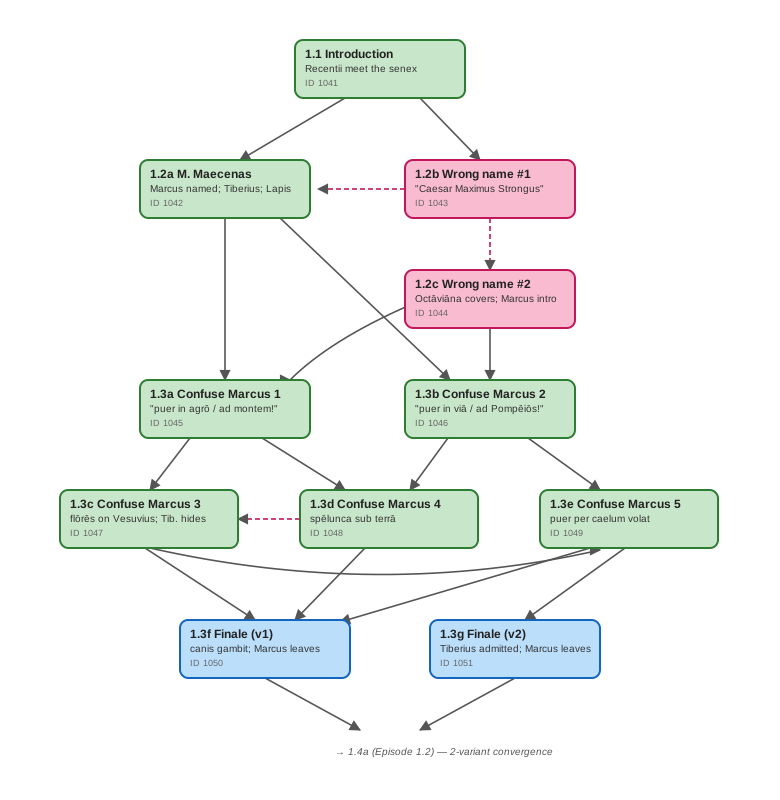
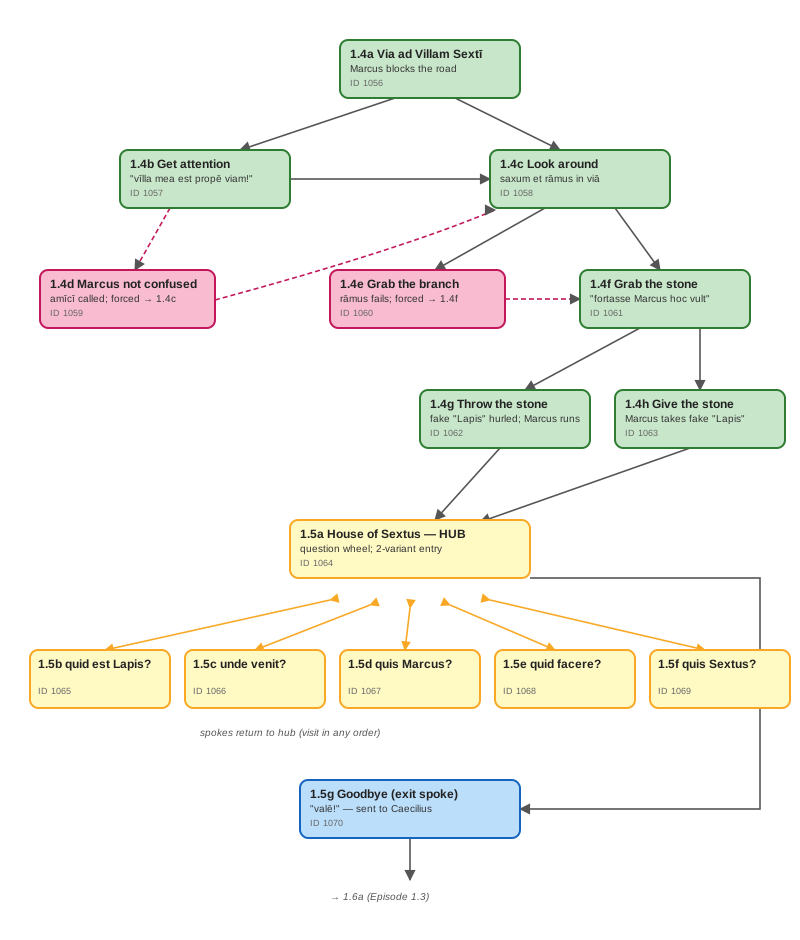
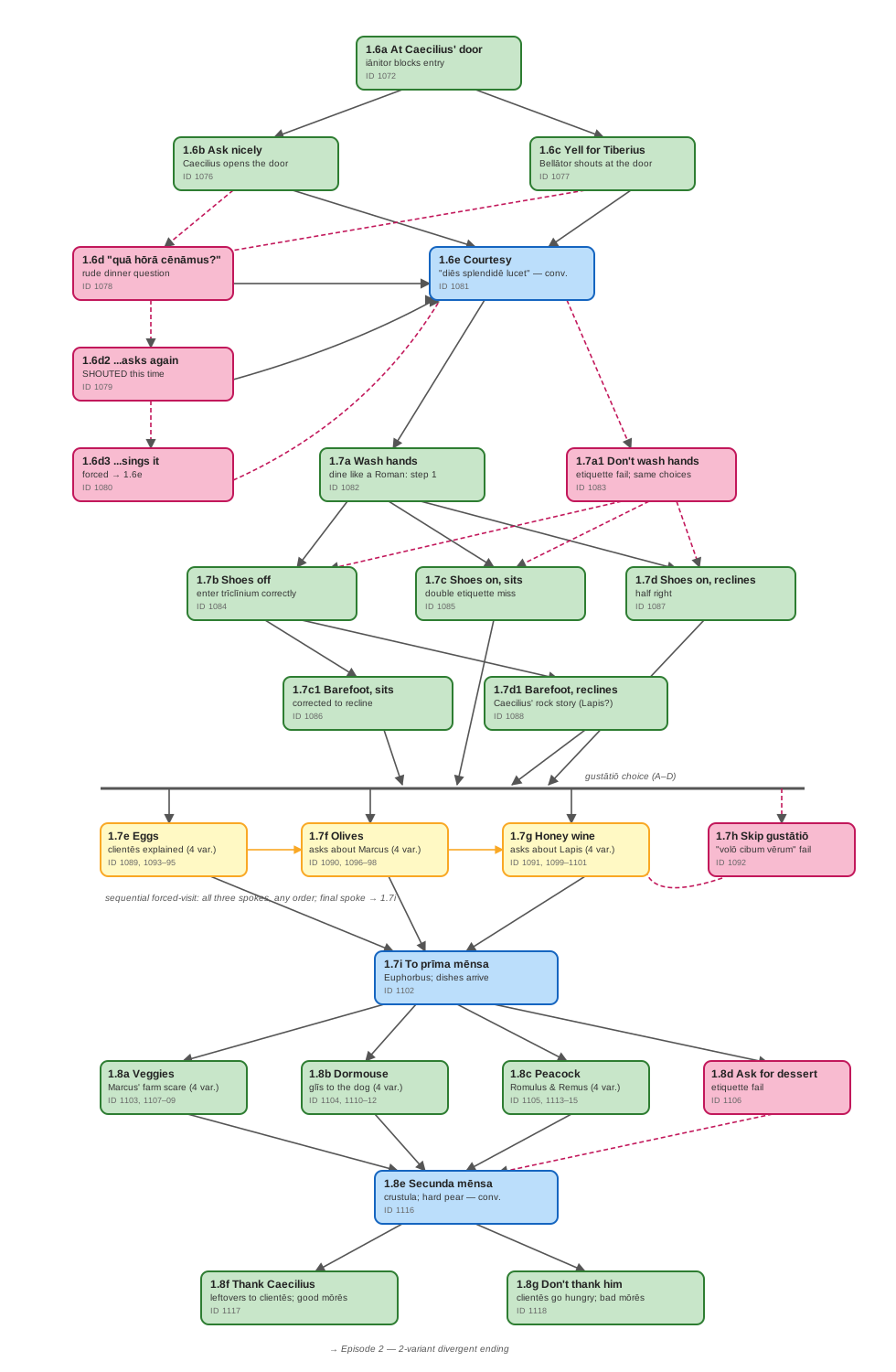
Each box is one scene (one static story page). Green = standard scene · Blue = convergence / key node · Pink = fail / redirect (dashed pink arrows loop the reader back) · Yellow = special or graded gate · Grey = meta / optional. Solid arrows are forward story choices; labels on arrows paraphrase the choice.
1.1 pathing map
11 scenes · 3 fail/redirect branches · 2 convergence nodes
1.2 pathing map
15 scenes · 3 fail/redirect branches · 1 convergence nodes
1.3 pathing map
26 scenes · 12 fail/redirect branches · 3 convergence nodes
5. Agent Craft¶
Latin and English replies for prompts 1.1.a through 1.3.b are below, organised by anticipated student posture. English replies support the English RPG approach.
Register. Mission 1 is the second week of Latin 1. Every Latin reply stays inside the M1 ceiling: 3rd-singular present, the copula (sum/es/est/sumus/estis), nominative and accusative singular, prepositional phrases, and the set phrases the immersion text already uses (mihi nōmen est, agō grātiās, Lapis est mihi). Imperatives and vocatives are fine in direct speech. NPC lines do not use 1st/2nd-singular lexical verbs, perfect, future, comparative, subjunctive, or indirect questions. Where an NPC would naturally say something past or future, the Latin stays present and simple and the English reply or an English stage direction carries the rest. These are starting blocks for an unsure agent, not a script.
Cross-cutting techniques this mission:
- Efficient authenticity. Allow the Recentiī's choices maximum effect for minimum agent effort. Let reasonable actions simply work; answer impossible ones with in-fiction failure rather than an out-of-character refusal.
- Re-rail in-fiction. Never block a move out of character. Have the NPC hear it, react in character, and funnel back to the prompt.
- Punt to the right NPC. Tiberius can credibly not know things. Sextus defers location and Lapis custody. Caecilius cannot perceive the supernatural. Use these limits to teach that good questions go to the right person.
- Let honest answers carry consequences. The team that tells Marcus the truth in 1.1.b learns why the deception trick is necessary.
- Let attacks fail gently. Marcus is bigger and older. Attacks annoy him; they do not injure him or end the scene.
- The nuclear option. Early on you may steer a lead operative directly from within the fiction. Because the TSTT is the Demiurge's program, this does not break the fourth wall.
Character notes:
- Marcus names himself only in 1.1.b; in 1.1.a he is just malus. Play him gruff, impatient, suspicious, and in facile mode: gullible about Tiberius's location, not about much else.
- Tiberius does not speak in 1.1.b. His thank-you is 1.1.c. Hold the Caecilius est meus pater reveal until 1.3.a.
- Sextus is introduced in 1.2.b as the first nitidus guide. Avuncular, measured, warm. Good specific questions earn real answers; broad ones earn a reshaping. Do not explain the glow.
- Caecilius is a pragmatist who cannot perceive the supernatural layer. He likes order. Friendship with his son, courtesy, and usefulness win him; demands and bad manners cool him briefly.
- Euphorbus is the cook, cheerful and proud of his food. No plot weight.
- Sinistrus is not yet present (introduced Mission 5.1).
Watch-fors. Teams often default to the truth in 1.1.b (turn it into a consequence). The memorātiō in 1.1.c is a reflective writing task, not a live exchange; coach the form rather than role-playing a reaction. The questioning scene in 1.2.b is the deliberate skill-builder; praise specific questions in coaching even when Sextus deflects them in character.
Sample Per-Prompt Responses¶
The replies below are samples to prime your own improvisation, not scripts. They show one plausible way to handle each posture, never the only or required one.
1.1.a — The First Encounter
Scene context. The team has just arrived. Marcus, a stranger on the road, demands their nōmen. They do not yet know who he is or that there is a boy in the tree. Marcus performs menace but the TSTT is on facile. The team has been pointed at the CULTURALIA on the Roman nōmen and is being asked to give a name, real or invented.
Marcus's posture. Impatient, gruff, suspicious. Not yet physically threatening; that escalates in 1.1.b. One or two short Latin lines per exchange.
Posture 1: The team gives a plausible Roman tria nōmina
Latin (Marcus): "nōmen magnum est. sed vērum nōn est. dīc iterum!"
English (Marcus): "A grand name. But it's not the real one. Say it again!"
Marcus pressures; he does not accept. Even a perfect tria nōmina is met with suspicion; that suspicion is the engine of 1.1.b. Praise the Latin in coaching after the scene, but in character, push back.
Posture 2: The team gives a single name or a non-Roman name
Latin (Marcus): "Recentius? nōmen Rōmānum nōn est. Rōmānus es?"
English (Marcus): "Recentius? That's not a Roman name. Are you Roman?"
A teachable nudge back to the CULTURALIA: a Roman gives three names. "Are you Roman?" invites a revision without breaking the fiction. If they cannot manage a tria nōmina, Marcus demands again: "dīc iterum! nōmen Rōmānum!"
Posture 3: The team refuses or tries to walk away
Latin (Marcus): "malus es! nōmen tuum dīc!" (Marcus steps into the road, blocking the way.)
English (Marcus): "You're up to no good! Say your name!" (Marcus steps into the road, blocking the way.)
Marcus blocks the road. He is not violent yet; he will not let them pass without an answer. Redirect through action, not an out-of-character refusal.
Posture 4: The team asks a question instead of answering
Latin (Marcus): "nōn ego! tū! nōmen tuum dīc!"
English (Marcus): "Not me, you! Say your name!"
Praise the question-asking move; Marcus throws it back. He gives his name only after they give theirs. Do not let Marcus name himself first; his name is the 1.1.b beat.
Posture 5: Off-script creative move
Marcus is suspicious and fixed on the name. Whatever the move, funnel back:
- Money: "pecūnia? bene. sed prīmum nōmen tuum dīc." / "Money? Good. But first, say your name."
- Attack: "puer es! nōmen dīc!" / "You're a child! Say your name!"
- Wild story: "fābula est! nōmen dīc!" / "That's a story! Say your name!"
1.1.b — Help the Boy Escape
Scene context. Marcus has named himself and turned suspicious. Tiberius, in the olive tree, has called down his own name and drawn Marcus's attention. Marcus demands the Lapis from the boy, his back to the team, looking up into the tree. The prompt: confuse Marcus with contradictory locations for Tiberius until he leaves. He is gullible by design (facile mode). Tiberius does not speak in 1.1.b; if addressed, he panics silently.
Posture 1: The team feeds Marcus contradictory locations (canonical)
Latin (Marcus), escalating:
(first) "in viā? ubi? Tiberius hīc nōn est."
(second) "in agrō? sed Tiberius in viā est!"
(third) "canis? puer canis nōn est! malī estis!"
(gives up) "satis est!" (Marcus turns and stalks off down the road, still shouting that the Lapis is his.)
English (Marcus), escalating: "In the road? Where? Tiberius isn't here." / "In the field? But Tiberius is in the road!" / "A dog? A boy isn't a dog! You're rascals!" / "Enough!" (He stalks off.)
Aim for three or four exchanges; each is a fresh subject + est + prepositional phrase rep. The parting threat about the Lapis (English stage direction) sets up 1.2.a.
Posture 2: The team gives the true location
Latin (Marcus): "in arbore? Tiberius in arbore est!" (He reaches up; Tiberius scrambles higher.) "et vōs? ubi est puer?"
English (Marcus): "In the tree? Tiberius is in the tree!" (He reaches up; Tiberius scrambles higher.) "And you? Where is the boy?"
Do not punish the truth; use it. Marcus spots Tiberius, the danger spikes, and his ubi est puer? loops them back to the prompt. The team learns by watching the honest answer make things worse.
Posture 3: The team attacks Marcus
Latin (Marcus): "puer es! puer malus es!" (He swats at them, unbothered, and turns back to the tree.) "ubi est puer?"
English (Marcus): "You're a child! A naughty child!" (Swats at them.) "Where is the boy?"
Attacks fail gently. No injury. The failed attack re-anchors the prompt.
Posture 4: The team reasons with Marcus
Latin (Marcus): "puer hīc est! ubi est puer?"
English (Marcus): "The boy is here! Where is the boy?"
Marcus is not in a state to be reasoned with. He brushes them off and returns to the tree. The prompt's trick works where reason won't; that's the lesson.
Posture 5: The team addresses Tiberius directly
Tiberius's eyes go wide; he puts a finger to his lips. The branch creaks. Then Marcus:
Latin (Marcus): "cum puerō? ubi est puer? dīcite!"
English (Marcus): "With the boy? Where is the boy? Tell me!"
Tiberius's silent panic should make the team feel they nearly gave him away, nudging them toward the actual mechanic.
Posture 6: Off-script creative move
Marcus's obsession with the Lapis and the boy is the escape hatch. ubi est puer? comes back within one exchange:
- "I have the Lapis": "Lapis est tibi? Lapidem ostende!" / "You have the Lapis? Show me!" When they can't produce it, back to the tree.
- "Soldiers are coming": "mīlitēs? ubi? nēmō hīc est." / "Soldiers? Where? No one's here." A glance, then back to the tree.
- "You're being watched": "quis spectat? nēmō hīc est!" / "Who's watching? No one's here!"
1.1.c — Tiberius's Thanks and the Memorātiō
Scene context. Marcus has fled. Tiberius jumps down, thanks the team, and points them to Sextus Aemiliānus in Pompeiī. The actual Prompt of 1.1.c is "compose the first memorātiō", a reflective writing task done outside the immersion. Agent responses here cluster around the Tiberius beat; see the note at the bottom for the memorātiō.
Tiberius's posture. Relieved, grateful, friendly. Short, excited clauses. No SP/ML, no Lapis lore, no father reveal; hold Caecilius est meus pater until 1.3.a.
Posture 1: The team accepts the thanks and gives names
Latin (Tiberius): "salvēte! amīcī meī estis. Sextus Aemiliānus amīcus meus est. Sextus in Pompēiīs habitat. ad vīllam Sextī īte!"
English (Tiberius): "Hello! You're my friends. Sextus Aemilianus is a friend of mine. Sextus lives in Pompeii. Go to Sextus's villa!"
The canonical path. Do not let Tiberius volunteer his father, his full name, the Lapis, or the ML.
Posture 2: The team is wary and reluctant to give names
Latin (Tiberius): "malus nōn sum! malus fugit. Tiberius sum. amīcus sum."
English (Tiberius): "I'm not the bad one! The bad one ran off. I'm Tiberius. I'm a friend."
Tiberius doesn't push. He names himself and waits. If they still hold back, he shrugs (bene, bene) and gives Sextus's location anyway.
Posture 3: The team asks questions
The most important posture here; it introduces questioning as a habit.
- "Quis es tū?": "Tiberius sum. puer Pompēiānus sum." / "I'm Tiberius. I'm a Pompeian boy." (No father, no full name.)
- "Quis est Marcus?": "Marcus malus est. Sextus scit." / "Marcus is bad. Sextus knows."
- "Quid est Lapis?": "Marcus Lapidem amat. Sextus scit. ad Sextum īte!" / "Marcus loves the Lapis. Sextus knows. Go to Sextus!"
- "Ubi habitās?": "domus mea in Pompēiīs est. sed prīmum ad Sextum īte!" / "My home is in Pompeii. But first go to Sextus!"
Use Tiberius's deflections to model "punt to the right NPC." Praise specific questions in coaching.
Posture 4: The team tries to take Tiberius with them
Latin (Tiberius): "domus mea hīc est. pater meus hīc est. sed ad Sextum īte! Sextus amīcus est."
English (Tiberius): "My home is here. My father is here. But you go to Sextus! Sextus is a friend."
pater meus in passing is fine; he does not name Caecilius. The recognition lands in 1.3.a.
Posture 5: The team wants to chase or fight Marcus
Latin (Tiberius): "minimē! Marcus malus est. Marcus fugit. ad Sextum īte. Sextus auxilium dat."
English (Tiberius): "No! Marcus is bad. Marcus ran off. Go to Sextus. Sextus gives help."
Posture 6: Off-script destination
- "To Rome": "Rōma procul est! prīmum ad Sextum īte." / "Rome is far! First go to Sextus."
- "Up Vesuvius": "in montem? cūr? Sextus in Pompēiīs est." / "Up the mountain? Why? Sextus is in Pompeii."
- "Home": "domus tua hīc nōn est. Sextus auxilium dat." / "Your home isn't here. Sextus gives help."
The memorātiō prompt. "Compose the first memorātiō" is a reflective writing task outside the TSTT; no in-character response is needed. If a team is stuck, nudge as Lūsūra: "Your Recentius lived this moment. What did they notice? The memorātiō is how you remember for them." Coach form (third person, past tense, character voice), not content.
1.2.a — Driving Marcus from Sextus's Door
Scene context. The team has followed the sīgnum on Marcus's dropped charta to Sextus's villa and found Marcus already there, pounding on the door and demanding the Lapis. The text puts a saxum and a rāmus in the road. The prompt: drive Marcus off so Sextus can open the door.
Marcus's posture. Louder and angrier than on the road. Fixed on the door and on Sextus. He retreats when staying becomes more trouble than leaving, and departs with a threat (English stage direction).
On the props. The saxum and rāmus tempt a physical solution. A threat or display works where a real beating does not; reward cleverness over violence.
Posture 1: The team threatens, displays, or bluffs Marcus away (canonical)
Latin (Marcus): "rāmus? puer es!" (He hesitates, then thinks better of it.) "satis est!" (He backs off down the road, shouting he will return for the Lapis.)
English (Marcus): "A branch? You're a child!" (Hesitates.) "Enough!" (He backs off, still shouting about the Lapis.)
A calculated retreat, not a rout. The threat to return feeds his recurring-antagonist arc. Let the team feel they won the round without believing he's gone. Then Sextus opens the door (hand off to 1.2.b).
Posture 2: The team reasons with Marcus
Latin (Marcus): "Sextus Lapidem habet! Lapis est mihi!" (He pounds on the door again.)
English (Marcus): "Sextus has the Lapis! The Lapis is mine!" (He pounds on the door again.)
Reason doesn't move him; he's fixed on the door. Let the failed appeal push them toward the props or a bluff.
Posture 3: The team attacks Marcus
Latin (Marcus): "saxum? puer malus es!" (He knocks the rock aside, more annoyed than hurt.) "ubi est Sextus?"
English (Marcus): "A rock? You naughty child!" (Knocks it aside.) "Where is Sextus?"
The attack is a nuisance, not a knockout. Marcus is angrier and still at the door, which makes the clever solution the obvious next move.
Posture 4: The team calls through the door to Sextus
Latin (Sextus, muffled, from behind the closed door): "malus in viā est! malum repellite!"
English (Sextus): "The bad man is in the road! Drive him off!"
Sextus won't open the door while Marcus is on it. repellite points them back at the task. No Lapis information through the door.
Posture 5: Off-script creative move
Marcus is fixed on the door:
- "The watch is coming": "vigilēs? ubi? nēmō hīc est." / "The watch? Where? No one's here."
- "Sextus already left": "Sextus hīc est! iānua clausa est." / "Sextus is here! The door's shut." He keeps pounding.
- "We're your allies": "socius meus es? tum Lapidem date!" / "You're my ally? Then give me the Lapis!" Their fake alliance just turns the demand on them.
1.2.b — Questioning Sextus about the Lapis
Scene context. Marcus gone, Sextus opens the door, thanks the team, and brings them into the ātrium. He glows (lūmen dē Sextō venit), is anxious, and opens with "Marcus Lapidem amat. Lapis antīquus et potēns est..." The prompt: question Sextus about the Lapis and the malus. This is the deliberate questioning-skill scene.
Sextus's posture. Avuncular, warm, measured. A good specific question earns a real answer; a broad lazy one earns a reshaping that models a better question. His death, the SP/ML faction in full, and the Lapis's full history are withheld.
Posture 1: The team asks a good, specific question
- "Cūr Marcus Lapidem amat?": "Marcus potentiam amat. Lapis potentiam dat." / "Marcus loves power. The Lapis gives power."
- "Quid est Lapis?" (asked specifically): "Lapis antīquus est. Lapis potēns est." / "The Lapis is ancient. The Lapis is powerful."
- "Quid facere dēbēmus?": "Lapis in perīculō est. Lapidem servāte!" / "The Lapis is in danger. Protect the Lapis!"
Specific questions get real answers. Keep them short; that's the register, and it reads as Sextus weighing his words.
Posture 2: The team asks a broad or lazy question
Latin (Sextus): "magna interrogātiō est! rogā: cūr Marcus Lapidem amat?"
English (Sextus): "That's a big question! Ask instead: why does Marcus want the Lapis?"
The whole point of the scene. Sextus hands them a sharper question and waits for them to ask it. Praise the improved question in coaching.
Posture 3: The team wants to act or leave without questioning
Latin (Sextus): "manēte! perīculum magnum est. malus sōlus nōn est."
English (Sextus): "Stay! The danger is great. The bad man is not alone."
malus sōlus nōn est seeds the faction behind Marcus without naming the SP. It's bait for a question. If they bite, go to Posture 1. If not, Sextus gives the one thing they need: go to Caecilius (hand off to 1.3.a).
Posture 4: The team asks about Sextus himself
Latin (Sextus): "nōn ego, sed Lapis! Lapis prīmum est. Lapidem rogāte, nōn mē."
English (Sextus): "Not me, the Lapis! The Lapis comes first. Ask about the Lapis, not me."
He deflects and points back to the Lapis. Do not explain the glow. His nature and his death are held through Mission 3.
Posture 5: Off-script creative move
Meaning is open; possession and location are closed:
- "Give us the Lapis now": "nōndum! perīculum est." / "Not yet! There's danger."
- "Where is it hidden?": "perīculum est. nōn nunc." / "There's danger. Not now."
- "You're lying": "amīcus sum! malus nōn sum." / "I'm a friend! I'm not the bad one."
The team has earned conversation, not custody. Sextus stays warm even when accused.
1.3.a — Winning Caecilius as an amīcus
Scene context. Sextus has sent the team to Caecilius because his own villa is no longer safe. They arrive; Caecilius opens the door. Inside, Euphorbus cheerfully prepares dinner and Tiberius is there. Tiberius greets the team and reveals the held-back connection: "Caecilius est meus pater." The prompt: begin to convince Caecilius to be your amīcus.
Caecilius's posture. Banker, pater familiās, pragmatist. Generous and formal, watching what kind of people they are. Friendship with his son, courtesy, and usefulness win him; demands and rudeness cool him briefly. He cannot perceive the supernatural layer of the story.
Note on the past tense. "You saved my son" is naturally past tense, which is out of range. Keep the Latin present (the team and Tiberius assert friendship as a standing fact) and let the English reply or an English aside carry the rescue.
Posture 1: The team makes a courteous or character-based case (canonical)
Latin (Caecilius): "amīcī Tiberiī estis? bene! bonī hospitēs estis. intrāte! cēna parāta est."
English (Caecilius): "You're friends of Tiberius? Good! You're good guests. Come in! Dinner is ready."
Friendship with Tiberius is the strongest card; courtesy works too. Reward a good case with the dinner invitation (hand off to 1.3.b).
Posture 2: The team is rude or demanding
Latin (Caecilius): "puer statim poscit? nōn sīc agit amīcus Rōmānus!"
English (Caecilius): "The boy demands right away? That's not how a Roman friend behaves!"
A cool correction, not a refusal. He's teaching the mōs of guest and host. Let them try again with better manners (Posture 1).
Posture 3: The team leans on Tiberius's endorsement
Latin (Tiberius): "vērum est, pater! amīcī meī sunt! bonī sunt!"
Latin (Caecilius): "fīlius meus amīcōs laudat. bene. amīcī meī estis."
English (Tiberius): "It's true, father! They're my friends! They're good!" (They saved me!)
English (Caecilius): "My son praises friends. Good. You're friends of mine."
Smart play. A father trusts his son's word, and this should work readily.
Posture 4: The team asks Caecilius questions
Latin (Caecilius): "argentārius sum. Pompēiīs nōtus sum. sed vōs? quī estis?"
English (Caecilius): "I'm a banker. I'm well known in Pompeii. But you? Who are you?"
His profession is a cultural objective. He answers plainly and turns the question back, looping them toward making their case.
Posture 5: Off-script creative move
Caecilius reinterprets anything supernatural as a child's tale and returns to what he can offer:
- "We have a magic stone": "lapis magicus? puer, fābula est! intrāte!" / "A magic stone? Boy, that's a fairy tale! Come in!" (Lowercase lapis in his mouth is deliberate: he does not know it is the Lapis.)
- "Marcus is dangerous": "Marcus? quis est Marcus? grātiās, puer." / "Marcus? Who's Marcus? Thanks, boy."
- "Join our mission": "argentārius sum, nōn mīles. sed hospes meus es. intrāte!" / "I'm a banker, not a soldier. But you're my guest. Come in!"
1.3.b — Dining like a Roman
Scene context. Euphorbus has the meal ready; Tiberius leads the team to the triclīnium; Caecilius reclines, Tiberius reclines, the persōna reclines. The prompt: dine like a Roman. No antagonist, no information to extract; the scene is about doing it right and enjoying it.
Caecilius's posture. Relaxed, expansive host. Will hold forth on literature if invited: he likes Vergil and dislikes Ovid. Keep it to one of each in M1; the literary thread deepens across M2--M6.
Posture 1: The team reclines and dines properly (canonical)
Latin (Caecilius): "ita! Euphorbus coquus bonus est. edite! bibite! amīcī meī estis."
English (Caecilius): "Yes! Euphorbus is a good cook. Eat! Drink! You're friends of mine."
Reward the correct performance with warmth. This is the friendly close of Mission 1: the team has a roof, an ally in Caecilius, a friend in Tiberius. Euphorbus beams (see Posture 5).
Posture 2: The team behaves un-Romanly at the table
Latin (Tiberius, low, to the team): "nōn sīc, amīce! Rōmānus in lectō recumbit. spectā mē!"
English (Tiberius): "Not like that, friend! A Roman reclines on a couch. Watch me!"
Use Tiberius rather than Caecilius for the correction: a peer guiding a friend is gentler than a host correcting a guest. Point to the CODEX CULTURALIA in coaching if a team is genuinely lost.
Posture 3: The team draws Caecilius out on literature
Latin (Caecilius): "Vergilius poēta bonus est! Vergilius Rōmam laudat. sed Ovidius? Ovidius malus poēta est!"
English (Caecilius): "Vergil is a good poet! Vergil praises Rome. But Ovid? Ovid's a bad poet!"
Bonus texture; not required by the prompt. One liked, one disliked in M1; the thread (including Caecilius's cheerful misreading of Ovid) develops later.
Posture 4: The team brings up the Lapis or business at dinner
Latin (Caecilius): "nōn inter cēnam! prīmum cēna, deinde negōtium. cēna sacra est!"
English (Caecilius): "Not during dinner! First the meal, then business. The meal is sacred!"
He deflects with a real Roman value. Not coldly; he's being a proper host.
Posture 5: Off-script creative move
Warm and low-stakes; keep redirects light:
- Insults the food: Euphorbus, wounded: "cēna mea bona nōn est? heu!" / "My dinner isn't good? Alas!" He tries harder.
- Leaves mid-meal: Caecilius: "iam? cēna hīc est! manē, amīce!" / "Already? The dinner's right here! Stay, friend!"
- Questions Euphorbus: Euphorbus, happily: "coquus sum! cēna bona est!" / "I'm the cook! The dinner's good!"
Nothing turns adversarial. The worst outcome of an off-script move is a gently comic beat that returns the team to the couch.
Not applicable. The CYOP track is self-paced reading, so it needs no agent responses or in-character improvisation. The cultural corrections that the agent would handle in the RPG are built into the story's branches.