Mission 11. Alexandria, Tertius, and the First Punic War¶
1. Episode Overview¶
Essential Question
What happens when cultures meet?
ACTFL Proficiency Benchmarks — Intermediate Low
- Interpretive: I can understand the main idea and some related pieces of information on familiar topics from sentences and series of connected sentences in texts that are spoken, written, or signed.
- Presentational: I can provide information and express my thoughts about familiar topics, creating sentences and series of connected sentences through spoken, written, or signed language.
- Cultural Investigation: I can compare products and practices to understand perspectives from a variety of cultures and communities, including my own.
Cultural & Historical Learning Targets — student-facing
- Summarize and describe the significance of Roman Egypt: the emperor's own province, governed by an equestrian prefect and closed to senators without his leave, whose grain fed the city of Rome.
- Evaluate the importance of Alexandria: Alexander's city, with the Pharos and its causeway, harbors on the sea and on Lake Mareotis, the great library, and three peoples, Greeks, Egyptians, and Jews, living under different Roman rules.
- Design a route around Alexandria on the TSTT's map, naming the streets, quarters, and landmarks along the way.
- Explain how Romans knew Egypt mostly through Greek writers such as Herodotus, and how they also brought Egypt's gods and monuments to Italy, from the Temple of Isis at Pompeii to Augustus's obelisks.
- Describe and evaluate the circumstances of the First Punic War (264 to 241 BCE) and its importance to Roman identity: the Mamertines at Messana, a deadlocked Senate and the people's vote, Rome's first fleet and the corvus, Duilius at Mylae, and Sicily as Rome's first province.
Grammatical Learning Objectives — teacher-facing
- The genitive, singular and plural, read off taberna Euphorbī and the other 11.1 texts: "of" and 's; the genitive beyond ownership (rēx Macedonum, lūmen Pharī); the endings across three declensions (vīlla, servus, mercātor) and the -ium genitive plural (omnium); and the warning that a first- or second-declension genitive singular looks exactly like the nominative plural (amīcī Caeciliī). The dictionary entry is held for 11.2 (11.1).
- Nouns in the dictionary, read off Aegyptus Rōmāna, initium bellī Pūnicī, and epistula Sextī: the entry gives the nominative, the genitive, and the gender; the genitive ending shows the declension (-ae, -ī, -is) and gives the stem; and the warning that a third-declension stem often looks different from its nominative (homō, hominis). The -ūs and -ēī genitives are held for Mission 12 (11.2).
- Four irregular verbs, volō, nōlō, eō, and possum, read off texts from all three episodes: side-by-side present and imperfect tables, the perfect and pluperfect built from the principal parts, eō's two perfect stems (iērunt, īverat), and compounds of eō such as redeō and trānseō (11.3).
- The mission's arc is a chain: 11.1 teaches the genitive, 11.2 shows that the genitive is the second form in every dictionary entry and the key to a noun's declension and stem, and 11.3 gathers the four verbs the mission's letters have used all along.
Lapis thread
Mission 11 drops the team in Alexandria in 80 CE, a year before Britain, among dead fish on the harbor front, with the Pharos on its island across the water. Mission Control points them to a taberna marked on their navigation device, and its keeper is Euphorbus, Caecilius's cook from Pompeii, freed by a shout on the day of the eruption. Beside them stands a third Aemilianus, Tertius, the twin of Sextus and Septimus, who warns them to be careful: the Potentēs are in the city, hunting a man with Sextus's face, and in the taberna the team learns that the Potentēs' praetōrium is close and that the Lapis is about to move. In his hiding place by the harbor, Tertius holds a copy of the map the team left with Salvius. He works from what Rome knew about Egypt, mostly through Greek writers, to why Rome went to war with Carthage, and what that war had to do with the Societās Potentium and the Mīlitēs Lapidis. The mission closes with a TSTT training aboard Duilius's flagship off Sicily in 260 BCE. The consul Asina, who carried a Lapis his family said came from Troy, has been captured at the Lipari Islands, and Duilius, a new man with a copied fleet and a boarding bridge called the corvus, must decide what to tell his men. The operation sets Asina's belief that the Lapis wins Rome's battles against what actually won at Mylae.
Instructor background, withheld from students
Mission Control speaks in English, outside the frame, as it has since Mission 9. Sinistrus does not appear in the RPG this mission; in the CYOP he appears once, in the break that sends the siblings to Alexandria. Tertius, like Septimus, cannot perceive him: whenever an operative names Sinistrus, the name that reaches Tertius is "Prometheus," and when he looks at the brand he sees only reddened skin. Play both bare, with no explanation to the team. Only the Recentii see the Aemiliani's light, so in Alexandria Tertius is simply a man with Sextus's face, which is exactly what the Potentēs are hunting. The year 80 CE is deliberate, and nobody in the fiction explains it. Hold back Sextus's fate, where the Potentēs' praetōrium stands (Missions 12 and 13), how the TSTT holds a copy of the map, and the road the Lapis took after the Lipari Islands, which Tertius picks up in Mission 12. Asina is captured, never killed, in every telling. Tiberius is in Alexandria this year and the team must not meet him; if they go looking, Tertius stops them. Tertius's hiding place differs by approach: the RPG puts him in a hidden cave under a ruined granary by the harbor, and the CYOP in a rented room above a spice shop, so describe whichever one your approach shows. Frame the Cornelii's story of a Lapis from Troy as a family story, never as history.
2. Shared CODEX Backbone¶
Each approach works from the same CODEX pages. For what the sections contain and how students reach them, see The CODEX. Each episode's ATTUNEMENT set closes with an inline Memorātiō.
CODEX pages: CODEX 11.1 · CODEX 11.2 · CODEX 11.3
KEY-TEXTs
- 11.1: taberna Euphorbī (Euphorbus's road from Pompeii to Alexandria: Caecilius frees him with a shout on the day of the eruption, with no tablet and no witnesses, and does not flee himself; Tiberius finds him on the shore and they sail to Egypt together; he cooks in merchants' houses, works in a Greek merchant's taberna, and then buys his own near the harbor, where he will not talk about Pompeii), with a Visual Walkthrough, and epistula ex Alexandrīā (an unsigned report from the Potentēs in Alexandria to Marcus Maecenas: they have not found the Aemilianus he seeks, one of their recruits lost a man with Sextus's face in the harbor crowd, the city is too big and too mixed to search, and they mean to stay), with a Visual Walkthrough.
- 11.2: epistula Sextī (Sextus to Tertius at dawn on the day Pompeii was destroyed: Marcus found the Herculaneum inscription after the Recentii, Marcus has recruits in Egypt, Sextus is taking the Recentii to Stabiae that day, they will soon have to go to Egypt, and Tertius must find them before the Potentēs do; Sextus thinks the Lapis is in Egypt), with a Visual Walkthrough.
- 11.3: Asina Duīliō (the consul Cornelius Asina to Duilius on the eve of the Lipari Islands: he sails tomorrow with seventeen ships because the Liparans have offered to surrender their town; he is not afraid, because he carries the Lapis, which his family says came from Troy, and the few and the best must guard it; he calls Duilius a new man and gives him the advice Duilius later quotes), with a Visual Walkthrough.
Informational Texts
- 11.1: Alexandrīa (Alexander's founding in 331 BCE, the Ptolemies, and the Roman conquest in 30 BCE; the Pharos island, the causeway, the two harbors, and the lighthouse; the straight streets and the great street from the Gate of the Sun to the Gate of the Moon; the palace and the library; and three peoples, Greeks, Egyptians, and Jews, under Roman rule, with the Greeks favored quod Rōmānī ita volēbant).
- 11.2: Aegyptus Rōmāna (Augustus takes Egypt; the emperor's own province under an equestrian prefect, closed to senators without his leave; the Nile, the grain, and the grain fleet to Rome; Herodotus on Cheops's pyramid; temple writing that few but the priests could read; Egypt known to Rome through Greek words) and initium bellī Pūnicī (Carthage's sea power and its hold on Sicily, Rome ruling Italy with few ships, the Mamertines at Messana, the double appeal of 264 BCE, the deadlocked Senate and the people's vote, and Appius Claudius crossing to Sicily).
- 11.3: bellum Pūnicum prīmum (the war of 264 to 241 BCE: Hiero made an ally, Agrigentum taken, the new fleet, Asina captured at the Lipari Islands, Duilius's victory at Mylae, defeat in Africa and the storms, victory at the Aegates Islands, and Sicily as Rome's first province) and corvus (the boarding bridge with an iron spike that turned sea battles into land battles, first used at Mylae, and the column in the Forum hung with the bronze rams of captured ships).
GRAMMATICA
- 11.1: the genitive singular and plural in three declensions, "of" and 's, the -ium genitive plural, and the warning that a genitive singular can look like a nominative plural, with a video briefing on the tab.
- 11.2: nouns in the dictionary, the genitive as the form that shows a noun's declension and gives its stem, and the warning about third-declension stems (homō, hominis).
- 11.3: volō, nōlō, eō, and possum in the present, imperfect, perfect, and pluperfect, with side-by-side tables and the two perfect stems of eō.
VERBA
- 11.1: longus, ingēns, sōl, unda, igitur.
- 11.2: causa, relinquit, aqua, invenit, nōlō.
- 11.3: medius, nāvis, procul, pugnat, glōria.
CULTURALIA
- 11.1: "The layout of Alexandria," on the five lettered quarters, Rhakotis and the Serapeum, the Delta quarter, the Canopic Way, and the sea and lake harbors, with the TSTT's map of the city and a flyover video; and "Three peoples under Roman rule," on what Greeks, Egyptians, and Jews could and could not do, Claudius's letter of 41 CE, and the tax laid on the Jews after 70 CE, closing on why Rome might keep the three peoples unequal.
- 11.2: "Egypt in Roman Italy," on the Temple of Isis at Pompeii and its freedman rebuilder and on Augustus's obelisks; and "Why Rome said yes to Messana," on Polybius's account, the Rhegium precedent, the Senate's deadlock, the fear of Carthage, and the people's vote for plunder, closing in Tertius's voice on which group pushed Rome into the war and what it hoped to gain.
- 11.3: "How Rome built its first fleet," on the quinquereme, the copied Carthaginian ship, the rowers trained on dry land, and the two Hannibals; and "The honors of a new man," on the novus homō, the Cornelii, Duilius's column, his triumph, and his torch-bearer and flute-player, closing on which facts answer Asina's charge.
ATTUNEMENT
- 11.1: six exercises: a forced-choice run on the genitive with one nominative-plural trap, a sentence-combining task that turns a habet sentence into a genitive, a route plan on the TSTT's map, a true-and-false audit with corrections on taberna Euphorbī, a four-tier reading of epistula ex Alexandrīā that is the episode's interpretive centerpiece, and a fact sort on the city's three peoples, closing with the inline Memorātiō.
- 11.2: five exercises: a dictionary-entry grid that finds each noun's declension and stem, a cloze retelling Aegyptus Rōmāna with each noun given as its dictionary entry, an open comprehension with mandatory citation on epistula Sextī, a find-the-Latin task on Aegyptus Rōmāna, and a parallel analysis of initium bellī Pūnicī whose capstone asks who pushed Rome into the war, closing with the inline Memorātiō.
- 11.3: five exercises: a tense sort of fifteen forms of the four verbs, a sentence-grid build, a character-profile grid on Asina Duīliō with a capstone set against the defeat at the Lipari Islands, a sequencing task across three sources, and the mission's once-per-mission Products, Practices, and Perspectives organizer on Duilius's honors, closing with the inline Memorātiō.
3. Episodes¶
The story beats are the same across all tracks. Track-specific links and running notes are in §4.
Numbering map (Mission 11): 11.1 (Alexandria: Euphorbus's Taberna) = prompts 11.1.a / 11.1.b; 11.2 (Tertius: Roman Egypt and the Road to War) = 11.2.a / 11.2.b; 11.3 (The First Punic War: Duilius and the Corvus) = 11.3.a / 11.3.b.
11.1, Alexandria: Euphorbus's Taberna¶
The team comes to among dead fish on the harbor front of Alexandria in 80 CE, a year before Britain, with a smell to rival Stabiae. Then they stand, and the city opens up: an enormous sea, ships coming and going, and out in the water the Pharos on its island, joined to the land by a long causeway. Mission Control welcomes them and points to a taberna marked on their navigation device, and the team must find tabernam Euphorbī and describe the way there. The taberna is small and packed with Romans, Greeks, and Egyptians, and the man pouring wine in the corner is Euphorbus, Caecilius's cook from Pompeii, who cannot believe his eyes. At the same moment a man appears at their side, the twin of Sextus and Septimus, his familiar light barely showing in the dim room, and whispers cautē! nescīmus quī adsint. The team must find out who is in the room and what they might know about the Lapis.
11.2, Tertius: Roman Egypt and the Road to War¶
Tertius lives in hiding by the harbor, where water runs down the walls and the place smells of dead fish; he smells nothing, being a figure of the TSTT, and counts himself lucky. He has the map, though the team left it with Salvius: the TSTT keeps a copy in memory, and he warns them not to think too hard about it. The map says the Potentēs' praetōrium is close but not where, so he starts from what is known and asks what Romans knew about Egypt, most of it through Greek writers. Then he reasons that the Potentēs chose their praetōrium for its value to the Lapis and to Rome, and that they were once in Africa. He has an exemplum ready, but first he wants to know why Rome went to war with Carthage, and whether the Societās Potentium had a reason.
11.3, The First Punic War: Duilius and the Corvus¶
The TSTT puts the team aboard Duilius's flagship off Sicily in 260 BCE, seasick, with Tertius beside them and untroubled. At the bow stands the corvus, a great bridge held upright against a tall post, with a huge iron spike at its top. The commander does not see them; he stares at the islands and mutters about Scipio Asina's advice, a speech he must make, the power of the Lapis, and Asina's capture, and the team must get his attention without making him suspicious. Once they can talk, Duilius quotes Asina's advice word for word, reads the Lapis as the old Roman way of the Claudii and the Cornelii, wonders whether Rome is better when the patricians do not deceive the plebs, and doubts the alliance with the Mamertines. He knows nothing of war, and he asks the team how to lead the fleet.
4. Running the Mission¶
Immersion links:
Episode 11.1: Alexandria: Euphorbus's Taberna
-
Post 11.1.a and read it together: the dead fish, the harbor and the Pharos, and Mission Control pointing to a taberna on the navigation device. The prompt asks for the path, not only the destination.
-
Before teams compose, read the first part of the CULTURALIA section, "The layout of Alexandria," together. Its map marks where the team woke and where the taberna stands, so the route has real streets to follow.
-
Teams post their route. Post your agent response; see §5 Agent Craft for a destination with no path, following their noses, a detour to the Pharos, and questions about the year.
-
Read Informational Text A, Alexandrīa together after the walk: the founding, the Pharos and its causeway, the straight streets, and the three peoples the team is about to meet in one room.
-
Work the Routes Through Alexandria task: three routes traced on the map, each with a sourced fact about a place on the way, ending on which harbor a grain ship would use.
-
Read KEY-TEXT A, taberna Euphorbī together before the next prompt: how Caecilius's cook was freed on the day of the eruption and came to own a taberna in Alexandria. A Visual Walkthrough supports the reading.
-
Introduce GRAMMATICA 11.1 from the key-text's own title, taberna Euphorbī, and servus Caeciliī: the genitive links one noun to another, usually "of" or 's. A video briefing supports the tab.
-
Work the Whose Is It? task, eight sentences that mostly need a genitive, with one -ī form that turns out to be a nominative plural, exactly as the GRAMMATICA warns.
-
Work the True or False: Euphorbus's Story task, eight statements with five false, so the team knows his story before he crosses the room to greet them.
-
Post 11.1.b and read it together: the crowded taberna, Euphorbus's disbelief and delight, and the stranger with Sextus's face who whispers a warning.
-
Before teams compose, read the second part of the CULTURALIA section, "Three peoples under Roman rule," together, because finding out who is in the room means knowing how Rome treated each of them.
-
Work the Two Sentences, One Owner task alongside the composing: eight pairs joined with a genitive, the form a team needs to ask whose table, whose cup, and whose face.
-
Teams post what they ask and learn. Post your agent response; see §5 Agent Craft for the room, Euphorbus's own story, the corner table, the stranger, and asking about the Lapis out loud.
-
Read KEY-TEXT B, epistula ex Alexandrīā together after the scene: the Potentēs' own report to Marcus, written in the same city, about a man with Sextus's face. A Visual Walkthrough supports the reading.
-
Work the Reading the Letter from Alexandria task, the episode's interpretive centerpiece: a four-tier reading that ends on what a Roman from Italy found strange about a city like this one.
-
Work the Three Peoples, One City task, two sourced facts each about the Greeks, the Egyptians, and the Jews, closing on why it might help Rome to keep them unequal.
-
Close the episode with the inline Memorātiō, composed in the operative's voice: where they arrived, the island and its bridge, where they went and who poured the wine, and the stranger's exact words.
-
Award LP for 11.1 per operative and mark ATTUNEMENT and KEY-TEXT completion in Mission Control.
Episode 11.2: Tertius: Roman Egypt and the Road to War
-
Read KEY-TEXT A, epistula Sextī together before the prompt: Sextus's letter to Tertius at dawn on the day Pompeii was destroyed, asking him to find the Recentii before the Potentēs do. A Visual Walkthrough supports the reading.
-
Work the Reading Sextus's Letter task, six questions answered with quotations. Accept any reading of cum Recentiīs diū manēre volō, sed nōn possum that the Latin supports, since nothing yet confirms what became of Sextus.
-
Post 11.2.a and read it together: Tertius's cave by the harbor, the map he should not have, his warning not to think about it, and his question about the pyramids.
-
Before teams compose, read Informational Text A, Aegyptus Rōmāna together. It holds every fact the prompt asks for, including Herodotus, the Greek filter the prompt reminds teams about.
-
Teams tell Tertius three things. Post your agent response; see §5 Agent Craft for modern facts, the map paradox, the cave and its smell, and the oath or the brand.
-
Introduce GRAMMATICA 11.2 from the text just read, agrōs Aegyptī: a dictionary lists each noun's nominative, genitive, and gender, and the genitive shows the declension and gives the stem.
-
Work the Reading a Dictionary Entry task, eight entries to turn into a declension, a stem, and two forms, with ager and puer as the trap pair.
-
Work the Egypt and Rome task, a cloze that retells Aegyptus Rōmāna in the present, so the content is known and only the form from each dictionary entry is at stake.
-
Read the first part of the CULTURALIA section, "Egypt in Roman Italy," together: the Temple of Isis at Pompeii and Augustus's obelisks, the Egypt a Roman could see for himself.
-
Work the What the Text Says About Roman Egypt task, eight true statements to prove with Latin, ending on how seeing Egypt in Italy differs from reading Herodotus.
-
Read Informational Text B, initium bellī Pūnicī together before the next prompt: Messana, the double appeal, the deadlocked Senate, and the people's vote, the outbreak Tertius is about to ask about.
-
Post 11.2.b and read it together: Tertius's reasoning about the praetōrium, the Potentēs once in Africa, the exemplum he has ready, and his question about the Punic Wars.
-
Before teams compose, read the second part of the CULTURALIA section, "Why Rome said yes to Messana," together. It closes on Tertius's own question: which group pushed Rome into the war, and what it hoped to gain.
-
Teams answer Tertius. Post your agent response; see §5 Agent Craft for Messana and the people's vote, Hannibal and the elephants, a verdict instead of a cause, the exemplum, and the praetōrium.
-
Work the Carthage, Rome, and Messana task, three questions on the informational text and a capstone on who pushed Rome into war and what the senators feared on each side.
-
Close the episode with the inline Memorātiō, composed in the operative's voice: where Tertius lives, what he had and where they last saw it, what he said was near, and which wars he asked about.
-
Award LP for 11.2 per operative and mark ATTUNEMENT and KEY-TEXT completion in Mission Control.
Episode 11.3: The First Punic War: Duilius and the Corvus
-
Read KEY-TEXT A, Asina Duīliō together before the prompt: the consul's letter on the eve of the Lipari Islands, his trust in the Lapis, and the advice the commander will be muttering over. A Visual Walkthrough supports the reading.
-
Introduce GRAMMATICA 11.3 from the same letter, trādere volumus, vincere nōn possunt, and ad tē redeō: four irregular verbs in four tenses, laid out side by side.
-
Work the Which Tense? task, fifteen forms from the mission's texts to sort by tense and verb, with poterant and īverant as the pair that looks alike.
-
Post 11.3.a and read it together: the seasickness, Tertius untroubled beside them, the corvus at the bow, and the commander muttering about Asina's advice and Asina's capture.
-
Before teams compose, read the first part of the CULTURALIA section, "How Rome built its first fleet," together: the copied Carthaginian ship and the sixty-days story the commander mutters about, so teams understand his worry.
-
Work the Sentences for the Fleet task alongside the composing: six sentences with the four verbs, which are the verbs a team needs to say what it wants and what it can do for him.
-
Teams post their approach. Post your agent response; see §5 Agent Craft for a Roman approach, showing the signum, the wrong title, prophecy or force, and asking Tertius.
-
Read Informational Text A, bellum Pūnicum prīmum together before the next prompt: the whole war, including the night the Carthaginians took Asina's ships and the consul himself at the Lipari Islands.
-
Work the What Asina Believes task, five questions on Asina's letter with Latin evidence, and a capstone that sets his confidence against what happened at the islands.
-
Post 11.3.b and read it together: Duilius quotes Asina's advice, reads the Lapis as the old Roman way, doubts the patricians and the Mamertine alliance, and asks how to lead the fleet.
-
Before teams compose, read Informational Text B, corvus together: how the iron spike joined two ships and let Roman soldiers fight at sea as if on land, one strong answer to his question.
-
Teams answer Duilius. Post your agent response; see §5 Agent Craft for the mōs maiōrum, the corvus, the power of the Lapis, the Lapis in Carthaginian hands, and the politics.
-
Read the second part of the CULTURALIA section, "The honors of a new man," together after the scene: the triumph, the column, and the torch-bearer that answered Asina's contempt.
-
Work The War in Order task, nine events placed in order from three sources, ending on how the corvus turned a sea battle into a land battle.
-
Work the Why Rome Honored Duilius task, the mission's once-per-mission Products, Practices, and Perspectives organizer, set against Asina's belief in the Lapis. Its compare row reaches into students' own world.
-
Close the mission with the inline Memorātiō, composed in the operative's voice: where and when they arrived, who came with them, what stood ready at the bow, who had been captured, and Asina's exact advice.
-
Award LP for 11.3 per operative and mark ATTUNEMENT and KEY-TEXT completion in Mission Control.
Openings: the two CYOP tutorials are covered on the Introduction & Tutorials page; the episode openings follow below. The reads and comprehension tasks mirror the RPG, so they carry the same links and pill colors. Run the mission as an Operation LAPIS (CYOP) cohort in Mission Control, where each student keeps a per-episode Memorātiō on their dossier and the attunement and key-text checks work as in the RPG; see About Fabula Lapidis for cohort setup.
Episode 11.1: Alexandria: Euphorbus's Taberna
-
Post the 11.1 opening. On the road near Londinium the year on the TSTT display flickers, Sinistrus steps into the road, says it is better for them to see Alexandria now, and the light takes them.
-
The siblings wake among dead fish in the harbor of Alexandria, and Tertius appears at their elbow, notes the wrong year, and refuses to lead. Read the first part of the CULTURALIA section, "The layout of Alexandria," together here.
-
Students choose Octāviāna's route along the main street or Bellātor's nose. The nose ends in a fish-salting street and a light correction on the city's grid, and both routes reach the taberna door.
-
Read Informational Text A, Alexandrīa together after the walk: the founding, the Pharos and its causeway, the straight streets, and the three peoples the siblings are about to meet.
-
Work the Routes Through Alexandria task: three routes traced on the map, each with a sourced fact about a place on the way.
-
Read KEY-TEXT A, taberna Euphorbī together before the siblings walk in: how Caecilius's cook was freed and came to own a taberna here. A Visual Walkthrough supports the reading.
-
Introduce GRAMMATICA 11.1, the genitive singular and plural, read off the key-text's own title, with a video briefing on the tab.
-
Work the Whose Is It? task, eight sentences that mostly need a genitive, with one nominative-plural trap.
-
Work the True or False: Euphorbus's Story task, eight statements with five false, so students know his story before he sees the siblings.
-
In the taberna Euphorbus covers his surprise with a shout for wine, and Tertius warns the siblings to be careful. Read the second part of the CULTURALIA section, "Three peoples under Roman rule," together before students choose a conversation.
-
Students choose among five conversations: Roman rule, rumors of the Lapis, the street outside, Euphorbus's own story, and the Greeks and Egyptians. After the first, the men at the corner table become audible.
-
Work the Two Sentences, One Owner task, eight pairs to join with a genitive, one step harder than choosing a form.
-
The first listen at the corner table is safe and carries the intelligence. Pushing again risks a near miss and then detection, which sends the siblings out the back door with less. Every path reaches Tertius's reading of what they heard.
-
Read KEY-TEXT B, epistula ex Alexandrīā together after the eavesdrop: the Potentēs' own report to Marcus about a man with Sextus's face. A Visual Walkthrough supports the reading.
-
Work the Reading the Letter from Alexandria task, the episode's interpretive centerpiece, a four-tier reading that ends on how Romans from Italy saw a city like this one.
-
Work the Three Peoples, One City task, two sourced facts each about the Greeks, the Egyptians, and the Jews, closing on why Rome kept them unequal.
-
Close with the inline Memorātiō. Award 11.1's LP on the quality of that reflection.
-
Debrief as a class: which conversations did each reader choose, and how close did they get to the corner table? What did the quiet Greek with the blue hands say by saying nothing?
Episode 11.2: Tertius: Roman Egypt and the Road to War
-
Read KEY-TEXT A, epistula Sextī together before the opening: the letter that set Tertius looking for the siblings, written at dawn on the day Pompeii was destroyed. A Visual Walkthrough supports the reading.
-
Work the Reading Sextus's Letter task, six questions answered with quotations; accept any reading of Sextus's farewell line that the Latin supports.
-
Post the 11.2 opening. Tertius leads the siblings through narrow streets to his rented room above a spice shop, turns a wax tablet face down, and asks exactly what they heard in the taberna.
-
Students choose to probe the name Titus with Octāviāna or the words Lapis movētur with Bellātor. Either probe opens the way to Tertius's turn toward the First Punic War.
-
Read Informational Text A, Aegyptus Rōmāna together after the probes: Egypt as the emperor's own province, which is why the emperor's name matters so much in this city.
-
Introduce GRAMMATICA 11.2, nouns in the dictionary and the genitive as the key to declension and stem, read off the text just finished.
-
Work the Reading a Dictionary Entry task, eight entries to turn into a declension, a stem, and two forms, with ager and puer as the trap pair.
-
Work the Egypt and Rome task, a cloze retelling Aegyptus Rōmāna with each noun given as its dictionary entry.
-
Read the first part of the CULTURALIA section, "Egypt in Roman Italy," together: the Temple of Isis at Pompeii and Augustus's obelisks.
-
Work the What the Text Says About Roman Egypt task, eight true statements to prove with Latin from the informational text.
-
Read Informational Text B, initium bellī Pūnicī together as Tertius makes his leap: the Potentēs' trouble with the Lapis, he reasons, began in the First Punic War, when Rome trusted it too much.
-
Students choose to hear about the Societās in Africa or to show what they know about the war. Bellātor's Hannibal mistake earns a straight-faced correction, and the war path ends in Tertius's briefing on Sicily, the fleet, and Duilius.
-
Read the second part of the CULTURALIA section, "Why Rome said yes to Messana," together: Polybius's reasons for a hard decision, and the people's vote for plunder.
-
Work the Carthage, Rome, and Messana task, three questions and a capstone on who pushed Rome into war.
-
Tertius sends the siblings to sleep, with the Pharos fire in the narrow window. Close with the inline Memorātiō, and award 11.2's LP on the quality of that reflection.
-
Debrief as a class: which probe and which thread did each reader take? Tertius says that something which keeps you safe, if you do not know how, can destroy you. What might he mean by that?
Episode 11.3: The First Punic War: Duilius and the Corvus
-
Read KEY-TEXT A, Asina Duīliō together before the opening: the consul's letter on the eve of the Lipari Islands, and the advice Duilius will be turning over on deck. A Visual Walkthrough supports the reading.
-
Introduce GRAMMATICA 11.3, volō, nōlō, eō, and possum in four tenses, read off the same letter.
-
Work the Which Tense? task, fifteen forms from the mission's texts to sort by tense and verb.
-
Post the 11.3 opening. At dawn Tertius sends the siblings into a training aboard Duilius's flagship to learn what he believes about the Lapis; seasick, they watch the commander mutter about sixty days and Asina.
-
Read the first part of the CULTURALIA section, "How Rome built its first fleet," together before students choose how to approach him: the copied ship and the sixty-days story behind his worry.
-
Students choose Octāviāna's way through the man at the bow or Bellātor's shout of centuriō! The shout costs a moment's dignity, and both paths reach Duilius, who sees the mark on their arms and opens up.
-
Work the Sentences for the Fleet task, six sentences built from a grid with the four verbs in four tenses.
-
Read Informational Text A, bellum Pūnicum prīmum together as Duilius begins to talk about Asina: the whole war, including the night the consul was captured at the Lipari Islands.
-
Work the What Asina Believes task, five questions on Asina's letter and a capstone that sets his confidence against what happened at the islands.
-
Students ask Duilius first what the Lapis is or what happened to Asina. Either probe opens the speech choice: Rome's tradition, the Lapis as a guarantee, or the courage of the men and the corvus.
-
Read Informational Text B, corvus together before students choose the speech, so the third option rests on what the bridge actually did.
-
The Lapis-as-guarantee speech meets Duilius's own doubt, since Asina believed it and was captured, and drops out of the choice. Both other speeches steady him and lead into the battle.
-
In the battle students can watch the corvus fall on a Carthaginian ship, and every path ends at the same discovery, with Asina's captured standard on an enemy ship and Tertius's quiet iam intellegō.
-
Read the second part of the CULTURALIA section, "The honors of a new man," together after the victory, when Octāviāna tells Duilius about the column Rome will raise for him.
-
Work The War in Order task, nine events placed in order from three sources.
-
Work the Why Rome Honored Duilius task, the mission's Products, Practices, and Perspectives organizer on Duilius's honors. Its compare row reaches into students' own world.
-
Close with the inline Memorātiō. Award 11.3's LP on the quality of that reflection.
-
Debrief as a class: which speech did each reader give, and why did the story refuse the Lapis answer? What did the siblings find at the end of the battle, and why did Tertius need them to find it?
Story Map¶
Sinistrus pulls the Recentii back a year to Roman Alexandria, where they orient themselves in the city, use a taberna as an exploration hub, and eavesdrop on the SP at escalating risk. Guided toward the First Punic War as necessary backstory, they enter a training immersion aboard Duilius's flagship at the Battle of Mylae, advising his speech and discovering that the Lapis was lost at the Lipari Islands.
How to read the maps
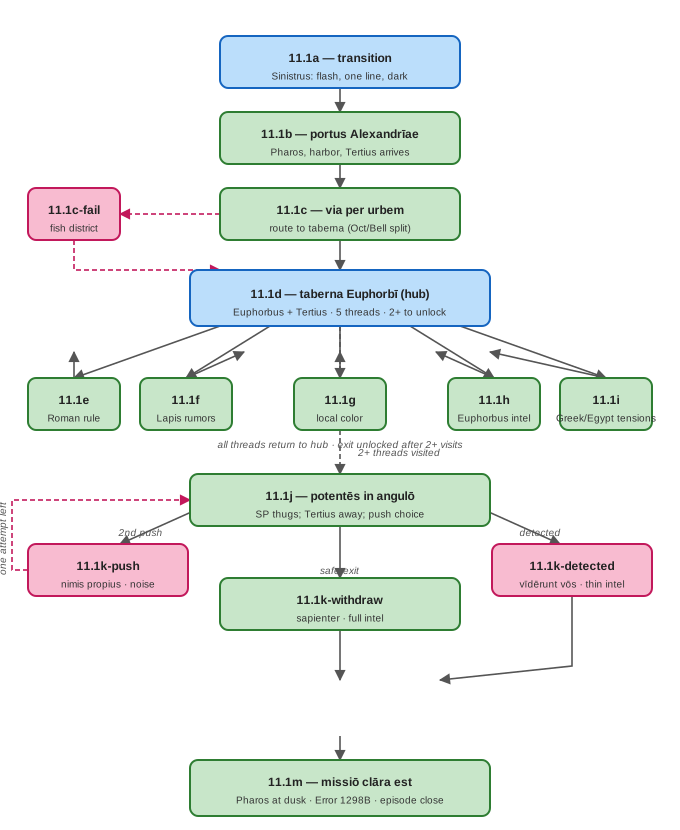
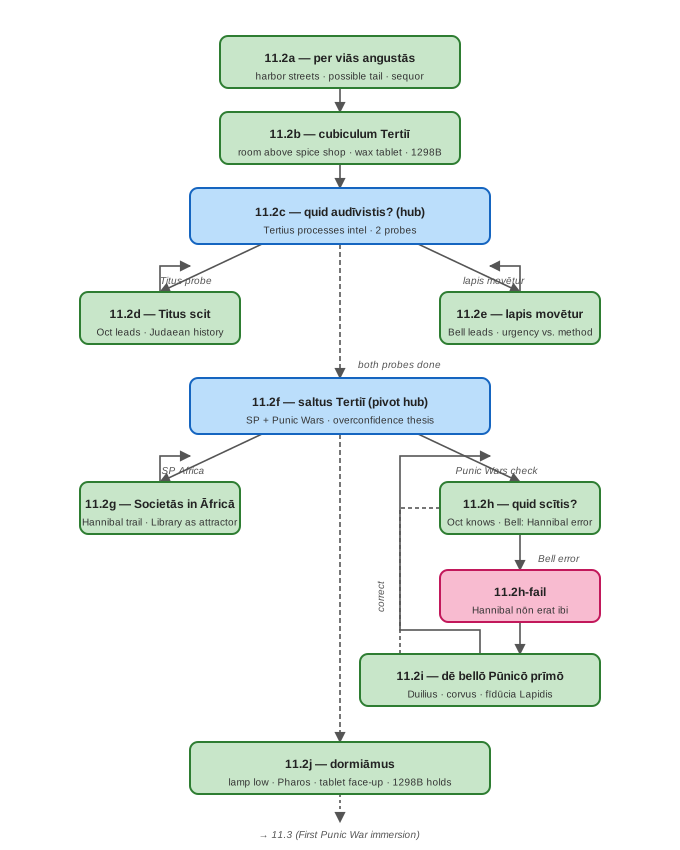
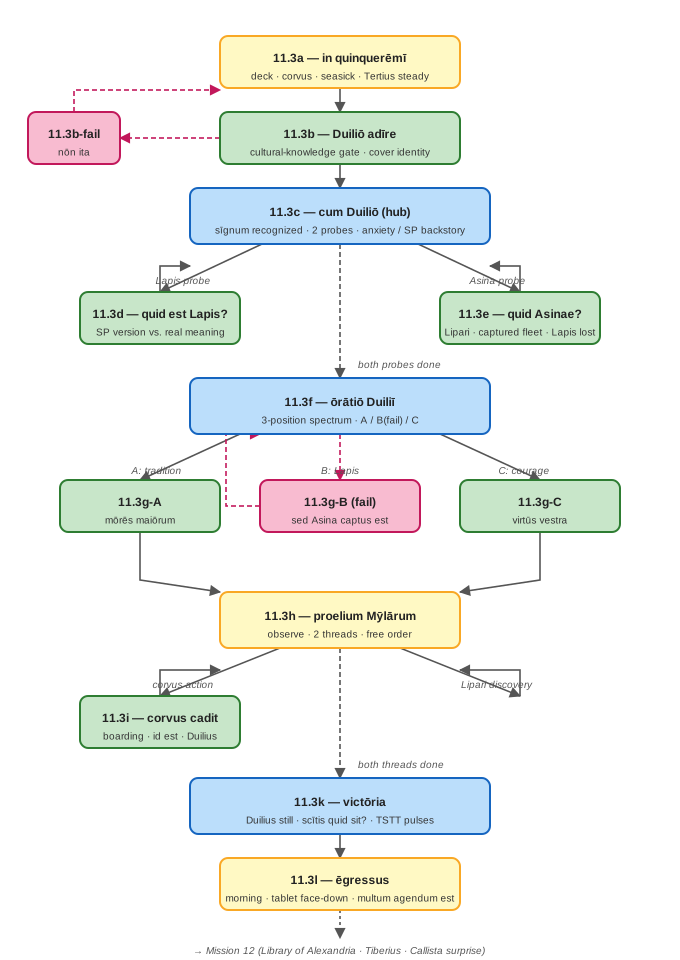
Each box is one scene (one static story page). Green = standard scene · Blue = convergence / key node · Pink = fail / redirect (dashed pink arrows loop the reader back) · Yellow = special or graded gate · Grey = meta / optional. Solid arrows are forward story choices; labels on arrows paraphrase the choice.
11.1 pathing map
16 scenes · 3 fail/redirect branches · 3 convergence nodes
11.2 pathing map
11 scenes · 0 fail/redirect branches · 3 convergence nodes
11.3 pathing map
15 scenes · 4 fail/redirect branches · 3 convergence nodes
5. Agent Craft¶
Latin and English replies for all six prompts, 11.1.a through 11.3.b, are below, organised by anticipated student posture. At 11.1.a no one is on stage, so the replies are narration of the walk with Mission Control in the team's ear. English replies support the English RPG approach.
Register. Mission 11 headlines the genitive, singular and plural, now with any common noun (lūmen Pharī, praetōrium Societātis, mōs maiōrum), and volō, nōlō, eō, possum in the present, imperfect, perfect, and pluperfect; Mission 10's pluperfect, -ne and the question words, and sum in four tenses carry in. Reply lines sit below the immersion text's ceiling rather than at it: short present-tense clauses that reach for the mission's headline structures, with past and future meaning carried in the English reply or an English stage direction. Not permitted in reply lines: future, subjunctive, comparatives, productive passives, and productive indirect statement or indirect question. The prompts' adsint, dēbeāmus, incipiāmus, agam, their futures (dīcet, vocābō, dūcam, faciam), their indirect statements (scītis praetōrium... prope esse, putātisne Societātem... habēre), and their plūs and melior are receptive set-pieces on the page, never models for a reply.
Cross-cutting techniques this mission:
- Mission Control sees effects, never Sinistrus. It speaks in English in the team's ear, acknowledges the year 80 CE without explaining it, and if a team names Sinistrus, its logs show an anomaly it calls Prometheus, in one line.
- Play the perception gaps bare. Tertius hears every "Sinistrus" as "Prometheus" and sees the brand as reddened skin. No one but the Recentii sees an Aemilianus's light, so to the room Tertius is a man with Sextus's face, which is why he whispers and keeps his back to the crowd.
- The signum opens the wrong doors. Inside the Potentēs' orbit the brand reads as a mark, so Duilius, advised by Asina, trusts a team that shows it at 11.3.a. Let an attentive team feel the irony of getting in by wearing the enemy's mark.
- Tertius's thesis carries the arc. His line at 11.2.b, aliquid tē servat. sed quōmodo tē servat? sī hoc nescīs, id tē nōn servat. id tē perdit., lands on Asina at 11.3, and a team that remembers it will recognize the Lapis answer for what it is.
- The grammar arrives in their mouths. Genitives sit at the hinges of the replies (nōmen Lapidis, verbum Asinae, verbum Rōmae) and the four verbs run through every request (vultis, ītis, possumus). Point at them in the debrief, and reward a team that builds its own.
Character notes:
- Euphorbus is delighted, loud, and hospitable, with the cook's pride intact (hospitēs meī, food listed like treasure). The loudness is cover: everyone in the room knows he shouts, so his shouting hides theirs, and he drops his voice only for what matters.
- Tertius is calmer than Septimus and more formal than Sextus, warm underneath, methodical, and dry. He asks a question and waits for the answer, rewards reasoning over recital, and says nesciō plainly where his knowledge stops.
- Duilius is anxious, not heroic: a new man who has never commanded at sea, about to fight the finest navy in the Mediterranean with a copied fleet. He is earnest and frightened, honest about both, and he weighs every answer out loud.
Watch-fors. Hold back Sextus's fate (nesciō ubi nunc est, never more), where the Potentēs' praetōrium stands, how the TSTT holds the map and anything about what Tiberius later does with it, and the road the Lapis took after the Lipari Islands. Never add how Caecilius died. Asina is captured, never killed. Tiberius is in Alexandria this year and the team must not meet him. The name Titus and the woman Callista belong to the CYOP and surface nowhere in the RPG. Lapis is capitalized whenever it names the artifact.
Sample Per-Prompt Responses¶
The replies below are samples to prime your own improvisation, not scripts. They show one plausible way to handle each posture, never the only or required one.
11.1.a: The Harbor of Alexandria
Scene context. The team comes to among dead fish on the Alexandrian waterfront, a smell to rival Stabiae. Then they stand, and everything is better: the sea is enormous, the sun breaks on the waves, ships come and go, and sailors shout from deck to deck. Out in the water sits the island of Pharos, joined to the land by a long causeway, and on it the tower so high it seems to touch the sky. Mission Control crackles in: welcome to Alexandria; a taberna is marked on their navigation device; proceed there as soon as possible.
Who answers. No one is on stage. Replies are second-person Latin narration of the walk, with Mission Control's English in the team's ear where a push is needed.
Posture 1: A route on the map (canonical)
Example composition: Pharus post nōs est. per lītus portūs magnī ambulāmus. deinde per viam rēctam īmus, et prope portum tabernam Euphorbī invenīmus.
Latin (narration): viam bonam ēlēgistis. per viās Alexandrīae ītis. viae rēctae sunt, et plēnae hominum: Graecī, Aegyptiī, Rōmānī. vōcēs Graecās et Aegyptiās et Latīnās simul audītis.
tandem ad iānuam parvam prope portum venītis. ex iānuā odor bonus venit: odor cibī, nōn odor piscium mortuōrum.
English (narration): You chose a good road. You walk through the streets of Alexandria. The streets run straight, and they are full of people: Greeks, Egyptians, Romans. You hear Greek and Egyptian and Latin all at once.
At last you come to a small door near the harbor. A good smell comes out of it: the smell of cooking, not of dead fish.
Any route that follows the streets of the 11.1 CULTURALIA map is right; the map marks Piscēs beside the Great Harbor and Taberna Euphorbī near it. Reward named landmarks: the Pharos and its causeway, the Canopic Way running from the Gate of the Sun to the Gate of the Moon, the grid of straight streets crossing it, the harbor. The route invites the mission's genitive (viae Alexandrīae, lūmen Pharī, taberna Euphorbī); point it out when a team builds one. Held: who keeps the taberna. The team knows only the name on the map, and whether it is their Euphorbus is 11.1.b's surprise.
Posture 2: A destination but no path
Example composition: ad tabernam Euphorbī īmus.
Latin (narration): ad tabernam īre vultis. sed ubi est taberna? Alexandrīa urbs ingēns est, et multae viae sunt. quam viam ītis?
in aure vestrā aliquid crepitat: "Operatives, the device shows you the way. We need you to tell us the way. Streets, landmarks, turns."
English (narration): You want to go to the taberna. But where is it? Alexandria is a huge city, and there are many streets. Which way are you going?
Something crackles in your ear: "Operatives, the device shows you the way. We need you to tell us the way. Streets, landmarks, turns."
A destination alone does not answer the prompt, which asks for the path. Hand back the map, not the route: send the team out of fiction to the 11.1 CULTURALIA map and Alexandrīa, which give the causeway, the straight streets, and the great street ā portā Sōlis ad portam Lūnae. vultis and ītis are two of the mission's four verbs in one line.
Posture 3: Following their noses
Example composition: cibum olēmus! post odōrem cibī īmus.
Latin (narration): post odōrem ītis. sed odor nōn est odor cibī. est odor piscium. in viā angustā estis, et ubīque piscēs in sale iacent. hīc nūlla taberna est.
in aure vestrā: "Operatives, you're off the map. Find the main street and start again."
English (narration): You follow the smell. But it isn't the smell of food. It's the smell of fish. You are in a narrow street, and everywhere fish lie in salt. There is no taberna here.
In your ear: "Operatives, you're off the map. Find the main street and start again."
One wrong turn, played for comedy: the dead fish come back in a fish-salting street, the same beat the CYOP uses. It costs nothing. The correction is the city's own logic: in a grid of straight streets, find the great street and everything else follows. If a team asks a passer-by, he answers in Greek, which they cannot follow, and points.
Posture 4: Off to the Pharos, or the Library
Example composition: ad Pharum īre volumus! turrem altissimam vidēre volumus.
Latin (narration): Pharus in īnsulā stat, et pōns ad īnsulam longus est: ferē mīlle passūs. turris altissima est, et nocte in summā turre ignis ārdet.
in aure vestrā: "It's one of the wonders of the world, Operatives, and it'll still be there tonight. The taberna first."
English (narration): The Pharos stands on its island, and the causeway out to the island is long: nearly a mile. The tower is very tall, and at night a fire burns at its top.
In your ear: "It's one of the wonders of the world, Operatives, and it'll still be there tonight. The taberna first."
Pay the wonder honestly in one beat, from Alexandrīa (pōns ferē mīlle passūs longus erat; nocte in summā turre ignis ārdēbat), then funnel. The Library gets the same treatment: it is near the palace quarter, maxima omnium, and not today. A team that wants to see the Pharos lit at night is reading the episode well.
Posture 5: Questions for Mission Control
Example composition: cūr in Alexandrīā sumus? in Britanniā erāmus! et cūr annus est 80 CE?
Latin (narration): in aure vestrā prīmum nihil est nisi crepitus. deinde vōx redit: "We see what you see: Alexandria, 80 CE. The TSTT put you here, and we don't know why yet. What we do know is that the taberna is your next step."
English (narration): At first there is nothing in your ear but crackling. Then the voice comes back: "We see what you see: Alexandria, 80 CE. The TSTT put you here, and we don't know why yet. What we do know is that the taberna is your next step."
Mission Control acknowledges the date and does not explain it. The chronology is fixed: the Recentii left Britain in 81 CE and the TSTT inserts them a year earlier, by design. If a team names Sinistrus, MC's logs show an anomaly it calls Prometheus and nothing more, in one line. On Septimus, Salvius, or the oath, MC has nothing for them here. Held: everything about why the year is wrong.
11.1.b: Euphorbus's Taberna
Scene context. The taberna is small and packed: Romans, Greeks, and Egyptians shouting, laughing, and drinking all at once, and after the harbor glare the team can barely see. Then, in a corner, a man pouring wine: Euphorbus, Caecilius's cook from Pompeii. He cannot believe it, sets his cup down, crosses the room smiling, and greets them: why are they in Alexandria? At the same moment another man is at their side, the twin of Sextus and Septimus, his familiar light barely showing in the dim room. The new Aemilianus whispers in their ear: cautē! nescīmus quī adsint.
Who answers. Euphorbus is the host and the main voice. Tertius speaks only in whispers, short and wary. The patrons and the two men at the corner table can be overheard but never address the team.
Posture 1: Asking Euphorbus who is here (canonical)
Example composition: Euphorbe, quī sunt hī hominēs? quis dē Lapide scit?
Latin (Euphorbus): (He pours, and talks while he pours, loud enough for the room.) "hic mercātor Rōmānus est. frūmentum Aegyptī ad Ītaliam mittit, et pācem Rōmānam semper laudat. ille Graecus, cuius manūs caeruleae sunt, nihil dīcit. Graecī hīc multa sciunt, sed pauca dīcunt."
(Then low, without looking at the corner.) "et in angulō duo Rōmānī sedent. diū hīc sunt. nihil emunt, nihil vēndunt. nōlīte eōs spectāre. audīte."
English (Euphorbus): (He pours, and talks while he pours, loud enough for the room.) "This is a Roman merchant. He ships Egypt's grain to Italy, and he never stops praising the Roman peace. That Greek, the one with the blue hands, says nothing. The Greeks here know a great deal, but they say very little."
(Then low, without looking at the corner.) "And in the corner there are two Romans. They've been here a long time. They buy nothing, they sell nothing. Don't look at them. Listen."
The room is the session's cultural payload, so let the team meet it person by person. The merchant is Rome's case for Egypt: the grain fleet, the peace, Egypt as the emperor's own province. If a team asks him directly he holds forth: sine Rōmā nūlla pāx est. The Greek with the dyer's blue hands is the other side of that case, and his silence is evidence: render it by what he does (he looks into his cup, gets up, moves to another table), never explain it. A Greek and an Egyptian quarreling over the price of fish at the counter can give the three-peoples tension if the team goes looking; it does not resolve. cuius is the mission's genitive inside a relative. Funnel to the corner table, which is Posture 3.
Posture 2: Asking Euphorbus about himself, Pompeii, Caecilius
Example composition: Euphorbe! cūr in Alexandrīā es? ubi est Caecilius?
Latin (Euphorbus): (The smile stays, but his voice drops.) "Caecilius mē līberāvit, illō diē. 'nōn iam servus es! līber es!' clāmāvit. nūlla tabula, nūllī testēs. ego ad mare cucurrī. Caecilius nōn cucurrit."
(A beat. He refills a cup that is already full.) "Tiberius mē in lītore invēnit, et ad Aegyptum īvimus. nunc haec taberna mea est. vīnum! vīnum hospitibus meīs!"
English (Euphorbus): (The smile stays, but his voice drops.) "Caecilius freed me, that day. 'You're not a slave any more! You're free!' he shouted. No tablet, no witnesses. I ran to the sea. Caecilius didn't run."
(A beat. He refills a cup that is already full.) "Tiberius found me on the shore, and we came to Egypt together. Now this taberna is mine. Wine! Wine for my guests!"
taberna Euphorbī says he will not talk about Pompeii to his guests (dē Pompēiīs dīcere nōn vult); he tells the Recentii because they were there, low and short, and that is the gift. Freed by a shout, no tablet, no witnesses; Caecilius did not escape, as Tiberius said at 9.2.a. Never add how Caecilius died. Why he stayed: nēmō scit. fortasse nōn potuit. fortasse nōluit. On Sextus: Sextum illō diē nōn vīdī, and nothing more; the question is held until Mission 14. If a team asks where Tiberius is, Euphorbus answers Tiberius in hāc urbe est, hōc annō. sed ubi nunc habitat? nesciō., and Tertius, at once, in the ear: nōlīte eum quaerere. duo tempora ūnum hominem sīc ferre nōn possunt ("Two times cannot carry one man like that"). Nothing about whom Tiberius travels with.
Posture 3: Listening to the corner table
Example composition: ad mēnsam prope angulum sedēmus et audīmus. quid dīcunt?
Latin (narration, then the two men): ad mēnsam proximam ītis, et vīnum bibitis, et audītis. duo virī vōce minimā dīcunt. sed vōx minima nōn semper tūta est.
"praetōrium nostrum tūtum est. sed aedificium prope praetōrium: ibi multī custōdēs sunt, multī."
"et vir quem quaerimus? vultum eius nōvimus, sed virum nōn invēnimus."
"Lapis hīc nōn diū manet. omnēs quī audīre volunt iam audīvērunt."
ūnus vir oculōs tollit. Tertius in aurem vestram: "satis audīvistis. redīte."
English: You go to the next table, drink your wine, and listen. The two men are speaking very low. But a low voice is not always a safe one.
"Our praetorium is safe. But the building next to the praetorium: there are guards there, a lot of guards."
"And the man we're looking for? We know his face, but we haven't found the man."
"The Lapis won't stay here long. Everyone who wants to hear has already heard."
One of the men looks up. Tertius, in your ear: "You've heard enough. Come back."
This is the intelligence, and only this: the Societās's praetōrium is close, a building beside it is heavily guarded, the Potentēs are hunting a man by his face, and the Lapis is about to move. The face is Sextus's, and so Tertius's (epistula ex Alexandrīā), which is why he whispers and keeps his back to the room; a team that connects the two has done real work. On a first listen the men never learn they were heard. A second push gets lips moving and no words; a third gets one man standing and the other taking the door, and Euphorbus breaks it up with loud hospitality and puts the team out the small door, at no cost anyone can see.
Posture 4: Talking to the stranger
Example composition: quis es? geminusne Sextī es?
Latin (Tertius, in a whisper, eyes on the room): "Tertius sum, frāter Sextī et Septimī. quem ex frātribus meīs nōvistis?"
(If they say both.) "ambōs? hoc rārum est."
"sed nōn hīc. vultus meus vultus Sextī est, et hīc multī oculī sunt. cautē!"
English (Tertius): "I am Tertius, brother of Sextus and Septimus. Which of my brothers have you met?"
(If they say both.) "Both? That's rare."
"But not here. My face is Sextus's face, and there are a great many eyes in this room. Careful!"
His caution has a reason the team can find: the Potentēs are hunting an Aemilianus by Sextus's face. No one but the Recentii sees his light, so in this room he is a man with a face, and that is the danger. On Sextus: nesciō ubi nunc est, never more. If a team names Sinistrus, he hears Prometheus (Prometheus? cūr dē Prometheō dīcitis?), puzzled, with no gloss and no suspicion. On the wrong year: cūr? nesciō. sed hīc estis. Everything else waits for his hiding place at 11.2.a.
Posture 5: Asking the room about the Lapis out loud
Example composition: magnā vōce rogāmus: quis dē Lapide scit?
Latin (Euphorbus, louder than you): "vīnum! vīnum hospitibus meīs! et pānem, et olīvās, et cāseum optimum!"
(He drops onto the bench beside you, laughing too loudly; under the laugh.) "nōn hīc. nōmen Lapidis audiō, sed in ōre eōrum quī dē praetōriō dīcunt. tacēte."
(Tertius's hand closes on your arm.) "cautē, dīxī."
English (Euphorbus, then Tertius): "Wine! Wine for my guests! And bread, and olives, and the very best cheese!"
(He drops onto the bench beside you, laughing too loudly; under the laugh.) "Not here. I hear the name of the Lapis, but in the mouths of the people who talk about the praetorium. Be quiet."
(Tertius's hand closes on your arm.) "Careful, I said."
Euphorbus's noise is his cover, and here it covers theirs. He has heard the name Lapis in the same mouths as the praetōrium, and he does not know what it is or what it looks like. The two men in the corner look up once and go back to their wine, so a careless team pays with a harder listen (Posture 3's second push: lips moving, no words). nōmen Lapidis and in ōre eōrum are the mission's genitives at work.
11.2.a: Tertius's Cave
Scene context. Tertius lives underground, in a cave by the harbor. It is not large: water runs down the walls, and the place smells of dead fish. The smell is dreadful to the team; Tertius, a figure of the TSTT, smells nothing and counts himself lucky. He has the map. The team left it at Salvius's, then understands: the TSTT keeps a copy in memory. They start to think it through (Tiberius found this map in Egypt, so this is the map Tiberius will give them...) and Tertius stops them: don't think about the map; think about it too hard and you break the world, his world certainly. They need the next trace. The map says the Potentēs' praetōrium is close, but where? They could search the pyramids for a long time and find nothing. So start from what is known: what are the pyramids, who made them, and what do they have to do with the Lapis?
Tertius's posture. Methodical and pleased with his cave. He asks a question and waits for the answer; he does not lecture. Dry humor, the avuncular-wizard register in a drier key than Sextus's.
Posture 1: Three good facts (canonical)
Example composition: Hērodotus, scrīptor Graecus, dē pyramidibus scrīpsit: rēx Cheops pyramidem maximam aedificāvit. paucī Rōmānī litterās Aegyptiās legere poterant. Aegyptus prōvincia imperātōris erat, et frūmentum Aegyptī Rōmam ībat.
Latin (Tertius): "bene. trēs rēs habēmus." (He counts them on his fingers.) "prīmum, Rōmānī Aegyptum per verba Graecōrum cognōscunt, nōn per verba Aegyptiōrum. deinde, litterās Aegyptiōrum paucī legere possunt: sacerdōtēs, nōn Rōmānī. et Rōma frūmentum Aegyptī dēsīderat."
(He looks round the dripping walls, satisfied.) "sed pyramidēs et Lapis? adhūc nesciō."
English (Tertius): "Good. We have three things." (He counts them on his fingers.) "First, Romans know Egypt through the words of the Greeks, not through the words of the Egyptians. Next, few can read the Egyptians' writing: the priests can, the Romans can't. And Rome needs Egypt's grain."
(He looks round the dripping walls, satisfied.) "But the pyramids and the Lapis? I still don't know."
Aegyptus Rōmāna carries the whole answer set: Herodotus on Cheops and his hundred thousand men for twenty years; the temple writing that few but the priests could read; Egypt known to Rome through Greek words; Egypt as the emperor's own province, governed by a prefect who was an eques, with no senator allowed in without the emperor's leave; the grain fleet from Alexandria. The 11.2 CULTURALIA adds Isis at Pompeii and the obelisks Augustus brought to Rome. Any three, well grounded, count, but the Greek filter is the one the prompt names, so ask for it if it is missing (Posture 2). His last line is honest, not a hint: what the pyramids have to do with the Lapis is his open question, and the replies never answer it. Success hands straight into 11.2.b's opening (magnum auxilium mihi dedistis).
Posture 2: Modern facts, or no Greek filter
Example composition: Tutankhamun rēx erat. servī pyramidēs aedificāvērunt.
Latin (Tertius): "Tutankhamun? nōmen nōn nōvī." (Dry.) "nec Rōmānus id nōvit. Rōmānī Aegyptum nōn oculīs suīs vident, sed per librōs Graecōrum. quis Graecus dē pyramidibus scrīpsit? et quid scrīpsit?"
English (Tertius): "Tutankhamun? I don't know the name." (Dry.) "And no Roman knows it either. Romans don't see Egypt with their own eyes, but through the books of the Greeks. Which Greek wrote about the pyramids? And what did he write?"
Tertius knows what a Roman of 80 CE could know and no more: no Tutankhamun, no Rosetta Stone, no Champollion. His correction hands back the Greek-filter question and points it at Herodotus. On slaves: the CODEX text gives centum mīlia hominum, men, and does not say slaves; Tertius accepts the reading in the text and does not argue modern evidence. Graecōrum against Aegyptiōrum is the genitive plural doing the mission's cultural work.
Posture 3: The map paradox
Example composition: sed haec est charta Tiberiī! Tiberius eam nōbīs in Britanniā mōnstrāvit. quōmodo hīc est?
Latin (Tertius): "nōlīte! iterum dīcō: nōlīte dē chartā cōgitāre." (He puts a hand on the wet wall, as if it might be listening.) "mundus meus parvus est, et aqua iam per mūrōs fluit. ad pyramidēs redīte, nōn ad Tiberium."
English (Tertius): "Don't! I'll say it again: don't think about the map." (He puts a hand on the wet wall, as if it might be listening.) "My world is small, and the water's already coming through the walls. Back to the pyramids, not to Tiberius."
Comic and firm. The paradox stays unexplained in his mouth for good: he does not say whose world, what breaks, or how the TSTT holds the copy, and nothing in a reply may anticipate what later happens to the map. If a team pushes, he repeats his own scripted line, sī nimis dē chartā cōgitātis, mundum frangitis, and turns back to the prompt.
Posture 4: The cave, the smell, Tertius himself
Example composition: hic locus pessimē olet! cūr hīc habitās?
Latin (Tertius): "olet? nihil oleō." (Pleased.) "locus bonus est. sub grānāriō vetere est, et nēmō hūc venit. Potentēs vultum meum quaerunt, nōn cavum meum."
(Then, back to it.) "sed pyramidēs: quid scītis?"
English (Tertius): "Smells? I smell nothing." (Pleased.) "It's a good place. It's under an old granary, and nobody comes here. The Potentes are hunting for my face, not my cave."
(Then, back to it.) "But the pyramids: what do you know?"
His home is a hidden cave under a ruined granary by the harbor, the Granarium Tertiī marked on the 11.1 CULTURALIA map. He is a TSTT figure and smells nothing, which he counts as luck; the team's discomfort is the joke. One beat, then the prompt. A team that heard the corner table at 11.1.b will catch vultum meum quaerunt.
Posture 5: The oath, the brand, or Sinistrus
Example composition: Salviō iūrāvimus. et vidē: signum in bracchiō habēmus. Sinistrus id posuit.
Latin (Tertius): (He takes the arm, turns it to the lamp, and looks for a long moment.) "cutem rubram videō, nihil aliud."
(If the name was spoken.) "Prometheus? cūr dē Prometheō dīcitis?"
(He lets it go, and turns to the oath.) "iūs iūrandum Salviō dedistis? grave est. hoc sciō. nunc tamen ad pyramidēs."
English (Tertius): (He takes the arm, turns it to the lamp, and looks for a long moment.) "I see red skin, nothing else."
(If the name was spoken.) "Prometheus? Why are you talking about Prometheus?"
(He lets it go, and turns to the oath.) "You swore an oath to Salvius? That's a serious thing. I know it. But now: the pyramids."
Sinistrus reaches him as Prometheus, and he is tripped up without suspecting a block; he sees the brand only as reddened skin. Play both bare, with no gloss and no wink. Teams that swore at 10.3.b and teams that refused both reach Egypt; he neither condemns nor absolves, and he does not say what the signum is for. A team that refused gets the same weight: nōn iūrāvistis? et tamen hīc estis. bene.
11.2.b: Why Rome Went to War
Scene context. Tertius is pleased: the team has helped. If he reads the Societās right (and he nearly always does; don't ask why), the Potentēs chose their praetōrium with great care, a place that counts both for the Lapis and for the fortune of Rome. Then he knows what to do. He has an exemplum ready, and it will tell them about the Potentēs, who were once in Africa. But first: what do they know about the Punic Wars? How did they start? Do they think the Societās had a reason?
Tertius's posture. The teacher who wants their reasoning, not a recital. He rewards a mechanism over a verdict and says nesciō where his knowledge stops.
Posture 1: Messana, the Senate, the people (canonical)
Example composition: Mamertīnī Messānam tenēbant et auxilium Rōmānōrum petīvērunt. senātōrēs cōnstituere nōn potuērunt, sed populus bellum voluit, quod praedam dēsīderābat. fortasse Potentēs populum vocāvērunt, quod bellum volēbant.
Latin (Tertius): "euge!" (He sits back on his heels in the wet.) "senātus nōn cōnstituit, et populus bellum voluit. sed quis populum vocāvit? virī quī praedam prōmīsērunt. et quis cōnsul mīlitēs in Siciliam dūxit? Appius Claudius."
(He lets the name sit.) "nōmen Claudiī tenēte. et hoc quoque tenēte: aliquid tē servat. sed quōmodo tē servat? sī hoc nescīs, id tē nōn servat. id tē perdit."
English (Tertius): "Splendid!" (He sits back on his heels in the wet.) "The Senate couldn't decide, and the people wanted the war. But who called the people? Men who promised them plunder. And which consul led the soldiers into Sicily? Appius Claudius."
(He lets the name sit.) "Hold on to the name Claudius. And hold on to this as well: something keeps you safe. But how does it keep you safe? If you don't know that, it doesn't keep you safe. It destroys you."
The answer key is initium bellī Pūnicī and the CULTURALIA's Polybius section: the Mamertines, Italian soldiers who had seized Messana, asked both Carthage and Rome for help; the Senate deadlocked, partly because Rome had just executed its own soldiers in the Forum for seizing Rhegium the same way, partly from fear that a Carthaginian Sicily would be a bridge to Italy; the question went to the people, worn out and poor, whose commanders promised plunder; the consul Appius Claudius crossed with the legions. The Societās half has no single right answer, and Tertius rewards reasoning. The strongest line runs from the CODEX: a deadlocked Senate, a war sold to the people, a Claudius at the head of it. At 11.3.b Duilius names the Claudii and the Cornelii as families that call on the plebs when the plebs is useful, so a team that holds on to the name gets it paid off. The closing line is his thesis for the arc, and it lands on Asina at 11.3. Held: the Lapis's road through this war, which the 11.3 immersion and Mission 12 discover.
Posture 2: Hannibal and the elephants
Example composition: Hannibal cum elephantīs Alpēs trānsiit, et bellum incēpit!
Latin (Tertius): (Completely straight.) "Hannibal in bellō Pūnicō secundō erat, nōn in prīmō." (A beat.) "in bellō prīmō Hannibal puer erat."
(He moves on without a flicker.) "bellum prīmum in Siciliā coepit. quod oppidum? et quī auxilium petīvērunt?"
English (Tertius): (Completely straight.) "Hannibal was in the second Punic War, not the first." (A beat.) "In the first war Hannibal was a boy."
(He moves on without a flicker.) "The first war began in Sicily. Which town? And who asked for help?"
Played completely straight, which is what makes it funny. Two Hannibals are a real trap: the 11.3 CULTURALIA notes that the Carthaginian commander at Mylae was also named Hannibal, and the famous one was born near the end of this first war. His two questions point straight at Messana and the Mamertines.
Posture 3: A verdict instead of a cause
Example composition: Rōmānī avārī erant. Potentēs malī sunt, itaque bellum incēpērunt.
Latin (Tertius): "fortasse. sed 'malī sunt' causa nōn est." (He holds up a finger.) "senātōrēs diū certāvērunt. multī Messānam dēfendere nōlēbant. cūr nōlēbant? et quis tandem bellum voluit?"
English (Tertius): "Perhaps. But 'they're wicked' isn't a cause." (He holds up a finger.) "The senators argued for a long time. Many of them didn't want to defend Messana. Why didn't they? And who wanted the war in the end?"
Push past the verdict to the mechanism. The answer to cūr nōlēbant? is the Rhegium precedent in the CULTURALIA: helping the Mamertines would look like approving the crime Rome had just punished. nōlēbant and voluit are the mission's verbs in two tenses. Do not let the conservative and progressive frame flatten into good and evil: the Potentēs' case has been presented as genuinely appealing (Salvius, 10.3.a), and Tertius treats it as a position, not a villainy.
Posture 4: Asking about the exemplum
Example composition: quod exemplum? quō īmus? cum Hannibale pugnāmus?
Latin (Tertius): "nōlīte rogāre." (Almost a smile.) "prīmum respondēte mihi. exemplum vōs exspectat, et Potentēs ōlim in Āfricā fuērunt. hoc satis est."
English (Tertius): "Don't ask." (Almost a smile.) "Answer me first. The exemplum is waiting for you, and the Potentes were once in Africa. That's enough for now."
He echoes his own scripted nōlīte rogāre. The destination, Duilius's flagship off Sicily in 260 BCE, is 11.3.a's opening and its seasickness the first joke, so do not spoil it. Potentēs ōlim in Āfricā fuērunt is the most he gives about the Societās in Carthage this mission.
Posture 5: Asking about the praetōrium
Example composition: ubi est praetōrium Potentium? cūr hunc locum ēlēgērunt?
Latin (Tertius): "nesciō. hoc quaerimus." (He taps the map.) "locum ēlēgērunt quī multum valet: et ad Lapidem, et ad fortūnam Rōmae. itaque prīmum fortūnam Rōmae intellegere dēbēmus. bellum Pūnicum: quōmodo coepit?"
English (Tertius): "I don't know. That's what we're looking for." (He taps the map.) "They chose a place that counts for a great deal: for the Lapis, and for the fortune of Rome. So first we have to understand the fortune of Rome. The Punic War: how did it start?"
He repeats his own scripted line and funnels. The praetōrium's location is held for Missions 12 and 13. A team that brings up the guarded building from the corner table at 11.1.b is taken seriously (bene audīvistis), but he does not know which building is which.
11.3.a: Aboard the Flagship
Scene context. Seasick. Tertius stands beside them and is not sick at all, being a figure of the TSTT. The Roman commander is on board but does not see them: he stands at the other end of the ship, staring at the islands in the distance. A man at the bow calls back: ō imperātor! corvus parātus est! And then the strange thing: a great bridge, not lying flat but standing upright against a tall post at the bow, and at its top a huge iron spike. The Romans call it the corvus, the name of a bird. The commander talks to himself, and the team overhears: Scipio Asina said... he is to make a speech? The power of the Lapis? What is it? Asina has been captured. And that ridiculous story about the fleet the Romans built in sixty days does him no good. He has no other plan.
Who answers. Duilius, consul of 260 BCE. The man at the bow, a centurion, can step in. Tertius whispers and never approaches Duilius himself; Duilius never addresses him.
Duilius's posture. Anxious, not heroic. A novus homō who has never commanded at sea, about to fight the finest navy in the Mediterranean with a fleet copied from a stranded Carthaginian ship. Wary of strangers on his deck before a battle, but he has no plan, and that makes him reachable.
Posture 1: A Roman approach to his worry (canonical)
Example composition: ō cōnsul, ōrātiōnem tuam audīvimus. tē adiuvāre volumus.
Latin (Duilius): (He turns, startled, and looks you over: odd clothes, green faces, no weapons.) "quī estis? vōs in nāve meā nōn vīdī."
(Then the worry wins.) "ōrātiōnem? ita, ōrātiōnem facere dēbeō, et verba nōn habeō. venīte. dīcite mihi."
English (Duilius): (He turns, startled, and looks you over: odd clothes, green faces, no weapons.) "Who are you? I haven't seen you on my ship."
(Then the worry wins.) "A speech? Yes, I have to make a speech, and I have no words. Come here. Tell me."
Any approach that respects his rank and meets his worry works: imperātor or cōnsul as the address, a cover a Roman deck would accept (a scribe, a messenger, a junior officer), or an offer that answers what he is muttering about (the speech, the corvus, Asina). Let him notice that something is off, once, and decide he needs them more than he needs an answer. Then he talks before they can, which is 11.3.b. vīdī and dēbeō keep his Latin plain; his scripted futures (vocābō, dūcam, faciam) belong to 11.3.b and stay receptive.
Posture 2: Showing the signum
Example composition: bracchia nostra tibi mōnstrāmus. signum habēmus.
Latin (Duilius): (His eyes go to your arm and stay there: recognition, then suspicion, then something like relief.) "vōs ab illīs venītis, quī Rōmae dē Lapide dīcunt."
(He glances along the deck.) "bene. sed cautē dīcite. nautae meī omnia audiunt."
English (Duilius): (His eyes go to your arm and stay there: recognition, then suspicion, then something like relief.) "You come from them, the ones in Rome who talk about the Lapis."
(He glances along the deck.) "Good. But speak carefully. My sailors hear everything."
The signum reads as a mark to people inside the Potentēs' orbit, and Duilius, advised by Asina, is inside it, so this works and opens him, warily. He takes the team for allies of the Societās; an attentive team should feel the irony of getting in by wearing the enemy's mark. He never says what the mark means or who gives it. Tertius sees only reddened skin and says nothing. This is a legitimate route, not the expected one, and a team that never shows an arm loses nothing.
Posture 3: The wrong approach (shouting, the wrong title, too familiar)
Example composition: salvē, centuriō! hīc sumus!
Latin (the centurion, then Duilius): (The man from the bow is between you at once.) "quis vōs hūc mīsit? abīte ab imperātōre!"
(Duilius turns, irritated.) "cōnsul sum, nōn centuriō. quid est hic clāmor?" (Then he sees your green faces, and something in him gives.) "nautae nōn estis. venīte hūc. quid vultis?"
English (the centurion, then Duilius): (The man from the bow is between you at once.) "Who sent you here? Get away from the commander!"
(Duilius turns, irritated.) "I'm a consul, not a centurion. What's all this noise?" (Then he sees your green faces, and something in him gives.) "You're not sailors. Come here. What do you want?"
The cost is social, not a dead end, and the noise is what makes him call them over. One undignified moment (Tertius pinches the bridge of his nose) and forward. vultis is the mission's volō in the question every team must now answer.
Posture 4: Prophecy, or force
Example composition: ex tempore futūrō venīmus! hodiē vincis!
Latin (Duilius): (He stares, looks at the sea, and looks back at you.) "aegrī estis, et aegrī multa dīcunt." (Not unkindly.) "Asina quoque mihi dīxit: 'semper vincis.' et Asina captus est."
English (Duilius): (He stares, looks at the sea, and looks back at you.) "You're sick, and sick men say a great many things." (Not unkindly.) "Asina told me 'you always win' too. And Asina has been captured."
Telling a Roman his future is the true-answer trap: he hears it as the same promise Asina made, the promise that failed, so the prophecy lands as more of the Potentēs' guarantee. Let them feel it; it sets up 11.3.b, and his line quotes Asina's letter exactly. Force fails gently: a hand on a consul brings the centurion and two marines, who move the team back to the rail without injury, and Duilius does not even look round. Either way he is still the man with no plan, and the next approach can work.
Posture 5: Asking Tertius what to do
Example composition: Tertī, quid facere dēbēmus?
Latin (Tertius, low, steady on the heaving deck): "nōlīte mē rogāre. ille imperātor est, et vōs eum adīre dēbētis." (He nods at the man staring at the islands.) "sed audīte eum. quid timet? hoc est iānua."
English (Tertius): "Don't ask me. He's the commander, and you're the ones who have to approach him." (He nods at the man staring at the islands.) "But listen to him. What is he afraid of? That's the door."
Tertius is present in a supporting role: he does not fight and does not approach Duilius. He gives one structural hint, that the way in is the man's own fear (the speech, the Lapis, Asina), and the work goes back to the team.
11.3.b: Duilius Asks
Scene context. The sickness has passed and the team can talk with Duilius. Asina told him: "If you call on the power of the Lapis and keep to my counsel, you always win." But what did he mean? Duilius cannot tell. He has his own idea, though. The Claudii and the Cornelii are always talking about the power of the Senate, and they call on the plebs when the plebs is useful to them. So the Lapis must mean the mōs maiōrum, the old Roman way: that story about the Trojan Lapis, the one Asina was carrying when he was captured. But isn't Rome better when the patricians don't deceive the plebs? And that treaty with the Mamertines: wasn't it stupid? He looks at the team. What is he to do? He has to fight, and he knows nothing about war. How will he call the fleet to order? How will he lead the soldiers into battle? How will he win glory for Rome?
Duilius's posture. Earnest and frightened, and honest about both. He needs a real answer, not a ritual one, and he weighs every answer out loud. A new man, skeptical of the patricians and of Asina's promise both.
Posture 1: The mōs maiōrum (canonical)
Example composition: dīc mīlitibus: 'maiōrēs nostrī numquam fūgērunt. Rōmānī semper fortēs fuērunt. hodiē nōs quoque nōn fugimus.'
Latin (Duilius): (He says the words over to himself, testing them.) "maiōrēs nostrī numquam fūgērunt..." (He nods slowly.) "hoc nōn est verbum Asinae. hoc est verbum Rōmae. Rōma semper viam invēnit."
(His hands are not steady yet, but he straightens.) "bene. ad mīlitēs eō."
English (Duilius): (He says the words over to himself, testing them.) "Our ancestors never ran..." (He nods slowly.) "That isn't Asina's word. That's Rome's word. Rome has always found a way."
(His hands are not steady yet, but he straightens.) "Good. I'm going to the men."
Tradition as what Romans are, not what a stone does for them. He is not turned into a hero, and his hands still shake; he has a footing, which is all the scene needs. This also settles his own reading of the Lapis (mōrem maiōrum significat) without the guarantee. verbum Asinae, verbum Rōmae puts the mission's genitive at the hinge of the argument. A team that tells him about his column in the Forum, the bronze rams of captured ships, and the first triumph for a victory at sea is handing a historical figure his own future, which the CYOP does by design: let him hear it as a strange kind of hope and say nothing back.
Posture 2: The corvus and Roman soldiers
Example composition: mīlitēs Rōmānī in terrā optimē pugnant. corvus nāvem hostium tenet, et mīlitēs nostrī in nāvem hostium eunt. ita proelium in marī est proelium in terrā!
Latin (Duilius): (For the first time, he almost laughs.) "ita vērō! Rōmānī in terrā pugnāre sciunt, et corvus terram in marī facit."
(He looks at the bridge standing at the bow.) "Poenī nāvigāre sciunt. sed in nāve suā contrā mīlitēs nostrōs pugnāre nōn possunt. bene. hoc mīlitibus dīcō."
English (Duilius): (For the first time, he almost laughs.) "Yes indeed! Romans know how to fight on land, and the corvus makes land in the middle of the sea."
(He looks at the bridge standing at the bow.) "The Carthaginians know how to sail. But they can't fight our soldiers on their own ship. Good. That's what I'll tell the men."
corvus gives the mechanism (the iron spike drops into the enemy's deck, the two ships are joined, the soldiers cross) and the conclusion (proelia in marī in proelia in terrā mūtāvērunt). Both this and Posture 1 are right; a team that combines them earns both reactions. He does not promise victory: the battle is history, but in his mouth it stays a plan.
Posture 3: The power of the Lapis
Example composition: potentiam Lapidis vocā! Lapis Rōmam servat. sī Lapidem vocās, vincis.
Latin (Duilius): (His face changes. Not anger: disappointment.) "Asina hoc crēdēbat." (Quietly.) "et Asina captus est. Lapidem portābat, et tamen captus est."
(He looks at you, asking you to do better.) "verba Asinae iterum audīre nōlō. dīcite mihi aliud."
English (Duilius): (His face changes. Not anger: disappointment.) "Asina believed that." (Quietly.) "And Asina has been captured. He was carrying the Lapis, and he was captured all the same."
(He looks at you, asking you to do better.) "I don't want to hear Asina's words again. Tell me something else."
This is the Potentēs' answer, and the redirect is not a punishment: Duilius states the problem himself, which hands the correct answer back to the team, as the CYOP's Duilius does with the same speech. One strike, then Posture 1 or 2. It is also Tertius's thesis from 11.2.b made flesh, and a team that remembers aliquid tē servat... should recognize it.
Posture 4: The Lapis is with Carthage
Example composition: Lapis cum Asinā captus est! nunc Poenī Lapidem habent!
Latin (Duilius, then Tertius): (He goes very still, and looks out at the islands.) "fortasse. Asina Lapidem portābat, et nunc Asina apud Poenōs est."
(He shakes it off.) "sed Lapis nōn pugnat. mīlitēs pugnant. dīcite mihi: quōmodo mīlitēs dūcō?"
(Beside you, very quietly, Tertius.) "iam intellegō."
English (Duilius, then Tertius): (He goes very still, and looks out at the islands.) "Maybe. Asina was carrying the Lapis, and now Asina is in Carthaginian hands."
(He shakes it off.) "But the Lapis doesn't fight. Soldiers fight. Tell me: how do I lead the men?"
(Beside you, very quietly, Tertius.) "Now I understand."
The team has reached the discovery it will report to Tertius at the start of Mission 12, so let it land in Duilius's silence; he does not confirm it as fact, and nobody on deck can. His turn away from it is the mission's thesis in his own mouth. Tertius's three words are recognition: he was missing this piece, and the team found it. Held: the rest of the chain, which Tertius picks up in Mission 12. Do not let him lecture here.
Posture 5: The politics instead of the battle
Example composition: foedus cum Mamertīnīs stultum erat. patriciī plēbem fallunt. Rōma est plēbis, nōn paucōrum!
Latin (Duilius): (He nods hard, a new man hearing his own thought said aloud.) "ita. plēbs Rōmam facit, nōn paucī."
(Then the islands pull his eyes back.) "sed hodiē in senātū nōn sum. in nāve sum, et Poenī veniunt. quid mīlitibus dīcō?"
English (Duilius): (He nods hard, a new man hearing his own thought said aloud.) "Yes. The plebs makes Rome, not the few."
(Then the islands pull his eyes back.) "But today I'm not in the Senate. I'm on a ship, and the Carthaginians are coming. What do I tell the soldiers?"
He is a novus homō, the first of his family to be consul, and Asina's letter calls him one with contempt and claims the Lapis for paucī et optimī. A team that sides with the plebs is on his side, and the struggle the 11.2.b prompt asked about is standing on this deck. On the Mamertine treaty, a team that calls it stupid agrees with the senators who balked in initium bellī Pūnicī. But the war is in front of him, so he funnels to the speech.
Not applicable. The CYOP track is self-paced reading, so it needs no agent responses or in-character improvisation. The corrections the agent would handle in the RPG are built into the story's branches: the fish-salting street that sends Bellātor's route back to the main street, and the near miss and detection that thin the intelligence when the siblings push at the corner table, in 11.1; Tertius's straight-faced correction when Bellātor puts Hannibal in the first war, in 11.2; and in 11.3 the centurion who steps in when Bellātor shouts, and the Duilius who answers the Lapis-as-guarantee speech with Asina's capture and takes that option away.