Character Mechanics
Each Recentius character is a shared team persona with a set of game mechanics that reward participation and scaffold Latin composition. Each persona has a unique background narrative that gives the team their core identity in the story. Characters are managed through Mission Control and are visible to students on the character sheet at /c/<code>.
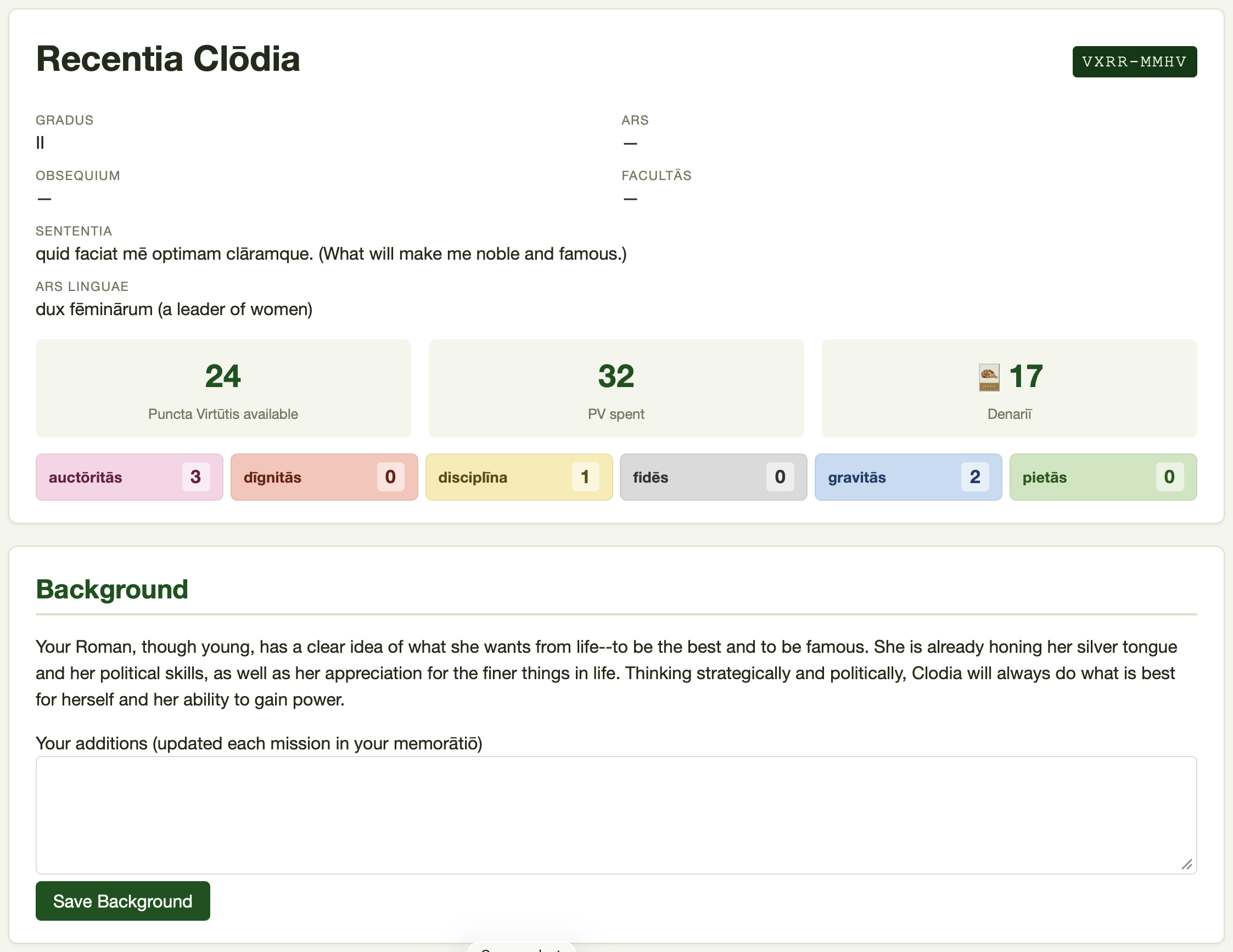
The Eight Recentii
Each cohort's characters are drawn from the eight Recentius personas. Each persona has a fixed background, a sententia (motto), and an Ars (skill set) that unlocks when a Profession is assigned. Multiple student operatives share one character as a team.
The personas are: Bellātor, Agricola, Amōrōsus, Clōdia, Horātiāna, Octāviāna, Prīscus, and Tulliāna. Each brings a distinct personality to the story and a distinct voice for the team's Latin composition.
Virtūtēs (Virtue Traits)
Each character has six virtue traits drawn from core Roman values:
| Trait | Meaning |
|---|---|
| Auctōritās | Influence, standing |
| Dīgnitās | Dignity, reputation |
| Disciplīna | Discipline, training |
| Fidēs | Loyalty, trustworthiness |
| Gravitās | Gravity, seriousness of purpose |
| Pietās | Duty to family, gods, and Rome |
These traits are not abstract stats. They reflect what Romans believed made a person worth knowing and trusting. The descriptions in Mission Control give students a sense of how Romans understood each virtue, which is somewhat different from how modern RPGs handle character attributes.
A savvy agent can use a character's trait ranks exactly the way a game master uses stats in tabletop RPGs: to adjudicate success and failure. A team with high Gravitās might handle a tense negotiation with an NPC more effectively; a character with low Fidēs might find allies less forthcoming. You do not need a formal dice system to do this; a glance at the character sheet before posting your response is enough. Narrating consequences through the lens of the virtūtēs reinforces the cultural content (students start to internalize what these values actually meant to Romans) and rewards teams who have invested in their character's development.
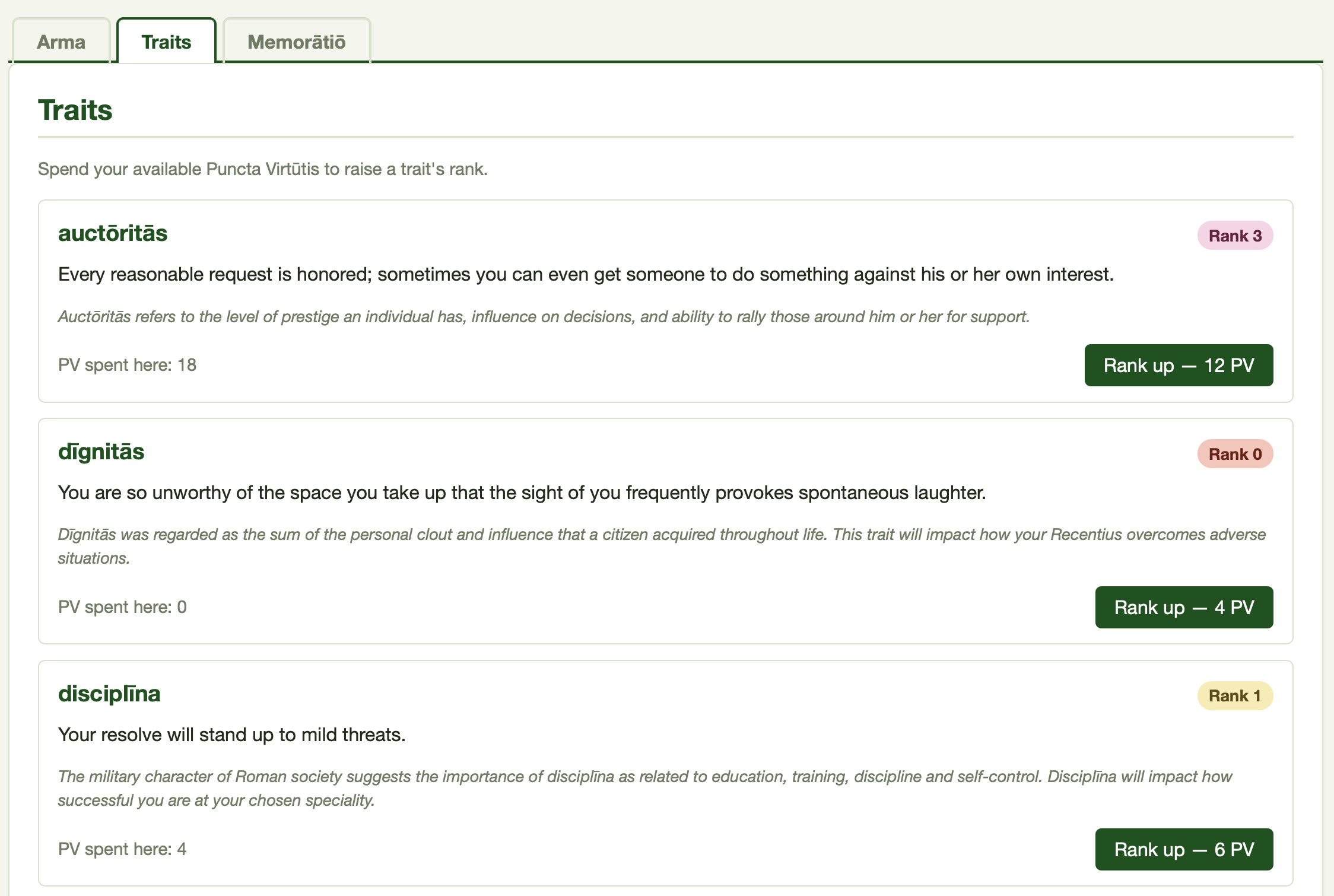
Ranks and Gradus
Each trait can be ranked up by spending Puncta Virtūtis (PV). As traits increase in rank, the character's Gradus (level) rises automatically. Gradus is computed from the sum of all trait ranks and cannot be edited directly.
Each rank unlocks an ability description and, at rank 10, grants the character an agnomen, an earned surname. For example, reaching rank 10 in Auctōritās grants the agnomen Aquilīnus ("Eagle-like"). From that point, a character named Gāius Recentius Bellātor becomes Gāius Recentius Bellātor Aquilīnus.
Puncta Virtūtis (PV)
PV are awarded by you and spent by students. The suggested award structure below ties PV to team participation and collaboration, an intentional incentive. Students who learn to work together and contribute meaningfully earn the currency that lets them develop their character; the mechanic and the pedagogy point in the same direction.
- 3 PV if all team members contribute meaningfully to the immersion episode discussion
- +2 PV bonus if the lead operative fulfills their duty and posts the character's final response
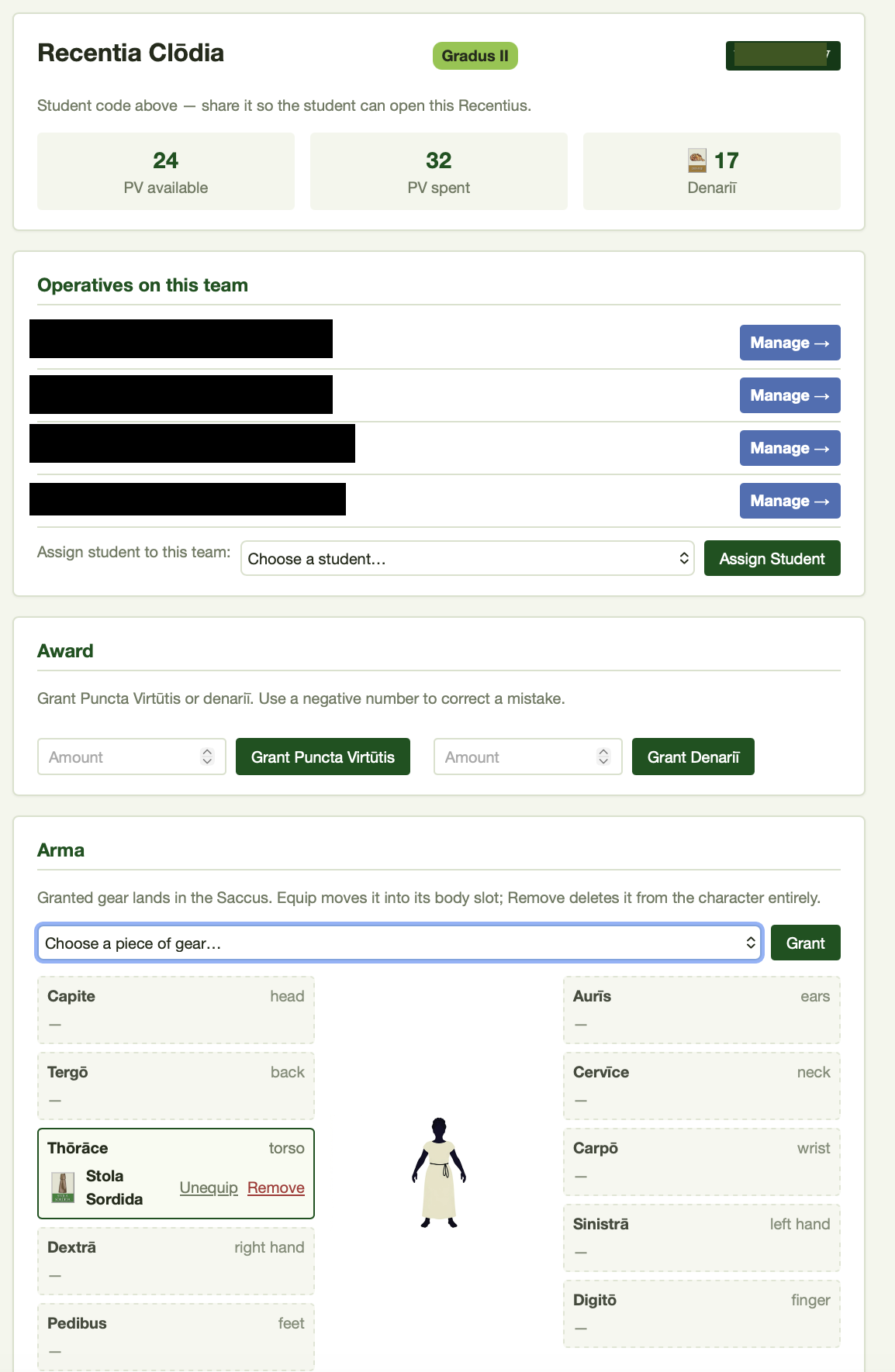
PV are awarded from the character's manage page in Mission Control using the Grant Puncta Virtūtis field. Negative values subtract (useful for corrections).
Students spend PV on their own by clicking Rank up on the Traits tab of the character sheet. You cannot rank up a trait on their behalf.
Dēnāriī
Dēnāriī are the in-game currency. Beginning with Episode 3.3b (the first trip to a Roman forum), you award dēnāriī to characters after each immersion episode. The amount is your discretion; the forum item prices were designed around teams receiving 1--5 dēnāriī per episode.
Award generously for responses that reflect genuine cultural thinking: a team that greets Caecilius correctly, reclines properly at the cēna, or navigates a social situation the way a Roman would have done deserves more dēnāriī than one that goes through the motions. Where PV reward collaboration, dēnāriī reward students for internalizing the world they are inhabiting. The two systems together create a classroom incentive structure that points toward the core objectives of the curriculum.
A natural way to award them is at the end of your in-character response post before moving to the next episode:
Missiō Gubernātor dat... Horātiānae V dēnāriōs. Amōrōsō IV dēnāriōs. Bellātōri IV dēnāriōs.
This is also a useful exercise in dative case and Roman numerals.
Dēnāriī are awarded from the character manage page using the Grant Dēnāriī field. Negative values subtract.
Arma (Equipment)
Each forum in the game world has a set of items for sale. When a team visits a forum (beginning in Episode 3.3b) and has enough dēnāriī, you can grant them gear from the Arma section of the character manage page.
Each piece of equipment has a unique ability, a specific Latin construction that activates it during an immersion response. For example, a clipeus līgneus (wooden shield) might require the student to write attollit clipeum ad caelum ("lifts the shield to the sky") to activate its effect. As the missions progress and the forums change, the Latin constructions required for abilities scale with increasing grammatical complexity.
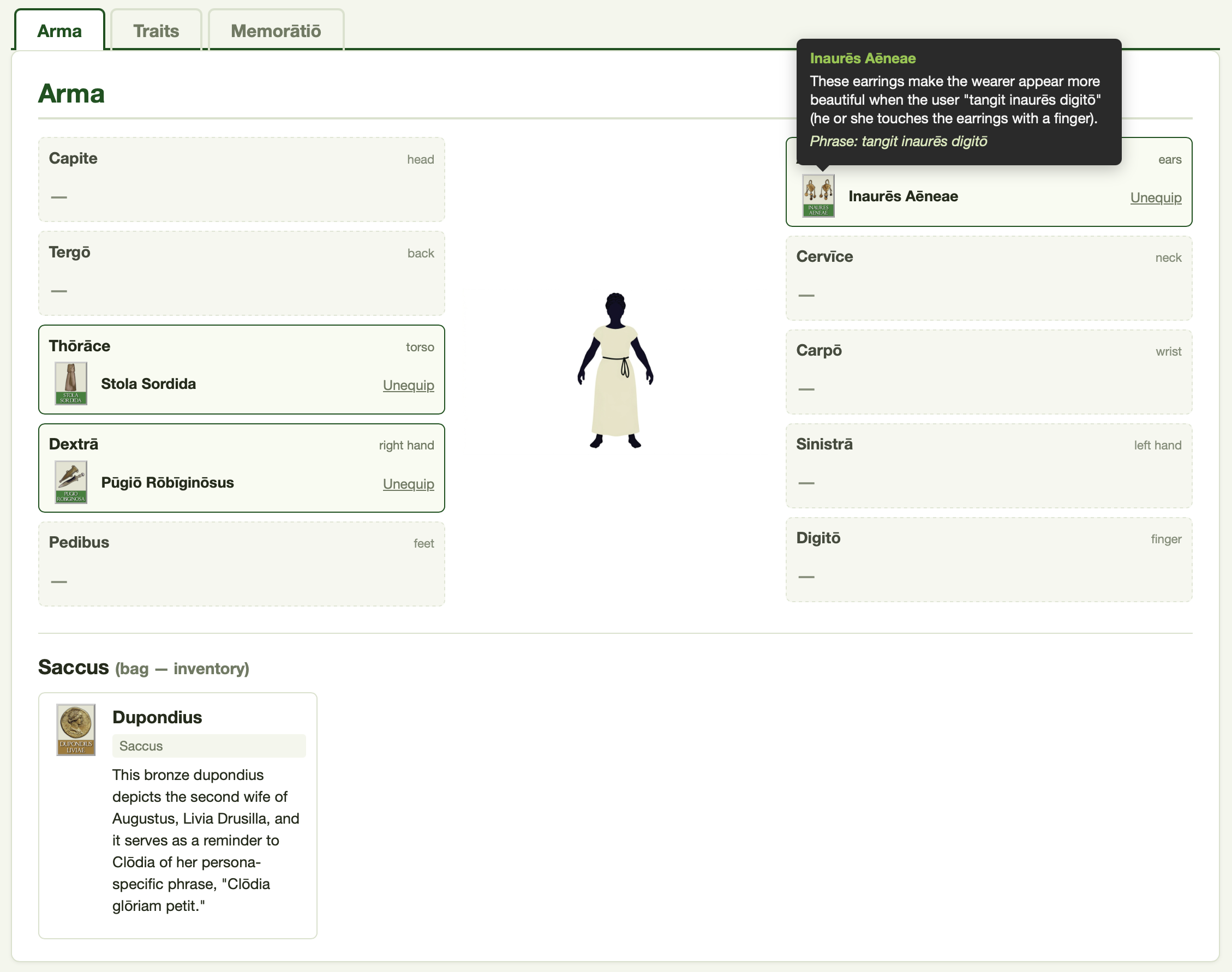
Equipping and Managing Gear
| Action | What it does |
|---|---|
| Grant | Adds the item to the character's Saccus (bag). Items never auto-equip. |
| Equip to slot | Moves the item from Saccus to its body slot. If that slot is occupied, the previous item returns to the Saccus. |
| Unequip | Returns an equipped item to the Saccus. |
| Remove | Permanently deletes the item. Use this only for story-driven consequences, not to unequip. |
Students can equip and unequip on their side of the character sheet. You and they share the same view of what is currently equipped.
Memorātiō
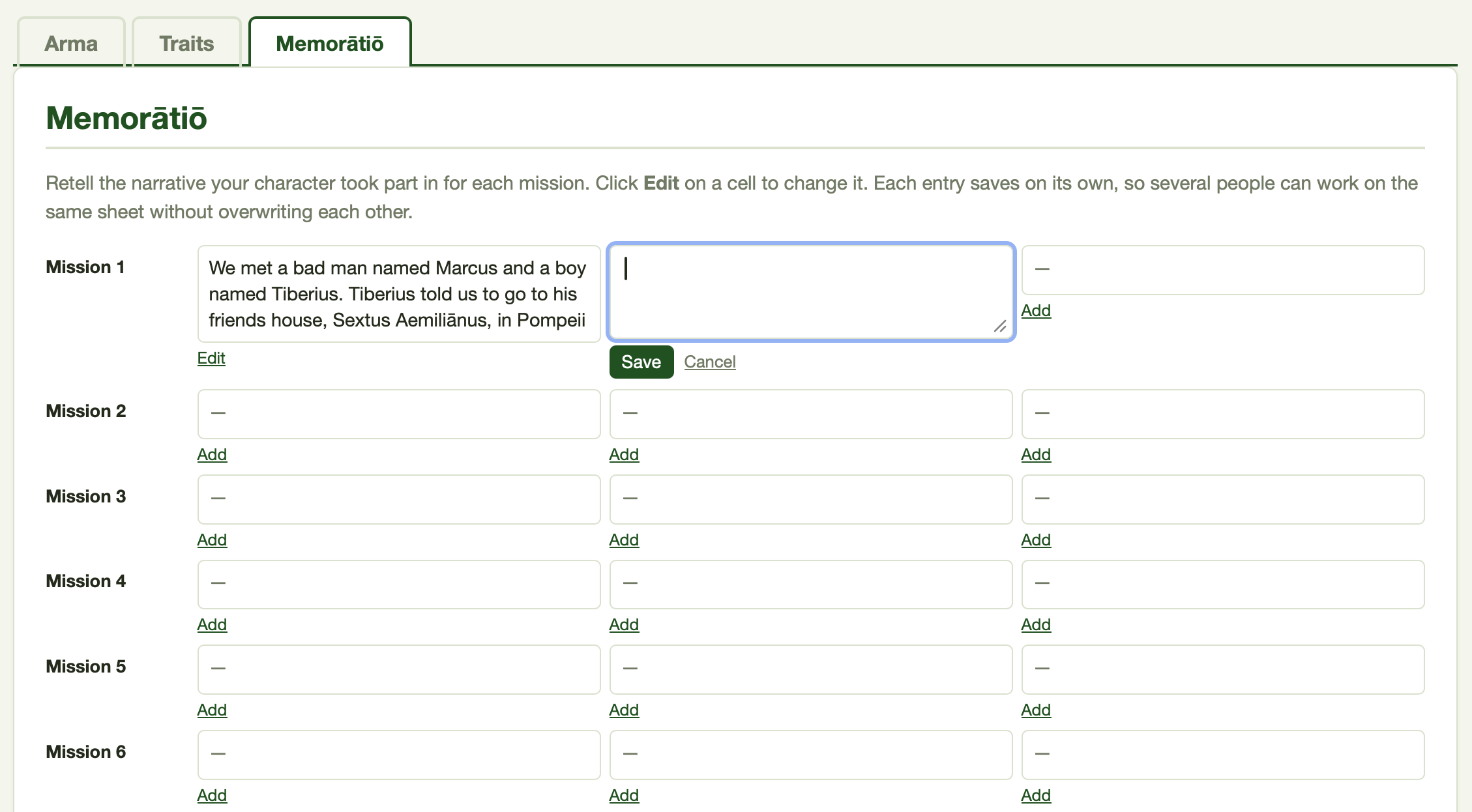
The Memorātiō tab on the character sheet is a team writing journal: a 28-mission grid where the team records a short narrative entry for each episode. It is the team's record of what their character did and experienced across the story.
Memorātiō is not graded directly, but do not skip it. Operation LAPIS runs across two years; students who do not maintain some record of the narrative will lose the thread, especially across extended breaks and summer vacation. The Memorātiō is the team's owned version of the plot, written in their own words and from their character's perspective. A student who returns in September and reads back through their entries can re-enter the story with genuine context rather than a vague sense of what happened two semesters ago.
Encourage teams to record not just what happened but what mattered: NPC names and relationships, important objects, decisions that had consequences, things they noticed that others might not have. The entries do not need to be long. Two or three sentences per episode adds up to a meaningful archive over 28 missions.
The Teacher View (Mission Control)
The character manage page in Mission Control is the teacher-facing counterpart to the student character sheet. From here you grant PV, award dēnāriī, manage Arma, and see which operatives are on the team.
Next: Operative Dossier