Mission 2. Titanomachy and the Papyrus of Destiny¶
1. Episode Overview¶
Essential Question
Who were the Romans?
ACTFL Proficiency Benchmarks — Novice
- Interpretive: I can identify the general topic and some basic information in both very familiar and everyday contexts by recognizing practiced or memorized words, phrases, and simple sentences in texts that are spoken, written, or signed.
- Cultural Investigation: In my own and other cultures I can identify products and practices to help me understand perspectives.
Cultural & Historical Learning Targets — student-facing
- Summarize and describe the Creation Myth and the Greek influence on Roman identity.
- Summarize and describe the Titanomachy and the succession myth.
- Summarize and evaluate the functions of the Olympian gods.
- Identify and describe oral poetry, Homer, and Hesiod.
- Evaluate the significance of Roman literature and patronage.
- Identify and describe Roman writing materials.
- Navigate through a Roman house.
Grammatical Learning Objectives — teacher-facing
- Introduction to ablative-singular endings and to the concept of declension (2.1).
- First- and second-person singular verbs, with the personal pronouns ego and tū in the nominative and recognition of tē and tibi (2.2).
- Consolidation: singular verbs in all persons, with nominative, accusative, and ablative singular nouns (2.3).
Lapis thread
The Lapis backstory begins to surface in-fiction. The Titanomachy training mission stages the origin of the Lapis as a chip off the enormous stone swallowed by Saturn. Whichever Olympian the operatives choose to hold the Lapis, Neptune ends up with it, setting up its journey to Troy in Mission 3. The episode closes with the recovery of the Papyrus of Destiny from Marcus's house, which points cryptically to the "town of Hercules", Herculaneum, as the next destination.
Instructor background — withheld from students
The Papyrus is a document composed by the historical Gāius Cilnius Maecēnās (patron of Vergil and Horace), the founder of the Societas Potentium. Its cryptic reference to the "town of Hercules" is Maecēnās's coded name for Herculaneum, where a branch of the ML kept a hidden archive. Marcus knows this and will be furious when he discovers the theft; he does not yet know the team can decode it. The medicāmen (pill) Sextus uses to drop the team into the Titanomachy is borrowed openly from the Matrix; its function here is metacognitive: it signals that the operatives are playing inside a fiction, and plants the seed that Sinistrus (Ep 5) will cultivate when he challenges them to question their assumptions about the TSTT itself.
2. Shared CODEX Backbone¶
Each approach works from the same CODEX pages. For what the sections contain and how students reach them, see The CODEX. Each episode's ATTUNEMENT set closes with an inline Memorātiō.
CODEX pages: CODEX 2.1 · CODEX 2.2 · CODEX 2.3
KEY-TEXTs
- 2.1: the Creation Myth, the cosmogony behind the battle, and the Gigantomachīa, the Giants' later revolt against the Olympians.
- 2.2: dē avō Marcī, on Marcus's grandfather, and Ignis Promētheī, the theft of fire.
- 2.3: in tablīnō Marcī, the scene inside Marcus's study, and versipellis, Marcus's werewolf tale.
Informational Texts
- 2.1: Homer, Hesiod, and oral poetry; the Olympian gods.
- 2.2: Gāius Cilnius Maecēnās; Roman writing materials.
- 2.3: the Roman villa in Vīlla Rōmāna.
GRAMMATICA
- 2.1: the ablative in prepositional phrases, the accusative for motion set against the ablative for position, and an introduction to the five declensions.
- 2.2: first- and second-person singular present, with the personal pronouns ego and tū.
- 2.3: consolidation of case and person endings, with no new feature.
VERBA
- 2.1: sum, omnis, deus, rēx, capit.
- 2.2: sed, habet, nunc, ubi, via.
- 2.3: sunt, sub, terra, pōnit, volūmen.
CULTURALIA
- 2.1: the Titanomachy, and Homer and Hesiod as oral tradition, drawing on Hesiod's Theogony as the primary source.
- 2.2: literary patronage and the patron-client bond, with Maecēnās as the archetype.
- 2.3: the social structure of the domus, from public to private, anchored to the House of Venus in the Shell.
ATTUNEMENT
- 2.1: a set that climbs from recognition to short answer. A sequence-the-events task and a motion-versus-position forced choice fix the ablative, then comprehension on the Creation Myth key-text and the oral-poetry text, and a chart on the Olympian gods, put the reading to work.
- 2.2: exercises on the first-, second-, and third-person present. A sort-by-person task and a match-the-ending task drill the endings, then Latin and English comprehension on the two key-texts and the writing-materials text, closing with a patronage then-and-now comparison.
- 2.3: a consolidation set. A build-the-sentence word grid puts case and person back to work in production, then comprehension on both key-texts, the Vīlla Rōmāna text, and the house-as-social-map reading.
3. Episodes¶
The story beats are the same across all tracks. Track-specific links and running notes are in §4.
Numbering map (Episode 2): 2.1 (The Titanomachy) = prompts 2.1.a / 2.1.b; 2.2 (To the House of Marcus Maecēnās) = 2.2.a / 2.2.b; 2.3 (The Papyrus of Destiny) = 2.3.a / 2.3.b.
2.1, The Titanomachy¶
The morning after the cēna at Caecilius's house, the team returns to Sextus, who reveals the Fābula Lapidis and hands each operative a glowing medicāmen. Taking it drops the team into the Titanomachy, where they fight as gods, Titans, or monsters and witness the origin of the Lapis: a chip off the great stone Saturn swallowed and Jupiter shattered in his victory. Before they return, they must decide which Olympian should be entrusted with the Lapis, though the stone finds its way to Neptune whatever they choose.
2.2, To the House of Marcus Maecēnās¶
Back in the present, Sextus sets the team a theft. A volūmen that may point to the Lapis is held in the villa of Marcus Cilnius Maecēnās, grandson of the faction's founder. The team questions Sextus for what it needs, learns the scroll's opening line, the initium, that will identify the right one among many, and plans a night route across Pompeii to the villa.
2.3, The Papyrus of Destiny¶
At midnight the team talks its way past the custōs and enters the villa in explore mode, moving room to room while Marcus dines in the trīclīnium. They find the scroll of Gāius Maecēnās hidden in a crack behind a small table in the tablīnum and slip out to Sextus, who reads it, calls it an aenigma, and sends them to Caecilius's house before Marcus discovers the theft. The papyrus points cryptically to the "town of Hercules," Herculaneum; its full deciphering pays off in Mission 5.
4. Running the Mission¶
Immersion links:
Episode 2.1 — The Titanomachy
-
Post 2.1.a and read it together for comprehension. The morning after the dinner, Sextus reveals the Fābula Lapidis and hands each operative a glowing medicāmen; taking it drops the team into the Titanomachy, standing beside Sextus below the crag where Jupiter fights. See §5 Agent Craft for the medicāmen and the choice of combatant.
-
Introduce GRAMMATICA 2.1 before the first Latin the team writes in the battle. This is the episode's new grammar: the ablative ending inside a prepositional phrase, the accusative for motion (in montem, into the mountain) set against the ablative for position (in monte, on the mountain), and the idea that nouns fall into five declensions. The battlefield is nothing but movement and position, so the grammar is in play from the first blow.
-
Run the Motion vs Position task as the team composes its attacks. Describing where a blow lands and where a figure moves is a live choice between the accusative and the ablative, so the game action and the grammar drill are the same work.
-
The battle plays out as the team's response to 2.1.a: escalating exchanges in which the chosen opponent recovers and answers back, with the team landing a finishing blow after two or three rounds. The immortality rule in §5 turns any "kill" into a banishment. Post your in-character agent responses; see §5 Agent Craft for the postures.
-
Now deepen the myth the team has been living. Read the Creation Myth KEY-TEXT together, the cosmogony that leads up to this battle, and work the Creation Myth comprehension. This is a strong moment for intercultural comparison: bring in creation stories your students already know from other traditions.
-
Read the oral poetry informational text on Homer and Hesiod and work its comprehension. It frames the myth as something retold across centuries rather than fixed by a single author, which is exactly the point Sextus is making by dropping the team inside it.
-
Before the team decides who receives the Lapis, it needs to know the gods. Read The Olympian Gods informational text and complete the Olympian Gods chart, which lines up the Greek and Roman names.
-
Post 2.1.b. The duel ends: Jupiter defeats Saturn, the swallowed stone shatters, and the small Lapis remains. The team chooses which Olympian should receive it and, more to the point, argues why. Whatever they decide, Neptune ends up with the Lapis; note the planted detail that he will carry it to Troy. Post your reply as the chosen god accepting in the first person; see §5 Agent Craft.
-
Read the Gigantomachīa KEY-TEXT together, the Giants' later revolt against the new Olympian order, then work through the CULTURALIA section with its selection from Hesiod's Theogony, the team's first primary source.
-
Run the Sequence the Events task to consolidate the order of what the team has just lived through.
-
Close the episode with the inline Memorātiō, composed in the memorātiō tab of the operative dossier; coach the form.
-
Award LP for 2.1 and mark ATTUNEMENT completion in Mission Control.
Episode 2.2 — To the House of Marcus Maecēnās
-
Post 2.2.a and read it together. The team wakes groggy in Sextus's atrium; he recaps the Titanomachy, notes that in their Fābula the Lapis went to Neptune (a sīgnum he cannot yet read), and sets the job: a volūmen in Marcus Maecēnās's villa may show the way to the Lapis. He then invites their questions. This is the mission's questioning-skill scene, so let the team drive it.
-
Introduce GRAMMATICA 2.2: the first- and second-person endings, how the ending alone names who acts (dēsīderō, "I want"; dēsīderās, "you want"), and the optional pronouns ego and tū. The questioning of Sextus is built on exactly this exchange: the team asks in the second person and he answers in the first.
-
Run the Sort the Verbs by Person task and the Match the Ending to the Subject task alongside the questioning, as its form-parallel practice: the grammar drill and the in-character interrogation are the same skill.
-
Read the Gāius Cilnius Maecēnās informational text to introduce the man behind the mission: the historical patron of Vergil and Horace and, though the team does not know it yet, the founder of the faction it is up against.
-
Read the dē avō Marcī KEY-TEXT together and work its Latin comprehension. It sorts out the two men named Maecēnās, the grandfather Gāius and the grandson Marcus, before the team has to tell them apart at the villa.
-
Work through the CULTURALIA section on literary patronage, the patron-client bond and why a Roman poet needed a patron, and complete the Patronage Then and Now task, which sets how artists were supported then against how they are supported now.
-
Post 2.2.b. With the briefing done, the team plans a night route to the villa. Push them to reason about why a direct route on the main streets is a poor idea after dark with a theft ahead of them; knowledge of Pompeii by night is the real content. If you want to ground the planning in the real city, share the Google Maps location of Sextus's house and let them trace the streets from there.
-
Read the Roman writing materials informational text and work its comprehension. Knowing what a volūmen is, and how it differs from a cōdex, is what will let the team recognize the right object when it hunts through the villa in 2.3.
-
Read Ignis Promētheī (KEY-TEXT B) and work its comprehension. A good discussion question: when humans burn only the fat and bones as an offering, are they really giving up anything? Use it to open critical thinking about myth and sacrifice.
-
Close the episode with the inline Memorātiō, composed in the memorātiō tab of the operative dossier. Post your in-character agent response, award LP, and mark ATTUNEMENT and KEY-TEXT completion in Mission Control.
Episode 2.3 — The Papyrus of Destiny
-
Post 2.3.a. Midnight at Marcus's door; the custōs blocks the way and demands a name and a reason. The team talks its way in using the cover Sextus planted, that they are clients of Caecilius, or by playing to the guard's love of the chariot races. See §5 Agent Craft for the guard's postures.
-
Before the team goes room to room, give it the map of the house. Read the Vīlla Rōmāna informational text and work its comprehension, so the team knows what each room is and is likely to hold before it starts searching in the dark.
-
Introduce GRAMMATICA 2.3: no new grammar this episode, only a review of the case endings (nominative, accusative, ablative) and the person endings the team already commands. Run the Build the Sentence task as the production checkpoint, assembling whole sentences from a word grid that puts case and person back to work together.
-
Post 2.3.b and open the exploration of the villa. Launch the Exploration Board before the team begins composing its moves. The team moves room to room, avoiding the trīclīnium where Marcus dines, and converges on the tablīnum, where the real scroll waits in a crack behind a small table. The canonical outcome is the undetected escape. The stock room descriptions and the two resolution snippets are in §5 Agent Craft.
Mission Asset: The Villa of M. Maecenas Exploration Board
The Exploration Board is an interactive floor plan built into the Recentius web app. It replaces a static map with a live, shared tabletop that you manipulate and students watch in real time.
Launching a session. Each time you start the mission for a class, Recentius creates a fresh board instance with its own state and share code. Instances auto-purge 14 days after the last edit. You can also end an instance (freezes it but keeps it viewable) or delete it manually. Multiple cohorts never share a board.
Sharing with students. Give students the share link for your instance. Their view is read-only and auto-refreshes every 30 seconds; a manual Refresh button is also available. Your moves appear on their screens shortly after you make them, turning the board into a shared narrative space.
The tokens. Eight player-character tokens are available (Bellator, Priscus, Agricola, Amorosus, Octaviana, Horatiana, Clodia, Tulliana), each with a colored ring and letter badge. Guard tokens auto-number as you add them (G1, G2, G3...). A Marcus token (M) represents the master of the house. Prop tokens cover the mission objects: Key, Closed Chest, Open Chest, and Scroll.
Running the explore session. Drag tokens anywhere on the floor plan to narrate movement. Add or remove tokens from the toolbar as guards appear or are bypassed. Flip the Closed Chest to Open Chest once it is unlocked; place the Scroll in the tablīnum rīma and reveal it when the team finds it. All positions save automatically. There are no fixed win/lose rules: the board is a visual anchor for the Latin storytelling, not an automated game.
Pacing note. Small, frequent moves work better than large jumps. Reward examination: let finds appear when the team looks, not before. The fail-and-restart paths are intentional. See the stock room descriptions in §5 for Latin room text to drop into your in-character responses as the team moves through.
-
Read the in tablīnō Marcī KEY-TEXT and work its Latin comprehension, the scene set inside the very study the team is searching.
-
Read the versipellis KEY-TEXT and work its comprehension, the werewolf tale Marcus tells his guests at the dinner the team is skirting.
-
Work through the CULTURALIA section, reading the house as a social map from public front to private back, and complete the House as a Social Map task. Both consolidate the villa navigation the team has just performed and explain why something valuable would be tucked away from the show-rooms.
-
Close with the inline Memorātiō, composed in the memorātiō tab of the operative dossier. Post your agent response closing the mission: read the recovered papyrus with the team (the image is linked in §5), noting its cryptic "town of Hercules." The full deciphering pays off in Mission 5. Award LP for 2.3 and mark ATTUNEMENT and KEY-TEXT completion for all three episodes in Mission Control.
Openings: the two CYOP tutorials are covered on the Introduction & Tutorials page; the episode openings follow below. The reads and comprehension tasks mirror the RPG, so they carry the same links and pill colors. Run the mission as an Operation LAPIS (CYOP) cohort in Mission Control, where each student keeps a per-episode Memorātiō on their dossier and the attunement and key-text checks work as in the RPG; see About Fabula Lapidis for cohort setup.
Episode 2.1 — The Titanomachy
-
Post the 2.1 opening. Students take up Octāviāna and Bellātor, return to Sextus, take the glowing medicāmen, and drop into the Titanomachy. Have them read for comprehension and pause at the battle choice.
-
Introduce GRAMMATICA 2.1, the ablative in prepositional phrases and the motion-versus-position contrast, and run the Motion vs Position task alongside the battle scenes.
-
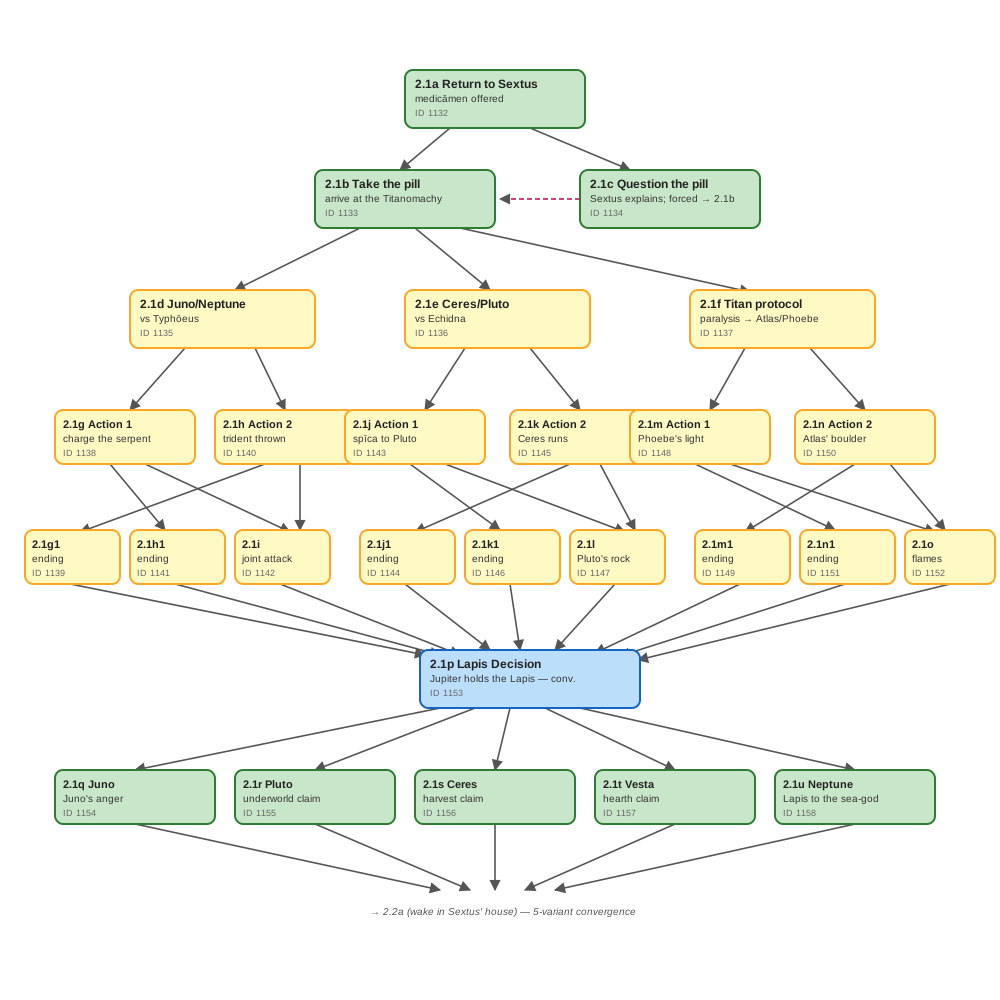
At the battle fork, students choose a god pair to play, Neptune and Juno or Ceres and Pluto, through up to three battle beats. Students who cannot decide meet the Titan Protocol: Sextus assigns them the Titans' side, and they play as Atlas and Phoebe. The Titan Protocol is a CYOP-only path.
-
Deepen the myth. Read the Creation Myth KEY-TEXT and its comprehension, and compare creation stories across cultures as a class.
-
Read the oral poetry informational text and its comprehension.
-
Before the Lapis choice, read The Olympian Gods informational text and complete the Olympian Gods chart.
-
At the choice point, students pick which Olympian receives the Lapis. Whatever they choose, Neptune ends up with it; debrief the class on why.
-
Read the Gigantomachīa KEY-TEXT and work the CULTURALIA with its Hesiod primary source.
-
Run the Sequence the Events task, then close with the inline Memorātiō. Award 2.1's LP on the quality of that reflection.
-
Debrief the episode's choices as a class: why did the narrative correct an off-base choice, and what would a Roman have known that the siblings needed to know? The discussion is where the cultural learning settles.
Episode 2.2 — To the House of Marcus Maecēnās
-
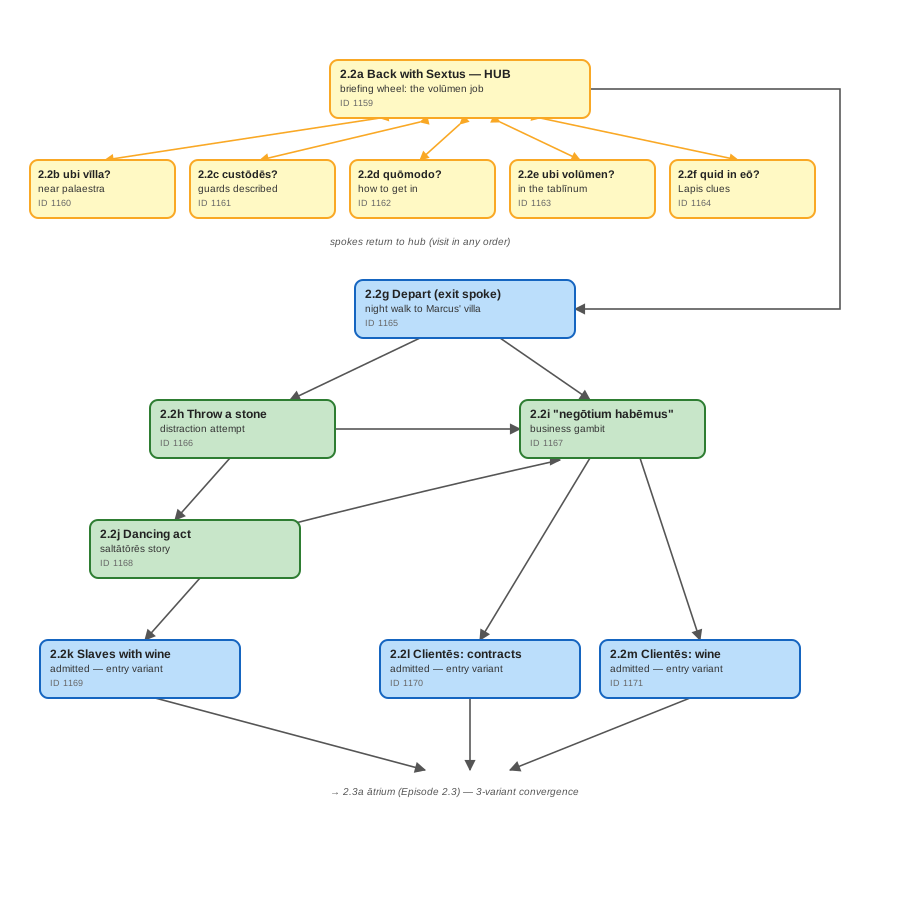
Post the 2.2 opening. Students question Sextus in the briefing; the branches let them ask about the villa, the guards, the way in, and the scroll.
-
Introduce GRAMMATICA 2.2, the first- and second-person endings, and run the Sort the Verbs by Person task and the Match the Ending to the Subject task alongside.
-
Read the Gāius Cilnius Maecēnās informational text, then the dē avō Marcī KEY-TEXT with its Latin comprehension.
-
Work the CULTURALIA on literary patronage and the Patronage Then and Now task.
-
Read the Roman writing materials informational text and its comprehension; it prepares students to recognize the scroll in 2.3.
-
Read Ignis Promētheī (KEY-TEXT B) and its comprehension.
-
As students work through the night route and the guard at the door, let off-base choices play out, then debrief the cultural reasoning behind them. Close with the inline Memorātiō. Award 2.2's LP on the quality of that reflection.
Episode 2.3 — The Papyrus of Destiny
-
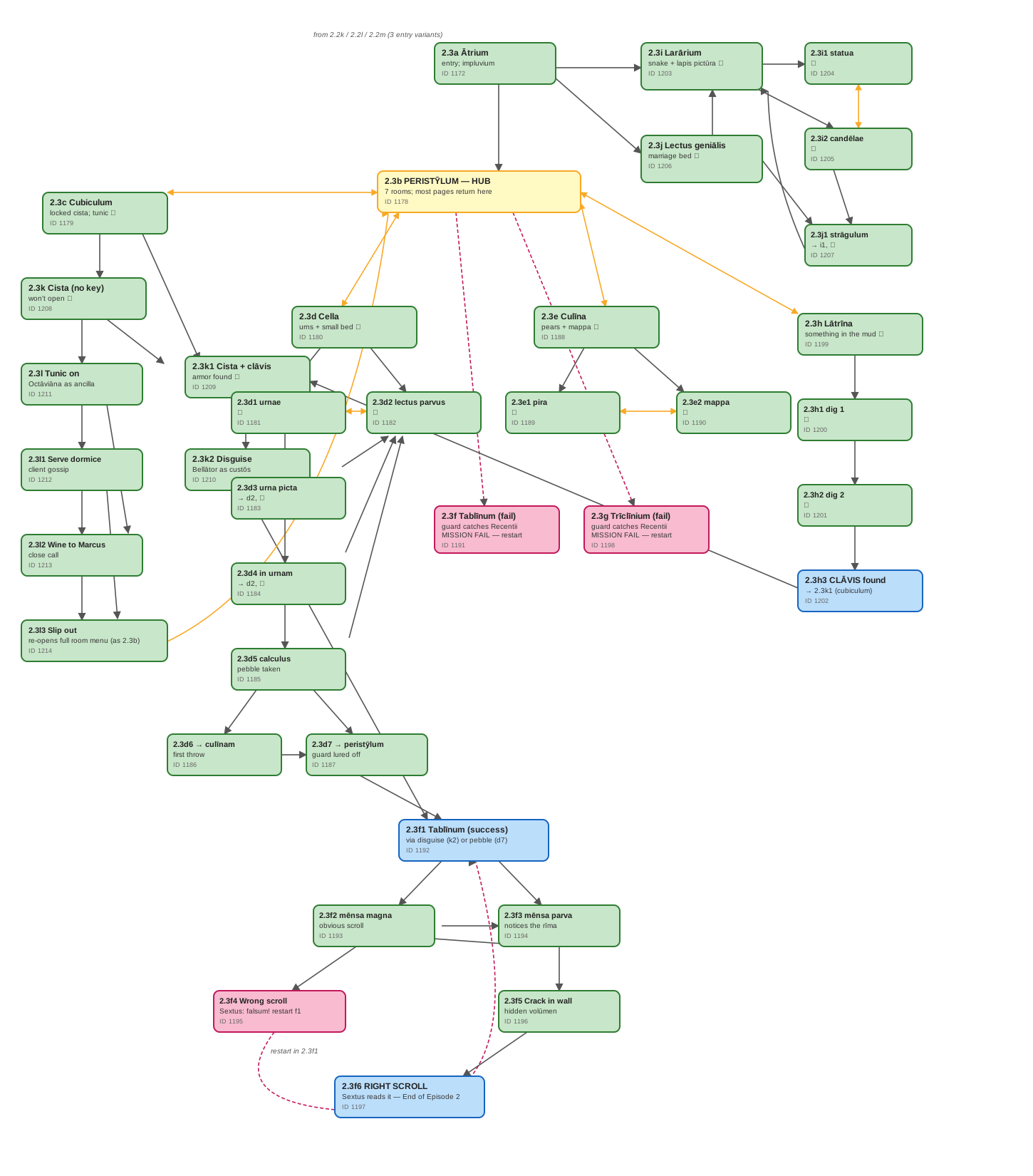
Post the 2.3 opening. The branching exploration of the villa builds toward the tablīnum; let wrong turns play out before debriefing, since the in-narrative corrections show what close reading and cultural knowledge would have prevented.
-
Give students the map first: read the Vīlla Rōmāna informational text and its comprehension.
-
Review case and person with GRAMMATICA 2.3 and run the Build the Sentence task as the production checkpoint.
-
Read the in tablīnō Marcī KEY-TEXT and its Latin comprehension; read the versipellis KEY-TEXT and its comprehension.
-
Work the CULTURALIA and the House as a Social Map task.
-
Close with the inline Memorātiō. Debrief the episode as a class. Award 2.3's LP on the quality of the Memorātiō reflection.
Story Map¶
Back at Sextus's house, the Recentii take a glowing pill and are immersed in the myth of the Titanomachy, learning how Sextus's training works. Returned to the present, they prepare and carry out a plan to steal a scroll from Marcus, exploring his house at real risk of discovery.
How to read the maps
Each box is one scene (one static story page). Green = standard scene · Blue = convergence / key node · Pink = fail / redirect (dashed pink arrows loop the reader back) · Yellow = special or graded gate · Grey = meta / optional. Solid arrows are forward story choices; labels on arrows paraphrase the choice.
2.1 pathing map
27 scenes · 1 fail/redirect branches · 1 convergence nodes
2.2 pathing map
13 scenes · 0 fail/redirect branches · 4 convergence nodes
2.3 pathing map
38 scenes · 3 fail/redirect branches · 3 convergence nodes
5. Agent Craft¶
Latin and English replies for prompts 2.1.a through 2.3.b are below, organised by anticipated student posture. English replies support the English RPG approach.
Register. Mission 2 introduces first and second person singular verbs and the ablative singular. NPC spoken lines stay inside the M2 ceiling: everything Mission 1 allowed, plus singular verbs in all persons, the ablative singular (in prepositional phrases and as time or means), the demonstratives hic/haec/hoc, datives (mihi, tibi, singular noun datives), a modal plus infinitive, -ne questions, and present plural verbs. No perfect, imperfect, future, subjunctive, or comparative in spoken lines. Two rules specific to this mission:
- The two-layer rule. Narration the team hears (Fābula action, room descriptions, consequences) may be fuller and may carry past and future meaning; spoken NPC lines stay at the ceiling, with the English reply or a stage direction carrying tense where needed.
- The immortality rule (2.1). Gods and Titans cannot die. A blow defeats, binds, sweeps under, or casts down; the narration converts any "kill" into a banishment without scolding the team.
Cross-cutting techniques this episode:
- Efficient authenticity. This is the team's first sustained role-play against the wider world and your first real test at playing it. The guard in 2.2 should be a real but not daunting challenge; do not get hung up on details.
- Make the house feel challenging (2.3). Reward examination, not luck. Treasure appears when the team looks, not before.
- The nuclear option (2.3). If a team pushes to get caught, you can have a guard strip a piece of gear with the implication they lose everything if they continue. As a last resort, narrate in-fiction concern: "Bellātor tries to stay and fight, but his concern for his cousins gets the better of him, and he follows them out."
The medicāmen and the fiction of myth. Two metacognitive threads to run explicitly this episode:
- The pill. Sextus's medicāmen is openly from the Matrix. Use it to reinforce, gently, that the operatives are playing inside a fiction. It seeds the bigger fourth-wall challenges Sinistrus brings in Mission 5.
- Myth has no authentic version. There is no single true Titanomachy: some versions are older or more respected, but none is authoritative. The same scaffolding makes clear that the Lapis's role in the TSTT's retelling of myth is itself a fiction of the TSTT. Letting students in on this "secret" keeps them engaged and starts the climb up the metacognition curve.
Character and perception notes:
- Sextus still glows. He remains the nitidus guide through the Pompeii arc; keep the glow consistent.
- Marcus is the recurring antagonist. Mission 2 is the team's first time on his ground. Keep him formidable but beatable.
- Sinistrus is not yet present (introduced Mission 5.1). The pill device here is the groundwork his later challenges build on.
Watch-fors. Teams may treat the explore mode in 2.3 as a loot hunt; slow them toward close reading and small actions. The fail-and-restart paths are intentional, but a team that keeps failing may need a quiet difficulty adjustment rather than another restart.
Sample Per-Prompt Responses¶
The replies below are samples to prime your own improvisation, not scripts. They show one plausible way to handle each posture, never the only or required one.
2.1.a — The Titanomachy: Choose and Fight
Scene context. Euphorbus sends the team from Caecilius's villa to Sextus's. Sextus announces their first Fābula Lapidis, hands each operative the medicāmen, and the world dissolves into the Titanomachy. The team stands with Sextus below a great crag; Jupiter is above; the battle of gods and Titans is everywhere. They may choose any figure except Jupiter and Saturn, and must attack an appropriate opponent.
Sextus's posture. Inside the Fābula he is the calm guide at the team's elbow: dry, short spoken lines, unbothered by cosmic violence. The fuller Titanomachy narration is your narration layer, not Sextus's spoken register.
Posture 1: Canonical choice and attack
Latin (narration, then the opponent): tū es Neptūnus, deus maris. unda māgna circum tē surgit. unda Titānem pulsat. Titān per āera volat et in terram cadit. Titān clāmat: "tū mē pulsās? ego Titān sum! ego māgnus sum!" (He hauls himself up for another round.)
English: A great wave rises around you and slams into the Titan. He flies through the air and crashes to the earth, bellowing: "You strike me? I am a Titan! I am mighty!" (He hauls himself up for another round.)
Reward embellishment with escalation, not closure: the opponent recovers and answers back, inviting a second and third exchange. Each exchange is fresh first- and second-person practice (pulsō, pulsās), the mission's grammar target. Let the team land the finishing blow after two or three rounds (see Posture 3 for what a "finish" looks like).
Posture 2: The team picks Jupiter or Saturn
Latin (Sextus): "minimē! Iuppiter et Sāturnus tibi nōn licent. Iuppiter et Sāturnus in Fābulā labōrant. alium optā!"
English (Sextus): "No! Jupiter and Saturn are off limits. They have their own work in this Fābula. Pick another!"
The exclusion protects the 2.1.b beat: the duel and the broken stone must play out canonically. Sextus is firm but light; offer a quick menu in coaching if they stall (Neptune, Minerva, a Cyclops, a terrified shepherd).
Posture 3: The team tries to kill their opponent
Latin (narration, then Sextus): gladius Titānem pulsat. Titān cadit. terra Titānem accipit: Titān sub terram lābitur, victus sed vīvus. Sextus: "deus perīre nōn potest. Titān perīre nōn potest. sed victōria tua est!"
English: Your blade strikes home. The Titan falls, and the earth itself swallows him down, defeated but alive. Sextus, at your side: "A god cannot die. A Titan cannot die. But the victory is yours!"
The immortality rule in action: grant the team the full glory of the win while the narration converts the kill into a banishment. Myth-mechanics, not a rules correction.
Posture 4: The team refuses the medicāmen
Latin (Sextus): "prūdēns es! sed medicāmen bonum est. medicāmen tē tūtum facit. sine medicāmine, Fābula perīculōsa est. Demiurgus medicāmen dat. cōnsūme!"
English (Sextus): "Sensible of you! But the medicine is good. It keeps you safe. Without it, the Fābula is dangerous. It comes from the Demiurge himself. Take it!"
Suspicion of a strange pill is healthy and worth a nod (prūdēns es), but the Fābula cannot start without it. If a team digs in, Sextus takes one himself first, visibly unharmed, and the holdout usually folds. Do not explain what the medicāmen "really" is; the TSTT's true nature is held back until the operation's endgame.
Posture 5: The team attacks the wrong side or a bystander
Latin (narration, then Sextus): Minerva tē spectat. oculī deae sunt frīgidī. hasta in manū deae lūcet. Sextus, quietly: "Minerva nōn est hostis tuus. Titānēs sunt hostēs. contrā Titānōs pugnā, aut Minerva contrā tē pugnat!"
English: Minerva turns. Her eyes are cold, and the spear in her hand gleams. Sextus, quietly: "Minerva is not your enemy. The Titans are the enemy. Fight against the Titans, or she will fight against you!"
Let the bad idea have a visible cost (a goddess's attention) before Sextus funnels them back. If they insist, Minerva swats them across the battlefield without injury and returns to her own fight.
Posture 6: The team watches and will not fight
Latin (narration, then Sextus): saxum māgnum dē caelō cadit. saxum ad tē volat! Sextus: "spectāsne sōlum? Fābula tē videt! quid facis?"
English: A boulder torn loose by the battle comes screaming down toward you. Sextus: "Just watching, are you? The Fābula sees you! What do you do?"
A bystander is a legal choice, but the prompt still asks for an attack, and a shepherd swinging a crook at a falling rock counts. Make the battle come to them: the Fābula does not permit spectators.
Posture 7: Off-script, the team goes for the stone early
Latin (narration, then Sextus): saxum in manū Sāturnī est. Sāturnus in vertice montis pugnat. tū saxum capere nōn potes: mōns altus est, et proelium māgnum est. Sextus: "saxum vidēs? bene. sed nōndum. nunc pugnā. mox saxum fātum suum invenit."
English: The stone is in Saturn's fist, and Saturn is fighting at the very peak. You cannot reach it; the mountain is high and the battle is everywhere. Sextus: "You've spotted the stone? Good eye. But not yet. Fight now. The stone will meet its fate soon enough." (He says this like a man who has read the ending.)
Reward the genre-savvy instinct without letting them short-circuit 2.1.b. If fātum suum feels above your room, drop that sentence and keep sed nōndum. nunc pugnā.
2.1.b — Who Receives the Lapis?
Scene context. The duel: Jupiter defeats Saturn with the thunderbolt, Saturn falls through the sky and through the earth, and the stone he once swallowed shatters into a greater and a lesser part, both nitidae. Jupiter takes the greater part; the lesser part, the small Lapis, remains. Sextus asks: "quem dē Olympicīs Lapidem accipere dēbet?" Every god and goddess looks at the team.
Sextus's posture. Socratic and expectant. He wants a choice with a reason; the reasoning is the exercise. He does not care which god wins the debate, but the gods themselves are listening.
Posture 1: A reasoned choice (canonical)
Latin (Sextus, then the chosen god): Sextus: "cōnsilium bonum est. audī: deus venit." Neptūnus ad tē ambulat. deus māgnus est, et aqua dē deō cadit. Neptūnus: "tū mē optās? bene. ego Lapidem accipiō. ego Lapidem in rēgnō meō custōdiō."
English: Sextus: "A sound argument. Listen: the god is coming." Neptune strides toward you, vast, seawater streaming from him. "You choose me? Good. I accept the Lapis. I will guard it in my kingdom." (He closes his fist around the small bright stone, and the Fābula begins to dim.)
Any Olympian with a real reason earns this treatment: Sextus validates the reasoning, the god arrives and accepts in the first person (modeled back at the team). Do not steer the deliberation toward any particular god; whatever the team chooses, Neptune ends up with the Lapis, and the Fābula resolves the seam on its own by Sextus's recap in 2.2.a.
Posture 2: A choice with no reason
Latin (Sextus): "Mārs? fortasse. sed cūr? dīc mihi: cūr Mārs Lapidem accipere dēbet? quid Mārs cum Lapide facit?"
English (Sextus): "Mars? Perhaps. But why? Tell me: why should Mars receive the Lapis? What will Mars do with it?"
The reshaping move, same engine as 1.2.b: no refusal, just a sharper question handed back. Any attempt at a reason, however wobbly, graduates them to Posture 1. Do not accept a bare name; the explanation is the language work.
Posture 3: The team picks Jupiter or Saturn
Latin (Sextus): "Iuppiter saxum māgnum iam habet. Sāturnus nōn est Olympicus, et Sāturnus sub terrā iacet. dē Olympicīs optā: quis Lapidem accipere dēbet?"
English (Sextus): "Jupiter already has the great stone. And Saturn is no Olympian; Saturn lies beneath the earth. Choose from the Olympians: who should receive the Lapis?"
Both exclusions have in-fiction reasons, so the redirect never feels like a referee's whistle. Then run Posture 2's "why" on their next pick.
Posture 4: The team claims the Lapis for themselves
Latin (narration, then Sextus): omnēs deī ad tē spectant. omnēs deae ad tē spectant. nēmō rīdet. āēr circum tē frīgidus est. Sextus, low: "tū nōn es deus. Lapis tibi nōn est, nōndum. deō Lapidem dā. quem optās?"
English: Every god and every goddess turns to look at you. Nobody laughs. The air around you goes cold. Sextus, low: "You are not a god. The Lapis is not yours. Not yet. Give it to a god. Whom do you choose?"
The team's whole arc is about carrying the Lapis, so the grab is thematically right and should feel dangerous rather than silly. nōndum is a deliberate wink from Sextus. The weight of divine attention re-rails without a fight.
Posture 5: The team picks a non-Olympian
Latin (Sextus): "Titānem optās? audāx es! sed Titānēs sunt victī. Sextus rogat dē Olympicīs. quis dē Olympicīs Lapidem accipere dēbet?" (He gestures at the assembled victors, who are visibly waiting.)
English (Sextus): "A Titan? Bold of you! But the Titans are beaten. The question is about the Olympians. Which of the Olympians should receive the Lapis?" (He gestures at the assembled victors, who are visibly waiting.)
Acknowledge the mythological literacy in coaching (a Prometheus pick is a smart pick), but the scene's mechanism is an Olympian handoff. If a team argues for their Titan with a genuinely good reason, praise the reasoning, then let an Olympian sponsor the compromise: the Titan's suggestion, an Olympian's custody.
Posture 6: Off-script, the team proposes sharing or a vote
Latin (Sextus): "omnēs? Lapis est ūnus et parvus. ūnus deus Lapidem accipere dēbet. quis?"
English (Sextus): "All of them? The Lapis is one, and it is small. One god must receive it. Which one?"
The diplomatic instinct is charming and doomed: a single small object cannot be shared among immortals who all want it. The physical fact of the stone does the re-railing.
2.2.a — Debriefing and Questioning Sextus
Scene context. Back in Sextus's atrium, groggy, headache. Sextus recaps the Titanomachy on the narration layer, notes that in the team's Fābula Jupiter gave the Lapis to Neptune, calls it a sīgnum, and pivots to the job: Marcus Maecēnās has a volūmen in his villa that may show the way to the Lapis. Then he waits: "deinde? quaestiōnēsne habēs?"
Sextus's posture. Mission-giver in briefing mode. Good specific questions get real answers with first-person verbs (the mission's grammatical showcase: the team asks in the second person, he answers in the first). Lazy questions get reshaped. He gives the next handhold only. Held back: the full SP/ML picture, the deeper meaning of the sīgnum, his death, and everything about the villa's interior that 2.3.b must discover.
Posture 1: The team asks good, specific questions
The heart of the scene. A bank of question-and-answer pairs; deploy the ones asked, in any order.
- "quid est volūmen?": "volūmen est liber antīquus. volūmen fortasse mōnstrat viam ad Lapidem. ego volūmen legere volō." / "The scroll is an ancient book. It may show the way to the Lapis. I want to read it."
- "cūr tū volūmen dēsīderās?": "ego Lapidem quaerō. sine volūmine, ego viam nōn sciō. cum volūmine, fortasse sciō." / "I am searching for the Lapis. Without the scroll I don't know the way. With it, perhaps I will."
- "quis est Marcus?": "Marcus dīves est. Marcus potēns est. Marcus multōs custōdēs habet. Marcus nōn est amīcus." / "Marcus is rich. Marcus is powerful. He keeps many guards. He is no friend of ours." (A beat; he does not elaborate on why.)
- "ubi est vīlla Marcī?": "vīlla Marcī prope palaestram et amphitheātrum stat. in chartā sīgnum vidēs." / "Marcus's villa stands near the palaestra and the amphitheater. You'll see the mark on the map."
- "quandō īmus?": "mediā nocte īte! custōdēs mediā nocte saepe dormiunt." / "Go at midnight! The guards are usually asleep at midnight."
- "estne perīculōsum?": "perīculum est, ita. sed tū potes. et ego hīc labōrō: sine volūmine, ego nihil possum." / "There is danger, yes. But you can do this. And my work waits here: without that scroll I can do nothing."
- "quid est sīgnum? cūr Neptūnus?": "nesciō. Neptūnus est deus maris. fortasse Lapis in marī est? fortasse nōn. volūmen fortasse respondet." / "I don't know. Neptune is the god of the sea. Perhaps the Lapis is in the sea? Perhaps not. The scroll may answer." (He is genuinely puzzled, and it visibly bothers him.)
Scaffold the mission's target exchange: second-person question in, first-person answer out (dēsīderās? … dēsīderō). Answer generously; this briefing is the team's ammunition for 2.2.b and 2.3.a. What Sextus will not do: describe the inside of the villa (he has never been in), name the SP, or speculate further on the sīgnum.
Posture 2: The team asks a broad, lazy question
Latin (Sextus): "māgna interrogātiō est! rogā mē: quis est Marcus? ubi est vīlla? quandō īre dēbēmus? rogā!"
English (Sextus): "That's a big question! Ask me: who is Marcus? Where is the villa? When should we go? Ask!"
Same reshaping engine as 1.2.b, now with a menu. He models three well-formed questions and waits. Each one they actually ask gets its Posture 1 answer.
Posture 3: The team asks nothing and heads for the door
Latin (Sextus): "manē! ubi est vīlla Marcī? scīsne? quid quaeris? scīsne? interrogā prīmum, deinde ī!"
English (Sextus): "Wait! Where is Marcus's villa? Do you know? What are you looking for? Do you know? Questions first, then go!"
The -ne questions do the work: each one exposes something the team does not yet know. Two beats of this usually produces real questions. If they truly will not ask, Sextus gives the irreducible minimum (the initium, the charta, midnight) in 2.2.b as written and lets the thinness of their preparation surface at the guard.
Posture 4: The team probes the held-back layer
Latin (Sextus): "multa rogās! bene rogās. sed nōn hodiē. hodiē volūmen est labor tuus. dē volūmine rogā!"
English (Sextus): "So many questions! Good ones, too. But not today. Today your job is the scroll. Ask about the scroll!" (Something in his tone says: earn the big answers.)
Praise the instinct, close the door, point at the mission. Held back here: the glow, the Demiurge, the TSTT's nature, the SP and Marcus's place in it, Sextus's own history with Marcus. nōn hodiē is his all-purpose deferral; it promises later missions without dating them.
Posture 5: Off-script, the team wants weapons or a different plan
Latin (Sextus): "gladium? minimē! tū nōn es mīles. cōnsilium bonum est gladius tuus." Or, to "why not just ask Marcus": "Marcus? Marcus nihil dat. Marcus omnia dēsīderat. necesse est volūmen capere."
English (Sextus): "A sword? Absolutely not! You are not a soldier. A good plan is your sword." / "Marcus? Marcus gives nothing. Marcus wants everything. The scroll must be taken."
Both rails hold: no armed assault (the mission is an infiltration and the guard encounter is built for wits), and no negotiation with Marcus. cōnsilium bonum est gladius tuus hands the team the theme of 2.2.b.
2.2.b — The Initium, the Charta, and the Route
Scene context. Sextus recites the scroll's initium (the team's key to identifying the right scroll among many), gives them the charta of Pompeii with Marcus's villa marked at location IV, advises midnight, and plants the Caecilius-client cover for the door guard. The prompt is a planning task built around the charta.
Sextus's posture. Plan-reviewer. He responds to the plan the team brings: approving the sound parts, questioning the unsound parts with pointed questions rather than corrections. He seeds the guard-handling ideas but does not run the errand for them.
Posture 1: A sound stealthy plan (canonical)
Latin (Sextus): "cōnsilium bonum est! viae parvae sunt tūtae. mediā nocte hominēs dormiunt. bene. et memoriā tenē: 'Gāius Cilnius Maecēnās scrībit librum.' hoc est initium. sine initiō, volūmen invenīre nōn potes."
English (Sextus): "A good plan! The small streets are safe, and at midnight people are asleep. Good. And keep this in your memory: 'Gāius Cilnius Maecēnās scrībit librum.' That is the opening line. Without it, you cannot find the right scroll."
Approve, then use the approval beat to re-anchor the initium, the thing teams most often forget to bring into 2.3.b. Encourage the team to reason about the route over the charta here; if you want to ground it in the real city, the Google Maps location of Sextus's house gives them a starting point, and the payoff is students reasoning about real Pompeian streets. Route specifics can be loose; what matters is the reasoning (small streets, midnight, few eyes).
Posture 2: The direct main-street route
Latin (Sextus): "via māgna celeris est, ita. sed quis in viā māgnā ambulat? multī hominēs! tabernae, lūmina, custōdēs. spectantne tē hominēs? cōgitā iterum!"
English (Sextus): "The main road is fast, yes. But who walks the main road? Everyone! Shops, lights, watchmen. Will people see you? Think again!"
Question, don't veto: the goal is students reasoning about why the direct route is a bad idea at night with a stolen scroll in your future. Send them back to the charta; when the revised plan comes in, Posture 1.
Posture 3: A daytime plan
Latin (Sextus): "bene vidēs, ita. sed custōdēs quoque bene vident! sōl amīcus custōdum est. quandō custōdēs dormiunt?"
English (Sextus): "You see well by day, true. But so do the guards! The sun is the guards' friend. When do guards sleep?"
His own briefing already answered the closing question (mediā nocte custōdēs saepe dormiunt); this is retrieval practice disguised as a snub. Let the team quote him back and enjoy it.
Posture 4: The overbuilt plan
Latin (Sextus): "audāx es! sed audī: cōnsilium māgnum saepe cadit. cōnsilium parvum saepe stat. via parva, media nox, silentium. hoc est cōnsilium bonum."
English (Sextus): "Bold! But listen: big plans tend to fall apart. Small plans tend to hold. A back street, midnight, silence. That is a good plan."
For disguises, rooftop routes, and tunnel schemes: acknowledge the creativity, then compress. Salvage one usable element from their scheme if you can (a cloak from the disguise plan, a listening pause from the diversion plan) so the funnel feels like editing, not erasure. The peristylium's grey cloak in 2.3.b can even pay off a disguise-minded team later.
Posture 5: The team asks Sextus to come along
Latin (Sextus): "minimē. ego hīc labōrō, et Marcus mē scit. tū es novus in Pompēiīs: custōs tē nōn scit. hoc est dōnum tuum!"
English (Sextus): "No. My work is here, and Marcus knows my face. You are new in Pompeii; the guard doesn't know you. That is your gift!" (He says it like a man handing over a tool.)
The refusal carries real tactical information: the team's anonymity is their asset, which is exactly why the Caecilius cover can work. Marcus knowing Sextus quietly seeds their history without opening it.
Posture 6: The team plans for the guard
Latin (Sextus): "bene cōgitās! audī: Caecilius negōtium cum Marcō agit. fortasse vōs estis clientēs Caeciliī? et audī: custōs fortasse aurīgās amat. omnis Pompēiānus aurīgās amat! Marcus aurīgae pecūniam dat. cōgitā dē hōc."
English (Sextus): "Now you're thinking! Listen: Caecilius does business with Marcus. Perhaps you are clients of Caecilius, tonight? And listen: the guard probably loves the chariot races. Every Pompeian loves the races! Marcus funds a driver. Think about that."
This hands the team both keys to 2.3.a: the Caecilius cover and the aurīgae angle. Teams that ask get the easier guard encounter; that asymmetry is the reward structure for planning. Do not rehearse the actual lines with them; leave the performance for the door.
2.3.a — The Custōs at the Door
Scene context. Midnight, moonlight, the team at Marcus's door. The malus on guard has sword and shield, is angry, and demands: "quid nōmen est tibi? … cūr ades? tū nōn intrās!"
The custōs's posture. Gruff, dutiful, not too bright, a little bored. He wants a reason he can accept so he need not think hard. Susceptible to confidence, to names bigger than his (Caecilius), and to shared enthusiasm (the chariot races). Honesty spikes his suspicion. He poses a challenge but not a daunting one; attacks fail gently, no injury either way. Held back: everything about the Lapis, the scroll's importance, and the SP. He is a doorman, not an initiate.
Posture 1: The Caecilius-client cover (canonical)
Latin (custōs): "Caecilius? … Caecilium sciō. Caecilius vir māgnus est. Caecilius negōtium cum dominō meō agit." (He lowers the sword a degree, squinting at you.) "bene. intrāte. sed tacēte! dominus meus in trīclīniō cēnat. dominum nōn turbāte!"
English (custōs): "Caecilius? … I know Caecilius. A great man. He does business with my master." (He lowers the sword a degree, squinting at you.) "Fine. Go in. But keep quiet! My master is dining in the triclinium. Don't disturb him!"
The cover works because it gives him a reason he can accept: a big name plus plausible business. His parting instruction is load-bearing: it plants the avoid-the-triclinium rule of 2.3.b in-fiction. Make the team sweat one beat (the squint, maybe one follow-up: "quid nōmen est tibi?") so the win feels earned.
Posture 2: The honest answer
Latin (custōs): "volūmen? mediā nocte?!" (The sword comes up.) "fūr es! fūrēs estis! abī, aut clāmō! … aut dīc: quis tē mittit?"
English (custōs): "A scroll? At midnight?!" (The sword comes up.) "You're a thief! Thieves! Clear off, or I shout! … Or tell me: who sends you?"
The true-answer trap, exactly as in 1.1.a: honesty makes it worse, and the team must feel that before recovering. His closing quis tē mittit? is the deliberate lifeline back to the Caecilius mechanic. One honest blunder is recoverable; doubling down on honesty gets the door slammed and a retry after a tense wait.
Posture 3: The bribe
Latin (custōs): (He looks at the coins. He looks at you. The coins do not disappear, but they do not move either.) "pecūnia bona est. sed quis es? cūr ades? nōmen! nōmen māgnum mihi dā, et pecūniam quoque."
English (custōs): (He looks at the coins. He looks at you. The coins do not disappear, but they do not move either.) "Money is nice. But who are you? Why are you here? A name! Give me a big name to go with it."
A bribe works only paired with a name: he needs a story to tell if the steward asks questions in the morning. The bribe alone funnels straight back to the Caecilius cover; bribe plus Caecilius is an easy, slightly grubby win (and costs the team their coins, worth an eyebrow in coaching).
Posture 4: The chariot-race angle
Latin (custōs): "aurīgae?" (The sword drops. His face changes completely.) "ego aurīgās amō! quis est aurīga tuus? ego Scorpum amō! Scorpus semper vincit! … bene, bene, intrāte. sed tacēte! dominus meus cēnat."
English (custōs): "The races?" (The sword drops. His face changes completely.) "I love the races! Who's your driver? Scorpus is my man! Scorpus always wins! … Fine, fine, in you go. But quietly! My master's at dinner."
The most fun at the table: shared enthusiasm melts him. If the team can improvise thirty seconds of race talk (a driver's name, a faction color), let it carry them straight in. Scorpus is a historical charioteer name you can hand a stuck team; any invented name works too, since the custōs is not fact-checking, he is fanning.
Posture 5: The team attacks the custōs
Latin (custōs): (He catches the blow on the shield without stepping back; it costs him nothing.) "puer es! ego custōs sum. ego scūtum habeō, tū nōn." (He plants himself in the doorway.) "iterum: quid nōmen est tibi? cūr ades?"
English (custōs): (He catches the blow on the shield without stepping back; it costs him nothing.) "You're a child! I'm the guard. I have the shield; you don't." (He plants himself in the doorway.) "Again: what's your name? Why are you here?"
Attacks fail gently, no injury either way. His shield absorbs the move and his repeated questions re-rail to the talking game the prompt wants. He does not summon other guards for a first offense; escalation stays available if a team keeps swinging (the door closes, a wait, a retry).
Posture 6: The team claims Marcus's friendship
Latin (custōs): "amīcus dominī meī? hm. dominus meus nihil mihi dīcit. dominus meus in trīclīniō cēnat. vocōne dominum meum?" (He half-turns toward the house, watching your face.)
English (custōs): "A friend of my master? Hm. My master told me nothing. He's at dinner. Shall I call him?" (He half-turns toward the house, watching your face.)
The dangerous bluff: it invites verification by the one man who must not see them. The vocōne threat is the trap snapping; a smart team backpedals to the Caecilius cover (a name the custōs can verify without fetching Marcus). If they say "yes, call him," see the capture path in 2.3.b Posture 7; better to let them squirm and retract.
Posture 7: Off-script creative moves
- Diversion (noise down the street): it half-works. "quid est? … manē hīc!" / "What was that? … Stay here!" He takes five steps toward the noise, and the team has one tense narrated beat to slip through the door; if they dither, he is back. Reward decisiveness.
- Around the back: narration: the walls are high, the back gate barred; a dog barks somewhere inside. The front door and its guard remain the puzzle. Do not open a second entrance; the villa's real layout waits in 2.3.b.
- Lost travelers: "mediā nocte? nēmō mediā nocte errat. quis es?" / "At midnight? Nobody wanders at midnight. Who are you?" Suspicion, not sale; funnel to the cover story.
The scene's engine is the custōs's question pair (quid nōmen est tibi? cūr ades?); every move that is not a good answer loops back to it. Let genuinely clever plays shorten the encounter rather than stonewalling them.
2.3.b — Inside the Villa: Explore Mode
Scene context. The team is in the moonlit atrium: larārium right, lectus geniālis left, shouting and lamplight from the trīclīnium, which they must avoid. Free-form exploration; the tablīnum holds the decoy scroll and, behind the small table, the rīma (a crack in the plaster) hiding the real volūmen of Gāius Cilnius Maecēnās. The deployable room text is in the Stock Room Descriptions below; the postures here cover the live exchanges around that furniture: traps, wobbles, and escalations the room text does not resolve.
The house's posture. The villa itself is the antagonist here: sleeping cook, guard in the peristylium, noise from the trīclīnium, and time pressure. Marcus speaks only if the team is caught; until then he is offstage voice and lamplight.
Posture 1: Methodical exploration (canonical)
Deploy the stock room description for each room as the team enters; the aliquid nitidum hooks are the side-quest engine. Answer small, frequent actions with small, frequent payoffs. Treasures should require one deliberate look (sub lectō spectō) rather than lying in plain view. Track the found items lightly: key (lātrīna) opens the cista (cubiculum); cloak (peristȳlium); coins under the decoy lapis (tablīnum).
Latin (sample connective narration, cubiculum): sub lectō spectās. in umbrā aliquid lūcet. manum extendis: est gladius rōbīginōsus. gladius antīquus est, sed gladius est.
English: You peer under the bed. Something glints in the shadow. You reach in: a rusty sword. Ancient, but a sword all the same.
Steer the team into the tablīnum once the side quests have had their fun, using noise from the trīclīnium as the clock. On the scroll's recovery, go straight to Snippet A (Resolution Snippets below) unless the team has earned Snippet B.
Posture 2: The decoy trap springs
Latin (narration): volūmen capis. sed manē: memoriāne tenēs initium? volūmen ēvolvis. litterae sunt: "Rērum gestārum dīvī Augustī…" hoc nōn est initium tuum. hoc nōn est volūmen Maecēnātis. volūmen Maecēnātis adhūc in tablīnō latet.
English: You snatch the scroll. But wait: do you remember the opening line? You unroll it. The letters read: "Of the deeds of the deified Augustus…" That is not your initium. This is not Maecēnās's scroll. The real one is still hiding somewhere in this room.
The initium is the built-in trap-check: a team that memorized it in 2.2.b self-corrects; a team that did not gets this narration as the gentle cost of skipping the briefing. Big LP for any operative who identifies the Rēs Gestae. The narration's last line points back into the tablīnum without handing them the rīma; let the small table earn its scene.
Posture 3: The team disturbs the sleeping cook
Latin (narration; the cook does not truly wake): coquus nōn surgit. coquus in somnō murmurat: "…pira… pira mātūra…" caput coquī cadit. coquus iterum dormit. sed mappa ōrnāta prope coquum iacet, et litterae "SP" in mappā sunt.
English: The cook does not get up. He mutters in his sleep: "…pears… ripe pears…" His head drops. He sleeps on. But the ornate napkin beside him lies in reach, and the letters "SP" are stitched on it.
The cook has no dialogue in this scene, so he talks in his sleep (a stage-direction beat, and a callback gag to Euphorbus's pears). If a team is loud twice, one eye opens and the team must hide for a narrated ten-count; he never fully wakes. Use the SP napkin as the consolation prize; do not explain the letters. The SP is surface-seeded in Mission 2, unexplained.
Posture 4: The team heads for the trīclīnium
Latin (narration): ad iānuam trīclīniī ambulās. custōs ad iānuam stat! tē nōn videt: custōs in trīclīnium spectat. per rīmam iānuae lūmen vidēs, et virum dīvitem in lectō. subitō custōs sē vertit. necesse est tibi latēre, statim!
English: You edge toward the triclinium door. A guard is standing at it! He hasn't seen you; he's watching the dinner. Through the crack you glimpse lamplight, and a rich man on a couch. Then the guard starts to turn. Hide. Now.
One free glimpse of Marcus (they have never seen him at leisure; the dramatic irony is delicious), then immediate pressure that re-rails to stealth. A team that pushes past the hide beat is choosing capture: go to Posture 7. Never let the trīclīnium become a conversation scene; Marcus speaks only if the team is caught.
Posture 5: The team attacks or robs the peristylium guard
Latin (narration, then the guard, blind in the dark): custōdem pulsās. custōs clāmat: "quis adest?! quis mē pulsat?!" custōs gladium capit, sed custōs tē in umbrā nōn videt. custōs ad trīclīnium spectat. tempus fugit!
English: You strike the guard. He shouts: "Who's there?! Who hit me?!" He grabs for his sword, but in the dark he can't find you. His head swings toward the triclinium. Time is running out!
The attack fails gently (no injury) but loudly: the cost is noise and a countdown, not a wound. If the team hides and waits, the guard settles, grumbling. If they strike again, the shout carries; escalate per Posture 7. The gear-rip is also available here: the guard's blind grab tears a piece of gear from the attacker, recoverable in a future immersion-session.
Posture 6: The team loots everything and forgets the mission
Latin (narration): clāmor ē trīclīniō subitō māgnus est. vōx virī: "vīnum! plūs vīnī!" servus per ātrium ambulat, ad culīnam. lūmen servī per ātrium movet. tempus fugit. ubi est volūmen?
English: The noise from the triclinium suddenly swells. A man's voice: "Wine! More wine!" A slave crosses the atrium toward the kitchen, his lamp swinging shadows up the walls. Time is running out. Where is the scroll?
The clock is the re-railing tool: dinner will not last forever, and household traffic makes each additional room riskier. The wandering slave is a narration device, not a speaking NPC; he passes through and is gone. Two of these beats, escalating, will herd any team toward the tablīnum. Keep the loot they have found; greed is not punished, only slowness.
Posture 7: The team is caught, or wants to be
Marcus enters the tablīnum in fury ("custōdēs! adeste!") and the chase runs to Caecilius's door. Marcus does not bargain, does not monologue, and does not name the SP; he is a rich, dangerous man whose house has been violated, and his Latin stays at the ceiling ("quis es? quid in vīllā meā agis?"). If an operative tries to stay and fight, use the nuclear option: gentle narration of the Recentius's own better judgment carrying them out. A deliberately-caught team can also pay the gear-rip cost on the way out.
Capture is a contingency, not a failure state: the team escapes with the scroll either way if they have found it. If they are caught before finding it, the chase ejects them empty-handed to Caecilius's door, and the retry (a second, warier infiltration) becomes its own immersion-session; flag this in Mission Control rather than improvising a full second heist cold. Held back throughout: Marcus's full name, his SP identity, and any hint that he knows who sent them.
Stock Room Descriptions (2.3 explore mode)¶
Drop these into your in-character responses as the team moves through Marcus's villa; they mirror the deployable set in the mission file. Expand freely.
larārium (in the ātrium)
larārium Marcī est malīgnum et antīquum. statua in larāriō est frācta. statua lapidem in ūnā manū tenet. statua gladium in aliā manū tenet.
lectus geniālis (in the ātrium)
lectus geniālis est in ātriō. lectus est līgneus. lectus imāginem Iūnōnis habet. litterae "SP" in lectō sunt. strāgulum in lectō iacet. aliquid nitidum sub pulvīnō latet.
cubiculum
in cubiculō est lectus. tunica et toga in lectō iacent. cista quoque in cubiculō est. cista clausa est. clāvem nōn habēs. aliquid nitidum sub lectō latet.
If they open the locked chest (the key is in the lātrīna): in cistā est galea rōbīginōsa.
If they look under the bed: sub lectō est gladius rōbīginōsus.
culīna
mēnsa in mediā culīnā stat. in mēnsā est cēna optima. ecce! coquus in sellā sedet. coquus tamen in sellā dormit. prope coquum est mappa ōrnāta. litterae "SP" in mappā sunt.
lātrīna
in lātrīnā est multum stercoris. cavum est in mediā lātrīnā. aliquid nitidum prope cavum in lutō latet.
The key to the locked chest is here. If a second team searches, a bronze ring is here too.
peristylium
lūna in peristyliō lūcet. via parva est in mediō peristyliō. frutex prope viam stat. multae statuae circum peristylium sunt. lūmen ē trīclīniō venit. clāmor ē trīclīniō venit. custōs ad iānuam trīclīniī stat. custōs tē nōn videt.
A grey cloak is hidden near the shrubbery.
tablīnum (the objective)
tū in tablīnum intrās. tablīnum vacuum hominum est sed plēnum chartārum.
mēnsa māgna in tablīnō stat. in mēnsā est lūmen. in mēnsā est tabella. in mēnsā est lapis. in mēnsā est volūmen.
mēnsa parva quoque in tablīnō stat, prope mēnsam māgnam.
Contents and easter eggs:
- The lapis on the table is just a rock; Marcus believes it is the Lapis. If the team gave Marcus the stone from in front of Sextus's house in 1.2, this is that stone, and the callback is scripted: est lapis parvus in mēnsā. ecce! estne hic lapis tuus? Marcus crēdit hunc esse Lapidem. rīdiculum est. Under the rock are a few dēnāriī.
- The volūmen on the large table is an unfinished transcription of the Rēs Gestae, a decoy; good LP for a team that identifies it. Show the decoy scroll.
- The tabella holds a shopping list.
- If they explore the small table: est pirum līgneum in mēnsā parvā. pirum dē mēnsā volvitur et in pavīmentum cadit. rīma in mūrō post mēnsam apparet. in rīmā est aliquid.
- If they reach into the rīma: manum in rīmam extendis. volūmen capis. volūmen ēvolvis. hoc est volūmen Gāī Cilniī Maecēnae. Show the real papyrus.


Resolution Snippets (2.3 close)¶
Canonical outcome is the undetected escape (Snippet A). Snippet B is contingency material if the team gets caught or chooses to confront Marcus.
Snippet A — undetected escape (canonical)
volūmen capis. celeriter per vīllam ambulās. iānuam aperīs. in viam exīs.
ad vīllam Sextī celeriter ambulās. Sextus iānuam aperit.
"redīstis! bene! optimē! date mihi volūmen!"
Sextus volūmen legere incipit. vultus Sextī laetus est.
"ita vērō! hoc est volūmen Marcī! nunc viam ad Lapidem invenīre possumus!"
sed vultus Sextī mūtātur. Sextus cōgitat.
"hoc volūmen est aenigma. necesse est mihi dē hōc volūmine cōgitāre. tū nōn tūtus hīc es. māne ad vīllam Caeciliī redī. Marcus mox volūmen āmissum inveniet. Marcus īrātus erit."
Snippet B — Marcus catches them (contingency)
subitō Marcus in tablīnum intrat. Marcus tē videt. Marcus īrātus est.
"quis es?" clāmat Marcus. "quid in vīllā meā agis? custōdēs! adeste!"
Marcus ad tē currit. necesse est tibi fugere.
curris ē tablīnō. curris per ātrium. iānuam aperīs. in viam currīs.
post tē Marcus clāmat. custōdēs clāmant. sed tū celeriter currīs. tū per viās Pompēiōrum currīs. tū ad vīllam Caeciliī pervenīs.
Caecilius iānuam aperit. Caecilius tē intrāre sinit. Caecilius iānuam claudit.
Not applicable. The CYOP track is self-paced reading; cultural corrections that the agent handles in the RPG are built into the story's branches.