Mission 14. The Final Speeches, Marcus Maecēnās, and the Empty Chamber¶
1. Episode Overview¶
Essential Question
What happens when cultures meet?
ACTFL Proficiency Benchmarks — Intermediate Low
- Interpretive: I can understand the main idea and some related pieces of information on familiar topics from sentences and series of connected sentences in texts that are spoken, written, or signed.
- Presentational: I can provide information and express my thoughts about familiar topics, creating sentences and series of connected sentences through spoken, written, or signed language.
- Cultural Investigation: I can compare products and practices to understand perspectives from a variety of cultures and communities, including my own.
Cultural & Historical Learning Targets — student-facing
- Identify and evaluate Cicero: the new man from Arpinum, his prosecution of Verres, his consulship and the Catilinarian conspiracy, his exile and return, the Philippics against Antony, and his death in the proscriptions of 43 BCE, and weigh how Romans remembered him.
- Identify and evaluate Caesar: his family and his stand against Sulla, the pirates, the conquest of Gaul, the Rubicon and the civil war, his clemency, the calendar, and the dictatorship for life, and decide whether he wanted to be king.
- Describe the meeting of Caesar, Pompey, and Crassus at Luca in 56 BCE, and explain how the three men divided power without the Senate.
- Describe and evaluate the end of the Republic, from the Ides of March and the Liberators to the triumvirate, the proscriptions, Philippi, and the partnership and rivalry of Antony and Octavian, and explain why Romans counted civil war the worst kind of war.
- Explain what a Roman coin could claim, from the Liberators' EID MAR coin to the gold coins of 41 BCE that carried Antony on one face and Octavian on the other.
Grammatical Learning Objectives — teacher-facing
- The present active participle, read off Caesar rīdēns respondit in Lūcae: a verb form that works like an adjective, usually "-ing"; agreement with its noun in gender, number, and case (trēs virī, inter sē rīdentēs); action at the same time as the main verb (Cicerō, ē lectīcā spectāns); -ns in the nominative singular and -nt- everywhere else, with -āns, -ēns, or -iēns by the verb's family; the full declension of portāns as a third-declension adjective; and the warning that a participle can stand several words from its noun (14.1).
- is, ea, id in all cases, anchored on Marcus's numquam id invēnī: "he, she, it," with gender and number from the noun it stands for and case from its own job; the genitive as "his, her, its, their" (sermōnēs eōrum); the forms beside a noun as "this" or "that" (eās tabulās); and the warning that eius does not show the owner's gender (14.2).
- suus against eius: suus points back to the subject (Octāviānus exercitum suum habēbat) and eius to someone else (Marcus Agrippa eius classēs dūcēbat); plural owners with suōs and eōrum; and the warning that the gender of suus follows the thing owned, never the owner (14.3).
- The mission's arc is a chain: 14.1 adds the participle, 14.2 the pronoun, and 14.3 sets the pronoun against suus, so the last form task of Part I asks for all three in one sentence.
Lapis thread
Mission 14 closes Part I in the Potentēs' praetōrium in the rock near the pyramids, in 80 CE. The probātor praises the second speeches, tells the team that Marius and Sulla both opened the way for the Societās Potentium, and gives every Recentius an ānulus Potentium, a ring that means safe passage among the Potentēs. Then the declamation trial ends with its last names, Cicero and Caesar. When the speeches are done, the probātor gives his own harsh verdict on both men, the ground shakes, and a stone door opens on a chamber hidden in a wall everyone thought was solid. Marcus Maecenas, leader of the Societās and the team's enemy since Pompeii, bursts in with his guards: the Recentiī have led him to the room he could never find. The probātor withdraws into the shadows. The team fights, Tertius arrives to stand with them, and Sinistrus appears, claiming the Lapis for himself while Tertius sees no one there. Inside the last chamber the team finds no Lapis, only an empty pedestal, dust thinner where something heavy once rested, and a gold coin standing on its edge, with Mark Antony on one face and Octavian on the other. Then a familiar voice speaks behind them. It is Sextus, or his image, or his shade; he does not know which. The Lapis is not here, he says, and Part I ends on one question: where did the Lapis go?
Instructor background, withheld from students
Mission Control is dark from 13.1 to the end of Part I, and nothing breaks that silence. Sinistrus appears only at 14.2.b. Tertius cannot perceive him at all: Sinistrus's own voice never reaches him, and the name spoken by someone else reaches him once as "Prometheus," which trips him up without making him suspicious, so play it bare. Marcus sees Sinistrus and takes him for one of the Potentēs; Sinistrus ignores him. The probātor's exit at 14.2.a is his last appearance, and his name is never given. Whether Sinistrus got into the last chamber is never said; he is simply not there at 14.3.a. Hold back Tertius's fate through Part II (for you only: he does not survive the fight at the door, where he presumably falls buying the team time, and he returns as a ghost beside Sextus in the send-off at the Fīnāle of Mission 28), where the Lapis went, what the coin means, and why the Aemiliānī cannot see Sinistrus. Sextus confirms at 14.3.b that he died at Pompeii, but he does not know what he is now, and nothing resolves it. His line that Mission Control "is in the shadows too" belongs to the RPG only, and he never explains it. The coin is a real coin of 41 BCE; the RPG authors no reading of it, so confirm or rule out none, Rome included. The CYOP tells the mission differently, because it ran all three rounds of the declamation trial in Mission 13. In its 14.1 the siblings explore the inner rooms of the praetōrium, where a TSTT vision shows Cicero's Philippics and his death, before Marcus confronts them at the wall; Callista, the Greek copyist from Mission 12, opens the wall in 14.2; and in 14.3 Sextus reads the coin for them, says that he believes the Lapis was carried to Rome, and leaves them his saying aliquis eum portāre dēbet. aliquis scīre dēbet quid portet. The CYOP ends at dawn in the desert, with Mission Control asking what happened in there.
2. Shared CODEX Backbone¶
Each approach works from the same CODEX pages. For what the sections contain and how students reach them, see The CODEX. Each episode's ATTUNEMENT set closes with an inline Memorātiō.
CODEX pages: CODEX 14.1 · CODEX 14.2 · CODEX 14.3
KEY-TEXTs
- 14.1: Lūcae (Caesar, Pompey, and Crassus meet alone in a villa at Luca in 56 BCE while senators crowd the town to greet Caesar: Crassus asks for Syria, because Hannibal's road carried the Lapis east to Damascus; Caesar, laughing, says there is no Lapis and offers him Syria for a war on the Parthians; Pompey says Sulla, his old commander, often spoke of it; Caesar sets out the consulships, Spain, Syria, and five more years in Gaul, with his daughter Julia, Pompey's wife, binding them; Cicero must be brought to heel, and Pompey, who recalled him from exile, will do it; a few months later Cicero speaks for Caesar in the Senate), with a Visual Walkthrough.
- 14.2: Marcus Alexandrīae (Marcus Maecenas lands at Alexandria, brings the scholars of the Mūsaeum news of Pompeii's destruction, and on the way to the praetōrium in the rock near the pyramids meets a spy of the Potentēs in a tavern: the Recentiī are in Egypt looking for traces of the Lapis; Marcus, who has searched the praetōrium for a hidden room for years, laughs and tells the spy not to stop them, because the Recentiī can lead him to the Lapis), with a Visual Walkthrough.
- 14.3: Antōnius Octāviānō (Antony writes to Octavian from Asia in 41 BCE: cities and kings greet him with gifts, and he gathers money for their soldiers; his craftsmen have struck gold coins with his face on one side and Octavian's on the other, and he sends one as a sign of their fidēs, since they fought together at Philippi and hold the world together, East and West; if Fulvia troubles Octavian in Italy, Antony is not to blame; he has summoned Cleopatra to Tarsus to explain her help to Cassius; the letter makes no claim about the Lapis), with a Visual Walkthrough.
Informational Texts
- 14.1: Marcus Tullius Cicerō (Arpinum and a family without consuls; Greek teachers and philosophy; Roscius defended against Sulla's friends and Verres prosecuted; consul as a new man in 63 BCE, Catiline's conspiracy, ō tempora, ō mōrēs!, five conspirators executed without trial, and the name pater patriae; exile under Clodius's law and return; a speech for Caesar in 56 BCE; the Philippics against Antony; his death in 43 BCE, looking out of his litter, his head and hands nailed to the Rostra; more than nine hundred letters; and the closing question, whether he was brave or too timid) and Gāius Jūlius Caesar (a patrician family descended from Aeneas and Venus, and an aunt married to Marius; his refusal to divorce Cornelia for Sulla; the pirates; pontifex maximus, consul, and partner of Pompey and Crassus; eight years in Gaul, the Rhine bridge, Britain twice, and Vercingetorix at Alesia; the Rubicon and the civil war; clēmentia toward Brutus and Cicero; the 365-day calendar; dictator for life in 44 BCE; and the closing question, whether he wanted to be king).
- 14.2: Īdūs Mārtiae (why senators feared Caesar; Cassius and Brutus, a descendant of the Brutus who drove out the kings; about sixty conspirators; Spurinna's warning, Calpurnia's dream, and Decimus Brutus bringing Caesar out; the daggers in the Curia of Pompey, Casca's first blow, and twenty-three wounds at the foot of Pompey's statue; lībertās redit! in a silent forum; Antony's funeral speech and the will that adopted Gaius Octavius; and the closing question, whether the conspirators saved the Republic or destroyed it) and triumvirī (Antony and the young Octavius, now called Caesar, at war at Mutina in 43 BCE; the triumvirate with Lepidus and five years of power without the Senate; the proscriptions, with Cicero's name written by Antony and not saved by Octavian; Philippi and the deaths of Cassius and Brutus; the world divided; Sextus Pompey defeated and Lepidus stripped of power in 36 BCE; and the closing question, whether the Roman world could bear two masters).
- 14.3: Marcus Antōnius (the orator's grandson, a young man of wine and debt; his stepfather executed by Cicero, and his hatred of Cicero; Caesar's officer in Gaul and at Pharsalus; the crown refused at the Lupercalia; Cicero's name on the list; Cleopatra at Tarsus, marriage to Octavia, the Parthian losses, Roman lands given to Cleopatra's children; Actium and his death in Alexandria; and the closing question, whether he was a traitor to Rome or only a general who lost) and Octāviānus (Velitrae and his mother Atia, Caesar's niece; adopted in Caesar's will at eighteen; consul at nineteen and triumvir; land for the veterans, the war at Perusia, and his sister married to Antony; Agrippa leading his fleets and Maecenas managing his affairs; Sextus Pompey defeated, Actium, and Egypt taken; the name Augustus in 27 BCE and peace after the civil wars; and the closing question, whether this was a true republic or a new kingdom).
GRAMMATICA
- 14.1: the present active participle, its agreement with its noun, its family endings, the declension of portāns, and the warning that a participle can stand several words from its noun, with a video briefing on the tab.
- 14.2: is, ea, id in all cases, by gender, number, and job, as "he, she, it" and as "this" or "that" beside a noun, with full tables, the warning that eius does not show the owner's gender, and a video briefing on the tab.
- 14.3: suus against eius, for a single owner and for plural owners, with a table for choosing and the warning that the gender of suus follows the thing owned.
VERBA
- 14.1: ager, bene, cōgit, simul, vērus.
- 14.2: autem, cognōscit, quālis, servus, tollit.
- 14.3: adest, ars, nescit, nōtus, perit.
CULTURALIA
- 14.1: "How Romans remembered Cicero," on Augustus finding his grandson with a book of Cicero's ("a learned man and a lover of his country") and Livy's harsher verdict; "Caesar's own account," on the Commentāriī written in the third person while he still fought for his place in Rome, and Cicero's praise of their style; and "Cicero, Caesar and Cato," on Cato's death at Utica, Cicero's Cato, and Caesar's Anticato, closing on which book tells more about its writer.
- 14.2: "Civil war in Roman eyes," on Caesar's offensive triumph over Pompey's sons and Horace's poems on Rome falling by her own strength; "The Liberators' coin," on Brutus's EID MAR coin, two daggers around the cap of a freed slave; and "Caesar's dignitās," on the standing Caesar called dearer than life and his "They wanted this" after Pharsalus, closing on whether Caesar fought only for himself.
- 14.3: "Faces on coins," on the first living Roman on Roman money and the gold coins of 41 BCE that carried two faces; "A war against a queen," on Antony's will read in the Senate and the war declared on Cleopatra alone; and "Cicero's son," consul with Octavian in 30 BCE when Antony's statues came down, closing on how the civil wars ended.
ATTUNEMENT
- 14.1: five exercises: a forced choice of the participle form that agrees, a sentence-combining task that turns verbs into participial phrases, a true-and-false audit with corrections on Lūcae, a parallel analysis of Cicero and Caesar whose Capstones plan the final speech, and a supporting-detail audit on the two books about Cato, closing with the inline Memorātiō.
- 14.2: five exercises: a cloze of is, ea, id forms across all three texts, a guided English-to-Latin build mixing is, ea, id with the participle, a sequencing task on the Ides, an open comprehension with mandatory citation on Marcus Alexandrīae that is the episode's interpretive centerpiece, and the mission's once-per-mission Products, Practices, and Perspectives organizer on the Liberators' coin, closing with the inline Memorātiō.
- 14.3: five exercises: a forced choice between suus and eius, a column build that needs the participle, is, ea, id, and suus or eius in every sentence, a multiple-choice run on Antōnius Octāviānō, character profiles of Antony and Octavian, and a CULTURALIA comprehension on how the wars ended, closing with the inline Memorātiō.
3. Episodes¶
The story beats are the same across all tracks. Track-specific links and running notes are in §4.
Numbering map (Mission 14): 14.1 (The Final Speeches: Cicero, Caesar, and Luca) = prompts 14.1.a / 14.1.b; 14.2 (The Hidden Chamber: Marcus Maecēnās, the Ides of March, and the Triumvirs) = 14.2.a / 14.2.b; 14.3 (The Empty Chamber: Antony, Octavian, and Sextus) = 14.3.a / 14.3.b.
14.1, The Final Speeches: Cicero, Caesar, and Luca¶
The probātor praises the second speeches and asks a leading question: was the struggle between the optimātēs and the populārēs not greatest under Marius and Sulla? Both men, he says, opened the way for the Societās Potentium, Marius with the land his "mules" won for the army and Sulla with a lesson, ūtile est potentiam in manūs paucōrum cōgere. He gives every Recentius an ānulus Potentium: show it to the Potentēs, and you will be safe. Then the trial's last names come up, Cicero for manus prīma and Caesar for manus secunda, and the teams prepare. At 14.1.b he asks whether they are ready and calls for the final speeches.
14.2, The Hidden Chamber: Marcus Maecēnās, the Ides of March, and the Triumvirs¶
"Good! Good!" says the probātor, and gives his own verdict: remember how shamefully Cicero died, his hands, head, and tongue fixed to the Rostra he loved, and remember that Caesar, whatever he said, fought for no side but his own. Then the ground shakes, and a stone door opens on a new chamber in a wall the team was sure was solid. Marcus Maecenas runs in with many guards, thanks the Recentiī for leading him to the hidden chamber, and tells them they will serve him as slaves; the probātor slips back into the shadows and is gone. The team fights its way through the guards. Marcus calls more, Tertius arrives shouting semper vōs servābō, and a third voice claims the Lapis: Sinistrus. Tertius sees no one but Marcus and the guards, the door to the last chamber is closing, and the team must choose between fighting beside Tertius and running for the door.
14.3, The Empty Chamber: Antony, Octavian, and Sextus¶
The door shuts behind the team. A light flickers on an empty pedestal in the middle of the last chamber, and there is no Lapis. The dust in the middle is thinner, where something large and heavy once stood, and a Roman gold coin stands on its edge, with Mark Antony on one face and Octavian on the other, while the fighting grows louder outside. The team deliberates over what the coin means. Then a familiar voice says they have come a long way, and they turn expecting Tertius, but the door is shut. It is Sextus, translucent, who died at Pompeii and does not know how he came to Egypt or what he is now. Time is short, he warns: the door will not hold Marcus forever, he is worried about Tertius, the Lapis is not here, and Mission Control too is in the shadows. He moves to the coin, says the two names, and says nothing more. The team must tell him where the Lapis went.
4. Running the Mission¶
The declamation trial, round three¶
In either RPG, the declamation trial begun in Mission 13 ends with its third names at 14.1, and the two manūs keep the sides they took at 13.2.a (see dividing the class). Manus prīma speaks first at 14.1.b, defending Cicero, and manus secunda follows with Caesar; a class running a single team gives both speeches, Cicero then Caesar.
Immersion links:
Episode 14.1: The Final Speeches: Cicero, Caesar, and Luca
-
Read KEY-TEXT A, Lūcae together before the prompt: the two men the final speeches defend, meeting at Luca in 56 BCE, with Crassus chasing the Lapis east and Cicero brought to heel. A Visual Walkthrough supports the reading.
-
Work the Reading Lūcae task, ten true-or-false statements, each false one corrected from the Latin and every answer backed by a quotation.
-
Introduce GRAMMATICA 14.1 from the text just read, Caesar rīdēns respondit and trēs virī, inter sē rīdentēs: the present participle and its agreement. A video briefing supports the tab.
-
Work the Which Word Agrees? task, ten sentences that each offer three forms of one participle, only one of which agrees with any noun in the sentence.
-
Post 14.1.a and read it together: the probātor on Marius and Sulla, the rings, and the last names on the tablets, Cicero for manus prīma and Caesar for manus secunda.
-
This prompt is a preparation session, so the reading is the preparation. Read Informational Text A, Marcus Tullius Cicerō together: manus prīma's brief, and the charges manus secunda may raise.
-
Read Informational Text B, Gāius Jūlius Caesar together. Each life ends on the question its speech must answer: was Cicero brave or too timid, and did Caesar want to be king?
-
Work the Cicero and Caesar task as the planning itself: six questions on the two lives, then Capstones that ask for the fact to put first and a moment both sides can use.
-
Read the CULTURALIA section together, "How Romans remembered Cicero," "Caesar's own account," and "Cicero, Caesar and Cato," since each part hands a speech a witness.
-
Work the Two Books about Cato task, ten statements to prove from the CULTURALIA or mark absent, closing on which book about Cato tells more about its writer.
-
Teams finish their plans: the deed to put first, the charge to answer, and the close. There is no live reply; see §5 Agent Craft for the probātor's fallback lines.
-
Post 14.1.b and read it together: the probātor asks if they are ready and calls for the final speeches.
-
Work the Two Sentences, One Sentence task alongside the writing: ten pairs to combine into participial phrases, the shape a speech's close can take (Cicerō, ē lectīcā spectāns, caput praebuit).
-
Manus prīma speaks for Cicero, then manus secunda for Caesar. Post your agent response; see §5 Agent Craft for each defense, a denied charge or a life story, attacking the other man, and the last word.
-
Close the episode with the inline Memorātiō, composed in the operative's voice: the two men who opened the way, Sulla's lesson in the probātor's words, the ring, and the strongest point of their own speech.
-
Award LP for 14.1 per operative and mark ATTUNEMENT and KEY-TEXT completion in Mission Control.
Episode 14.2: The Hidden Chamber: Marcus Maecēnās, the Ides of March, and the Triumvirs
-
Read Informational Text A, Īdūs Mārtiae together before the prompt: how the man manus secunda just defended died, and whether his killers saved the Republic.
-
Read the CULTURALIA section together, "Civil war in Roman eyes," "The Liberators' coin," and "Caesar's dignitās." Its closing question is the claim the probātor makes at the top of the next prompt.
-
Work The Liberators' Coin task, the mission's once-per-mission Products, Practices, and Perspectives organizer, on what lībertās meant to Caesar's killers, with a closing question on whether Caesar fought only for himself.
-
Read KEY-TEXT A, Marcus Alexandrīae together before the prompt: Marcus's spy has seen the Recentiī, and Marcus has decided to let them lead him. A Visual Walkthrough supports the reading.
-
Work the Reading Marcus Alexandrīae task, the episode's interpretive centerpiece: six questions answered with quotations, ending on what Marcus means to do with the Recentiī.
-
Post 14.2.a and read it together: the probātor's verdict on Cicero and Caesar, the stone door, Marcus bursting in with his guards, and the probātor withdrawing into the shadows.
-
Teams fight for their lives. Post your agent response; see §5 Agent Craft for the fight, bargaining or surrender, the ring, the probātor or the open door, and questions for Marcus.
-
Introduce GRAMMATICA 14.2 from Marcus's own words, in the prompt and the KEY-TEXT alike: numquam id invēnī, where id is neuter because conclāve is. A video briefing supports the tab.
-
Read Informational Text B, triumvirī together: Antony and Octavian join Lepidus, and Antony writes Cicero's name on the list, the death the probātor named at the top of 14.2.a.
-
Work The Ides in Order task, ten events of the Ides to number, with a closing question that answers Īdūs Mārtiae's last line from both texts.
-
Work the Him, Her, It, Them task, a running retelling of all three texts with a form of is, ea, id in each blank, including both halves of the eius warning.
-
Post 14.2.b and read it together: more guards, Tertius's semper vōs servābō, Sinistrus claiming the Lapis while Tertius sees no one, and the door to the last chamber closing.
-
Teams stay and fight or run for the door. Post your agent response; see §5 Agent Craft for staying, running, telling Tertius about Sinistrus, facing Sinistrus, and refusing to leave Tertius.
-
Work the Building with is and the Participle task, ten English sentences from the episode's texts to write in Latin, choosing one form of is, ea, id and one participle where each is needed.
-
Close the episode with the inline Memorātiō, composed in the operative's voice: the probātor's words on Caesar, the door, Marcus, Tertius's promise, the voice that claimed the Lapis, and the choice they made.
-
Award LP for 14.2 per operative and mark ATTUNEMENT and KEY-TEXT completion in Mission Control.
Episode 14.3: The Empty Chamber: Antony, Octavian, and Sextus
-
Read KEY-TEXT A, Antōnius Octāviānō together before the prompt: Antony's letter of 41 BCE, sending Octavian a gold coin with both their faces as a pledge of their fidēs. A Visual Walkthrough supports the reading.
-
Work the Reading Antōnius Octāviānō task, ten multiple-choice questions on the letter, three of them cued by its grammar.
-
Read Informational Text B, Octāviānus together: how the partnership on that coin ended, with Octavian victorious at Actium, master of Egypt, and finally Augustus.
-
Introduce GRAMMATICA 14.3 from the text just read, exercitum suum against eius classēs: suus points back to the subject, and eius to someone else.
-
Work the Whose Is It? task, twelve sentences from the mission's texts, each asking whether the owner is the subject.
-
Post 14.3.a and read it together: the empty pedestal, the thinner dust, and the gold coin on its edge with Antony and Octavian.
-
Before teams deliberate, read the first part of the CULTURALIA section, "Faces on coins," together. It tells what a two-face coin claimed and leaves this coin to the team.
-
Work the Three Forms at Once task alongside the deliberation: its sentences, with a participle, is, and suus or eius, are the sentences a claim about the coin needs.
-
Teams deliberate in their own groups, then together in the immersion prompt. There is no live reply; see §5 Agent Craft for the evidence, the common drifts, and the chamber's fallback narration.
-
Read Informational Text A, Marcus Antōnius together: the other face, from Cicero's enemy to Actium and a death here in Alexandria.
-
Work the Antony and Octavian task, profiles of the two men with quotations, and Capstones that weigh each one without saying what the coin means.
-
Read the last two parts of the CULTURALIA section, "A war against a queen" and "Cicero's son," together: how the war that broke the partnership was named, and who was consul when Antony's statues fell.
-
Work the How the Wars Ended task, seven questions on the CULTURALIA, the last one asking how the civil wars ended.
-
Post 14.3.b and read it together: the familiar voice, the shut door, Sextus translucent and unsure what he is, his warnings, and the two names.
-
Teams tell Sextus where the Lapis went. Post your agent response; see §5 Agent Craft for a theory from the coin, Sextus himself, Tertius and the door, the shadows line, and "what now?"
-
Close the mission, and Part I, with the inline Memorātiō, composed in the operative's voice: the empty pedestal, the dust, both faces on the coin, Sextus, and the question left to answer.
-
Award LP for 14.3 per operative and mark ATTUNEMENT and KEY-TEXT completion in Mission Control.
Openings: the two CYOP tutorials are covered on the Introduction & Tutorials page; the episode openings follow below. The reads and comprehension tasks mirror the RPG, so they carry the same links and pill colors. Run the mission as an Operation LAPIS (CYOP) cohort in Mission Control, where each student keeps a per-episode Memorātiō on their dossier and the attunement and key-text checks work as in the RPG; see About Fabula Lapidis for cohort setup. The CYOP ran all three rounds of the declamation trial in Mission 13, so its 14.1 has no final speeches; the two tasks written for the speech are answered here as the defense each student would have made.
Episode 14.1: The Final Speeches: Cicero, Caesar, and Luca
-
Read KEY-TEXT A, Lūcae together before the opening: Caesar, Pompey, and Crassus dividing power at Luca, with Cicero brought to heel. A Visual Walkthrough supports the reading.
-
Work the Reading Lūcae task, ten true-or-false statements, each false one corrected from the Latin.
-
Introduce GRAMMATICA 14.1, the present participle, read off Caesar rīdēns respondit in the text just read, with a video briefing on the tab.
-
Work the Which Word Agrees? task, ten sentences that each offer three forms of one participle, only one of which agrees.
-
Post the 14.1 opening. The siblings walk a narrow passage into an inner court of the praetōrium, the TSTT's error message flickers for the first time in two missions, and three doors stand open.
-
Read Informational Text A, Marcus Tullius Cicerō together before students choose a door, because the Potentēs' records and the writing room both pass judgment on him.
-
Students explore two of three rooms: the record room, where a tablet grades Rome's great men; the shrine, with its warm ash; or the writing room, where Cicero's Philippics open a vision of his death.
-
Read Informational Text B, Gāius Jūlius Caesar together before students answer Marcus at the wall, since he argues that Caesar knew power was necessary.
-
The weapons pull the siblings to the far wall, which half opens and jams. Marcus steps out of the shrine to offer an alliance; students refuse, question him, or seem to accept, and on every path Tertius and Callista arrive.
-
Work the Cicero and Caesar task, six questions on the two lives, with Capstones answered as the defense each student would have made.
-
Read the CULTURALIA section together, "How Romans remembered Cicero," "Caesar's own account," and "Cicero, Caesar and Cato": the Romans' own verdicts beside the Potentēs' tablet.
-
Work the Two Books about Cato task, ten statements to prove from the CULTURALIA or mark absent, closing on which book tells more about its writer.
-
Work the Two Sentences, One Sentence task, ten pairs to combine into participial phrases, the construction the narration uses for Marcus and his guards.
-
Close with the inline Memorātiō. Award 14.1's LP on the quality of that reflection.
-
Debrief as a class: which rooms did each reader see, and what did the Potentēs' tablet say about Cicero and Caesar? How did each reader answer Marcus, and what did that answer cost?
Episode 14.2: The Hidden Chamber: Marcus Maecēnās, the Ides of March, and the Triumvirs
-
Read Informational Text A, Īdūs Mārtiae together before the opening: how Caesar died, and whether his killers saved the Republic.
-
Read the CULTURALIA section together, "Civil war in Roman eyes," "The Liberators' coin," and "Caesar's dignitās," which ends on whether Caesar fought only for himself.
-
Work The Liberators' Coin task, the mission's Products, Practices, and Perspectives organizer. Its closing question names the RPG's probātor; here, test it against Marcus's claim about Caesar at the wall.
-
Read KEY-TEXT A, Marcus Alexandrīae together before the opening: the spy, and Marcus's decision to let the Recentiī lead him. A Visual Walkthrough supports the reading.
-
Work the Reading Marcus Alexandrīae task, the episode's interpretive centerpiece: six questions answered with quotations.
-
Post the 14.2 opening. Tertius holds the court with his sword, Callista works at the Greek letters on the jammed wall, Marcus's guards keep arriving, and Bellātor asks how many one man can hold.
-
Students fight beside Tertius, take their weapons to the wall with Callista, or stall Marcus with questions. On every path Sinistrus walks in: Marcus greets him as an ally, Sinistrus ignores him, and Tertius sees no one.
-
Introduce GRAMMATICA 14.2, is, ea, id, read off Marcus's numquam id invēnī in the KEY-TEXT, with a video briefing on the tab.
-
Read Informational Text B, triumvirī together: the triumvirate, the proscriptions, and Cicero's name on Antony's list, the death some readers saw in the writing room.
-
Work The Ides in Order task, ten events of the Ides to number, with a closing question drawn from both texts.
-
Work the Him, Her, It, Them task, a running retelling of all three texts with a form of is, ea, id in each blank.
-
The wall slides open, and students choose to go at once or stop on the threshold, where Tertius says nōs Aemiliānī semper custōdēs fuimus. Both paths end in the dark passage behind the shut wall.
-
Work the Building with is and the Participle task, ten English sentences to write in Latin with is, ea, id and the participle.
-
Close with the inline Memorātiō. Award 14.2's LP on the quality of that reflection.
-
Debrief as a class: how did each reader help Tertius, and what did Marcus do when Sinistrus walked in? Tertius says that today he is the guardian. What is he guarding?
Episode 14.3: The Empty Chamber: Antony, Octavian, and Sextus
-
Read KEY-TEXT A, Antōnius Octāviānō together before the opening: Antony's letter sending Octavian a gold coin with both their faces. A Visual Walkthrough supports the reading.
-
Work the Reading Antōnius Octāviānō task, ten multiple-choice questions on the letter, three of them cued by its grammar.
-
Read Informational Text B, Octāviānus together: the young heir who won at Actium, took Egypt, and became Augustus.
-
Introduce GRAMMATICA 14.3, suus against eius, read off exercitum suum and eius classēs in the text just read.
-
Work the Whose Is It? task, twelve sentences that each ask whether the owner is the subject.
-
Post the 14.3 opening. The siblings step into a chamber lit by no lamp, with an empty pedestal, thinner dust, and a gold coin standing on its edge.
-
Read the first part of the CULTURALIA section, "Faces on coins," together before students choose a face to study, since it says what a two-face coin claimed.
-
Bellātor studies Antony's face and Octāviāna Octavian's. On both pages a familiar voice speaks behind them, and it is Sextus, translucent, with ash on his shoulders.
-
Students greet him with grief, report on Tertius and Marcus, or wait in silence. Sextus fades as he speaks, and asking him a second question shortens his farewell.
-
Read Informational Text A, Marcus Antōnius together before students choose Sextus's next subject, since every path ends with his reading of both faces on the coin.
-
Work the Antony and Octavian task, profiles of the two men with quotations, and Capstones that weigh each one.
-
Students ask about Cicero, about Sextus, or about recent events, or go straight to the coin. Every path ends with Sextus's reading of the coin, his saying about the Lapis, and the desert at dawn.
-
Read the last two parts of the CULTURALIA section, "A war against a queen" and "Cicero's son," together, then work the How the Wars Ended task.
-
Work the Three Forms at Once task, five Latin sentences that each need a participle, a form of is, and suus or eius: the last form task of Part I.
-
Close with the inline Memorātiō. Award 14.3's LP on the quality of that reflection.
-
Debrief as a class: what did each reader ask Sextus, and what did it cost? He tells them aliquis eum portāre dēbet. aliquis scīre dēbet quid portet. What do you think he meant?
Story Map¶
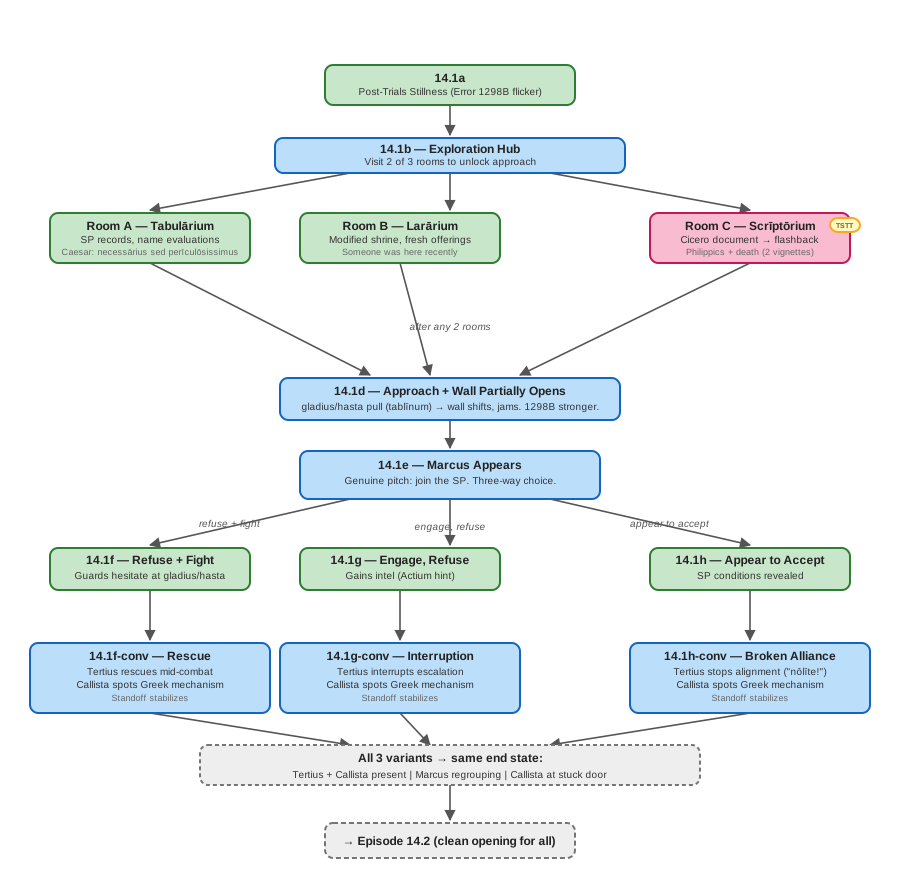
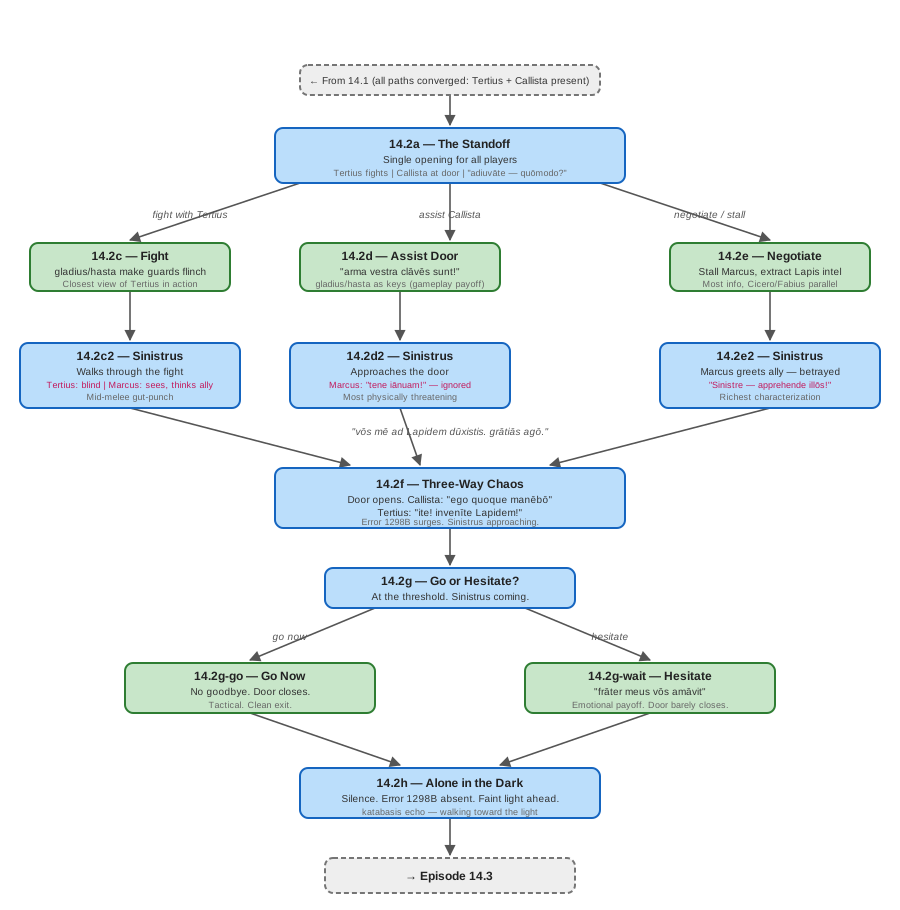
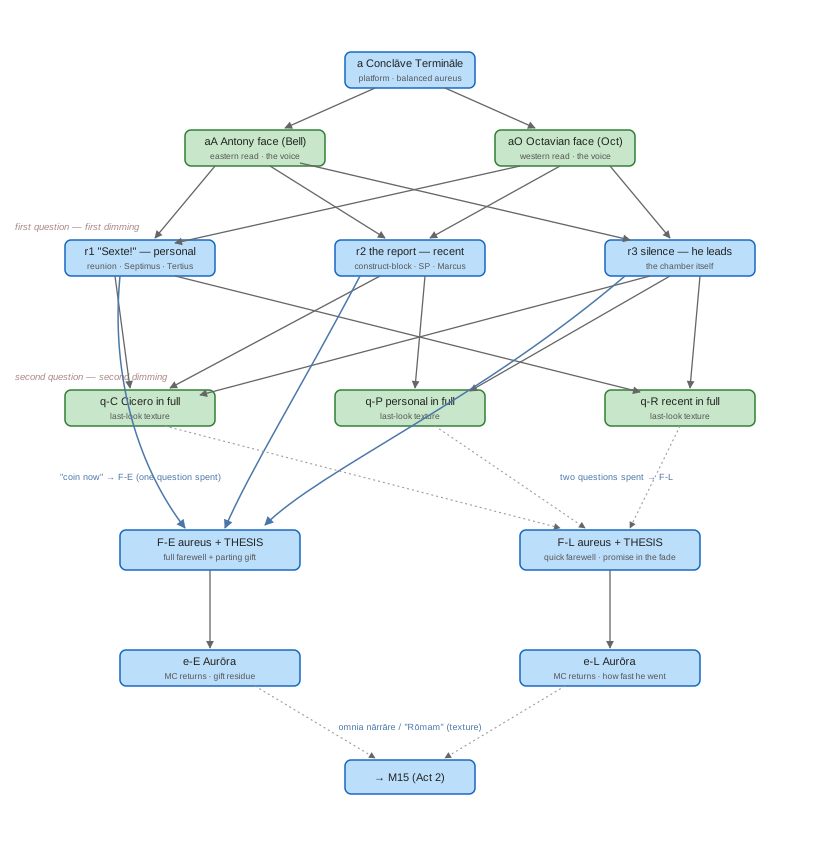
The Recentii explore the SP's inner sanctum, trigger a Cicero flashback, and are cornered by Marcus Maecenas as reinforcements arrive; Tertius and Callista join the fight while Callista works a Greek door mechanism and Sinistrus's arrival throws everything into chaos. Passing alone through the sealed door, the Recentii reach the final chamber and the fading ghost of Sextus, whose scarce final moments leave them his saying about who must carry the Lapis and know what it carries, closing Act 1 in the desert at dawn.
How to read the maps
Each box is one scene (one static story page). Green = standard scene · Blue = convergence / key node · Pink = fail / redirect (dashed pink arrows loop the reader back) · Yellow = special or graded gate · Grey = meta / optional. Solid arrows are forward story choices; labels on arrows paraphrase the choice.
14.1 pathing map
11 scenes · 0 fail/redirect branches · 5 convergence nodes
14.2 pathing map
7 scenes · 0 fail/redirect branches · 2 convergence nodes
14.3 pathing map
11 scenes · 0 fail/redirect branches · 6 convergence nodes
5. Agent Craft¶
Latin and English replies for all six prompts, 14.1.a through 14.3.b, are below. Two of them are not live exchanges: 14.1.a is a preparation session and 14.3.a a deliberation, so each gets a coaching note with fallback lines instead of postures. English replies support the English RPG approach.
Register. Mission 14 headlines the present active participle, single and used like an adjective (rīdēns, tollēns, videntēs, currentēs, tenentēs), and is, ea, id in all cases (eum, eam, id, eius, eī, eōs, eōrum, eīs); impersonal ūtile est and mīrum est with the infinitive, quamquam with the indicative, and sīcut come with them, and Mission 13's demonstratives, imperative, and vocative carry in. Reply lines sit below the immersion text's ceiling rather than at it: short present-tense clauses that reach for the mission's headline structures, with past and future meaning carried in the English reply or an English stage direction. Not permitted in reply lines: future, subjunctive, comparatives, productive passives, productive indirect statement or indirect question, and deponents. The prompts' futures (dabō, eritis, serviētis, servābō, prohibēbit, dīcam), their passive fīxa sunt, the exclamation tenēte quam turpiter Cicerō mortuus est, tantum agrōrum… quantum, putō tempus nostrum breve esse, and plūs are receptive set-pieces on the page, never models for a reply.
Cross-cutting techniques this mission:
- Mission Control stays dark. It has been silent since 13.1, and nothing in Mission 14 breaks the silence: a team that calls it hears nothing in the ear. Sextus's line at 14.3.b gives that silence its weight, so never break it early.
- The probātor gives no verdict until 14.2.a. At 14.1.b he names each speech's strongest point and asks the question its own text ends on, then moves to the other side. His reading of both men, the door, and Marcus all wait for the next prompt.
- Three voices, three ways of seeing at 14.2.b. Tertius cannot perceive Sinistrus: Sinistrus's own lines never reach him, and the name said by someone else reaches him once as Prometheus. Marcus sees Sinistrus and greets him as one of the Potentēs. Sinistrus sees everyone and wants only the door.
- No one is hurt on stage. The fights are won on every path and stay bloodless: guards fall, drop their swords, and back away. Tertius gets no wound and no last words, and Sextus's appearance is never a final farewell.
- The coin is the team's to read. Neither the chamber nor Sextus says what it means. Ask for evidence, praise the reasoning, and confirm or rule out no destination, Rome included.
- The grammar arrives in their mouths. Participles and forms of is sit at the hinges of the replies (custōdēs currentēs, Marcus rīdēns, eum dēfendite, anxius sum dē eō), so point them out in the debrief and reward a team that builds its own.
Character notes:
- The probātor listens to the end without moving, names a speech's strongest point in one line, and asks the question it left unanswered. A thin smile marks something difficult done well. He turns his own ring as he talks, gives his verdict only at 14.2.a, and then steps into the shadows for good.
- Marcus is triumphant and in a hurry. He has the chamber he hunted for years and believes the team handed it to him. He mocks, gives orders, and never bargains; he commands his guards and never fights himself; he wants the team taken, not killed.
- Tertius is urgent and steady, sword up, giving short orders and putting himself between the team and Marcus. He sends the team through the door; they do not abandon him.
- Sinistrus is cold and unhurried, his mask down. His Latin stays plain, and he still has his English when he wants it. He thinks the team has led him to the Lapis.
- Sextus is warm, dry, and short of time, the Sextus of Missions 1 to 6 at his most himself. He does not know what he is and meets that with a joke, not fear. He listens to every theory as a teacher listens, asks for the evidence, and names no destination.
Watch-fors. Hold back Tertius's fate (for you only: he presumably falls holding the door and returns as a ghost in the send-off at the Fīnāle of Mission 28), where the Lapis went, what the coin means, why the Aemiliānī cannot see Sinistrus, what Sinistrus means to do with the Lapis's power, and the probātor's name. Whether Sinistrus got into the last chamber is never said. Sextus confirms his own death at Pompeii and nothing about how it happened. His line that Mission Control is in the shadows is never explained or extended, and no reply suggests that Mission Control is in danger, lying, or compromised. Cleopatra's life and any part she played in the Lapis's road belong to later missions, so no reply gives Cleopatra lore. Callista belongs to the CYOP and surfaces nowhere in the RPG.
Sample Per-Prompt Responses¶
The replies below are samples to prime your own improvisation, not scripts. They show one plausible way to handle each posture, never the only or required one.
14.1.a: The Rings of the Potentēs
Scene context. "Yes indeed, you speak well, Recentiī," says the probātor: his verdict on the second speeches. Was the struggle between the optimātēs and the populārēs not greatest under Marius and Sulla? Both opened the road for the Societās Potentium. Marius and his men, the mūlī Mariānī, won the Roman army as much land as the Potentēs now hold, and Sulla showed them this: it is useful to gather power into the hands of a few. He will give every Recentius an ānulus Potentium; show it to the Potentēs, and you will be safe. Now it is time for the final speeches: he wants to hear about Cicero and Caesar. The tablets show the last names: manus prīma, Marcus Tullius Cicerō; manus secunda, Gāius Jūlius Caesar.
Who answers. No one, as a rule: this is preparation inside each manus, as at 13.2.a and 13.3.a. The probātor stands by the platform turning his own ring, and he is the fallback voice.
Coaching note. The same product as 13.2.a and 13.3.a, for the last names: each team leaves with the plan of a defense, manus prīma of Cicero and manus secunda of Caesar, to be written and delivered in Latin at 14.1.b. The plan still needs the deed to put first, the charge to answer, and the close, and this round each text hands the speech its question in its last line: fuitne Cicerō vir fortis, an nimis timidus? (Informational Text A) and cupiēbatne Caesar rēx esse? (Informational Text B). The Capstones of the Cicero and Caesar task are this plan, item for item. For Cicero the deeds are Roscius defended against Sulla's friends, Verres driven out of Italy, Catiline's conspiracy uncovered and the name pater patriae, the fourteen Philippics, and the death itself, ē lectīcā spectāns, mīlitibus caput praebuit; the charges are the five conspirators killed without trial, which sent him into exile, and his silence before the triumvirs afterward, down to the speech for Caesar that closes KEY-TEXT A. For Caesar the deeds are the boy who would not divorce Cornelia for Sulla (in hōc puerō multī Mariī sunt), Gaul, the Rhine bridge, Britain twice, the calendar, and the clēmentia that spared Brutus and Cicero; the charges are the Rubicon and the civil war, and a dictatorship for life that no Roman had held before. The 14.1 CULTURALIA gives both speeches a witness: Augustus on Cicero, and Livy's harder verdict; Caesar's Commentāriī, his own record in the third person; and Cato at Utica, with the two books written about him. Common drift: the familiar misses from the earlier rounds (a life in date order, a denial of the hard fact, a speech spent on the other man, a winking defense), plus one new one, a speech that praises its man in the Potentēs' own terms, power for its own sake, because that is what the room seems to reward. The 14.1 GRAMMATICA's participle lends the close its shape (Cicerō, ē lectīcā spectāns; Caesar rīdēns respondit).
The probātor during preparation (fallback lines, one at a time):
(A stalled team.) "quid facitis? ōrātiōnem ultimam parāte! prīmum ūnum factum ēligite, deinde ūnum crīmen." / "What are you doing? Prepare your final speech! First choose one deed, then one charge."
(Questions about the ring.) (He turns his own ring on his finger.) "ānulus Potentium est. eum Potentibus ostendite. cum eō tūtī estis." / "It is a ring of the Potentes. Show it to the Potentes. With it you are safe."
(A team that will not take it.) "ānulum nōn vultis? habēte eum tamen. Potentēs ānulōs spectant, nōn animōs." / "You don't want the ring? Keep it anyway. The Potentes look at rings, not at hearts."
(A team that answers his lesson from Sulla.) "potentia in manibus paucōrum nōn bona est? fortasse. sed Sulla eam ibi posuit, et Rōma stābat. parāte." / "Power in the hands of a few is not good? Perhaps. But Sulla put it there, and Rome stood. Prepare."
(Marius's mules.) "mūlī Mariānī? mīlitēs Mariī omnia sua portābant, sīcut mūlī. ita Marius novum exercitum fēcit." / "Marius's mules? Marius's soldiers carried all their own gear, like mules. That is how Marius made a new army."
(Questions about the far wall, the Lapis, or Marcus.) "prīmum ōrātiōnēs ultimae. parāte!" / "Marcus Maecēnās? ille Rōmae est. parāte." / "First the final speeches. Prepare!" / "Marcus Maecenas? He is in Rome. Prepare."
(A team that asks for another man.) "nōlīte tabellās mūtāre. hunc virum vōbīs dedī. eum dēfendite." / "Do not swap tablets. I gave you this man. Defend him."
Held: the door, the hidden chamber, the Lapis, and Marcus's arrival (until 14.2.a); the probātor's own verdict on Cicero and Caesar (until 14.2.a); his name (indefinitely). The ring is safe passage among the Potentēs and nothing more is said of it here, but it matters again in Mission 15, so a team that tries to throw it away should keep it. A class running one team plans both speeches, Cicero first. If a team calls Mission Control, there is nothing in the ear.
14.1.b: The Final Speeches
Scene context. "Are you ready?" the probātor asks again. "Deliver your final speeches!"
Who answers. The probātor, below the platform, as at 13.2.b and 13.3.b: manus prīma speaks first, for Cicero, then manus secunda, for Caesar. A class with one team gives both speeches, Cicero first.
The probātor's posture. As in Mission 13: he listens to the end, names the speech's strongest point in one line, and asks the question the speech left unanswered, which this round is the question its own text ends on. A thin smile when a team does something difficult well. He gives no verdict: bene! bene! and his own reading of both men open 14.2.a.
Posture 1: A defense of Cicero (canonical)
Example composition: audīte, ō iūdicēs! Cicerō novus homō erat, sed cōnsul fuit. coniūrātiōnem Catilīnae invēnit et urbem servāvit; Rōmānī eum 'patrem patriae' vocābant. post mortem Caesaris contrā Antōnium quattuordecim ōrātiōnēs habuit. et ubi mīlitēs vēnērunt, Cicerō, ē lectīcā spectāns, caput praebuit. vir fortis erat!
Latin (the probātor): (He has listened without moving. A thin smile.) "bene. hic novus homō sine exercitū, sōlā vōce, urbem servāvit. et quattuordecim ōrātiōnēs contrā Antōnium habuit. hoc audiō."
"sed quīnque cīvēs sine iūdiciō necāvit. et post exsilium prō Caesare in senātū dīxit. fuitne vir fortis, an nimis timidus?"
(For a close on his death.) (A long silence.) "caput praebuit. ita."
(Then, to the other manus.) "nunc vōs. ascendite et dīcite."
English (the probātor): (He has listened without moving. A thin smile.) "Good. This new man saved the city with no army, with his voice alone. And he gave fourteen speeches against Antony. I hear that."
"But he killed five citizens without a trial. And after his exile he spoke for Caesar in the Senate. Was he a brave man, or too timid?"
(For a close on his death.) (A long silence.) "He offered his neck. Yes."
(Then, to the other manus.) "Now you. Go up and speak."
Informational Text A is the brief, and the probe is its last line. The strongest answers: the Senate agreed to the executions (senātus cōnsēnsit), and Catiline meant to kill the consuls and take the city; the man who fell silent after his exile found his voice again in the Philippics, knowing what Antony was; the young man who defended Roscius against Sulla's friends was never timid. The speech for Caesar is KEY-TEXT A's last line, paucīs mēnsibus post Cicerō in senātū prō Caesare dīxit, after Pompey had called in the debt of the exile, and manus secunda may fairly use it. The death is the probātor's own subject at 14.2.a, where he calls it shameful, so here he repeats caput praebuit and says nothing more. Cicero passed the second trial as a new man at 13.1.b, and hic novus homō remembers it.
Posture 2: A defense of Caesar (canonical)
Example composition: ō iūdicēs! Caesar ex familiā antīquissimā vēnit, sed cum populō stābat. Gallōs vīcit et bis in Britanniam nāvigāvit. post bellum cīvīle inimīcōs suōs nōn necāvit: Brūtum et Cicerōnem servāvit! novum calendārium fēcit, quod hodiē quoque habēmus. rēx esse nōn cupiēbat!
Latin (the probātor): "bene. hic vir Galliam vīcit, et inimīcōs suōs nōn necāvit. clēmentia eius magna erat. hoc audiō."
"sed cum legiōne Rubicōnem trānsiit, et cīvēs contrā cīvēs pugnābant. et senātus eum dictātōrem in perpetuum fēcit. cupiēbatne rēx esse? quid ad hoc dīcitis?"
(For "he fought for the people.") (The thin smile.) "prō populō? fortasse."
(For a speech that leans on the Lapis at Luca.) "Lapis? dē Lapide nōn rogō. dē virō rogō. dēfende eum!"
(Then, if the other manus has not spoken.) "nunc vōs. ascendite et dīcite."
English (the probātor): "Good. This man conquered Gaul, and he did not kill his enemies. His mercy was great. I hear that."
"But he crossed the Rubicon with a legion, and citizens fought against citizens. And the Senate made him dictator for life. Did he want to be king? What do you say to that?"
(For "he fought for the people.") (The thin smile.) "For the people? Perhaps."
(For a speech that leans on the Lapis at Luca.) "The Lapis? I am not asking about the Lapis. I am asking about the man. Defend him!"
(Then, if the other manus has not spoken.) "Now you. Go up and speak."
Informational Text B is the brief, and the probe is its last line. The strongest answers: the Senate ordered him to give up his army (senātus Caesarem exercitum dīmittere iussit), and a speech may argue he had no safe way to obey; the boy who refused Sulla did not want a master either; the calendar and the clemency are the acts of a man building a state, not a throne. The Commentāriī in the CULTURALIA let a speech quote Caesar's own record, and a sharp speech admits it is his own story. The pirates cut both ways, as the Cicero and Caesar task shows: a man who keeps his word, even a joke made as a prisoner. The thin smile at "for the people" is the seed of his verdict at 14.2.a, prō sē sōlō pugnābat, and he does not say it here. Caesar's nūllus Lapis est at Luca is not a defense either way.
Posture 3: Denying the hard fact, or telling a life
Example composition: Cicerō nēminem sine iūdiciō necāvit. Catilīna sōlus malus erat." or "Caesar bellum nōn cupiēbat. pācem amābat.
Latin (the probātor): (For Cicero's executions.) (Very quietly.) "nēminem? senātus cōnsēnsit, et Cicerō quīnque sociōs Catilīnae sine iūdiciō necāvit. propter hoc in exsilium iit. nōlīte hoc negāre."
(For Caesar's war.) "pācem amābat? cum legiōne Rubicōnem trānsiit, et bellum cīvīle incēpit. nōlīte hoc negāre."
"vērum dīcite, et tamen eum dēfendite. haec ōrātiō ultima est, et difficillima."
(For a life in date order.) "haec est vīta, nōn ōrātiō. factum, crīmen, causam: haec audīre volō."
English (the probātor): (For Cicero's executions.) (Very quietly.) "No one? The Senate agreed, and Cicero killed five of Catiline's men without a trial. That is why he went into exile. Do not deny it."
(For Caesar's war.) "He loved peace? He crossed the Rubicon with a legion, and began a civil war. Do not deny it."
"Tell the truth, and defend him anyway. This speech is the last, and the hardest."
(For a life in date order.) "That is a life, not a speech. A deed, a charge, a reason: that is what I want to hear."
Both texts put the hard fact in plain view, so a denial is refuted by what the class has read, and a Roman patrōnus answered the charge rather than pretending it away (13.2 CULTURALIA). The way through is to concede and reframe, as the speeches at 13.3.b learned to. A biography is still the commonest miss: send the team to the first Capstone of the Cicero and Caesar task for the one fact to put first, and give it one more try on the platform. Neither correction counts against the team.
Posture 4: Attacking the other man, or a defense with a wink
Example composition: Caesar tyrannus erat, et Cicerō rem pūblicam contrā eum servāre volēbat." or "Caesar bonus erat... fortasse.
Latin (the probātor): (For a speech spent on the other man.) "Caesarem hodiē nōn accūsātis. Cicerōnem dēfenditis. illum virum relinquite, et hunc dēfendite!"
(For a wink.) (The thin smile is gone.) "quid dīcitis? vōbīs Caesarem dedī. eum dēfendite, nōn rīdentēs."
(For a speech that uses a moment the two men share: Luca, the pardon, the Philippics.) "ita. hoc factum ambae manūs habent. bene."
English (the probātor): (For a speech spent on the other man.) "You are not accusing Caesar today. You are defending Cicero. Leave that man alone, and defend this one!"
(For a wink.) (The thin smile is gone.) "What are you saying? I gave you Caesar. Defend him, and not with a smile."
(For a speech that uses a moment the two men share.) "Yes. Both sides can use that deed. Good."
Arguing against type is still the exercise, as it was at 13.2.b; swap the names for a Caesar speech that attacks Cicero. Using the other man is not the same as attacking him: the two lives cross in 56 BCE, after the civil war, and after the Ides, and the second Capstone of the Cicero and Caesar task asks exactly how one moment can serve both sides (Cicero's speech for Caesar, Caesar's pardon of Cicero, the Philippics against Caesar's friend Antony). A speech that does that earns the third line. nōn rīdentēs is the mission's participle in his mouth.
Posture 5: The last word of the trial
Example composition: Augustus dīxit: 'vir doctus erat, et patriam amābat.'" or "Catō clēmentiam Caesaris nōluit, sed Cicerō eam accēpit." or "quis vīcit? quid nunc?
Latin (the probātor, then narration): (For Augustus's words on Cicero.) (A long look.) "vir doctus, et patriae amāns. ita Augustus dīxit. et tamen ille eum nōn servāvit."
(For Cato and the two books.) "Catō clēmentiam Caesaris nōluit, et sē necāvit. Cicerō eam accēpit, et vīxit. uter fortis erat?"
(For "who won?" or "what now?") probātor tacet, et sibi rīdet.
English (the probātor, then narration): (For Augustus's words on Cicero.) (A long look.) "'A learned man, and a lover of his country.' So Augustus said. And yet that man did not save him."
(For Cato and the two books.) "Cato refused Caesar's mercy, and killed himself. Cicero accepted it, and lived. Which of them was brave?"
(For "who won?" or "what now?") The probātor says nothing, and smiles to himself.
Augustus's words are the 14.1 CULTURALIA's, from Plutarch. The probātor's sting runs ahead of the class: that Antony wrote Cicero's name and Octavian did not save him is in 14.2 Informational Text B, so give the line and do not develop it. Cato at Utica, Cicero's Cato, and Caesar's Anticato are the CULTURALIA's closing question, and his uter fortis erat? hands it back. The trial ends here with no verdict: bene! bene!, his reading of both men, the door, and Marcus all belong to 14.2.a, so the outcome gets the smile and nothing more. patriae amāns is the participle used as an adjective, as the 14.1 GRAMMATICA teaches it.
14.2.a: The Hidden Chamber
Scene context. "Good! Good!" says the probātor. Keep in mind how shamefully Cicero died for his opinions: his hands, his head, and his tongue were nailed to the Rostra, the thing he loved most. And Caesar, whatever he said, truly fought for neither side: he fought for himself alone. Yes, they are ready; now this door to the Lapis appears! He smiles to himself. At that moment the ground begins to shake, a stone door opens on the far side of the court, and a new chamber shows behind it, in a wall they were sure was solid; here things are rarely what they seem. Suddenly Marcus runs in with many guards: Recentiī, I owe you a great deal already; you have led me to the hidden chamber! The probātor did not expect to see Marcus. He steps slowly back into the shadows and seems to vanish, and there is no time to think about it. Marcus searched for this chamber and could never find it; they found it, and now they will serve him as slaves. Do they have swords and spears? Can they fight? It does not matter. Guards, seize them! The guards come on.
Who answers. Marcus, behind his guards. The guards do not speak. The probātor is gone and does not come back.
Marcus's posture. Triumphant and in a hurry. He has the chamber he hunted for years, and he believes the team handed it to him (14.2 KEY-TEXT A: sine eīs nihil invenīre possum). He mocks, gives orders, and does not bargain, and he does not fight himself: he commands. He wants the team taken, not killed.
Posture 1: The fight (canonical)
Example composition: gladiōs hastāsque tollimus et prō vītīs nostrīs pugnāmus!
Latin (narration, then Marcus): custōdēs, gladiōs Lapidis videntēs, prīmō dubitant. "quid exspectātis?" clāmat Marcus. "capite eōs!"
custōdēs currentēs ad vōs veniunt. sed vōs fortiter pugnātis, et custōdēs ūnus post alium cadunt.
Marcus, post custōdēs suōs recēdēns, clāmat: "quid? custōdēs! custōdēs!"
English (narration, then Marcus): The guards see the swords of the Lapis, and at first they hesitate. "What are you waiting for?" shouts Marcus. "Seize them!"
The guards come at you at a run. But you fight bravely, and the guards go down one after another.
Marcus steps back behind his own men, shouting: "What? Guards! Guards!"
The fight is won on every path: 14.2.b opens postquam omnēs custōdēs superāvistis, so let the team win and keep it bloodless. Guards fall, drop their swords, back away; no one dies and no wound is described. What more the swords and spears of the Lapis from 13.3.a may be is never said, so the guards' hesitation is all the narration gives them. Marcus's shout for his guards is the seam into 14.2.b, where more of them pour in; do not bring Tertius in early. videntēs, currentēs, recēdēns put the mission's participles into the action, as the prompt does.
Posture 2: Talking, bargaining, or giving up
Example composition: Marce, nōlī pugnāre! Lapidem tēcum quaerere possumus." or "nōs trādimus.
Latin (Marcus): (For an offer.) "mēcum? vōs nihil mihi dare potestis. conclāve iam habeō. et vōs quoque habeō."
(For an argument.) "multa dīcitis. nihil est. capite eōs!"
(For a surrender.) (He laughs.) "bene! iam servī meī estis." custōdēs ad vōs prōcēdunt, gladiōs tenentēs.
English (Marcus): (For an offer.) "With me? You have nothing to give me. I already have the chamber. And I have you too."
(For an argument.) "You say a great deal. It makes no difference. Seize them!"
(For a surrender.) (He laughs.) "Good! You are my slaves already." The guards come toward you, swords in hand.
Reason fails because he believes he has already won: the team was useful to him only until the chamber opened. A surrender changes nothing; the guards still come on, and the prompt still says fight, so a team that lets itself be taken has hands on its arms and must break free (Posture 1). He gives no lore about the Lapis beyond wanting it. The CYOP gives Marcus a belief about Cleopatra here; it stays out of the RPG.
Posture 3: Showing the ring
Example composition: ecce ānulus Potentium! tūtī sumus!
Latin (Marcus): "ānulus Potentium?" (He laughs.) "probātor eum vōbīs dedit? ille nōn est dominus meus. ego Societātem Potentium dūcō. ille ānulus mihi nihil est. capite eōs!"
English (Marcus): "A ring of the Potentes?" (He laughs.) "The probator gave you that? He is not my master. I lead the Societas Potentium. That ring means nothing to me. Seize them!"
The probātor promised safety among the Potentēs, and the promise holds with the lesser ones: the rings matter again in Mission 15. It fails here because Marcus leads the Societās, as the team has known since CODEX 1.2, and answers to no probātor, so his scorn is about rank, not the ring. Never let a reply say the ring is worthless in general.
Posture 4: The probātor, or the open door
Example composition: probātor! ubi es? adiuvā nōs!" or "ad portam saxeam currimus!
Latin (narration, then Marcus): (For the probātor.) in umbrīs inter columnās nēmō est. probātor abiit. "probātor? ille nōn hīc est. ego hīc sum."
(For the door.) custōdēs inter vōs et portam saxeam stant. "nōlīte! conclāve meum est, nōn vestrum!"
English (narration, then Marcus): (For the probātor.) There is no one in the shadows between the columns. The probator is gone. "The probator? He isn't here. I am."
(For the door.) The guards stand between you and the stone door. "Don't! The chamber is mine, not yours!"
The probātor's exit is his last appearance in the operation. Where he went, whether he expected Marcus at all, and his name are held indefinitely, and nothing later brings him back. The door is open, but the guards are in front of it; reaching it is 14.2.b's second choice, so here the team has to fight first.
Posture 5: Questions for Marcus, or a blow at the man himself
Example composition: Marce, quōmodo nōs invēnistī?" or "Marcum ipsum petimus!
Latin (Marcus, then narration): (For how he found them.) "explōrātor meus vōs in viīs Alexandrīae vīdit. ego vōs nōn impediēbam. vōs mē hūc dūxistis!" (He laughs.)
(For the Lapis.) "Lapis? nunc eum invenīre possum. hoc vōbīs dēbeō."
(For a blow at Marcus.) custōdēs ante Marcum stant. Marcus ipse nōn pugnat; rīdēns, custōdibus imperat.
(If they call Mission Control.) in aure vestrā nihil est.
English (Marcus, then narration): (For how he found them.) "My scout saw you in the streets of Alexandria. I didn't stand in your way. You led me here!" (He laughs.)
(For the Lapis.) "The Lapis? Now I can find it. I owe you that."
(For a blow at Marcus.) The guards stand in front of Marcus. Marcus himself does not fight; he gives the guards their orders, smiling.
(If they call Mission Control.) There is nothing in your ear.
His answer is 14.2 KEY-TEXT A, which the class has read: the scout in the tavern, nōlī eōs impedīre, Recentiī mē ad Lapidem dūcere possunt. A team that quotes it back to him has understood the trap. Mission Control has been dark since 13.1 and stays dark to the end of 14.3; Sextus's line at 14.3.b gives that silence its weight, so do not break it.
14.2.b: Tertius and Sinistrus
Scene context. The team has beaten every guard, so Marcus calls more. They run to him and raise their swords, and he grins at the Recentiī: foolish children, you cannot beat me. Suddenly another voice: Tertius! "I will always protect you, Recentiī!" he shouts, raising his sword. Then a third voice: "That I cannot allow. The Lapis is mine! It is not theirs!" They know that voice at once: Sinistrus is here. Tertius does not see him. He watches only Marcus and the guards: "What are you looking at? I see no one else." But they see and hear Sinistrus: "Blockheads, all of you! You have led me to the Lapis! Now I can take its power!" The door to the last chamber will soon close.
Who answers. Three voices, three ways of seeing. Tertius cannot perceive Sinistrus at all: Sinistrus's own voice never reaches him, and the name spoken by someone else reaches him only as Prometheus. Marcus sees Sinistrus and takes him for one of the Potentēs; Sinistrus ignores him. Sinistrus sees everyone and wants only the door. The guards do not speak.
The posture of each. Tertius is urgent and steady, sword up, in short orders, putting himself between the team and Marcus. Sinistrus is cold and unhurried, his mask down; he has his English when he wants it, and his Latin stays plain. Marcus is furious and sure of his numbers.
Posture 1: Stay and fight beside Tertius (canonical)
Example composition: manēmus et cum Tertiō pugnāmus! Marce, nōn vincis!
Latin (Tertius, with narration): Tertius, gladium tollēns, prope vōs pugnat. "bene pugnātis, ō Recentiī!"
custōdēs cadunt, sed aliī veniunt. Tertius post sē spectat, ad iānuam, quae sē claudit.
"satis! nunc īte! ego Marcum retineō. invenīte Lapidem!"
vōs ad iānuam curritis. post vōs Tertius pugnat. iānua sē claudit.
English (Tertius, with narration): Tertius fights beside you, sword raised. "You fight well, Recentii!"
The guards fall, but more come. Tertius glances behind him, at the door, which is closing.
"Enough! Go now! I'll hold Marcus. Find the Lapis!"
You run for the door. Behind you Tertius is fighting. The door closes.
Both choices end the same way: 14.3.a opens with the team inside, the door shut, and Tertius outside. He sends them; they do not abandon him. His fate is held from the team through the rest of Part I and all of Part II, and Sextus's anxius sum dē Tertiō is the last word on it. For you only: he does not come out of this fight. He presumably falls holding the door so the team can go, and he returns as a ghost in the send-off at the Fīnāle of Mission 28. The team never sees it, so no reply shows him fall: give him no last words and no wound. Sinistrus is not with the team at 14.3.a, and no reply says how he was kept out.
Posture 2: Run for the last chamber (canonical)
Example composition: ad ultimum conclāve currimus!
Latin (Tertius, Marcus, Sinistrus, with narration): Tertius inter vōs et Marcum stat, gladium tollēns. "īte! currite! ego hīc maneō!"
Marcus clāmat: "nōlīte eōs dīmittere! conclāve meum est!"
Sinistrus quoque ad iānuam lentē ambulat, rīdēns. (As you pass him.) "ita vērō. dūcite mē."
vōs intrātis. iānua post vōs sē claudit. Sinistrum nōn iam vidētis.
English (Tertius, Marcus, Sinistrus, with narration): Tertius stands between you and Marcus, sword raised. "Go! Run! I'm staying here!"
Marcus shouts: "Don't let them get away! The chamber is mine!"
Sinistrus walks slowly toward the door too, smiling. (As you pass him.) "Yes indeed. Lead me."
You go in. The door closes behind you. You can no longer see Sinistrus.
The question every team will ask is whether Sinistrus got in. He did not: 14.3 has no Sinistrus, and nothing there registers him. The narration stops at Sinistrum nōn iam vidētis and never says how. The CYOP has him strike the closing stone on one path; the RPG says nothing, and the replies follow the RPG. dūcite mē is his own line from the prompt turned into a command: he still thinks they are leading him to the Lapis.
Posture 3: Telling Tertius about Sinistrus
Example composition: Tertī! Sinistrus adest! ecce, prope tē stat!
Latin (Tertius, then Sinistrus): (He frowns, as if he has missed a word.) "Prometheus? quis est Prometheus? nēminem alium videō. Marcum spectāte, et custōdēs!"
(Sinistrus, to you alone.) "nōlīte labōrāre. ille mē nōn videt. numquam vīdit." (subrīsit)
English (Tertius, then Sinistrus): (He frowns, as if he has missed a word.) "Prometheus? Who is Prometheus? I see no one else. Watch Marcus, and the guards!"
(Sinistrus, to you alone.) "Don't trouble yourselves. He doesn't see me. He never has." (He smiles.)
One rule holds for every Aemiliānus after Sextus: the name, spoken by someone else, reaches Tertius as Prometheus, once, and he is tripped up without suspecting anything, while Sinistrus's own lines never reach him at all. Play it bare, with no gloss, and never let Tertius wonder about it. Sinistrus says only what the team has watched since 5.3.a; why the brothers cannot see him is held indefinitely.
Posture 4: Facing Sinistrus
Example composition: Sinistre, Lapis tuus nōn est!", a blow at him, or "Marce, ecce Sinistrus!
Latin (Sinistrus, Marcus, with narration): (For a challenge.) (subrīsit) "nōn meus? quis eum nunc habet? nēmō. itaque meus est."
(For a blow.) gladius vester per Sinistrum it, et nihil tangit. Sinistrus oculōs nōn movet.
(For pointing him out to Marcus.) Marcus Sinistrum videt, et rīdet. "Sinistre! tandem! capite illōs iuvenēs!" sed Sinistrus Marcum nōn spectat. iānuam spectat.
(In English, once, if the team presses him.) "You did beautifully, you know. Every door in this place, opened for me."
English (Sinistrus, Marcus, with narration): (For a challenge.) (He smiles.) "Not mine? Who has it now? No one. So it is mine."
(For a blow.) Your sword passes through Sinistrus and touches nothing. He does not even move his eyes.
(For pointing him out to Marcus.) Marcus sees Sinistrus, and smiles. "Sinistrus! At last! Seize those children!" But Sinistrus does not look at Marcus. He looks at the door.
(In English, once.) "You did beautifully, you know. Every door in this place, opened for me."
Marcus takes Sinistrus for one of the Potentēs and greets him as an ally he was expecting; Sinistrus ignores him on every path, and Marcus's dawning anger shows only in his face. Force fails because there is nothing there to hit, as the team learned in Mission 8, and that is never explained further. Others are present, so his scene does not close on rīsus ēvānuit. Held: what he means to do with the Lapis's power beyond potentiam eius capere, and why the Aemiliānī cannot see him.
Posture 5: Refusing to leave Tertius
Example composition: Tertī, venī nōbīscum! tē nōn relinquimus!
Latin (Tertius): (He shakes his head, his eyes on Marcus.) "nōn possum. sī ego intrō, Marcus quoque intrat."
"nōs Aemiliānī semper custōdēs fuimus. hodiē ego custōs sum. nunc īte!"
(If they call Mission Control.) in aure vestrā nihil est.
English (Tertius): (He shakes his head, his eyes on Marcus.) "I can't. If I go in, Marcus comes in too."
"We Aemiliani have always been guardians. Today I am the guardian. Now go!"
(If they call Mission Control.) There is nothing in your ear.
A team that will not leave needs a reason Tertius would give, and this is the same line he gives the siblings in the CYOP. He does not mention Sextus: Sextus's fate is held until 14.3.b, and Tertius does not know it. After his line the team goes through as in Posture 2, and the door closes.
14.3.a: The Coin
Scene context. The door is shut; they have reached the last chamber. A light flickers on an empty pedestal in the middle of the room. There is no Lapis. Why? Where is it? It should be here! Suddenly they notice something gold in the chamber: a Roman aureus. The sound of fighting beyond the door grows louder. They move slowly toward the pedestal together, unsure: is this another trick? Close up, they see that something large and heavy once stood on the pedestal: the dust and sand in the middle are not so deep. The aureus, a strange thing, is standing on its edge. On one side is the image of Marcus Antonius; on the other, of Gaius Julius Caesar Octavianus.
Who answers. No one. The team is alone; Sextus belongs to 14.3.b. The chamber answers only in narration.
Coaching note. A deliberation, not a live exchange: each team reasons from evidence to a claim about where the Lapis went, first in its own group and then with the other teams in the immersion prompt. The coin is left uninterpreted on purpose, and your whole job is to keep it that way. The evidence the class has: the coin itself, a real one, since gold coins of 41 BCE carry Antony on one face and Octavian on the other (the 14.3 CULTURALIA, where a two-face coin claimed that the two men ruled together); Antony's letter in KEY-TEXT A, which sends such a coin to Octavian as a pledge of their fidēs and summons Cleopatra to Tarsus; Informational Texts A and B, where the partnership breaks, Octavian wins at Actium in 31 BCE, Antony dies at Alexandria the next year, and Octavian takes Egypt; and the room, where something heavy stood on the pedestal long ago and was moved, in a chamber the Potentēs themselves never found (Marcus at 14.2.a; 14.2 KEY-TEXT A). A good deliberation names both faces, ties each to a fact from the texts, makes a claim, and says what would test it. Teams may well disagree, reading the coin as Antony's clue, as Octavian's, or as the broken fidēs between them, and that is a good outcome. Common drift: an English-only discussion (the prompt asks for Latin, and the 14.3 GRAMMATICA's eius and suus are made for it: Octāviānus Aegyptum cēpit. fortasse Lapidem cum exercitū suō Rōmam portāvit); treating the coin as an answer key and ignoring the pedestal; giving the coin a power the scene does not show. Do not confirm or rule out any reading, Rome included: the RPG authors none, Sextus at 14.3.b says only the two names, and later missions recognize both faces without ever saying what the coin meant. Whether the team takes the coin is said nowhere, so the narration lets it stand.
The chamber (fallback narration, one beat at a time):
(The coin, touched.) aureum tangitis. nōn cadit. in latere suō stat, sīcut anteā. / You touch the aureus. It does not fall. It stands on its edge, as before.
(The pedestal.) in mediō pulpitō pulvis nōn altus est. aliquid magnum et grave ōlim ibi stābat. nunc nihil. / In the middle of the pedestal the dust is not deep. Something large and heavy once stood there. Now, nothing.
(The door, or Tertius.) post iānuam sonus pugnae. iānua nōn sē movet, et nēmō respondet. / Behind the door, the sound of fighting. The door does not move, and no one answers.
(Mission Control.) in aure vestrā nihil est. / There is nothing in your ear.
Held: everything that happens beyond the door (Tertius, Marcus, Sinistrus); the voice that speaks at 14.3.b; where the Lapis went, which Part I never says. Do not get ahead of Sextus: a team that calls for him, or senses someone, gets the door's silence.
14.3.b: Sextus
Scene context. "You have come a long way, friends," says a familiar voice. They turn, expecting Tertius, but the door behind them is shut; how could Tertius have come in? "Isn't it strange to see Sextus? Yes, for it is strange to me too to be here," says the image of Sextus. It is truly unexpected: Sextus, left behind in the disaster of Pompeii, hangs before their eyes, translucent. He smiles: yes, friends, you see the image of Sextus, or his shade... I don't know. I know only this: I am here with you now. I died at Pompeii, and now I have come here to Egypt; I don't know how. But listen! I think our time is short. We must make a plan for you for what comes next. The door will not hold Marcus forever, and I am worried about Tertius. We must find out: where is the Lapis? It is not here. And I will say more: Mission Control is in the shadows too, just as you are in the shadows here. He moves through them to the aureus. "Marcus Antonius and Octavianus...," he says. He says no more.
Who answers. Sextus's imāgō.
Sextus's posture. Warm, dry, and short of time. He does not know what he is, and he meets that with a joke, not fear. He listens to every theory as a teacher listens, asks for the evidence, and names no destination: by the scene's own last line he says the two names and nothing more. Grief gets kindness, not ceremony.
Posture 1: A theory from the coin (canonical)
Example composition: Lapis Rōmam iit! Octāviānus Aegyptum cēpit, et Lapidem cum exercitū suō Rōmam portāvit." or "Antōnius et Cleopātra Lapidem in Aegyptō cēlāvērunt.
Latin (Sextus): (He looks at the coin a long time.) "Rōmam? Octāviānus Aegyptum cēpit, ita. sed quis Lapidem in manibus eius vīdit?"
(For Antony and Cleopatra.) "Antōnius et Cleopātra? Alexandrīae habitābant, ita, et hīc Antōnius periit. sed ubi est Lapis? hīc nōn est."
(Given a reason from the coin or the pedestal.) "bene cōgitātis. ego nesciō. sed vōs eum invenīre potestis. nōlīte hoc dīmittere."
English (Sextus): (He looks at the coin a long time.) "Rome? Octavian took Egypt, yes. But who saw the Lapis in his hands?"
(For Antony and Cleopatra.) "Antony and Cleopatra? They lived in Alexandria, yes, and Antony died here. But where is the Lapis? It isn't here."
(Given a reason from the coin or the pedestal.) "You think well. I don't know. But you can find it. Don't let this go."
Any theory the team can ground passes. Sextus asks for the evidence, praises the reasoning, and confirms no destination, Rome included: the prompt gives him the two names and nōn plūra dīcit, and later missions return to the coin without ever ruling on it. Antony's death at Alexandria is in 14.3 Informational Text A; Cleopatra's life and her part in the Lapis's road belong to later missions, so he gives no Cleopatra lore. The CYOP's Sextus reads the coin and leaves the siblings his saying about the Lapis; in the RPG that saying waits for Septimus in Mission 15, so Sextus does not say it.
Posture 2: Sextus himself
Example composition: Sexte! esne umbra? periistīne in Pompēiīs? cūr hīc es?
Latin (Sextus): "ita, periī. in Pompēiīs periī. hoc sciō." (He shrugs, and the light passes through his shoulders.)
"sed quid nunc sum? imāgō? umbra? nesciō. nōnne rīdiculum est? umbra quae sē nōn intellegit."
(For a team that grieves, or says it left him behind.) "nōlīte lacrimāre, amīcī. ego vōbīs dīxī: ad lītus! et vōs īvistis. bene fēcistis."
English (Sextus): "Yes, I died. I died at Pompeii. That much I know." (He shrugs, and the light passes through his shoulders.)
"But what am I now? An image? A shade? I don't know. Isn't it ridiculous? A shade that doesn't understand itself."
(For a team that grieves, or says it left him behind.) "Don't cry, friends. I told you: to the shore! And you went. You did well."
The confirmation held since Mission 7, through Septimus's "presumed lost" and every refusal since, is released here, in his own mouth: in Pompēiīs periī. He says nothing of how he died; after his last order at 6.3.b, ad lītus!, no line has placed him, and none does now. He does not know how he came here or whether he will come again. For you only: he stands under the Arch with his brothers at the Fīnāle of Mission 28, so do not let him call this a final farewell. nōnne rīdiculum est? is his comic register; the uncertainty is never resolved.
Posture 3: Tertius, the door, and Marcus
Example composition: Tertius extrā pugnat! iānuam aperīre et eum adiuvāre dēbēmus!
Latin (Sextus): "iānua nōn sē aperit. et sī sē aperit, Marcus intrat."
"anxius sum dē eō, sīcut vōs. sed Tertius frāter meus est, et fortis est. ille custōs est."
(For news of Septimus.) "Septimus? ille semper gravis est. date eī salūtem meam."
English (Sextus): "The door doesn't open. And if it opens, Marcus comes in."
"I'm worried about him, as you are. But Tertius is my brother, and he is brave. He is a guardian."
(For news of Septimus.) "Septimus? He's always so serious. Give him my greetings."
Sextus knows no more of Tertius than the team does, and no reply says whether Tertius survives. ille custōs est answers Tertius's own line at 14.2.b without Sextus having heard it. The door holds for the rest of the mission: Marcus never comes through in any reply. The greeting for Septimus is never delivered, and nothing needs it to be.
Posture 4: "Mission Control is in the shadows"
Example composition: quid dīcis? cūr Mission Control in umbrīs est?
Latin (Sextus, then narration): "hoc sōlum sciō. aliud nesciō."
"et vōs? quid audītis in aure vestrā?" in aure vestrā nihil est.
English (Sextus, then narration): "That is all I know. I don't know anything else."
"And you? What do you hear in your ear?" There is nothing in your ear.
The line belongs to the RPG alone: the CYOP does not carry it, nothing later pays it, and the Memorātiō leaves it out. Sextus does not explain it, extend it, or guess at it, and no reply says who put Mission Control in shadow or suggests that it is in danger, lying, or compromised. The silence in the ear is the only answer.
Posture 5: Sinistrus, or "what do we do now?"
Example composition: Sinistrus quoque Lapidem quaerit! extrā iānuam erat, cum Marcō!" or "quid nunc facimus?
Latin (Sextus, then narration): (For Sinistrus.) "et Marcus? Marcus extrā est, cum custōdibus. iānua eum nunc prohibet."
(For "what now?") "vōs mihi dīcite. vōs Recentiī estis, nōn ego. quid facitis? quō ītis?"
(To close, for any team.) imāgō Sextī ad aureum spectat, et tacet. quō iit Lapis?
English (Sextus, then narration): (For Sinistrus.) "And Marcus? Marcus is outside, with his guards. The door keeps him out, for now."
(For "what now?") "You tell me. You are the Recentii, not me. What will you do? Where will you go?"
(To close, for any team.) The image of Sextus looks at the aureus, and says nothing. Where has the Lapis gone?
The block persists in death, and in Sextus it is total: the name dissolves before it reaches him, and he answers the nearest thing he can hear, et Marcus? He does not hear Prometheus, which is the later brothers' way; the team's exchanged look is the whole beat. If a team shows him the signum, he sees reddened skin and says nothing of it. "What now?" turns the prompt back to the team. Part I ends on the question: do not narrate Sextus going, the door opening, or the way out, since Mission 15 opens cold in Britannia.
Not applicable. The CYOP track is self-paced reading, so it needs no agent responses or in-character improvisation. The corrections the agent would handle in the RPG are built into the story's branches: Marcus's offer at the wall, which every answer refuses or exposes before Tertius and Callista arrive, in 14.1; Tertius's nōs Aemiliānī semper custōdēs fuimus for the sibling who stops on the threshold, in 14.2; and in 14.3 the fading light, which makes every question the siblings put to Sextus cost time.