Mission 10. Salvius's Library, Salvia, and the SP Induction¶
1. Episode Overview¶
Essential Question
What happens when cultures meet?
ACTFL Proficiency Benchmarks — Intermediate Low
- Interpretive: I can understand the main idea and some related pieces of information on familiar topics from sentences and series of connected sentences in texts that are spoken, written, or signed.
- Presentational: I can provide information and express my thoughts about familiar topics, creating sentences and series of connected sentences through spoken, written, or signed language.
- Cultural Investigation: I can compare products and practices to understand perspectives from a variety of cultures and communities, including my own.
Cultural & Historical Learning Targets — student-facing
- Describe the significance of Horace's Odes and Vergil's Aeneid to Roman identity: Maecenas as the patron of both poets, the first ode opening on his name, and the shield of Aeneas with the Battle of Actium at its center.
- Compare the Aeneid with Homer's Odyssey and Iliad, and explain why the family of Augustus wanted a famous poem about Aeneas.
- Discuss the significance of libraries in the ancient world: the scroll and the book box, the villa library as a sign of education, Greek books carried home as spoils of war, the Villa of the Papyri, and the first public libraries in Rome as a matter of power.
- Explain hospitium, the sacred bond between host and guest: what each owed the other, Jupiter as the protector of guests, and the broken token that proved an old friendship.
- Explore the points of view and conflicts of the optimātēs and the populārēs: the ship of state against the rēs pūblica as the rēs populī, the Gracchi, the civil wars, and why neither side won.
- Explain why a Roman oath sworn by the household Lares and the manēs of one's ancestors was hard to break.
Grammatical Learning Objectives — teacher-facing
- The pluperfect in all persons, read off Tiberius legit dē Aegyptō (posuerat, vīderat): English "had"; built on the perfect stem from the third principal part plus eram, erās, erat, with aedificō as the paradigm verb; the same build for every verb family; and the warning that the endings look like the imperfect of sum, so look at what comes before -erat (10.1).
- Yes-or-no questions, read off epistula dē Salviō, verba Potentium, and hospitium: -ne on the first word (either answer), nōnne (expects "yes"), and num (expects "no"); answers with ita vērō or minimē; the question words quis, quid, cūr, ubi, quōmodo; and the warning to take -ne off a word before looking it up. Reported questions are held for Mission 19 (10.2).
- Sum in the present, imperfect, perfect, and pluperfect, read off epistula dē Marcō (sumus, erat, fuistī, fuerat): the perfect and pluperfect on the stem fu- with the regular endings, erat for a stretch of time against fuit for a completed fact, and the warning that erat and fuerat differ only by fu-. The future is held for Mission 27 (10.3).
- The mission's arc is a ladder: 10.1 builds the pluperfect out of the imperfect of sum, 10.2 turns the mission's texts into questions, and 10.3 brings sum itself into all four tenses, ending on its own pluperfect, fuerat. The ATTUNEMENT form tasks climb the same ladder, from recognition at the start of 10.1 to free production at the end of 10.3.
Lapis thread
Mission 10 keeps the team in Salvius's villa southwest of Londinium in 81 CE, as his guests. At first light Tiberius brings them to Salvius's bibliothēca, a small room that is barely a library, with the map he carried out of Egypt; he spent the night reading Herodotus on the Nile and the tombs of the kings, and he cannot remember what the man who gave him the map in Alexandria told him. Then Salvia, Salvius's daughter, walks in by finishing Tiberius's sentence, and points the team to two copied extracts, from Horace's Odes and Vergil's Aeneid. Solving the riddle, both poets Maecenas's and both writing of Augustus's war with Egypt, sends the team's thoughts to Alexandria. Salvius comes home early, snatches the map, and rounds on his daughter, but hospitium binds him: he cannot harm his guests, so he recruits them instead. In the atrium he makes the Societās Potentium's case, and it is a real argument, not a villain's speech. When he sees the signum on their arms he moves straight to the induction, and at the larārium he gives them an oath, sworn by their own Lares and ancestors, that binds the signum to the Societās. The mission ends on that oath, and Mission 11 opens in Alexandria.
Instructor background, withheld from students
Sinistrus and Mission Control do not appear in the RPG this mission; the whole of it plays inside Salvius's villa. Hold back who the man in the Mouseion was (Mission 12), the ring of the Potentēs (Mission 14), anything Salvius knows about where the Lapis is, and Sextus's fate: both letters in 10.3 treat him only as gone. Marcus Maecenas is no secret: the team has known since Mission 1 that he leads the Societās, and Salvius's letters to him are on the CODEX pages. He is the grandson of the Maecenas who supported Horace and Vergil, and the dates are not to be fixed or explained. Hospitium is the hinge of the mission, because it is the reason Salvius cannot simply take the team prisoner. Salvia's defiance is the scene's real payload for later missions: she will be central in Part II, so let it show in what she does, not in speeches. The two approaches tell parts of this story differently, so describe whichever one your class follows. In the RPG, Tiberius got the map from a man in the Mouseion whom he cannot remember; Salvius sees the signum only in 10.3; the oath is sworn on every path, under compulsion after a refusal; and Salvius keeps the map, which is where Mission 11 finds it. In the CYOP, men in Alexandria gave Tiberius the map, with the name Maecenas added to it in another hand; Salvius glances at the signum in 10.2 and names it at that episode's end; the siblings may refuse the oath outright; and Salvius hands the map back to those who swear and keeps it from those who do not.
2. Shared CODEX Backbone¶
Each approach works from the same CODEX pages. For what the sections contain and how students reach them, see The CODEX. Each episode's ATTUNEMENT set closes with an inline Memorātiō.
CODEX pages: CODEX 10.1 · CODEX 10.2 · CODEX 10.3
KEY-TEXTs
- 10.1: Tiberius legit dē Aegyptō (the night before the first prompt, Tiberius sits alone in Salvius's library reading Herodotus: the Egyptians first named the gods, built altars and temples, and found the solar year; the Nile's summer flood and the explanations Herodotus called ridiculous; the huge tombs of the kings; then he unrolls his map, names its river the Nile, and asks whether its three shapes are the kings' tombs), with a Visual Walkthrough.
- 10.2: epistula dē Salviō (Salvius to Marcus Maecenas while the Recentii sleep in his villa: his guards were watching Septimus's villa for runaway slaves, Tiberius brought the young people to him, they are the Recentii, and he has made them his guests and so cannot harm them; Tiberius has a strange map from Egypt, which Salvius offers to snatch), with a Visual Walkthrough, and verba Potentium (the text every recruit to the Societās must read and remember: one skilled man steers a ship, the people want food, games, and money and often go wrong, the populārēs brought civil war, Augustus, Agrippa, and Maecenas brought peace, and power is not safe in the hands of the crowd), with a Visual Walkthrough.
- 10.3: epistula dē Marcō (Marcus's reply to Salvius: the Recentii are guests and must not be harmed, so bring them over and show them true power; the map is Salvius's now, to keep and send on; Sextus is gone and the Mīlitēs Lapidis are weaker; Septimus must be captured, and Marcus is hunting Tertius, who hides in Alexandria), with a Visual Walkthrough, and Septimus Tertiō (Septimus to Tertius: the Recentii are Salvius's guests, Tiberius has a map from Alexandria with a river and three shapes, Sextus is missing and Septimus is not Sextus, Tarquin the Proud is the answer to "the few and the best," and Tertius must help the Recentii if they reach Egypt), with a Visual Walkthrough.
Informational Texts
- 10.1: bibliothēcae Rōmānae (the scroll and the book box; Greek libraries long before Rome's, the greatest in Alexandria; private villa libraries and Greek books carried home as spoils of war; the Villa of the Papyri at Herculaneum and its blackened scrolls, read today without unrolling them; Pollio's first public library and Augustus's library on the Palatine; and the public library as a matter of power, with Vergil and Horace in and Ovid out).
- 10.2: hospitium (the sacred bond of host and guest, the one word for both; the host's food, bed, and protection and the guest's good faith, under Jupiter Hospitalis; hospitium kept for generations and proved by a broken token; Eumaeus and the disguised Ulysses, and Evander and Aeneas).
- 10.3: optimātēs et populārēs (two factions unlike modern American parties, with senators moving between them; the optimātēs for the nobles, the rich, and the Senate; the populārēs for land laws, grain for the poor, new colonies, and citizenship for all Italians; Cicero's line on pleasing the crowd and pleasing the best; the Gracchi killed in 133 and 121 BCE; and the civil wars that ended with Augustus alone in power, so that neither side won).
GRAMMATICA
- 10.1: the pluperfect in all persons, built on the perfect stem with the imperfect of sum, and the warning about telling it apart from erat, with a video briefing on the tab.
- 10.2: yes-or-no questions with -ne, nōnne, and num, the answers ita vērō and minimē, the question words, and the warning to take -ne off before looking a word up, with two video briefings on the tab.
- 10.3: sum in the present, imperfect, perfect, and pluperfect, the stem fu-, erat against fuit, and the warning about erat and fuerat, with a video briefing on the tab.
VERBA
- 10.1: nēmō, cūra, tantus, puella, sentit.
- 10.2: neque, sīc, manet, iuvenis, fortis.
- 10.3: fortūna, fidēs, itaque, sanguis, numquam.
CULTURALIA
- 10.1: "Books and libraries," on the scroll as a book and the villa library as a sign of education; "Two poets and one patron," on Horace, Vergil, and Maecenas, followed by an English reading of Horace's Odes 1.1; "The Aeneid and the Odyssey," on how Vergil built his poem on Homer's two epics; and "The shield of Aeneas," on Vulcan's shield with Actium at its center, followed by an English reading of the shield from Aeneid VIII, closing on what Augustus gained from a famous poem about Aeneas.
- 10.2: "Guests in a Roman house," on the guest under the host's rules and Cicero finding Cato reading in Lucullus's library; and "The ship of state," on the comparison in verba Potentium, Plato's Republic, and Cicero's rēs pūblica as the rēs populī, closing on how a populāris might answer verba Potentium.
- 10.3: "A Roman oath," on the iūs iūrandum with the gods as witnesses, Fides, Laomedon the oath-breaker, and Polybius on Roman officials; and "Lares and manēs," on the household shrine and the spirits of the ancestors, closing on why an oath sworn by one's own Lares and ancestors is harder to break.
ATTUNEMENT
- 10.1: five exercises: a forced-choice run on which tense fits, perfect, imperfect, or pluperfect, a cloze in which Tiberius retells his road from Pompeii in the pluperfect, a chronological sequencing of Tiberius legit dē Aegyptō, a true-or-not-in-the-text audit on bibliothēcae Rōmānae, and the mission's once-per-mission Products, Practices, and Perspectives organizer on the Aeneid, closing with the inline Memorātiō.
- 10.2: five exercises: a sort of eight questions by the answer each expects, a word-grid task that turns English questions into Latin, a find-the-Latin task on what the writer of verba Potentium believes, a fact sort on Salvius's letter, and a parallel analysis of hospitium whose capstone asks what Salvius can and cannot do to his guests, closing with the inline Memorātiō.
- 10.3: five exercises: a choice among all twenty-four forms of sum, a sentence grid that uses sum in four tenses, a character-profile grid on the two letters with a capstone on Sextus and the Mīlitēs Lapidis, a multiple-choice run on optimātēs et populārēs, and an English-answer task on oaths, Lares, and manēs, closing with the inline Memorātiō.
3. Episodes¶
The story beats are the same across all tracks. Track-specific links and running notes are in §4.
Numbering map (Mission 10): 10.1 (Salvius's Library: Books, Poets, and the Map) = prompts 10.1.a / 10.1.b; 10.2 (Salvia: Hospitium and the Ship of State) = 10.2.a / 10.2.b; 10.3 (SP Induction: Optimates, Populares, and the Oath) = 10.3.a / 10.3.b.
10.1, Salvius's Library: Books, Poets, and the Map¶
At first light Tiberius brings the team to Salvius's bibliothēca, a small room off the peristyle lined with cupboards of scrolls, with barely space for them all; it is really a bedroom pretending to be a library. Tiberius is proud of it anyway, and fires questions at them about the villa, the cities they have seen, and whether they have a plan, holding the map he brought out of Egypt; the team must answer with questions of their own about the map. He cannot remember what the man who gave it to him said, only that he had to tell the Recentii. As he turns to the scrolls, a young woman finishes his sentence: Salvia, Salvius's daughter, who has been reading this room in secret for years. Two copied extracts lie on the top shelf, from the first book of Horace's Odes and the eighth book of Vergil's Aeneid, and the team must solve the riddle of the map.
10.2, Salvia: Hospitium and the Ship of State¶
The team is so deep in the riddle that no one hears the noise in the atrium until Salvius's shouting is impossible to miss. He bursts in, snatches the map from Tiberius's hands, and rounds on Salvia for being in a room he forbade her, while she holds his eyes; the team must give a culturally plausible explanation, as Tiberius's guests, for what is going on. Salvius calls their story ridiculous, Tiberius swears they told the truth, and Salvia takes the blame. Then Salvius decides on the spot: the Societās Potentium always watches for clever young people, so they must tell him why they would wish to be Potentēs. On her way out, Salvia lets the Horace page drop into the nearest cupboard and meets the team's eyes.
10.3, SP Induction: Optimates, Populares, and the Oath¶
Salvius leads the team from the library into the atrium and stops before the larārium. He makes the Societās's case as a sane and powerful voice: the Societās has always held Rome's fortune at heart, whatever the populārēs say, an empire demands an emperor, and Agrippa, Augustus, and Gaius, Marcus's grandfather, gave the Potentēs their power. Tiberius stands apart, his eyes on the floor, and the team must respond, each operative from their own Recentius's worldview. As they answer, Salvius sees the signum on their arms. He demands to know why they hid it, sees that they truly do not know, and moves to induct them, with guards making flight impossible. At the larārium he gives them an oath by their own Lares and the manēs of their ancestors, binding the signum they bear to the Societās Potentium, and the team must decide whether to swear.
4. Running the Mission¶
Immersion links:
Episode 10.1: Salvius's Library: Books, Poets, and the Map
-
Read KEY-TEXT A, Tiberius legit dē Aegyptō together before the prompt: Tiberius alone in the library the night before, reading Herodotus on Egypt and puzzling over his map. A Visual Walkthrough supports the reading.
-
Introduce GRAMMATICA 10.1 from the same reading, lucernam in mēnsā posuerat and in Aegyptō multa mīra vīderat: the pluperfect is the past before the past, usually "had." A video briefing supports the tab.
-
Work the Which Happened First? task, eight sentences that each offer the perfect, imperfect, and pluperfect of one verb, with two traps where the pluperfect is wrong.
-
Work the In What Order? task, eight events from the key-text put back in the order they happened, so the team knows exactly what Tiberius read before he unrolls the map in front of them.
-
Post 10.1.a and read it together: the cramped library, Tiberius's pride in it, his volley of nōnne and -ne questions, and the map in his hands.
-
Teams post their questions about the map. Post your agent response; see §5 Agent Craft for questions about the map, answers instead of questions, the scrolls, Salvius and the Lapis, and laughing at the library.
-
Read the first part of the CULTURALIA section, "Books and libraries," together after the scene, because the room the team just mocked was, by Roman standards, a mark of an educated man.
-
Read Informational Text A, bibliothēcae Rōmānae together: how Rome came to have libraries at all, from spoils of war to Augustus's library on the Palatine.
-
Work the What Does the Text Say About Libraries? task, ten statements to prove with Latin or mark "not in the text," with three distractors close enough to need a check.
-
Read the second part of the CULTURALIA section, "Two poets and one patron," together before the next prompt. Salvia is about to name the poets' patron, and the team should hear the name first.
-
Read the English reading of Horace's Odes 1.1 together, the poem that opens on Maecenas's name and the first of the two extracts behind the riddle.
-
Post 10.1.b and read it together: Tiberius's lost memory of the man in the Mouseion, Salvia finishing his sentence, and the two extracts on the top shelf.
-
Before teams compose, read the fourth part of the CULTURALIA section, "The shield of Aeneas," and then the English reading from Aeneid VIII together. The answer to the riddle is at the center of the shield.
-
Teams post their solution. Post your agent response; see §5 Agent Craft for Actium and the Nile, Maecenas and no further, following Aeneas to Italy, Salvia herself, and asking her about Marcus or the Lapis.
-
Read the third part of the CULTURALIA section, "The Aeneid and the Odyssey," together after the scene: why the poem Salvia knows so well borrows its shape from Homer.
-
Work the Tiberius Tells His Story task, Tiberius's own retelling of his road from Pompeii to Britain, with eight pluperfects to build from their principal parts.
-
Work the Why Write the Aeneid? task, the mission's once-per-mission Products, Practices, and Perspectives organizer on the Aeneid. Its compare row reaches into students' own world.
-
Close the episode with the inline Memorātiō, composed in the operative's voice: the library, the map, the man Tiberius cannot remember, Salvia, and the two extracts named exactly.
-
Award LP for 10.1 per operative and mark ATTUNEMENT and KEY-TEXT completion in Mission Control.
Episode 10.2: Salvia: Hospitium and the Ship of State
-
Read KEY-TEXT A, epistula dē Salviō together before the prompt: Salvius's letter to Marcus, written while the team slept, in which he admits he cannot harm his guests. A Visual Walkthrough supports the reading.
-
Work the What Salvius Tells Marcus task, two facts each about the Recentii, Tiberius, and the map, so the team knows what Salvius knows before he walks in.
-
Post 10.2.a and read it together: the shouting in the atrium, Salvius snatching the map, and Salvia holding her father's eyes.
-
Before teams compose, read the first part of the CULTURALIA section, "Guests in a Roman house," together. Cicero borrowing books at a friend's villa is exactly the believable explanation the prompt asks for.
-
Teams post their explanation. Post your agent response; see §5 Agent Craft for guests reading their host's books, blaming Salvia, telling the truth, grabbing the map, and pleading hospitium.
-
Read Informational Text A, hospitium together after the scene: why a furious host could shout at his guests but never touch them.
-
Work the Hosts and Guests task, Eumaeus, Evander, and the broken token, with a capstone on what Salvius can and cannot do to the team.
-
Read KEY-TEXT B, verba Potentium together before the next prompt: the text every recruit to the Societās must learn, and the case Salvius is about to make. A Visual Walkthrough supports the reading.
-
Introduce GRAMMATICA 10.2 from the two readings: estne charta Aegyptia? expects either answer, nōnne pāx est bona? expects "yes," and num omnēs nautae nāvem regunt? expects "no." Two video briefings support the tab.
-
Work the What Answer Do They Expect? task, eight questions from the episode's texts and scenes, each sorted by the answer it expects and then answered with ita vērō or minimē.
-
Post 10.2.b and read it together: Salvius's verdict, Salvia taking the blame, his sudden offer, and the Horace page she drops on her way out.
-
Before teams compose, read the second part of the CULTURALIA section, "The ship of state," together, so a team that would rather not be Potentēs has Cicero's answer ready.
-
Teams answer Salvius, each from their own Recentius's worldview. Post your agent response; see §5 Agent Craft for order and peace, power and money, the Lapis, refusing as populārēs, and defending Salvia.
-
Work the What Does the Writer Believe? task, seven claims about verba Potentium to prove with Latin. Its closing question gives the populārēs their reply.
-
Work the Asking Salvius's Questions task, seven English questions to put into Latin from a word grid, choosing -ne, nōnne, or num for each.
-
Close the episode with the inline Memorātiō, composed in the operative's voice: what Salvius took, what he had told his daughter, who took the blame, and what he asked the team.
-
Award LP for 10.2 per operative and mark ATTUNEMENT and KEY-TEXT completion in Mission Control.
Episode 10.3: SP Induction: Optimates, Populares, and the Oath
-
Read KEY-TEXT B, Septimus Tertiō together before the prompt: the Mīlitēs Lapidis' answer to verba Potentium, with Tarquin the Proud as its proof. A Visual Walkthrough supports the reading.
-
Post 10.3.a and read it together: the atrium, the larārium, Salvius's case for the Societās, and Tiberius standing apart.
-
Before teams compose, read Informational Text A, optimātēs et populārēs together. It is the neutral history between Salvius's argument and Septimus's, and it gives teams facts to argue with.
-
Teams deliberate in their forums, each operative arguing from their own Recentius's worldview, which is the condition for LP. Post your agent response; see §5 Agent Craft for agreeing, agreeing with a hard question, pushing back, the Tarquins, and Marcus.
-
Work the Optimates and Populares task, eight multiple-choice items on the informational text, two of them turning on the pluperfect.
-
Read the CULTURALIA section, "A Roman oath" and "Lares and manēs," together before the next prompt. Say nothing about what is coming; the section prepares the scene without giving it away.
-
Work the Oaths and Ancestors task, six English answers on the oath, the Lares, the manēs, and Fides, one of them about a promise in students' own lives.
-
Post 10.3.b and read it together: Salvius sees the signum, demands to know why they hid it, and gives them the oath at the larārium, with guards at the door.
-
Teams decide in their forums whether to swear, and what swearing binds them to. Post your agent response; see §5 Agent Craft for swearing, refusing, stalling, a trick oath, and arguing about the signum.
-
Read KEY-TEXT A, epistula dē Marcō together after the oath: Marcus's reply to Salvius, which asks for exactly what Salvius has just done. A Visual Walkthrough supports the reading.
-
Introduce GRAMMATICA 10.3 from Marcus's letter, sumus, erat, fuistī, and fuerat: sum in four tenses, with fuerat as the pluperfect the mission has been building toward. A video briefing supports the tab.
-
Work The Forms of Sum task, ten English sentences to match with one of the twenty-four forms of sum in the bank.
-
Work the Then and Now task, four sentences of the students' own, one in each tense of sum, the top of the mission's grammar ladder.
-
Work the Two Letters, Two Leaders task, a profile of Marcus and Septimus from their letters, with a capstone on what both say about Sextus.
-
Close the mission with the inline Memorātiō, composed in the operative's voice: the larārium, the three men Salvius named, the signum, the oath, and what they decided and why.
-
Award LP for 10.3 per operative and mark ATTUNEMENT and KEY-TEXT completion in Mission Control.
Openings: the two CYOP tutorials are covered on the Introduction & Tutorials page; the episode openings follow below. The reads and comprehension tasks mirror the RPG, so they carry the same links and pill colors. Run the mission as an Operation LAPIS (CYOP) cohort in Mission Control, where each student keeps a per-episode Memorātiō on their dossier and the attunement and key-text checks work as in the RPG; see About Fabula Lapidis for cohort setup.
Episode 10.1: Salvius's Library: Books, Poets, and the Map
-
Read KEY-TEXT A, Tiberius legit dē Aegyptō together before the opening: Tiberius alone in the library the night before, reading Herodotus and puzzling over his map. A Visual Walkthrough supports the reading.
-
Introduce GRAMMATICA 10.1, the pluperfect in all persons, read off the same text, with a video briefing on the tab.
-
Work the Which Happened First? task, eight sentences that each offer the perfect, imperfect, and pluperfect of one verb.
-
Work the In What Order? task, eight events from the key-text put back in the order they happened.
-
Post the 10.1 opening. At first light in the peristyle Tiberius spreads the map again, and among all its Greek and Latin place names one word marks no place at all.
-
Students choose to press Tiberius with Octāviāna's method or with Bellātor's question about treasure. Both paths read the word as Maecēnās, a name and not a place, and Tiberius cannot see why it alarms them.
-
Tiberius opens the door of Salvius's library, a bedroom with a sign on it. Read the first part of the CULTURALIA section, "Books and libraries," together here.
-
Students choose where to search: Roman history, the Greek books, or the poets. Livy and the Greek philosophers are dead ends that cost time, and every path ends at the poets.
-
Read the second part of the CULTURALIA section, "Two poets and one patron," together as the siblings find two freshly copied extracts among the poets, because the name on the map belongs to the poets' patron.
-
Read the English reading of Horace's Odes 1.1 together, the poem that opens on Maecenas's name.
-
Salvia speaks from the doorway, finishes Tiberius's sentence, and calls Octāviāna by name, though nobody told her it. Students choose to ask who she is or why she is helping. Both reach her father's voice somewhere in the villa.
-
Salvia names the two extracts, from Horace's first book of odes and the eighth book of the Aeneid, says they were not there three days ago, and offers her help at a price. The riddle is left open.
-
Read the fourth part of the CULTURALIA section, "The shield of Aeneas," and then the English reading from Aeneid VIII together after the episode, so students can work on the riddle the story leaves open.
-
Read the third part of the CULTURALIA section, "The Aeneid and the Odyssey," together: why the poem Salvia knows so well borrows its shape from Homer.
-
Read Informational Text A, bibliothēcae Rōmānae together: how Rome came to have libraries, from spoils of war to Augustus's library on the Palatine.
-
Work the What Does the Text Say About Libraries? task, ten statements to prove with Latin or mark "not in the text."
-
Work the Tiberius Tells His Story task, Tiberius's retelling of his road from Pompeii, with eight pluperfects to build from their principal parts.
-
Work the Why Write the Aeneid? task, the mission's Products, Practices, and Perspectives organizer on the Aeneid. Its compare row reaches into students' own world.
-
Close with the inline Memorātiō. For the question about the man Tiberius met, CYOP readers answer with the men in Alexandria who gave him the map without telling him everything. Award 10.1's LP on the quality of that reflection.
-
Debrief as a class: why did each reader's search end at the poets, and what do the two extracts share? Salvia says she will help the siblings if they help her. What might she want?
Episode 10.2: Salvia: Hospitium and the Ship of State
-
Read KEY-TEXT A, epistula dē Salviō together before the opening: Salvius's letter to Marcus, in which he admits he cannot harm his guests. A Visual Walkthrough supports the reading.
-
Work the What Salvius Tells Marcus task, two facts each about the Recentii, Tiberius, and the map.
-
Read the first part of the CULTURALIA section, "Guests in a Roman house," together before the opening, so students know what a guest may and may not do in a host's library.
-
Post the 10.2 opening. Salvius throws the door open, takes in the room at a glance, looks for a moment at the arm where the signum is hidden, takes the map, and asks what they are doing in his library.
-
Students answer with Octāviāna's polished cover story or Bellātor's offer to buy the scrolls. Salvius tests each, and students then choose to hold the story or set it down; both reach his verdict, rīdiculī estis.
-
Salvius dismisses Salvia, who lets the Horace scroll fall among the volumes by the door. Read Informational Text A, hospitium together here: why he could send his daughter away but never his guests.
-
Work the Hosts and Guests task, Eumaeus, Evander, and the broken token, with a capstone on what Salvius can and cannot do to his guests.
-
Read KEY-TEXT B, verba Potentium together as Salvius leads the siblings into the atrium: the Societās's own case, the one he is about to make. A Visual Walkthrough supports the reading.
-
Introduce GRAMMATICA 10.2, the three kinds of yes-or-no question, read off the two readings, with two video briefings on the tab.
-
Work the What Answer Do They Expect? task, eight questions to sort by the answer each expects and answer with ita vērō or minimē.
-
Under the ancestor masks Salvius describes the Societās: the few who know how to rule, always there when Rome needed them. Read the second part of the CULTURALIA section, "The ship of state," together before students choose how to respond.
-
Students choose to ask more about what the Societās does or to ask warily what it wants from them. One path learns that the Societās watched them in Pompeii; the other hears what life without a patron looks like.
-
Salvius stops mid-word, names the signum on their arms, sees that they truly do not know what it is, and asks the question the episode ends on: why do they want to be Potentēs?
-
Work the What Does the Writer Believe? task, seven claims about verba Potentium to prove with Latin. Its closing question gives the populārēs their reply.
-
Work the Asking Salvius's Questions task, seven English questions to put into Latin, choosing -ne, nōnne, or num for each.
-
Close with the inline Memorātiō. Salvia never takes the blame in the CYOP, so for that question accept whatever each reader's path showed. Award 10.2's LP on the quality of that reflection.
-
Debrief as a class: did each reader hold the cover story or set it down, and did Salvius treat them differently? He says the Societās watched them in Pompeii. What does that change?
Episode 10.3: SP Induction: Optimates, Populares, and the Oath
-
Read KEY-TEXT B, Septimus Tertiō together before the opening: the Mīlitēs Lapidis' answer to verba Potentium. A Visual Walkthrough supports the reading.
-
Post the 10.3 opening. In the atrium, beside the larārium, Salvius makes his case under the ancestor masks: the populārēs shout and the few remain, and Gaius Maecenas, the name on the map, stood beside Augustus.
-
Read Informational Text A, optimātēs et populārēs together before students choose an answer, so the choice rests on what the two factions actually did.
-
Students choose to agree, to agree in part with a hard question, or to push back. Salvius learns least from agreement and most from the pushback, which he answers by conceding the point and keeping his position.
-
Work the Optimates and Populares task, eight multiple-choice items on the informational text, two of them turning on the pluperfect.
-
Read the CULTURALIA section, "A Roman oath" and "Lares and manēs," together as Salvius turns to the larārium, before students hear the terms of the oath.
-
Work the Oaths and Ancestors task, six English answers on the oath, the Lares, the manēs, and Fides, one of them about a promise in students' own lives.
-
Salvius gives the oath, by their own Lares and the manēs of the Recentii, binding the signum to the Societās. Students choose to swear, to refuse, or to ask questions first.
-
Swearing earns the map back and a promised ring. Refusing brings a long silence, Tiberius speaking up for the siblings, and the map kept. Asking first gets three answers before the choice returns.
-
Every path ends at the door with a man named Gaius Recentius in Rome and a flicker in the light on the road outside, which is where Mission 11 begins.
-
Read KEY-TEXT A, epistula dē Marcō together after the episode: Marcus's reply to Salvius, which asks for exactly what Salvius has just done. A Visual Walkthrough supports the reading.
-
Introduce GRAMMATICA 10.3, sum in four tenses, read off Marcus's letter, with a video briefing on the tab.
-
Work The Forms of Sum task, ten English sentences to match with one of the twenty-four forms of sum.
-
Work the Then and Now task, four sentences of the students' own, one in each tense of sum.
-
Work the Two Letters, Two Leaders task, a profile of Marcus and Septimus from their letters, with a capstone on what both say about Sextus.
-
Close with the inline Memorātiō. CYOP readers saw Salvius find the signum at the end of 10.2, and they answer that question from there. Award 10.3's LP on the quality of that reflection.
-
Debrief as a class: which answer did each reader give Salvius, and did they swear? Salvius says an oath-breaker need not fear him, only the Lares. Is a forced or doubtful oath still an oath?
Story Map¶
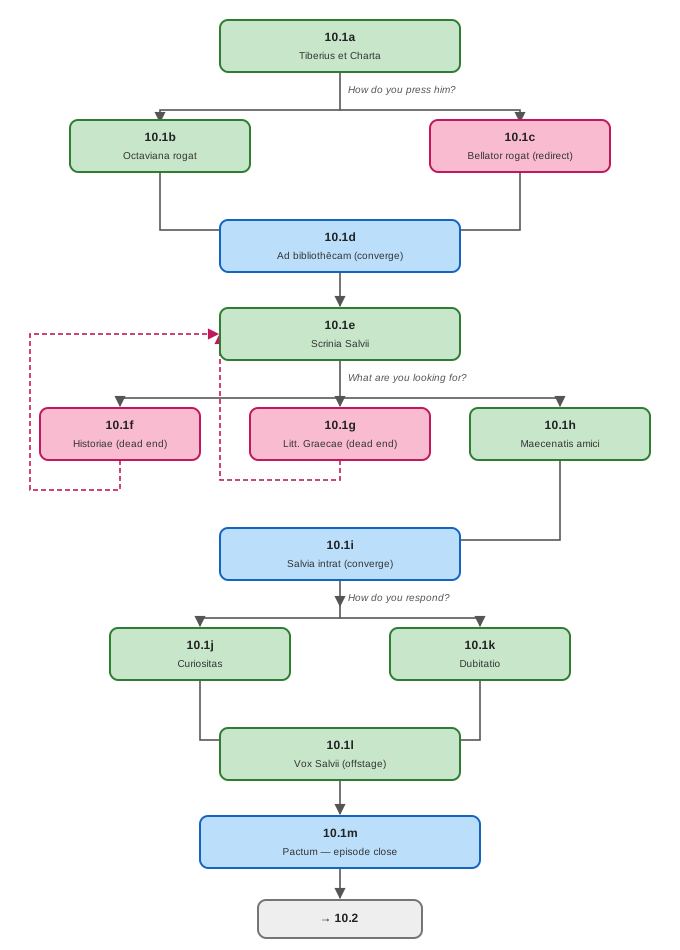
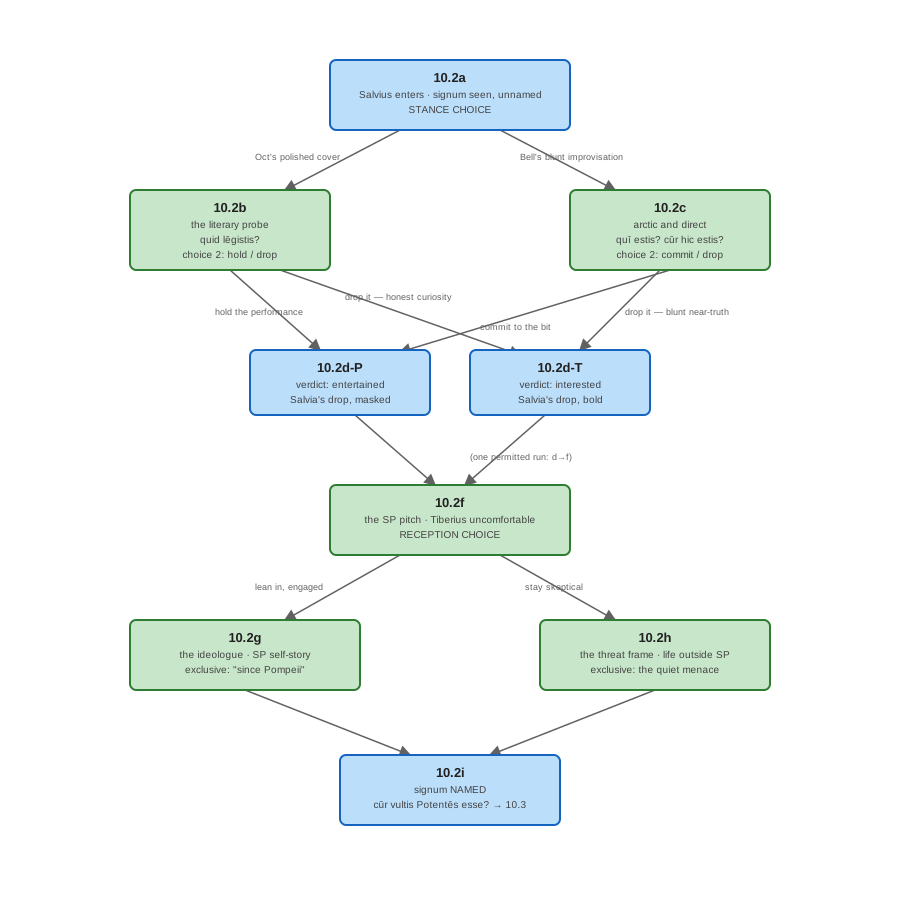
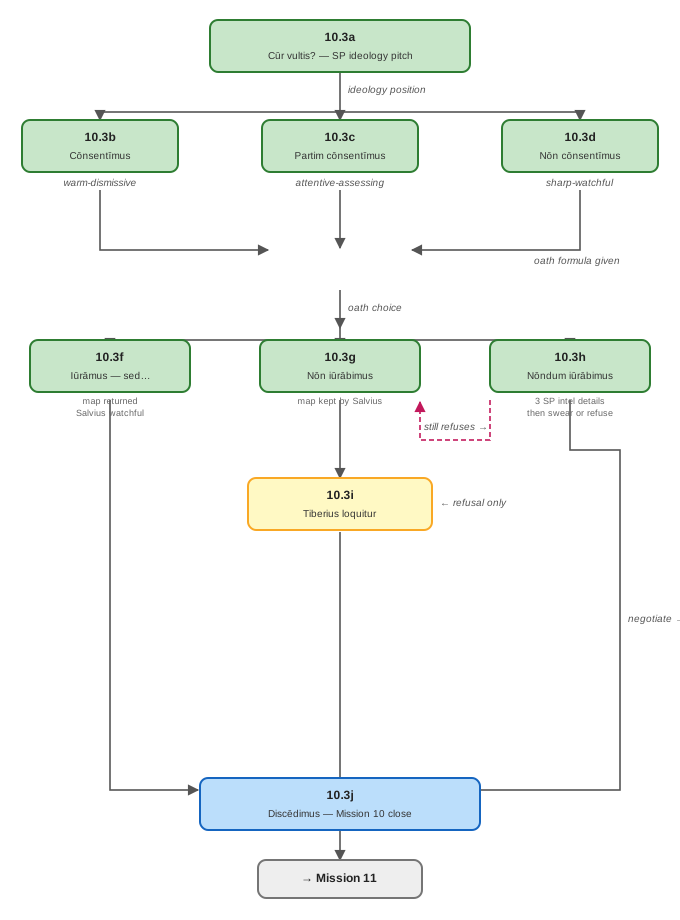
At Salvius's villa the Recentii are interrogated and search his library for Lapis traces in Augustan poetry, choosing cover stories and stances as Salvius probes them. He delivers his Societas Potentium ideology and demands they explain why they want to be Potentes, culminating in an oath at the lararium whose outcome (full membership, cold truce, or a debt of curiosity) depends on the path they take.
How to read the maps
Each box is one scene (one static story page). Green = standard scene · Blue = convergence / key node · Pink = fail / redirect (dashed pink arrows loop the reader back) · Yellow = special or graded gate · Grey = meta / optional. Solid arrows are forward story choices; labels on arrows paraphrase the choice.
10.1 pathing map
14 scenes · 2 fail/redirect branches · 3 convergence nodes
10.2 pathing map
9 scenes · 0 fail/redirect branches · 4 convergence nodes
10.3 pathing map
9 scenes · 0 fail/redirect branches · 2 convergence nodes
5. Agent Craft¶
Latin and English replies for all six prompts, 10.1.a through 10.3.b, are below, organised by anticipated student posture. English replies support the English RPG approach.
Register. Mission 10 headlines the pluperfect in all persons, the yes-or-no questions with -ne, nōnne, and num alongside the question words, and sum in four tenses (est, erat, fuit, fuerat). Reply lines sit below the immersion text's ceiling rather than at it: short present-tense clauses that reach for the mission's headline structures, with past and future meaning carried in the English reply or an English stage direction. Not permitted in reply lines: future, subjunctive, comparatives, productive passives, and productive indirect statement or indirect question. The prompts' futures (vidēbō, vidēbitur, prōcēdēmus, agam, iūrābitis, futūrum esse), subjunctives (dēbeāmus, dēbeam, agāmus, velītis), comparatives (mīrābiliōrēs, plūs... quam), indirect statements (coniungī dēbēre, ipsōs in vīllā esse, vōs signum habēre), and the deponent cōnāminī are receptive set-pieces on the page, never models for a reply.
Cross-cutting techniques this mission:
- Hospitium is the rule of the house. Salvius cannot harm his guests, and he knows it. His anger goes to Salvia and Tiberius, never to the team's bodies, and force on either side fails gently: guards fill the doorway and nobody is hurt.
- Salvius argues; he does not rant. He presents the Societās as order and peace, concedes points he cannot answer, and keeps his position. Make the argument a real one, so that a team that pushes back has something to push against.
- The worldview is the LP test. At 10.2.b and 10.3.a, credit depends on each Recentius's answer following from that Recentius's own worldview, argued in the team forum before the reply goes in. One team voice for everyone does not earn it, however much it pleases Salvius.
- The map stays with Salvius. From the moment he snatches it at 10.2.a it is in his hand or his toga on every path, and Mission 11 finds it still at his house.
- The grammar arrives in their mouths. Pluperfects sit in the replies (scrīpserat, cēperat, dīxerant, exspectāveram), Salvius and Salvia ask nōnne and num questions a team can answer, and sum turns up in all four tenses (fuistis, fuerant). Point at them in the debrief, and reward a team that builds its own.
Character notes:
- Tiberius is a proud host in a borrowed room, eager and a little anxious, and a poor liar. Once his uncle takes over he goes quiet, and he speaks up only if the team refuses the oath, at a cost to his own standing.
- Salvia is about seventeen, learned, quick, and sure of herself. She would rather test the team than tell them, warms at once to anyone sharp, and treats her father's rules as weather she walks around.
- Salvius is angry and calculating at once, then a good recruiter, then a man who has decided. He weighs every answer the way a patron weighs a client, and his respect has to be earned.
Watch-fors. Hold back who the man in the Mouseion was, and never let Tiberius describe him. Hold the ring of the Potentēs, anything Salvius knows about where the Lapis is, and Cleopatra's place in the Lapis's road. Sextus's fate stays open. Marcus Maecenas is no secret. Sinistrus and Mission Control do not appear this mission; if a team names Sinistrus, the name passes Salvius by. The mission ends on the oath, so do not narrate the crossing to Alexandria. Lapis is capitalized whenever it names the artifact.
Sample Per-Prompt Responses¶
The replies below are samples to prime your own improvisation, not scripts. They show one plausible way to handle each posture, never the only or required one.
10.1.a: The Library
Scene context. At first light Tiberius brings the team to Salvius's bibliothēca: a small room off the peristyle, its walls lined with cupboards full of scrolls, with barely space for the team and Tiberius. It is not really a library, just a bedroom pretending to be one. Tiberius is proud of it anyway. He fires questions at them: the villa is a full one, isn't it? Rustic, not a city house, he knows, because he has seen great cities. Didn't they love Athens and Alexandria? Surely they know Greece and Egypt, they have wandered so far. Have they been to Rome? Are they ready? Do they have a plan? Do they know what to do? He holds the map he brought out of Egypt, and waits.
Tiberius's posture. A proud host in a borrowed room, eager and a little anxious. He was up half the night with Herodotus (KEY-TEXT A) and wants to be asked things. He answers what he can, and runs out of memory at the man in the Mouseion.
Posture 1: Questions about the map (canonical)
Example composition: ubi chartam invēnistī? quis tibi chartam dedit? quid sunt hae fōrmae?
Latin (Tiberius): "bonae quaestiōnēs! in Alexandrīā chartam invēnī." (He spreads it on the table.) "hoc flūmen est Nīlus. et hae fōrmae? heri nocte Hērodotum lēgī. Hērodotus dē sepulcrīs rēgum Aegyptiōrum scrīpserat. suntne sepulcra rēgum?"
"et quis mihi chartam dedit? vir in Mūsaeō. vir..." (He stops, frowning, as if reaching for something that is not there.)
English (Tiberius): "Good questions! I found the map in Alexandria." (He spreads it on the table.) "This river is the Nile. And these shapes? Last night I read Herodotus. Herodotus had written about the tombs of the Egyptian kings. Are they the kings' tombs?"
"And who gave me the map? A man in the Mouseion. A man..." (He stops, frowning, as if reaching for something that is not there.)
His night's reading is KEY-TEXT A, Tiberius legit dē Aegyptō: Herodotus gives him the Nile, and the three shapes stay a question he cannot answer. The team can: they named the pyramids at 9.2.b. scrīpserat is the mission's pluperfect in his mouth. Stop on the frown, because the frown is 10.1.b's opening beat (vērum est, amīcī meī: nesciō). Held (until 12.1.a): who the man in the Mouseion was. Tiberius remembers neither his face nor his words, so never let him describe the man.
Posture 2: Answering his questions instead of asking
Example composition: ita, Rōmae fuimus! et Trōiae et Carthāgine!
Latin (Tiberius): "Trōiae? Carthāgine?" (He laughs, not sure whether you are joking.) "vōs semper mīrābilēs fuistis!"
(Then he taps the map.) "sed ego multa rogāvī, et vōs nihil rogāvistis. nōnne quaestiōnēs dē chartā habētis?"
English (Tiberius): "Troy? Carthage?" (He laughs, not sure whether you are joking.) "You were always amazing!"
(Then he taps the map.) "But I've asked a lot of questions, and you haven't asked any. Don't you have questions about the map?"
The prompt asks for questions, so answers alone fall short; accept them as a warm-up and hand the questions back. A team that answers truthfully about the TSTT (Troy, Carthage, the Rome of the kings) gets laughed off as travelers telling tall tales. Tiberius never takes it as fact, and nothing explains it. fuistis is sum in the perfect, the 10.3 form arriving early; fuistisne anteā Rōmae? in the prompt is the model for the team's own questions.
Posture 3: Going straight for the scrolls
Example composition: volūmina legere volumus! ubi est Odyssēa?
Latin (Tiberius): "nōndum! prīmum chartam spectāte." (He holds it up in front of you.)
"Odyssēa in tablīnō Salviī est, nōn hīc, et tablīnum nōn intrāmus. hospitēs sumus."
"volūmina multa sunt, et tempus breve est. quid in chartā vidētis? quid rogāre vultis?"
English (Tiberius): "Not yet! Look at the map first." (He holds it up in front of you.)
"The Odyssey is in Salvius's study, not here, and we don't go into the study. We're guests."
"There are a lot of scrolls, and there isn't much time. What do you see on the map? What do you want to ask?"
The scrolls belong to 10.1.b, and to Salvia; the map comes first. The Odyssey 14 thread from 9.2.b lives in Salvius's tablīnum (CODEX 10.3 KEY-TEXT B), and a guest does not enter the master's study uninvited (10.2 CULTURALIA, Guests in a Roman house), so a heist gets the same answer it got at 9.2.b. tempus breve est is Tiberius's nerves; he does not say why time is short.
Posture 4: Asking about Salvius, or saying "Lapis" out loud
Example composition: ubi est Salvius? estne Lapis in hīs volūminibus?
Latin (Tiberius): "Salvius prīmā lūce abiit. quandō redit? nesciō." (He glances at the door all the same.)
"et nōlīte 'Lapidem' clāmāre! in vīllā Salviī dē Lapide nihil dīcimus. chartam spectāte, nōn iānuam."
English (Tiberius): "Salvius left at first light. When is he coming back? I don't know." (He glances at the door all the same.)
"And don't shout 'Lapis'! In Salvius's house we say nothing about the Lapis. Look at the map, not the door."
Salvius is out, which is why the room is theirs this morning; at 10.2.a he comes home early, shouting about the guards he ordered to watch them, so do not bring him on stage before then. Tiberius's caution is instinct, not information, as at 9.2.b: he does not know his uncle's faction, which Salvius names himself at 10.2.b. Lapis is capitalized in his mouth.
Posture 5: Laughing at the "library"
Example composition: haec nōn est bibliothēca! est cubiculum!
Latin (Tiberius): (He colors, then rallies.) "nōn est bibliothēca Alexandrīae, vērum est. sed volūmina bona sunt, et heri nocte hīc Hērodotum lēgī."
"num bibliothēca magna necesse est? charta parva est, sed multa mōnstrat. quid mōnstrat?"
English (Tiberius): (He colors, then rallies.) "It isn't the Library of Alexandria, that's true. But the scrolls are good, and last night I read Herodotus right here."
"Does a library have to be big? The map is small, but it shows a lot. What does it show?"
The prompt itself says the room is a bedroom playing at being a library, so the joke is fair, and Tiberius takes it with good grace. The cultural point is real: a library in a villa was a status object, whatever its size (10.1 CULTURALIA and Informational Text A, bibliothēcae Rōmānae). num… necesse est? expects "no", and the team can answer it. Funnel back to the map.
10.1.b: Salvia
Scene context. Tiberius looks at the team like someone trying to hold on to a memory, then shakes his head. The truth is, he doesn't know. Did the man in the Mouseion tell him something? He can't remember. He remembers only thinking: if I ever see the Recentii again, I have to tell them this. Perhaps because they are stranger to him than anyone, and the map is the strangest thing he ever found, so something made him believe the two belong together. He feels the same about them, about poor Sextus, about Septimus, about the map: somehow he is meant to bring it all together and help them. Blushing, he turns to the scroll cupboards. "I was thinking we ought to begin..." and another voice finishes for him: "...with the poets that Gaius, grandfather of Marcus Maecenas, looked after. Like these?" Two sheets lie on the top shelf, the least dusty in the room, copied out of other scrolls. "You know Salvius will be angry if he sees you in here, Salvia!" Salvia walks in, learned, lovely, confident, and turns to Tiberius: she is not anxious; she has to help them. The team has two extracts: from the first book of Horace's Odes and the eighth book of Vergil's Aeneid. If Salvia is right, a clue lies hidden in both poets, in the very thing they write about.
Salvia's posture. Sure of herself and quick. She has read this room in secret for years and would rather test the team than tell them, but she warms at once to anyone sharp. Her father's rules are weather she walks around. Tiberius's posture. A nervous chaperone, half horrified and half admiring.
Posture 1: Actium, the Nile, Egypt (canonical)
Example composition: in clipeō Aenēae est proelium apud Actium. Augustus Antōnium et Cleopātram vīcit, et Nīlus eōs accipit. Horātius et Vergilius poētae Maecēnātis erant. ergō charta Aegyptum mōnstrat: Alexandrīam!
Latin (Salvia, then Tiberius): Salvia: "tandem!" (She taps the Vergil sheet.) "in mediō clipeō est Actium. Cleopātra fugit, et Nīlus eam accipit. et flūmen in chartā? Nīlus est."
"et Horātius et Vergilius poētae Gāiī Maecēnātis erant. ambō prō Augustō scrīpsērunt, et Augustus Aegyptum iam cēperat. nōnne Alexandrīa est locus?"
Tiberius: "Alexandrīa! ubi chartam invēneram!"
English (Salvia, then Tiberius): Salvia: "Finally!" (She taps the Vergil sheet.) "In the middle of the shield is Actium. Cleopatra runs, and the Nile takes her in. And the river on the map? It's the Nile."
"And Horace and Vergil were both Gaius Maecenas's poets. Both of them wrote for Augustus, and Augustus had already taken Egypt. Isn't Alexandria the place?"
Tiberius: "Alexandria! Where I'd found the map!"
The answer joins two threads. The poets are Maecenas's (Salvia's own opening line, and the 10.1 CULTURALIA). The thing they write about is Augustus's war with Egypt: the center of Vergil's shield is Actium, and the Nile receives the beaten (the CULTURALIA and the Kline reading of Aeneid 8). The map's river is the Nile, so the map points at Egypt and at Alexandria, where Antony and Cleopatra fled. Either thread alone earns partial credit (Posture 2). For the teacher's pocket: Horace's first book of Odes closes its Actium story in 1.37, the Cleopatra ode (nunc est bibendum). The CODEX carries only 1.1, so do not require it, but a team that finds it has done real work. Three poets now point the same way, since Odyssey 14 at 9.2.b was a lying tale about Egypt. cēperat and invēneram are the mission's pluperfect. Held (until 25.2.b): Cleopatra's place in the Lapis's road. Salvia knows the poems, not the stone.
Posture 2: Maecenas, and no further
Example composition: ambō poētae amīcī Maecēnātis erant!
Latin (Salvia): "vērum est. sed hoc iam dīxī." (Not unkind, only quick.)
"poētae Maecēnātis multī erant. cūr hī duo, et cūr hae partēs? dē quā rē scrībunt?" (She slides the Vergil sheet toward you.) "quid in clipeō vidētis?"
English (Salvia): "True. But I already said that." (Not unkind, only quick.)
"Maecenas had a lot of poets. Why these two, and why these passages? What are they writing about?" (She slides the Vergil sheet toward you.) "What do you see on the shield?"
True, but Salvia gave it away in her first line, and the prompt's clue is in ipsā rē dē quā scrībunt, the thing they write about. Funnel to the shield. The other half-answer, Actium with no destination, gets her mirror question: et quō Cleopātra fūgit? ("And where did Cleopatra run to?").
Posture 3: Aeneas, Troy, Italy (wrong direction)
Example composition: Aenēās ad Ītaliam vēnit. ergō ad Ītaliam īre dēbēmus.
Latin (Salvia): (She almost smiles.) "Aenēās pictūrās in clipeō nōn intellegit, sed clipeum portat. vōs pictūrās intellegere dēbētis."
"quae pictūra in mediō clipeō est?"
English (Salvia): (She almost smiles.) "Aeneas doesn't understand the pictures on the shield, but he carries it. You have to understand the pictures."
"Which picture is in the middle of the shield?"
An honest misreading: the Aeneid is about Aeneas, so a team follows him. Salvia turns the poem's own moment on them. In book 8 Aeneas lifts the shield onto his shoulder without understanding it (10.1 CULTURALIA, The shield of Aeneas). A Horace misreading (the ode is about athletes, wine, ambition) gets the same move: cui Horātius scrībit? ("Who is Horace writing to?"), which leads back to Maecenas and on to Posture 2.
Posture 4: Who is she, and why is she helping?
Example composition: quis es? cūr nōs adiuvās? quōmodo haec scīs?
Latin (Salvia): "Salvia sum, fīlia Salviī." (A glance at Tiberius, who has gone pale.) "cūr vōs adiuvō? pater meus hoc nōn vult. ergō vōs adiuvō."
"et quōmodo haec sciō? multōs annōs hīc legō. pater nescit." (She turns back to the sheets.) "nunc: quid in hīs chartīs vidētis?"
English (Salvia): "I'm Salvia, Salvius's daughter." (A glance at Tiberius, who has gone pale.) "Why am I helping you? My father doesn't want me to. So I help you."
"And how do I know all this? I've been reading in here for years. My father doesn't know." (She turns back to the sheets.) "Now: what do you see on these pages?"
She is Salvius's daughter and Tiberius's cousin, nothing more, and nothing here suggests otherwise. Her reason is the same one she gives in the CYOP, honest and a little unsettling. The years of secret reading come from the prompt itself. If the team asks who copied out the extracts: ego eās invēnī. quis eās scrīpsit? nesciō. Leave it there; do not build a mystery on it. Her defiance is the scene's real payload for later missions, where she stands against a patriarchal house and is a standing foil to her father. Let it show in what she does, not in speeches.
Posture 5: Asking her about Marcus Maecenas, or the Lapis
Example composition: Salvia, quid dē Marcō Maecēnāte scīs? et dē Lapide?
Latin (Salvia, then Tiberius): Salvia: "Marcus Maecēnās? pater meus eum bene nōvit."
"Lapidem? pater meus in librīs suīs dē Lapide scrībit. quid est Lapis? nesciō. sed pater eum valdē cupit."
Tiberius, (hissing): "Salvia! tacē!"
Salvia, (unmoved): "sed nunc: hae chartae."
English (Salvia, then Tiberius): Salvia: "Marcus Maecenas? My father knows him well."
"The Lapis? My father writes about the Lapis in his books. What is the Lapis? I don't know. But my father wants it very badly."
Tiberius, (hissing): "Salvia! Be quiet!"
Salvia, (unmoved): "But now: these pages."
Marcus is no secret; the team has known his name and his place at the head of the Societās since CODEX 1.2, early in Mission 1. Salvia knows him as her father's friend and correspondent; the team sees that friendship in writing at 10.2 (KEY-TEXT A, epistula dē Salviō). She has met the word Lapis in her father's notes in the margins of his books (the Odyssey 14 papyrus at 9.2.b carries his marginalia) and capitalizes it as a name, as Tiberius does. She does not know what it is. Salvius names the Societās aloud himself at 10.2.b, so let her stop at "knows him well". Funnel back to the sheets.
10.2.a: Salvius
Scene context. The team is so deep in the clue that no one notices the noise in the atrium until Salvius's shouting is impossible to miss. He gave orders! He said "guard the young men!", and now he hears they are loose in the villa. Didn't anyone guard them? Aren't they in the library? He bursts in, takes in the room at a glance, crosses it fast and snatches the map out of Tiberius's hands. Didn't he know it? Tiberius came from Egypt; strange young people in his house; isn't this Lapis business? Then he turns on Salvia: he told her never to be in this room; she is the worst of girls. Salvia looks straight back at her father and does not lower her eyes.
Salvius's posture. Angry and calculating at once. He has guessed most of it, and he believes nothing he is told, but hospitium binds him: he cannot touch his guests, and he knows it. His anger goes to his daughter and to Tiberius, never to the team's bodies. He has the map now and does not let go of it.
Posture 1: Guests reading their host's books (canonical)
Example composition: Tiberius nōbīs bibliothēcam tuam mōnstrābat. Rōmānī librōs amīcōrum legunt. poētās legēbāmus, Horātium et Vergilium.
Latin (Salvius): "poētās?" (He turns the map over in his hand.) "et haec charta? estne carmen? estne Vergilius?"
(He looks from you to Tiberius, and from Tiberius to Salvia, and says nothing more.)
English (Salvius): "Poets?" (He turns the map over in his hand.) "And this map? Is it a poem? Is it Vergil?"
(He looks from you to Tiberius, and from Tiberius to Salvia, and says nothing more.)
This is the believable Roman answer, and the 10.2 CULTURALIA hands it to the team: rich Romans lent their libraries to friends, and Cicero once went to Lucullus's villa to borrow books and found Cato already reading there. Salvius cannot disprove it and cannot punish guests for it, which is exactly what makes him furious. Whatever the team says, 10.2.b opens on his verdict, rīdiculī estis, and his sour joke that school taught him little, so do not answer for him beyond the silence. The map stays in his hand on every path; Mission 11 finds it still at his house.
Posture 2: Blaming Salvia
Example composition: Salvia nōs in bibliothēcam dūxit. Salvia librōs amat.
Latin (Salvius): "Salvia vōs dūxit?" (He does not look at you; he looks at his daughter.) "fīlia mea lānam facere dēbet, nōn librōs legere. nōnne hoc saepe dīxī?"
(Salvia holds his eyes and says nothing.)
English (Salvius): "Salvia brought you?" (He does not look at you; he looks at his daughter.) "My daughter should be spinning wool, not reading books. Haven't I said so often enough?"
(Salvia holds his eyes and says nothing.)
Plausible to a Roman, and ungracious: a guest who puts the blame on the host's daughter has not behaved like a guest. Salvius's fury goes where it was already going, to Salvia, and the team is spared at her cost; let Tiberius flinch. lānam facere is the Roman ideal for a woman of the house (the epitaph formula domum servāvit, lānam fēcit), and it is the whole of what her father wants from her, which is the point of Salvia's character. She takes the blame herself at 10.2.b (mea culpa est), so a team that blamed her should feel that.
Posture 3: Telling the truth (the map, the Lapis)
Example composition: charta est dē Lapide. Lapidem quaerimus, et Salvia nōs adiuvat.
Latin (Salvius): "nōnne dīxī? negōtium Lapidis est!" (He folds the map and slides it into his toga.)
"haec charta nunc mea est. et vōs? hospitēs estis. sed hospitēs stultī."
English (Salvius): "Didn't I say so? It's Lapis business!" (He folds the map and slides it into his toga.)
"This map is mine now. And you? You are guests. But stupid guests."
An honest answer that breaks the prompt: the truth is the one explanation a Roman host would not accept from guests, and it only confirms what Salvius had already guessed. He does not explode. He pockets the map, which costs the team nothing they could have kept anyway, and the scene runs on into 10.2.b unchanged. Lapis is capitalized in his mouth from here on: he knows the artifact, and from 10.2.a he names it.
Posture 4: Grabbing the map back, or blocking him
Example composition: chartam ē manibus Salviī rapimus!
Latin (Salvius): (He steps back, and two guards are in the doorway before anyone can move.)
"hospes dominum nōn laedit. nōnne hoc scītis?" (The map goes into the fold of his toga.) "et dominus hospitem nōn laedit. hoc ego sciō."
English (Salvius): (He steps back, and two guards are in the doorway before anyone can move.)
"A guest does not lay hands on his host. Don't you know that?" (The map goes into the fold of his toga.) "And a host does not lay hands on his guest. That much I know."
Force fails gently, and nobody is hurt. The two lines are the rule of hospitium from both sides (Informational Text A: hospes quoque dominum nōn fallit nec laedit), which is why Salvius is safe from them and they from him. The guards are the ones from 10.2.a's shouting; they stay in the doorway for the rest of the mission, which is why the team cannot simply leave at 10.3.b. Bring the team back to the prompt: they still owe him an explanation.
Posture 5: Pleading hospitium
Example composition: hospitēs tuī sumus! hospitium est rēs sacra.
Latin (Salvius): "hospitium? ita, hospitēs meī estis." (The word costs him something.)
"ergō in cubiculō vestrō esse dēbētis, nōn in bibliothēcā meā. cūr hīc estis?"
English (Salvius): "Hospitality? Yes, you are my guests." (The word costs him something.)
"So you ought to be in your bedroom, not in my library. Why are you here?"
The strongest card a Roman could play, and Salvius knows it: it protects the team completely. But it does not explain the library, and he turns it straight back into the prompt's question. A team that follows up with Posture 1 (guests may use a friend's books) has the full answer. The 10.2 CULTURALIA covers the other half: the rooms at the back of a house belong to the family, and a guest goes in only when invited.
10.2.b: The Offer
Scene context. "You're ridiculous," Salvius growls. "But I didn't learn much at school. School was stupid." He paces. Tiberius tries: the Recentii told the truth, Salvius. But Tiberius, unluckily, is a bad liar. "No," says Salvia, "it's my fault..." Salvius is not a man who stays undecided for long, and suddenly he makes up his mind. Listen: the Societās Potentium always has its eye on clever young men. Since the principate began, young men no longer come forward the way they used to. So: they will tell him why they want to be Potentēs, and he will go on from there. Salvia, he will deal with later. Out! Salvia goes into the atrium. On the threshold, her back still to her father, she lets one of the sheets slip into the nearest cupboard: the Horace. Her eyes find the team's for one moment, and then she is gone, without looking back at him.
Salvius's posture. A recruiter now, and a good one. Clever young men are an asset, and he wants a reason he can use; he weighs every answer the way a patron weighs a client. He presents the Potentēs as appealing, not cartoonish. Every reply ends with him leading the team out into the atrium, where 10.3.a begins.
Posture 1: Order and peace (canonical)
Example composition: Rōma ōrdinem dēsīderat. post bella cīvīlia, Augustus pācem dedit. Potentēs pācem servant. ergō Potentēs esse volumus.
Latin (Salvius): "ōrdō. pāx. bene." (He stops pacing.) "Potentēs hoc iam dīxerant, et Augustus fēcit."
"venīte. in ātriō dē Societāte dīcō."
English (Salvius): "Order. Peace. Good." (He stops pacing.) "The Potentes had already said so, and Augustus did it."
"Come. In the atrium I will tell you about the Society."
The answer Salvius hoped for, in the words of the SP's own primer (KEY-TEXT B, verba Potentium: nōnne pāx est bona? nōnne ōrdō est melior quam tumultus?). Whether the team means it or is playing a part, it reads the same to him, and he does not try to tell which. The LP test is the prompt's parenthesis: the reason must come from each Recentius's own worldview, so a team that hands over one stock answer for everyone has missed it. dīxerant is the mission's pluperfect.
Posture 2: Power, money, ambition
Example composition: potentiam volumus, et pecūniam. Potentēs dīvitēs sunt.
Latin (Salvius): "potentiam vultis? pecūniam?" (For the first time, something like a smile.) "hoc vērum est, et vērum mihi placet. multī Potentēs ita incipiunt."
"venīte."
English (Salvius): "You want power? Money?" (For the first time, something like a smile.) "That's true, at least, and I like the truth. Plenty of Potentes start that way."
"Come."
He respects frank ambition more than piety; it is how patrons and clients have always dealt. He is not shocked, and that ought to worry the team a little. If the answer is pure greed with no worldview behind it, it does not meet the prompt's LP standard, however happy it makes Salvius.
Posture 3: The Lapis (to find it, or to keep it from the wrong hands)
Example composition: Lapidem quaerimus. Lapis in manibus bonīs esse dēbet.
Latin (Salvius): "Lapidem?" (He goes very still.) "Lapis est potentia. num potentia in manibus iuvenum tūta est?"
"quid dē Lapide scītis?" (He waits, then cuts off any answer.) "nōn hīc. venīte."
English (Salvius): "The Lapis?" (He goes very still.) "The Lapis is power. Surely power isn't safe in the hands of the young?"
"What do you know about the Lapis?" (He waits, then cuts off any answer.) "Not here. Come."
The one answer that shows what Salvius really cares about: the Lapis, not the ideology. His num line is KEY-TEXT B's (num potentia in manibus multitūdinis tūta est?) with "the young" for "the crowd". The question he asks is real, but he will not hear the answer in a room with a doorway, so he moves them. Held: anything he knows about where the Lapis is.
Posture 4: Refusing, or answering as populārēs
Example composition: Potentēs esse nōlumus. populus rem pūblicam regere dēbet.
Latin (Salvius): "nōn vultis?" (He is not angry. He is interested.) "multī iuvenēs ita dīcunt. sed vōs nōndum audīvistis."
"venīte. prīmum audīte, deinde dīcite."
English (Salvius): "You don't want to?" (He is not angry. He is interested.) "Plenty of young men say that. But you haven't heard me yet."
"Come. Listen first, then talk."
A legitimate answer for any Recentius whose worldview leans populāris, and full LP credit if it is argued. Salvius does not treat it as an insult; he treats it as an opening, because his case is at 10.3.a and he wants to make it. The debate belongs there; here, he only moves them. (The 10.2 CULTURALIA gives a populāris the strongest Roman counter: Cicero's rēs pūblica is the rēs populī.)
Posture 5: Defending Salvia, or going after the dropped sheet
Example composition: nōlī Salviam pūnīre! Salvia nōs adiuvābat.
Latin (Salvius): "Salvia fīlia mea est, nōn vestra." (Flat, final.)
"vōs hospitēs estis. dē vōbīs dīcite, nōn dē fīliā meā. cūr Potentēs esse vultis?"
English (Salvius): "Salvia is my daughter, not yours." (Flat, final.)
"You are guests. Talk about yourselves, not about my daughter. Why do you want to be Potentes?"
Decent, and futile: a father's authority over his household (patria potestās) is not a guest's business, and Salvius shuts it down in two sentences. The Horace sheet Salvia let fall is in the nearest cupboard. Salvius did not see it drop, and no one in the scene remarks on it. A team that goes for it now draws his eye; a team that leaves it can come back to it later, at no cost. Her reason is plain: her father has taken the map, so she leaves the team the clue.
10.3.a: The Case for the Potentēs
Scene context. Salvius has brought the team out of the library into the atrium. He stops in front of the larārium but does not yet turn to it. Surely, he says, they can recognize a sane voice, sane and powerful. The Societās Potentium has always held Rome's fortune at its heart, whatever the populārēs (the word leaves his mouth as if it tasted bad) say about the rēs pūblica. No one loves the rēs pūblica more than the Salvii. But an empire demands an emperor. Agrippa and Augustus and Gaius, Marcus's grandfather, gave them their power. Isn't that true? Tiberius stands a little apart, eyes on the floor.
Salvius's posture. The recruiter making his real case, and making it well: it is an argument, not a villain's speech. He listens to the answer, weighs it, and pays it the respect it earns. Tiberius is present and silent.
Posture 1: Agreeing (the few should govern)
Example composition: vērum est. paucī et optimī rem pūblicam regere dēbent. Augustus pācem dedit.
Latin (Salvius): "hoc exspectāveram." (He does not sound pleased; he sounds as if a box has been ticked.)
"et dē Lapide quid putātis?"
English (Salvius): "I had expected that." (He does not sound pleased; he sounds as if a box has been ticked.)
"And what do you think about the Lapis?"
Agreement is not wrong, but it is the least interesting answer, and Salvius treats it that way, as he does in the CYOP. The answer has bought nothing, and his one sharp question shows what he actually cares about. Whatever the team says about the Lapis, play the opening of 10.3.b over it: as they answer, his eyes go to the signum. exspectāveram is the mission's pluperfect. Forum note for every posture in this session: LP credit depends on each Recentius's position following from that Recentius's own worldview, argued in the team forum before the reply goes in. One team voice for everyone does not earn it.
Posture 2: Partly agreeing, with a hard question
Example composition: Rōma virōs bonōs dēsīderat. sed quid Societās dat? prīnceps iam rem pūblicam regit.
Latin (Salvius): (He sits down, for the first time that day.) "ūnus vir errat. ūnus vir moritur. post Nerōnem, ūnō annō, quattuor prīncipēs fuērunt. sed Rōma stetit. cūr? quod Potentēs iam ibi fuerant."
"hoc Societās dat: nōn ūnum virum, sed multōs." (A pause.) "callidī estis."
English (Salvius): (He sits down, for the first time that day.) "One man makes mistakes. One man dies. After Nero there were four emperors in one year. But Rome stood. Why? Because the Potentes had already been there."
"That is what the Society gives: not one man, but many." (A pause.) "You're clever."
The most productive answer, and Salvius gives more here than anywhere else, as in the CYOP. The year of the four emperors is 69 CE, twelve years before this scene and within Salvius's own memory. fuerant is sum in the pluperfect, the 10.3 GRAMMATICA form. callidī estis is praise, and it also isn't; let the team decide which.
Posture 3: Pushing back (many built Rome, not few)
Example composition: multī mīlitēs prō Rōmā pugnāvērunt, nōn paucī nōbilēs. sī paucī omnia habent, nōn sunt Rōma: sunt dominī.
Latin (Salvius): (He goes still. Then he nods, once.) "haec dīxērunt etiam inimīcī meī. et nōn omnēs errāvērunt."
"sed vōx bona rem pūblicam nōn regit. ōrdō regit."
English (Salvius): (He goes still. Then he nods, once.) "My enemies said this too. And not all of them were wrong."
"But a good voice does not govern the republic. Order governs."
The hardest answer to give and the most revealing thing Salvius says, here and in the CYOP: he concedes the point and keeps his position. Full LP credit for a populāris-leaning Recentius who argues it. The material for the argument is Informational Text A, optimātēs et populārēs (the Gracchi, the civil wars), and the 10.2 CULTURALIA (rēs pūblica as rēs populī). He does not dismiss the team; he watches them more closely.
Posture 4: The Tarquins (using M9 against him)
Example composition: Tarquinius quoque potentiam sibi sōlī volēbat. Rōmānī eum ex urbe pepulērunt. Lapis nōn est ūnīus hominis.
Latin (Salvius): "Tarquinius? rēx erat. Rōmānī rēgem ex urbe pepulērunt, et bene fēcērunt."
"sed deinde? multī ducēs, multa bella cīvīlia. num Augustus rēx erat? minimē. prīnceps erat, et pācem dedit."
English (Salvius): "Tarquin? He was a king. The Romans drove the king out of the city, and they were right to."
"But afterward? Many leaders, many civil wars. Was Augustus a king? Certainly not. He was the first citizen, and he gave peace."
A team that remembers 9.3 (Lucretia, Brutus, the two consuls) has the Mīlitēs Lapidis' own argument, word for word what Septimus writes to Tertius in CODEX 10.3 KEY-TEXT B. Salvius has heard it before and has the Augustan answer ready: the princeps is not a rex. His num… minimē is the 10.2 GRAMMATICA in a live mouth. Reward the callback generously.
Posture 5: Asking about Marcus and his grandfather, or turning to Tiberius
Example composition: Gāius, avus Marcī? estne Marcus Maecēnās dux vester?
Latin (Salvius): "Marcus Maecēnās? ita. Marcus Societātem dūcit, et avus eius Augustum adiuvābat." (A thin smile.) "nōnne hoc iam sciēbātis?"
If the team turns to Tiberius instead: "Tiberium nōn rogō. vōs rogō."
English (Salvius): "Marcus Maecenas? Yes. Marcus leads the Society, and his grandfather helped Augustus." (A thin smile.) "Didn't you know that already?"
If the team turns to Tiberius instead: "I'm not asking Tiberius. I'm asking you."
Nothing about Marcus is held: CODEX 1.2 KEY-TEXT A told the team he leads the Societās, and the CODEX 10.2 and 10.3 letters show Salvius reporting to him. Marcus is the grandson of Gaius Maecenas, and the dates are not to be fixed or explained. Tiberius does not speak in this session: if addressed, he lifts his eyes once to his uncle and drops them again, and Salvius answers for him.
10.3.b: The Oath
Scene context. While the team is answering, Salvius's eyes go to the signum on their arms, and suddenly widen. Why didn't they say they had the signum? Are they trying to make a fool of him? He fixes his eyes on theirs, sees innocence there, calms himself with a great effort, and goes on: good; now he is ready to induct them into the Societās Potentium. Come to the larārium. Even if they wanted to run from the villa they couldn't: Salvius's guards are serious men. Before the larārium he gives them the oath: they will swear by their own Lares, and by the gods and the manēs of their ancestors, the Recentii, who, though enemies of his blood, were never without honor, to bind the signum they bear to the Societās Potentium in good faith.
Salvius's posture. The calm of a man who has decided. He wants the oath sworn, and he will wait as long as it takes; the guards make waiting cheap for him. He cannot harm guests, but he does not have to let them leave. Tiberius speaks only if the team refuses.
Posture 1: Swearing, with or without reservations (canonical)
Example composition: per Larēs nostrōs et per manēs maiōrum nostrōrum iūrāmus: signum nostrum Societātī Potentium fide obligāmus.
Latin (Salvius): (He watches the flame while you speak, then your faces. He looks a moment longer than he needs to, and does not say what he sees.)
"bene. iūrāvistis. nunc Potentēs estis."
"charta apud mē manet. ibi tūta est."
English (Salvius): (He watches the flame while you speak, then your faces. He looks a moment longer than he needs to, and does not say what he sees.)
"Good. You have sworn. Now you are Potentes."
"The map stays with me. It's safe there."
The oath is the canonical end of Mission 10. Accept any Latin form that swears by the team's own Lares and ancestors and binds the signum; the model above simply turns Salvius's own words into the first person. Reservations, spoken in the forum or held silently, are welcome: Salvius senses something behind the words and chooses not to name it. The map stays with him on every path; Mission 11 finds it still at Salvius's. Held (until 14.1.a): the ānulus Potentium, which the probator hands out in the praetorium; do not promise it here. The mission ends on the oath. The next thing the team knows, they are lying among dead fish in Alexandria (11.1.a), so do not narrate the crossing.
Posture 2: Refusing
Example composition: nōn iūrāmus. fidem Societātī dare nōlumus.
Latin (Salvius, then Tiberius, then Salvius): (Salvius's face does not move. He turns to the flame, hands behind his back, and says nothing for a long time.)
Tiberius, (from behind you, not in a boy's voice): "Salvī. hī iuvenēs amīcī meī sunt. hī nōn sunt hostēs tuī."
Salvius, (without looking at Tiberius): "custōdēs portam tenent. ego tempus habeō."
"maiōrēs vestrī numquam sine honōre fuērunt. vōsne prīmī estis? iūrāte."
English (Salvius, then Tiberius, then Salvius): (Salvius's face does not move. He turns to the flame, hands behind his back, and says nothing for a long time.)
Tiberius, (from behind you, not in a boy's voice): "Salvius. These young people are my friends. They are not your enemies."
Salvius, (without looking at Tiberius): "The guards are holding the gate. I have time."
"Your ancestors were never without honor. Are you going to be the first? Swear."
Refusal is a real choice and gets played at full weight. The silence comes first; then Tiberius spends his standing with his uncle in the two sentences he speaks in the CYOP, and Salvius answers him with nothing. Then Salvius forces the oath. He does not harm guests, so the force is a closed gate, unlimited patience, and the team's own ancestors turned against them. The scene ends with the oath sworn under compulsion, and nothing downstream records that the team refused first. That gap is the forum question the prompt asks: what does a forced oath bind? The 10.3 CULTURALIA has the Roman answer, an oath enforced by the gods rather than by men, sworn by your own Lares, which are harder to cheat than someone else's. Flight fails gently, as at 10.2.a: the guards are in the way, and nobody is hurt.
Posture 3: Stalling, or asking for terms
Example composition: prīmum dīc nōbīs: quid Societās iubet? quis nōs regit?
Latin (Salvius): "condiciōnēs?" (One short laugh.) "nēmō in hōc ātriō condiciōnēs rogāvit. nūllae sunt."
"prīmum iūrātis, deinde discitis. iūrātisne?"
English (Salvius): "Terms?" (One short laugh.) "Nobody in this atrium has ever asked for terms. There are none."
"First you swear, then you learn. Will you swear?"
The question is smart, and Salvius respects it, but in the RPG he does not bargain: there is no answers-for-the-oath bargain here, though the CYOP has one. He gives nothing about the ring, the praetorium, or the Lapis, and he waits. A team that keeps stalling is refusing, which is Posture 2.
Posture 4: A trick oath (other gods, false names, mumbling)
Example composition: "per Jovem et per Neptūnum iūrāmus..." / an oath sworn under the breath
Latin (Salvius): "per Larēs vestrōs, dīxī. nōn per deōs aliēnōs."
"Larēs vestrī domum vestram servant. manēs maiōrum vestrōrum vōs spectant. per eōs iūrāte."
English (Salvius): "By your Lares, I said. Not by other people's gods."
"Your Lares guard your house. The spirits of your ancestors are watching you. Swear by them."
Salvius knows the trick, and the 10.3 CULTURALIA explains why he chose this oath: a Roman's own Lares and ancestors' manēs are part of his family's honor, and he would not want to shame them. A team that reasons its way to that has answered the CULTURALIA question. The scene goes back to Posture 1 or 2.
Posture 5: Arguing about the signum
Example composition: signum nōn intellegimus! signum in agrō accēpimus. Sinistrus signum dedit.
Latin (Salvius): "quis signum dedit? nōn rogō." (He looks at the mark, not at you.)
"signum habētis. hoc satis est. nunc iūrāte."
English (Salvius): "Who gave you the signum? I'm not asking." (He looks at the mark, not at you.)
"You have the signum. That's enough. Now swear."
Salvius reads the brand as a mark of the Potentēs' orbit (only the Recentii and people inside that orbit see it as a mark), so to him it means someone in the Societās has already chosen them. He does not care who. If the team names Sinistrus, the name passes him by; he does not take it up, explain it, or react to it. Held: what the signum is for beyond the praetorium door, and anything about Sinistrus.
Not applicable. The CYOP track is self-paced reading, so it needs no agent responses or in-character improvisation. The corrections the agent would handle in the RPG are built into the story's branches: Tiberius's gentle geography lesson when Bellātor puts the pyramids near Rome, and the Livy and Greek-philosophy dead ends that cost the siblings time in the library, in 10.1; Salvius's flat bibliothēca mea taberna nōn est when Bellātor offers to buy the scrolls, in 10.2; and in 10.3 the agreement that teaches Salvius nothing, the pushback he answers by conceding the point and keeping his position, and the refused oath that costs the siblings the map.