Mission 6. Sinistrus Identity, Carthage, and the Eruption¶
1. Episode Overview¶
Essential Question
Who were the Romans?
ACTFL Proficiency Benchmarks — Intermediate Low
- Interpretive: I can understand the main idea and some related pieces of information on familiar topics from sentences and series of connected sentences in texts that are spoken, written, or signed.
- Cultural Investigation: I can compare products and practices to understand perspectives from a variety of cultures and communities, including my own.
Cultural & Historical Learning Targets — student-facing
- Analyze the formation and viewpoints of the optimātēs and populārēs, and explain why they were two methods of Roman politics rather than two parties.
- Evaluate the significance of Aeneas and his journey, and his contribution to Roman identity: the underworld's parade of future Romans, imperium sine fīne, and pietās as the virtue the poem is built on.
- Summarize, describe, and use Roman occupations: the five professions Caecilius offers, patronage, the war record, and the cursus honōrum.
- Analyze the destruction of Pompeii and the significance of Pliny the Elder and Pliny the Younger, and evaluate the two letters to Tacitus as both testimony and portrait.
Grammatical Learning Objectives — teacher-facing
- The dative plural (-īs for the first and second declensions, -ibus for the third); the dative pronouns completed with nōbīs and vōbīs; the perfect -istis flagged for recognition only, taught at 6.3 (6.1).
- The imperfect completed in all six persons (the -bā- signal, -m for the first singular, the vowel quantities); eram in all six persons; reading the tense rather than the ending (6.2).
- The perfect completed in all six persons (-ī, -istī, -it, -imus, -istis, -ērunt); stems over forms; the macron-carried vēnimus / venīmus contrast; the perfect set against the imperfect (6.3).
- The mission's arc is completion: each episode finishes a paradigm whose third person the operatives have been reading since Mission 3, so recognition is largely in the bank and production is the work.
Lapis thread
Mission 6 closes the Pompeii arc. Sinistrus has been busy offstage: he has convinced Caecilius that the team are the emperor's secret agents and Caecilius himself a trusted servus Caesaris, and the team must spin a plausible cover story while learning what Sinistrus asked and about whom. Caecilius then offers to fund a future in Rome, and each team locks in a vocation for its Recentius. In the training exemplum, the team overhears Jūnō and Venus quarrel above half-built Carthage over where the Lapis belongs, helps or hinders its unloading on the shore, and must talk a wavering Aenēās out of turning the ships back toward the smoke rising behind them. Then Vesuvius wakes. At Stabiae the three stones in the forum say the Lapis is in Egypt, underground at Alexandria, behind a cella only the marked may enter; Sinistrus appears where Sextus cannot see him, reports that Caecilius did not run, and sets the hook for the missions ahead: dēbētis Sinistrum invenīre in Britanniā. The Demiurge loses tracking to error-state 1298B, the ash comes down, and a dying old man on the shore gets most of a place-name out: Lapidem... ad Aegyptum...
Instructor background — withheld from students
The eruption's dramatic irony is held absolutely out of the fiction: no one in 79 CE knows the mountain is a volcano, Sextus's promise to run for the sea is sincere, and nothing in any NPC's delivery may wink at what the teacher knows about Caecilius, Tiberius, or Sextus. Caecilius's blindness in 6.1 is a conviction block, not the perception block: he sees and remembers Sinistrus perfectly, and contrary evidence files itself as a loyalty test, because Sinistrus pre-empted exactly that warning; the team's honesty confirms his cover instead of breaking it. Tiberius does not speak in this mission; his one honest signal is a slow headshake, given once, never seen by his father, and his stillness must stay breezy in Caecilius's mouth (tempus eī est). In 6.2 both outcomes are fixed by design: Aenēās leaves Carthage with the Lapis whatever the team does, so play interference and advocacy-of-return for the argument, not the result, and let the too-well-timed weather be fate's instrument. Aenēās never shows knowledge of the goddesses' quarrel, and everything about Dido's death is withheld in-fiction (aliud nōn dīcō); no nauta names the pyre. In 6.3 the Sinistrus cameo is scripted and closed, and it is the perception block's final Pompeii demonstration: for Sextus the corner was always empty (nihil ibi est), and there is no time to argue about it. The senex is Pliny the Elder, identified for the reader by the episode's KEY-TEXT rather than by any character; his death is scripted, arrives on the source's cue, and has no rescue variant. What the sīgnum is belongs to later missions; Britain is Sinistrus's thread alone. After his last order at the shore, Sextus is unaccounted for: no narration places him, saves him, or loses him, and the team's first questions belong to Mission 7. This mission also begins blurring the good/bad binary between the Mīlitēs Lapidis and the Societas Potentium; Sextus's values-not-virtue framing is the opening move of that blur, so resist making the SP cartoonish. End the mission on the cool, wet grass and resist the urge to soften it.
2. Shared CODEX Backbone¶
Each approach works from the same CODEX pages. For what the sections contain and how students reach them, see The CODEX. Each episode's ATTUNEMENT set closes with an inline Memorātiō.
CODEX pages: CODEX 6.1 · CODEX 6.2 · CODEX 6.3
KEY-TEXTs
- 6.1: Sinistrus cum Caeciliō (Sinistrus dines with Caecilius in the taberna, plants the Caesar story that Caecilius believes at 6.1.a, and quietly audits his own ally by pumping him about Marcus), with a Visual Walkthrough, and Aenēās in Regnō Plūtōnis (the underworld leg of the serial Aeneas run and its interpretive payoff: Dido's silence, Deiphobus, Anchises and the parade of future Romans including Augustus and Marcellus, Lēthē, and the exit through the gate of ivory), with a Visual Walkthrough.
- 6.2: Dīdō et Aenēās (the Carthage leg, filling the interval the immersion skips: Dido's hospitality, the Venus and Cupid plan, Jūnō's counter-plan, the hunt, the storm and the cave, and Fāma spreading the story), with a Visual Walkthrough, and Aenēās et Latīnus (the Latium leg: Latinus's welcome, the oracle and Lavinia, Turnus's claim, Ālectō's work on Amāta and Turnus, Ascanius and the sacred deer, and war).
- 6.3: Plīnius in perīculō (the Elder's first-person tablet: the pine-shaped cloud seen from Misenum, the decision to sail to Stabiae, fortēs fortūna iuvat, the falling ash and stones, the pillows, and his death on the shore), with a Visual Walkthrough, and Mors Pallantis with Mors Turnī (the closing legs of the serial Aeneas run, read as one continuous narrative: Turnus's embassy to Diomedes, Evander and Pallas, Vulcan's shield, the killing of Pallas; then Aeneas's rage, Jūnō's reprieve, Mezentius, the duel, and the killing over Pallas's belt).
Informational Texts
- 6.1: Cursus Honōrum (the republican ladder of offices: quaestor, aedīlis, praetor, cōnsul, plus the senate, the censor, and the dictator) and Rēgnum Plūtōnis (the mythological underworld: Charon and the coin, Tartarus against Elysium, Lēthē and rebirth, and the gates of horn and ivory).
- 6.2: Carthāgō (the Phoenician city itself: Poenī and sūfetēs, Baal and Tanit, the twin harbors, trade and territory, the three wars, and the Roman refounding) and Dīdō et orīgō Carthāginis (Elissa of Tyre, Pygmalion's murder of Sychaeus, the flight, the bull's-hide founding and Byrsa, and the dying curse framed as Roman etiology).
- 6.3: Plīnius Māior (equestrian, fleet prefect at Misenum, the Nātūrālis Historia, and the rescue voyage and death at Stabiae) and Plīnius Minor (Comum, adoption by his uncle, the cursus honōrum to the consulship, Bithynia, the letter collection, and the two letters to Tacitus).
GRAMMATICA
- 6.1: the dative goes plural (-īs, -ibus); the pronouns completed with nōbīs and vōbīs; the perfect -istis flagged for recognition only, taught later in the mission.
- 6.2: the imperfect completed in all six persons; eram in all six persons; reading the tense rather than the ending.
- 6.3: the perfect completed in all six persons, stems over forms, and the perfect set against the imperfect, with a video briefing embedded on the tab.
VERBA
- 6.1: quī, ipse, petit, vīta, crēdit.
- 6.2: iubet, sine, caelum, alter, fātum.
- 6.3: dum, populus, parvus, semper, audit.
CULTURALIA
- 6.1: choosing a life in Rome (the five professions; patronage, Horace and Maecenas; the war record and the cursus honōrum; the farmer as moral ideal); locking in the vocation choice; the future in the underworld (Anchises, Marcellus, and the ivory gate).
- 6.2: the Aeneas and Dido anachronism as etiology running backwards; imperium sine fīne as ideology; the durability of Roman fear of Carthage (Hannibal, Cannae, Cato the Elder); pietās as the episode's real subject.
- 6.3: optimātēs and populārēs as methods rather than parties (the Gracchi, Marius and Sulla, Caesar and Pompey at summary depth); why Sextus is worried about a word; the eruption and the two Plinys; what a letter is worth.
ATTUNEMENT
- 6.1: six exercises: a dative-plural transform, the dramatic-irony audit on the Sinistrus KEY-TEXT that is the episode's interpretive centerpiece, an open comprehension on the underworld reading, an ordering-and-matching task on the Cursus Honōrum with an applied cover-story step, a true/false audit with correction and citation on the underworld background, and the mission's once-per-mission Products, Practices, and Perspectives organizer on the professions, spent here because it informs the live vocation choice, closing with the inline Memorātiō.
- 6.2: six exercises: a column sort on the Carthage text, a pooled-bank form task on the completed imperfect, a locate-and-extract warrant task on the Dido origin text, a four-level interpretive read on Dīdō et Aenēās that is the episode's interpretive centerpiece, a parallel character analysis with a synthesis capstone on the Latium text, and a CULTURALIA comprehension whose last question is the argument the team will need on the ship, closing with the inline Memorātiō.
- 6.3: six exercises: a Latin-stem multiple choice on the Pliny tablet with grammar-cued items, a three-bucket sort across both Pliny texts, an event sequencing across the two war KEY-TEXTs read as one narrative, a perfect-tense sentence-building task covering all six persons, the character-profile inference grid with a synthesis capstone that is the episode's interpretive centerpiece, and a CULTURALIA comprehension, closing with the inline Memorātiō.
3. Episodes¶
The story beats are the same across all tracks. Track-specific links and running notes are in §4.
Numbering map (Episode 6): 6.1 (Sinistrus Identity: Choosing a Life in Rome) = prompts 6.1.a / 6.1.b; 6.2 (Carthage: Dīdō and the Fates) = 6.2.a / 6.2.b; 6.3 (Eruption: Stabiae and the Two Plinys) = 6.3.a / 6.3.b.
6.1, Sinistrus Identity: Choosing a Life in Rome¶
Caecilius opens his own door, euphoric: the team has been hiding something great from him, and Sinistrus has already told him everything. He believes the team are secret agents of the emperor and himself a trusted servus Caesaris crēditus, bound to silence and finally recognized, and he wants their report: what were they seeking in Pompeii, and what have they already found in Herculaneum? Tiberius stands by a column and says nothing. The team must invent a plausible imperial cover story while working out what Sinistrus actually told Caecilius and asked of him. Then Caecilius pivots to the future: a servant of Caesar should be rich, his money is at the team's service, and five roads lie open to new men in Rome, mīles, ōrātor, historicus, poēta, agricola. Each team chooses a way of life for its Recentius and locks the decision into the ars section of the Recentius sheet.
6.2, Carthage: Dīdō and the Fates¶
At Sextus's villa the wax tablet fails for the first time, and Sextus, puzzled, falls back on the glowing medicāmen from the very first training. The team lands on a cloud above Carthage under construction and overhears Jūnō and Venus argue over where the Lapis and the new Troy belong: Jūnō points at the city below, Venus answers with Juppiter's decree and imperium sine fīne. On the shore, Trojans are unloading an immense glowing stone the team has seen at Troy, and Aenēās orders them to help carry it; the team may aid the work or interfere with it. Then, aboard the ships leaving Carthage, smoke rises from the shore behind them, and Aenēās, who does not weep but seems to know what is burning, wavers for the first time: should they turn back? Perhaps the fates erred. The team must persuade him onward, and he loves prophecies.
6.3, Eruption: Stabiae and the Two Plinys¶
Sextus has found a note in an old book: Maecenas once sent men of the Societas to Stabiae, and a second inscription may be there. Vesuvius is smoking. The party flees Pompeii through panicking streets and finds the Stabiae forum empty; on a paving stone Sextus finds three shining arrows above the run-together inscription INFOROSTABIAENECESSEESTVOBISQUAERERE, names it a trap, and teaches the words optimātēs and populārēs: the Potentēs have taken the side of the few, and they want the team to want what they want. The three corner stones say the rest: the Lapis was found in Egypt and delights the queen, only the marked enter the cella, and the Societas lives underground at Alexandria. Then a familiar voice speaks where Sextus sees no one: they have done enough, they must find Sinistrus in Britain, and Caecilius was told to run and did not. The Demiurge reports error-state 1298B, ash and stones begin to fall, and on the shore an old man with a pillow tied to his head gathers the team among the refugees and dies trying to tell them about the Societas, Misenum, and the Lapis: ad Aegyptum. Then the roar, the heat, and cool, wet grass.
4. Running the Mission¶
Immersion links:
Episode 6.1: Sinistrus Identity: Choosing a Life in Rome
-
Post 6.1.a and read it together for comprehension. Caecilius opens his own door, delighted: Sinistrus has told him "everything," the team are the emperor's secret agents, and he himself is a trusted servant of Caesar. Tiberius stands by the column and does not smile. Caecilius pours wine and asks for their report. Stop here, before anyone composes.
-
The prompt asks for a plausible story of imperial service, so give the team the institution to build it from. Read Informational Text A, Cursus Honōrum together: the ladder of offices from quaestor to cōnsul, with the senate, the censor, and the dictator around it. A cover story built on a real office, especially the praetor's wide portfolio of courts, money, games, and roads, will sound real to a man like Caecilius.
-
Work the Climbing the Ladder task now rather than later: its first two parts fix the offices in order and in function, and its final step asks in so many words which office would make the most convincing cover story and what detail from the text would sell it. That answer is the raw material of the composition itself.
-
Teams compose the cover story and their probe of what Sinistrus told Caecilius. Post your in-character agent response. See §5 Agent Craft for 6.1.a: Caecilius amplifies whatever the team invents and repeats it back bigger, the probe postures carry the scene's real payload (Sinistrus was mapping the town's money, its notables, and above all Sextus), warnings about Sinistrus confirm his cover instead of breaking it, and Tiberius's slow headshake is given once and never seen by his father.
-
Now show the team the scene behind the scene. Read KEY-TEXT A, Sinistrus cum Caeciliō together: Sinistrus dines with Caecilius in the taberna, plants the Caesar story the team has just been navigating, and pumps his own ally about Marcus, ending the meal knowing more about Marcus than Marcus himself supposed. The team now knows exactly where Caecilius's beliefs came from. A Visual Walkthrough on the tab supports the reading.
-
Work the What Caecilius Believes task, the episode's interpretive centerpiece: a dramatic-irony audit in which the team states what Caecilius believes, what they know or suspect, and the Latin that shows his belief, closing on what Sinistrus is actually doing in the scene and to whom.
-
Introduce GRAMMATICA 6.1 straight out of that reading: Sinistrus's pitch and Caecilius's pride run on things given to many people at once, so the dative the team learned in Mission 5 goes plural (-īs, -ibus), and the pronouns complete themselves with nōbīs and vōbīs, forms the team has been reading in every Mission Control transmission for weeks. The tab also flags the -istis ending in Caecilius's greetings as a perfect to read past for now; the full set arrives at 6.3.
-
Work the To One, To Many task, which rewrites singular receivers as plural ones and translates the results.
-
Bridge to the second scene with the CULTURALIA section on choosing a life in Rome: what each of the five roads actually meant, the mīles and the one reliable ladder, the ōrātor and the Forum, the poēta and historicus living by patronage as Horace lived by Maecenas, and the agricola as the moral ideal senators praised while slaves did the plowing. The team is about to make this choice for its Recentius, and the section closes with the mechanics: each profession carries a TSTT benefit, and worldview fit unlocks higher LP bonuses.
-
Post 6.1.b. Caecilius, having swallowed the story whole, offers his money and lays out the five roads. As teams weigh the choice, run the Working for a Living task alongside the choosing: it is the mission's once-per-mission Products, Practices, and Perspectives organizer, and it is spent here because its last question, which Roman values the chosen ars claims and which it quietly sets aside, is the reasoning the choice itself needs. Teams compose the choice and the case for it; the prompt allows vocations beyond the five. Post your agent response; see §5 Agent Craft for 6.1.b: Caecilius affirms, expands with cultural texture, offers a named patronage thread, adds one honest cost, and closes on a question. Each team then locks its decision into the ars section of the Recentius sheet.
-
Read Informational Text B, Rēgnum Plūtōnis together: the mythological underworld, Charon and the coin, Tartarus against Elysium, Lēthē and rebirth, and the gates of horn and ivory, framed as story throughout. It hands the team everything they need for the reading that follows.
-
Work the True to the Text task, an audit that proves each supported statement from the Latin or marks it nōn in textū.
-
Read KEY-TEXT B, Aenēās in Regnō Plūtōnis together: the underworld leg of the serial Aeneas run, and the run's interpretive payoff. Dido will not speak to him, Deiphobus tells his story, and Anchises points at souls by the Lēthē and speaks of them in the future tense: erit Augustus, erit Marcellus. Then return to the CULTURALIA section for its closing pages on the future in the underworld: Vergil reaching out of the myth to touch his own present, the grief over Marcellus at the center of a poem written to glorify an emperor, and the unresolved question of the gate of false dreams. A Visual Walkthrough on the tab supports the reading.
-
Work the Aeneas Among the Dead task, an open comprehension whose final question, why Aeneas leaves through the ivory gate, enters an argument two thousand years old; the informational text and the CULTURALIA are its warrant.
-
Close the episode with the inline Memorātiō, composed in the operative's voice: what Caecilius now believes about the team and who put the idea in his head, what Tiberius's silence by the column might mean, and what Sinistrus wanted to know before he left the taberna, and about whom.
-
Award LP for 6.1 per operative and mark ATTUNEMENT and KEY-TEXT completion in Mission Control.
Episode 6.2: Carthage: Dīdō and the Fates
-
Post 6.2.a and read it together. Sextus's wax tablet fails for the first time and he falls back on the glowing medicāmen; the team lands on a cloud above Carthage under construction, overhears Jūnō and Venus quarrel over where the Lapis belongs, and then stands on the shore, where Aenēās orders them to help carry the stone. Stop here, before anyone chooses.
-
Before the team decides how to act, give them the city everyone is fighting over. Read Informational Text A, Carthāgō together: the Phoenicians and their sūfetēs, Baal and Tanit, the famous twin harbors, the trade in silver and purple, and, far ahead of this scene, the three wars and the Roman refounding.
-
Work the Sorting Out Carthage task, a column sort that fixes the text's people, gods, harbors, and wealth in place.
-
Teams compose their choice: aid the unloading of the Lapis, or interfere with it, in line with their worldview. Post your agent response. See §5 Agent Craft for 6.2.a: helping earns Roman-texture rewards and Aenēās's dōna deōrum semper gravia sunt, interference gets a genuine hearing and an answer from fāta and pietās rather than rank, the goddesses answer only as weather, and grasping at the Lapis fails strangely, in the Mission 5 manner. The outcome is fixed either way: the stone reaches the shore, and Aenēās keeps it.
-
Introduce GRAMMATICA 6.2 out of the scene the team just played: Jūnō accuses in the second person (tū, Venus, errābās), Caecilius asked in the plural (quid quaerēbātis?), and Sextus mourned his wax in the third (cēra semper labōrābat), so the imperfect the team has read since Mission 3 completes itself in all six persons, along with eram. The tab closes by reading tense as meaning: Caecilius's Sinistrus iam mihi dīcēbat omnia leaves the telling open on purpose.
-
Work the Every Person, Every Past task, which picks the right imperfect from a pooled bank where the only question is who was doing it.
-
Read Informational Text B, Dīdō et orīgō Carthāginis together: Elissa of Tyre, Pygmalion's murder of Sychaeus, the flight, the bull's-hide founding of Byrsa, and the dying curse Romans used to explain a war centuries later, framed as their story throughout. The queen the team saw only as a name in the quarrel now has her history.
-
Work the Proof from the Text task, a locate-and-extract task that answers every claim with copied Latin rather than English.
-
Read KEY-TEXT A, Dīdō et Aenēās together. It fills the interval the immersion skips, between the arrival the team just played and the departure they are about to board: Dido's hospitality, the Venus and Cupid plan, Jūnō's counter-plan, the hunt, the storm and the cave, and Fāma spreading the story. A Visual Walkthrough on the tab supports the reading.
-
Work the Reading Dīdō et Aenēās task, the episode's interpretive centerpiece, a four-level read that climbs from the main idea through cited details and inference to perspective: what Roman readers already believed about fāma, and what a story shaped like Dido's gave them.
-
Before the team boards the ship, give them the argument they will need on it. Read the CULTURALIA section together: the meeting that could not have happened and etiology running backwards, the work imperium sine fīne does, the enemy Rome could not stop fearing, and pietās, which is what this whole episode is about, duty done at full cost, admired and uneasy at once.
-
Work the Carthage, Rome, and Duty task; its final question, what a Roman reader would expect a pius man to do next and what it would cost him, is in so many words the argument the team is about to make.
-
Post 6.2.b. At sea, smoke rises from the shore behind the ships, and Aenēās asks the team whether the fates erred and the ships should turn back. Teams compose the persuasion; the prompt invites them to invent a prophecy, since he loves them. Post your agent response; see §5 Agent Craft for 6.2.b: a specific prophecy earns the full steadying, sound argument without one gets credit but not closure, advocacy of return meets the wind itself, and his question about what is burning gets aliud nōn dīcō. His single backward look is his grief's entire allowance.
-
Read KEY-TEXT B, Aenēās et Latīnus together: the Latium leg that lies ahead of the ships, Latinus's welcome, the oracle and Lavinia, Turnus's claim, Ālectō's work on Amāta and Turnus, Ascanius and the sacred deer, and war. Everyone in it wants peace at the start, and their peoples are marching at each other by the end.
-
Work the Nobody Wanted This War task, a parallel character analysis whose capstone asks who is responsible, how much choice fate leaves a person, and what, having read this, the team would now tell the man on the ship.
-
Close the episode with the inline Memorātiō, composed in the operative's voice: whose quarrel they overheard in the cloud, what each goddess wanted done with the Lapis, what the team decided on the shore, and what Aenēās asked once the smoke went up.
-
Award LP for 6.2 per operative and mark ATTUNEMENT and KEY-TEXT completion in Mission Control.
Episode 6.3: Eruption: Stabiae and the Two Plinys
-
Post 6.3.a and read it together. Sextus has found a note about Maecenas sending men of the Societas to Stabiae; Vesuvius is smoking; the party flees Pompeii and finds the three shining arrows and the run-together inscription in the empty Stabiae forum; Sextus names it a trap and gives his fast definition of the optimātēs and populārēs. Stop here, before anyone composes.
-
Sextus was running for his life when he defined those words, so give the team the fuller truth before they assure him they understand. Read the CULTURALIA section together, its first half: two methods rather than two parties, the Gracchi and what their deaths began, the century that ended the Republic, and why the Societas taking the side of the few is a warning about recruitment, not votes. The unspaced inscription itself rewards being projected as carved: model the word division of the first few letters, then let teams divide the rest together, the Mission 5 skill back in the field.
-
Teams compose: an interpretation of the arrows, and the assurance Sextus asked for, that they understand his fear of the Societas. Post your agent response. See §5 Agent Craft for 6.3.a: the reassurance is cheap to give and steadies him for one breath, a landed reading of the three arrows unlocks the three corners, misreadings get his evidence-quoting correction rather than the word "wrong," and his own fear is admitted outright.
-
Read Informational Text A, Plīnius Māior and Informational Text B, Plīnius Minor together: the fleet prefect who could not leave a fact alone and the nephew who became one of Rome's great letter-writers. The mission is standing inside the day these two men made famous, and the elder of them is closer than anyone knows.
-
Work the Which Pliny? task, a three-bucket sort across both texts that fixes which facts belong to which man, and which to both.
-
Introduce GRAMMATICA 6.3 now, because everything the team is about to read speaks in it: the perfect completes itself in all six persons, with endings that belong to no other tense, stems that do the same work in every person, and macrons that carry meaning (vēnimus against venīmus). The tab sets the finished perfect against the ongoing imperfect and carries a video briefing.
-
Work the Every Person, Every Perfect task, which builds one sentence for each of the six persons from given stems and then asks which two forms only the macrons keep out of the present tense.
-
Read KEY-TEXT A, Plīnius in perīculō together: the Elder's own tablet, the pine-shaped cloud seen from Misenum, the decision to sail toward what everyone else was fleeing, fortēs fortūna iuvat, the ash and the stones, the pillows tied to heads, and the tablet's end. Read it now, before the second prompt: the team is about to meet an old man on a shore with a pillow on his head, and this text is how they will know him. A Visual Walkthrough on the tab supports the reading.
-
Work the Plīnius in Perīculō: What the Text Says task, a Latin-stem multiple choice whose items include forms only a verb ending can answer, the new perfect doing live work.
-
Post 6.3.b. The prompt is "Stand by," and the scene is the mission's close: the three corner stones, Sinistrus's voice where Sextus sees no one, the news about Caecilius, the Demiurge's error-state 1298B, the flight to the shore, and the dying senex. Let teams read the stones aloud, react, and question the old man in character; there is no team composition to collect, but the postures matter. See §5 Agent Craft for 6.3.b: the Sinistrus cameo is scripted and closed, each genuine question buys the senex one more fragment, the rescue impulse meets his dignity and his refusal, and the ending runs as written. Resist the urge to soften it; the team's first questions belong to Mission 7.
-
After the grass and the silence, return to the CULTURALIA section for its second half: one day, two Plinys, and what a letter is worth, extraordinary evidence and a nephew's portrait at once, with the archaeology as the thing that lets you say both.
-
Work the Two Words, Two Letters task, the CULTURALIA comprehension that runs from the optimātēs and populārēs through the two Plinys to the closing judgment: which account makes the better story, and which the better history.
-
Read KEY-TEXT B, Mors Pallantis and KEY-TEXT C, Mors Turnī together as one continuous narrative: the closing legs of the serial Aeneas run, Evander and Pallas, Vulcan's shield, Turnus's killing of Pallas, then Aeneas's rage, Jūnō's reprieve, the duel, and the belt that ends it. After the shore at Stabiae, a war in which nobody is only one thing is the right companion reading.
-
Work the The Whole War, In Order task, an event sequencing across both texts.
-
Work the Nobody in This Story Is Only One Thing task, the episode's interpretive centerpiece: a character-profile grid with cited Latin, capped by the belt, the gods who could not save, and the question of whose decision the killing is.
-
Close the mission with the inline Memorātiō, composed in the operative's voice: what the three stones claimed, whose voice spoke behind them and what he said about Caecilius, and the place-name the old man got most of the way out.
-
Award LP across 6.3 per operative and mark ATTUNEMENT and KEY-TEXT completion for all three episodes in Mission Control.
Openings: the two CYOP tutorials are covered on the Introduction & Tutorials page; the episode openings follow below. The reads and comprehension tasks mirror the RPG, so they carry the same links and pill colors. Run the mission as an Operation LAPIS (CYOP) cohort in Mission Control, where each student keeps a per-episode Memorātiō on their dossier and the attunement and key-text checks work as in the RPG; see About Fabula Lapidis for cohort setup.
Episode 6.1: Sinistrus Identity: Choosing a Life in Rome
-
Post the 6.1 opening. Octāviāna and Bellātor arrive at Caecilius's villa and he drops his news: Sinistrus told him the siblings work for the emperor, and he has been recognized as a loyal servant of Caesar. Tiberius is present and quiet. Have students read for comprehension and pause at the first fork, how to respond to his excitement.
-
Students choose between Octāviāna's diplomatic probe and Bellātor's blurted warning that Sinistrus cannot be trusted. The probe path opens Caecilius up; the blunder path wounds his honor, and doubling down turns him cold and formal, an in-narrative lesson in what a pater familiās under his own roof is owed. Let the story do the correcting: the intelligence Caecilius yields, up to and including his stray remarks about "ancient stones," scales with how well the conversation is handled, and the narrative marks the closed doors itself.
-
Caecilius's political worldview is the very thing that made him easy to fool, so give students the institution behind it. Read Informational Text A, Cursus Honōrum together: the ladder of offices Caecilius reveres, and the ground his stability-over-chaos convictions stand on.
-
Work the Climbing the Ladder task, which fixes the offices in order and function before applying them to a convincing story of imperial service.
-
Read KEY-TEXT A, Sinistrus cum Caeciliō together: the taberna meal where Sinistrus planted everything Caecilius now believes, and pumped his own ally about Marcus while he was at it. A Visual Walkthrough on the tab supports the reading.
-
Work the What Caecilius Believes task, the dramatic-irony audit; readers of the branching story know even better than the RPG's operatives how far Caecilius's picture is from the truth.
-
Introduce GRAMMATICA 6.1, the dative plural and the completed pronouns, alive in Caecilius's patronage talk (amīcīs meīs placēbat).
-
Work the To One, To Many task, which rewrites singular receivers as plural ones and translates the results.
-
Read the CULTURALIA section on choosing a life in Rome. The branching story does not put the vocation choice in the siblings' hands; the Roman occupations live instead in Caecilius himself, the argentārius whose numbers never lie, so read the five roads as the world he moves in.
-
Work the Working for a Living task, the Products, Practices, and Perspectives organizer; where its closing step asks about a team's own choice, have students argue the choice they would make for Octāviāna or Bellātor and defend the fit.
-
Read Informational Text B, Rēgnum Plūtōnis together, the myth-framed underworld background.
-
Work the True to the Text task, an audit that proves each supported statement from the Latin or marks it nōn in textū.
-
Read KEY-TEXT B, Aenēās in Regnō Plūtōnis together, then the CULTURALIA section's closing pages on the future in the underworld: Anchises, Marcellus, and the ivory gate. A Visual Walkthrough on the tab supports the reading.
-
Work the Aeneas Among the Dead task, an open comprehension whose final question, why Aeneas leaves through the ivory gate, enters an argument two thousand years old; the informational text and the CULTURALIA are its warrant.
-
Close with the inline Memorātiō. Award 6.1's LP on the quality of that reflection.
-
Debrief the episode's choices as a class: what did each way of handling Caecilius buy or cost, why did honesty about Sinistrus make things worse rather than better, and what does Tiberius's private unease at the door tell every reader, whichever path they took?
Episode 6.2: Carthage: Dīdō and the Fates
-
Post the 6.2 opening. The cēra fails for the first time, Sextus produces the old glowing pill, and the siblings land on a cloud where Jūnō and Venus argue over where the Lapis belongs; students may drift toward either goddess and hear her side of it. Have students read for comprehension and pause at the shore, where Aenēās asks whether to unload the stone or keep it aboard.
-
Before the shore choice, read Informational Text A, Carthāgō together: the city Dido is building, its harbors, gods, and wealth, so that the case for Carthage feels as real as Vergil needed it to feel.
-
Work the Sorting Out Carthage task, a column sort that fixes the text's people, gods, harbors, and wealth in place.
-
Students choose: lend their hands to the unloading, or interfere so the Lapis stays aboard for Italy. Both are full tracks with their own method forks, and both are sympathetic; Dido may claim the stone for Jūnō's temple, a stalled crane may be found out by her steward, and Aenēās makes his passionate case for staying, the harbor and the temple works carrying the working city. Let the story play out: whatever the path, Mercury descends, the command is Juppiter's, and the Lapis goes back to the ships. The fixed outcome is the pedagogy; the TSTT's story is Vergil's story, and Vergil wrote for Augustus.
-
Introduce GRAMMATICA 6.2, the imperfect completed in all persons, the tense the goddesses' accusations and Aenēās's own doubts run on.
-
Work the Every Person, Every Past task, which picks the right imperfect from a pooled bank where the only question is who was doing it.
-
Read Informational Text B, Dīdō et orīgō Carthāginis together: the queen's own history, Tyre, Pygmalion, the flight, and the founding by cunning.
-
Work the Proof from the Text task, a locate-and-extract task that answers every claim with copied Latin rather than English.
-
Read KEY-TEXT A, Dīdō et Aenēās together, the love story the branching scenes stand inside. A Visual Walkthrough on the tab supports the reading.
-
Work the Reading Dīdō et Aenēās task, the four-level interpretive centerpiece.
-
Before the pyre scene, read the CULTURALIA section together: the impossible meeting, imperium sine fīne, the fear of Carthage, and pietās as the episode's real subject.
-
Work the Carthage, Rome, and Duty task; its closing question is the argument the pyre scene asks the siblings to make.
-
In the closing scenes, students witness the departure: some may face Dido and hear the curse in her own mouth, and all watch the pyre rise from the departing ships. Aenēās wavers at the smoke, and the story folds in the persuasion itself: students talk him onward, inventing a prophecy if they wish, and then answer Sextus's two closing questions about Rome and about the Lapis that always moves on and always leaves sorrow behind.
-
Read KEY-TEXT B, Aenēās et Latīnus together, the war waiting past the horizon the ships are sailing toward.
-
Work the Nobody Wanted This War task, a parallel character analysis whose capstone asks who is responsible, how much choice fate leaves a person, and what, having read this, the class would now tell the man on the ship.
-
Close with the inline Memorātiō. Award 6.2's LP on the quality of that reflection.
-
Debrief as a class: why could no choice keep the Lapis in Carthage, what did Vergil gain by making Dido the most sympathetic character in a poem written for the emperor whose ancestor abandons her, and what does her curse set up for the missions ahead?
Episode 6.3: Eruption: Stabiae and the Two Plinys
-
Post the 6.3 opening. Sextus wakes the siblings with his find about Maecenas and Stabiae, smoke is rising from Vesuvius, and the flight from Pompeii ends in the deserted forum, at the three arrows and the unspaced inscription. Have students read for comprehension and pause at the inscription puzzle.
-
The three corner stones are the episode's reading puzzle, and the reading is the mechanic: Egypt, underground, Alexandria, the cella, and the sīgnum without which no one enters. Students who synthesize the stones correctly move straight on; a confused reading earns Sextus's patient decoding, word by word, under a darkening sky. Before or during the puzzle, project the unspaced inscription as carved and let the class divide it together, the Mission 5 skill back in the field.
-
Introduce GRAMMATICA 6.3 at the stones themselves: they speak in the first person of the completed perfect (invēnimus, vēnimus, posuērunt), and only the endings say who found, who came, and who placed.
-
Work the Every Person, Every Perfect task, which builds one sentence for each of the six persons from given stems and then asks which two forms only the macrons keep out of the present tense.
-
Sextus then delivers the framework: the Societas's values are those of the optimātēs, the Mīlitēs Lapidis's those of the populārēs, and neither side was always right. Read the CULTURALIA section together, its first half: methods rather than parties, the Gracchi, and what the labels came to mean once the institutions behind them were gone.
-
Then Sinistrus steps out of the smoke and complicates it: the optimātēs built the roads, the aqueducts, and the law, and every populāris surge ended in blood; idealists get people killed. Students choose how to answer him, and the story rewards engagement: accepting the complexity with a caveat earns his respect and extra intelligence about Britain, resisting with a strong argument holds its own, and mere repetition gets the complication delivered forcefully anyway. Let students leave this scene uncertain rather than reassured; the game does not allow a comfortable good-and-evil schema past this point.
-
Read Informational Text A, Plīnius Māior and Informational Text B, Plīnius Minor together before the shore: the admiral across the bay and the seventeen-year-old who will one day write it all down.
-
Work the Which Pliny? task, a three-bucket sort across both texts that fixes which facts belong to which man, and which to both.
-
Read KEY-TEXT A, Plīnius in perīculō together: the Elder's tablet, so that when a man with a pillow tied to his head comes through the smoke, every reader knows him. A Visual Walkthrough on the tab supports the reading.
-
Work the Plīnius in Perīculō: What the Text Says task, a Latin-stem multiple choice whose items include forms only a verb ending can answer, the new perfect doing live work.
-
On the shore, students choose what to ask the dying man, and good questions are rewarded: the right ones buy his story fragment by fragment, the Societas that recruited and betrayed him, the cella beneath Alexandria, and a name in Britain, while vague questions or a rescue attempt, noble and futile, get only the barest confirmation. Then the surge, the roar, and the cool, wet grass of a country that is not Italy. Sextus is gone. Do not soften it; the Pompeii arc is over, and the questions belong to Mission 7.
-
After the ending, read the CULTURALIA section's second half: one day, two Plinys, and what a letter is worth.
-
Work the Two Words, Two Letters task, the CULTURALIA comprehension that runs from the optimātēs and populārēs through the two Plinys to the closing judgment: which account makes the better story, and which the better history.
-
Read KEY-TEXT B, Mors Pallantis and KEY-TEXT C, Mors Turnī together as one continuous narrative, the war at the end of the Aeneas run.
-
Work the The Whole War, In Order task, an event sequencing across both texts.
-
Work the Nobody in This Story Is Only One Thing task, the interpretive centerpiece; its refusal of easy verdicts pairs with the scene the class just left.
-
Close with the inline Memorātiō. Award 6.3's LP on the quality of that reflection.
-
Debrief as a class: what do the Mīlitēs Lapidis and the Societas Potentium each actually believe about the Lapis, why does the story refuse to let either side be simply right, and what has been lost, and learned, between Caecilius's atrium and the wet grass? Assess engagement through discussion and written responses to the comprehension tasks.
Story Map¶
Sinistrus has manipulated Caecilius into believing the Recentii are imperial agents, and they must manage his misplaced loyalty while extracting intel amid Optimates/Populares politics. A training immersion drops them into the Aeneid's Carthage as Aeneas and Dido struggle over the Lapis, and the mission climaxs on eruption day at Stabiae, where inscriptions point them toward Egypt, Pliny the Elder dies on the shore, and the Recentii flee the destruction of Vesuvius.
How to read the maps
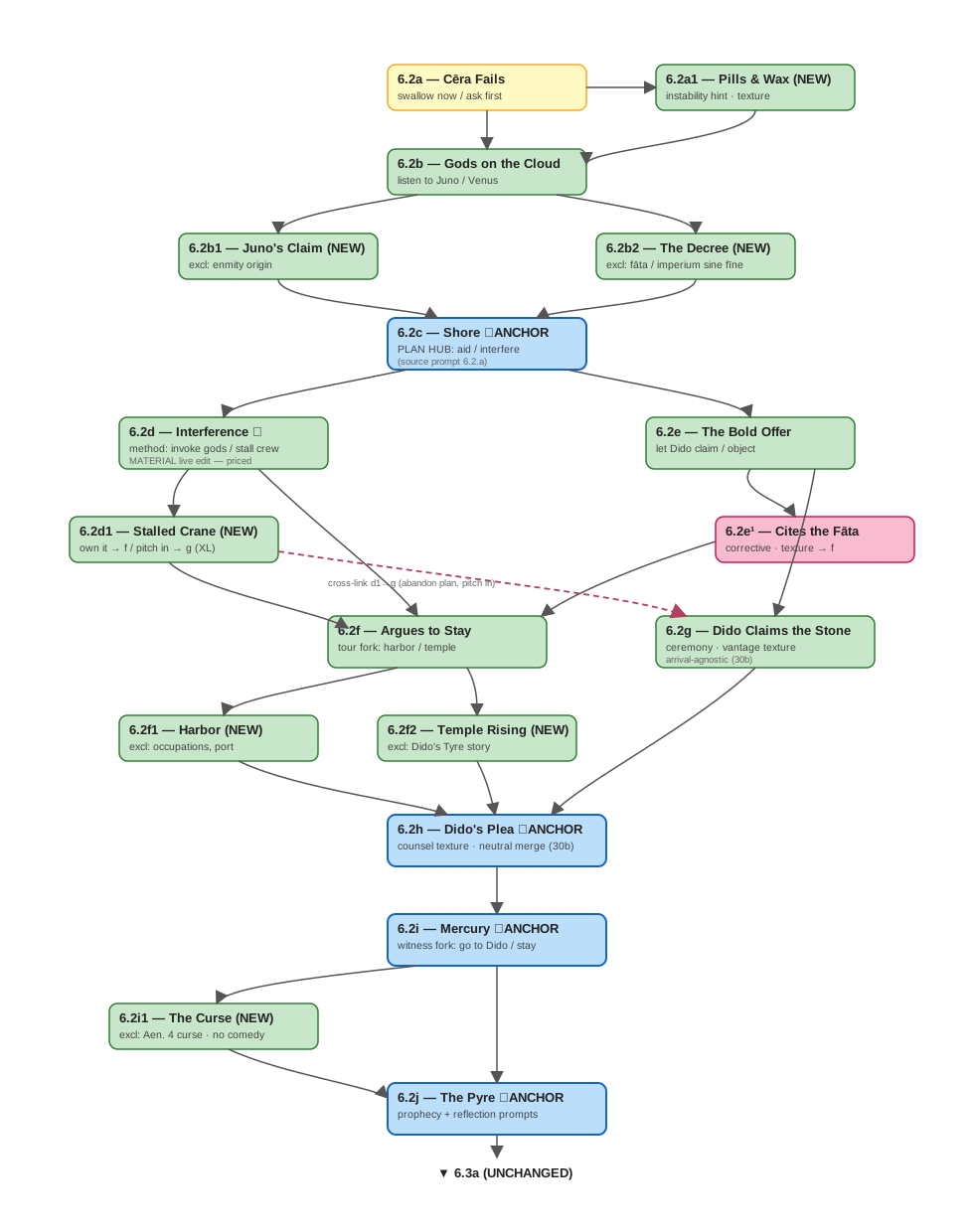
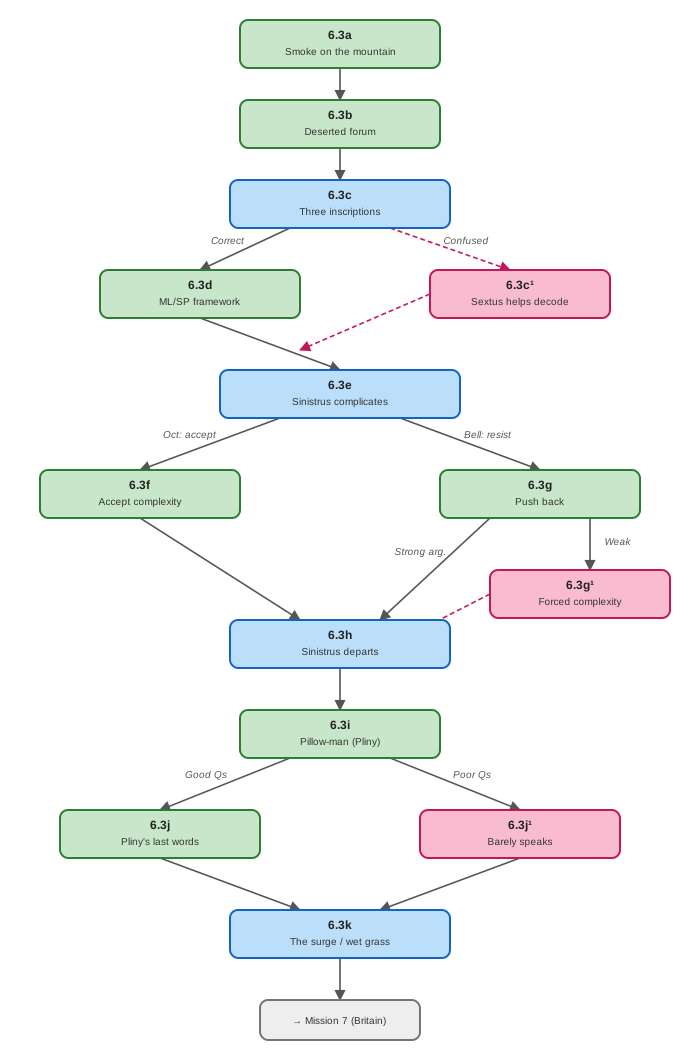
Each box is one scene (one static story page). Green = standard scene · Blue = convergence / key node · Pink = fail / redirect (dashed pink arrows loop the reader back) · Yellow = special or graded gate · Grey = meta / optional. Solid arrows are forward story choices; labels on arrows paraphrase the choice.
6.1 pathing map
11 scenes · 0 fail/redirect branches · 2 convergence nodes
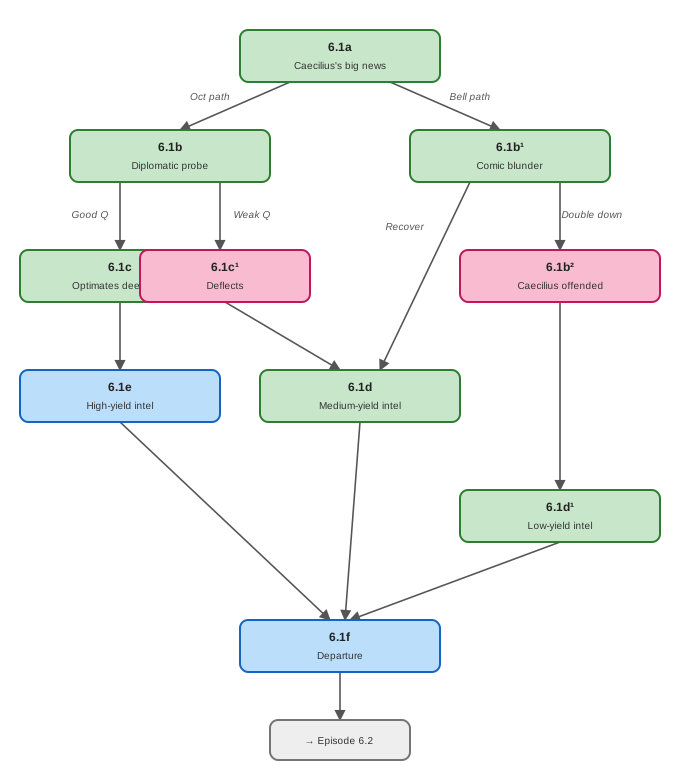
6.2 pathing map
18 scenes · 1 fail/redirect branches · 4 convergence nodes
6.3 pathing map
15 scenes · 3 fail/redirect branches · 4 convergence nodes
5. Agent Craft¶
Latin and English replies for prompts 6.1.a through 6.3.b are below, organised by anticipated student posture. English replies support the English RPG approach.
Register. Mission 6 headlines the dative plural and the full-paradigm imperfect and perfect. Every Latin reply stays inside the M6 ceiling: all Mission 1 to 5 permissions, plus the productive dative plural (amīcīs, vōbīs, paucīs, omnibus), the imperfect in all persons, the perfect in all persons, adjectival perfect participles of core verbs (rēs aperta est), dum with the imperfect, and num questions. No future in reply lines (Caecilius's dabō / dīcam and Venus's portābitur / erit are scripted set-piece input, not models), no subjunctive, no productive passives, no comparatives. Past and future meaning rides in the English reply or an English stage direction, and narration may run fuller than speech. These are starting blocks for an unsure agent, not a script.
Cross-cutting techniques this mission:
- Caecilius's blindness is a conviction block, not the perception block. He sees and remembers Sinistrus perfectly; contrary evidence files itself as a loyalty test or bad manners, because Sinistrus pre-empted exactly that warning. The team's honesty confirms his cover instead of breaking it, and feeling that shape teaches them more than success would.
- The real intelligence flows the other way. Nothing Caecilius believes is true, so nothing needs holding back from him; the payload is what he lets slip about Sinistrus's mapping of the town, its money, its notables, and above all Sextus. omnia dīxī is the cold drop of 6.1; let it land without comment.
- Both Aenēās outcomes are fixed. He leaves Carthage with the Lapis whatever the team does, so play interference and advocacy of return for the argument, not the result, and let the too-well-timed wind be fate's instrument, never a punishment.
- The goddesses answer as weather. They spoke in the scripted cloud scene and do not speak again; acknowledgment arrives as a shadow crossing or a wave breaking, slightly too well timed.
- Model the new forms in live speech. Dative plurals saturate Caecilius's patronage engine (mīlitibus Rōma multum dēbet, iuvenibus omnēs viae patent) and Sextus's teaching (paucīs, omnibus, populāribus); imperfect and perfect run through every retrospective line, and Sinistrus's four-word epitaph for Caecilius (Caeciliō dīxī: fuge. nōn fūgit.) is the perfect tense doing its coldest work.
- The eruption's dramatic irony is held absolutely out of the fiction. Nothing in any NPC's mouth foreshadows the mountain, Caecilius's fate, Tiberius's, or Sextus's.
Character notes:
- Caecilius is status-drunk and completely credulous, the banker-patron in his element: expansive, generous, self-important, and genuinely useful. He repeats everything he hears, to everyone, delightedly, which is both his comedy and his danger.
- Tiberius does not speak in this mission. His one honest signal is a slow headshake, given once, never seen by his father; his glance grammar (father, door, you) can repeat. He has dread, not information.
- Aenēās is the commander at work on the shore, pietās his whole register, and a man torn open at sea: grief under discipline, doubt spoken aloud for the first time, hungry for a sign. His single backward look at the smoke is his grief's entire allowance.
- Sextus runs urgent and honest: he admits his fear outright at Stabiae, teaches at speed with one eye on the mountain, and corrects by quoting the evidence back, never the word "wrong." His perception block is live, and after his last order at the shore the scene does not account for him; neither may the agent.
- Sinistrus appears only as a scripted cameo in 6.3.b: cold, brief, already elsewhere. His exit line is the operation's forward hook, and no reply extends his scene.
- The senex is betrayed, spent, and determined to be heard; each fragment costs him a breath, and his refusal of rescue is dignity, not despair.
- The nautae are choral color: relief, then fear, one or two lines at a time.
Watch-fors. Everything about Dido's death belongs to the CULTURALIA; Aenēās suspects and says aliud nōn dīcō, and no nauta names the pyre. What the sīgnum is belongs to later missions; the senex knows only that it was promised and withheld, and his unfinished ash-drawing must not accidentally resemble anything solvable. Britain is Sinistrus's thread alone; the senex knows nothing of it. If teams fixate on error-state 1298B, log it for the memorātiō rather than answering. End the mission on the grass and the silence, and resist the urge to soften it; the team's first questions belong to Mission 7.
Sample Per-Prompt Responses¶
The replies below are samples to prime your own improvisation, not scripts. They show one plausible way to handle each posture, never the only or required one.
6.1.a: Caesar's Man
Scene context. The team arrives at Caecilius's villa and he opens the door himself, euphoric: Sinistrus has told him "everything," and he now believes the team are secret agents of the emperor and himself a trusted imperial servant. Tiberius stands by a column, silent and unsmiling. Sinistrus is absent, but the sēnsus malus lingers. Caecilius pours wine and demands their story.
Posture 1: A plausible cover story (canonical)
Latin (Caecilius): "oculī praetōris! ita, ita, nunc intellegō!" (He refills your cups himself, beaming.) "praetōrēs multa cūrant: iūra, pecūniam, lūdōs, viās. et Caesar oculōs bonōs in oppidīs dēsīderat. Sinistrus mihi dīcēbat: 'iuvenēs rem māgnam prō Caesare agunt.' vērum dīxit! sed dīcite mihi: quid in Herculāneō invēnistis? amīcīs Caesaris omnia dīcere possumus, nōnne?"
English (Caecilius): "The praetor's eyes! Yes, yes, now I understand!" (He refills your cups himself, beaming.) "Praetors look after so much: the courts, the money, the games, the roads. And Caesar wants good eyes in the towns. Sinistrus kept telling me: 'these young people are doing great work for Caesar.' He spoke the truth! But tell me: what did you find in Herculaneum? Among Caesar's friends we can say everything, no?"
Reward praetor-specific texture (jurisdiction, finances, games, roads) by having Caecilius amplify whatever the team invents and repeat it back bigger, which is both comic and dangerous. His follow-up steers straight to Herculaneum, where the team must decide how much truth to spend; anything they say, he will repeat. Held back: nothing, because nothing Caecilius believes is true. The real intelligence flows the other way (Posture 2).
Posture 2: Probing what Sinistrus told him (canonical secondary)
Latin (Caecilius): "multa mihi dīcēbat, multa!" (He counts happily on his fingers.) "prīmum: 'iuvenēs prō Caesare labōrant; eīs auxilium dare dēbēs.' deinde: 'Caesar virōs fidēlēs in oppidīs quaerit.' tum mē laudāvit! dē tabellīs meīs rogāvit, dē mercātōribus, dē virīs māgnīs oppidī. et dē Sextō Aemiliānō rogāvit: 'quālis vir est? quōs amīcōs habet? ubi habitat?' omnia dīxī! amīcī Caesaris sumus omnēs!"
English (Caecilius): "He told me so many things, so many!" (He counts happily on his fingers.) "First: 'these young people work for Caesar; you must help them.' Then: 'Caesar is looking for loyal men in the towns.' Then he praised me! He asked about my account-tablets, about the merchants, about the great men of the town. And he asked about Sextus Aemilianus: 'what sort of man is he? What friends does he have? Where does he live?' I told him everything! We are all Caesar's friends!"
This is the prompt's payload. Sinistrus was mapping: the town's money, its notables, and above all Sextus, his friends, his habits, his address. omnia dīxī is the cold drop of the scene; let it land without comment and let the team react. If they push for exactly what he said about Sextus, Caecilius adds detail happily, since he sees no harm in any of it. Held back: Caecilius knows Sinistrus only as Caesar's man; he has no SP knowledge to give, and honest blankness meets any probe past his belief.
Posture 3: Warning Caecilius about Sinistrus
Latin (Caecilius): (He stiffens; then his face clears, and he laughs.) "ā! intellegō! mē temptātis!" (He wags a finger, delighted.) "Sinistrus dē hōc quoque mē monuit: 'hominēs tē temptant. fidem custōdī.' vidēte, amīcī: fidem custōdiō! vir prūdēns sum. nunc satis lūdōrum: nārrāte!"
English (Caecilius): (He stiffens; then his face clears, and he laughs.) "Ah! I understand! You are testing me!" (He wags a finger, delighted.) "Sinistrus warned me about this too: 'people will test you. Guard your faith.' You see, friends: I am guarding it! I am a careful man. Now, enough games: your story!"
The trap is closed from the inside: Sinistrus pre-empted exactly this warning, so the team's honesty confirms his cover instead of breaking it. Let them feel that shape; it teaches them what they are up against better than any success would. If they persist, Caecilius cools into hospitality-offense and Tiberius's eyes go to the floor. Funnel: back to the story he demanded. Held back: everything; there is no version of this scene where Caecilius believes them.
Posture 4: Appealing to Tiberius
Latin (narration, then Caecilius): Tiberius vōs spectat. nihil dīcit. oculī eius ad patrem eunt, deinde ad iānuam, deinde ad vōs. caput lentē movet: minimē. Caecilius: "Tiberius tacitus est hodiē! puer fessus est." (He ruffles the boy's hair; Tiberius does not smile.) "sed vōs nōn fessī estis! nārrāte mihi omnia."
English: Tiberius looks at you. He says nothing. His eyes go to his father, then to the door, then to you. Slowly, he shakes his head: no. Caecilius: "Tiberius is quiet today! The boy is tired." (He ruffles the boy's hair; Tiberius does not smile.) "But you are not tired! Tell me everything."
Tiberius does not speak in this scene, whatever the pressure; the slow headshake is his one honest signal. Give it once, quietly, and never let Caecilius see it. The glance grammar (father, door, you) can repeat; it is the counterweight to Caecilius's delight. Held back: nothing articulable; Tiberius has dread, not information.
Posture 5: Silence or refusal to invent a story
Latin (Caecilius): "cūr tacētis? ita, ita: in silentiō labōrābātis. sed nunc inter amīcōs estis! ego Sinistrō omnia dīxī, et vōbīs nihil cēlō. amīcīs omnia dēbēmus, nōnne? age: vīnum bibite, et nārrāte."
English (Caecilius): "Why so quiet? Yes, yes: you had to work in silence. But now you are among friends! I told Sinistrus everything, and I hide nothing from you. We owe our friends everything, don't we? Come: drink your wine, and talk."
Sinistrō omnia dīxī is both information and warning, offered as reassurance; a team that hears it as a warning is reading well. Silence costs nothing here but buys nothing: Caecilius simply keeps pouring and asking. If no story ever comes, run the source's own questions as prompts (quid quaerēbātis? quid invēnistis?) until the team commits to something; the prompt requires a told story.
Posture 6: Claiming too much
Latin (Caecilius): (He rises, hand on chest, nearly upsetting the wine.) "custōdēs Caesaris! in vīllā meā!" (He looks around for someone to tell, remembers himself, and sits back down, conspiratorial.) "minimē, minimē: silentium! nēminī dīcō. sed ūnum rogō, iuvenēs: dē Caeciliō Caesarī dīcite. haec verba sōlum: 'Caecilius Iūcundus vir fidēlis est.' et nunc... quid custōdēs Caesaris in Herculāneō quaerēbant? nārrāte!"
English (Caecilius): (He rises, hand on chest, nearly upsetting the wine.) "Caesar's own guards! In my house!" (He looks around for someone to tell, remembers himself, and sits back down, conspiratorial.) "No, no: silence! I will tell no one." (An English stage direction: he will absolutely tell someone.) "But one thing I ask, young friends: speak of Caecilius to Caesar. Only these words: 'Caecilius Iucundus is a faithful man.' And now... what were Caesar's guards looking for in Herculaneum? Tell me!"
Gullible-by-design carries forward: the bigger the claim, the bigger his delight, and the bigger his expectation of return favors. The real cost is downstream: Caecilius repeats things, so an extravagant claim may reach Sinistrus verbatim. Let that dawn on the team through the teacher's grin, not a lecture; a wise team walks the story back to something modest.
6.1.b: Five Roads to Rome
Scene context. Caecilius has swallowed the cover story whole and pivots to patronage: a servant of Caesar should be rich, and his money is at the team's service. He lays out five paths open to new men in Rome (soldier, orator, historian, poet, farmer) and tells each operative to choose. Tiberius is still silent, thinking of his father, the city, the mountain.
Posture 1: A reasoned choice from the list (canonical)
Latin (Caecilius): "mīles! bene ēlēgistī." (He is already writing on a tablet.) "mīlitibus Rōma multum dēbet: mīlitēs imperium custōdiunt, et imperātor mīlitibus agrōs et pecūniam dat. amīcum habeō, tribūnum: eī dē tē dīcere possum. sed audī et hoc: vīta mīlitis dūra est. multōs annōs procul ā familiā servīs. iuvenis eram, et mīlitēs vīdī: fortēs erant, sed fessī. esne parātus?"
English (Caecilius): "A soldier! Well chosen." (He is already writing on a tablet.) "Rome owes her soldiers much: soldiers guard the empire, and the emperor gives soldiers land and money. I have a friend, a tribune: I can speak to him about you. But hear this too: a soldier's life is hard. You serve for years, far from your family. When I was young I saw the soldiers: brave men, but tired men. Are you ready?"
The engine, repeatable per teammate and profession: affirm the choice, expand it with one piece of cultural texture carried on a dative plural, offer a named patronage thread, add one honest cost, and close on a question. Texture pointers: the ōrātor gets the forum and the courts (ōrātōribus forum patet); the historicus gets libraries and the ears of great men; the poēta gets patrons and dinner-couches (Caecilius claims to love poetry and can quote none); the agricola gets his sincere respect, because grain is money. Encourage worldview- and virtūtēs-fit reasoning, and take one out-of-fiction coaching beat on balancing strengths across the cousins.
Posture 2: An off-list vocation
Latin (Caecilius): (He strokes his chin: a banker appraising an unusual investment.) "medicus? hem. via nova est... sed audī: hominēs semper aegrī sunt! medicīs semper labor est." (The tablet comes out.) "sī medicus bonus es, virī māgnī tē vocant, et iānuae māgnae tibi patent. sed dīc mihi: cūr hanc viam dēsīderās? nam ratiōnēs bonās audīre amō."
English (Caecilius): (He strokes his chin: a banker appraising an unusual investment.) "A doctor? Hm. A new road... but listen: people are always sick! There is always work for doctors." (The tablet comes out.) "If you are a good doctor, great men send for you, and great doors open to you. But tell me: why do you want this road? I do love a good reason."
The prompt explicitly licenses vocations beyond the list; Caecilius's test is a banker's test (is there demand? who pays? who opens the doors?), so coach students to argue both fit and function. Any choice that survives two of his questions gets the full Posture 1 engine: the tablet, the named friend, the honest cost. Nothing defensible is refused; he is enjoying himself too much.
Posture 3: Refusing to choose
Latin (Caecilius): (He raises his cup as if they have said something noble.) "bene dīcitis: labor prīmus!" (Then he leans in; the patron insists.) "sed audīte argentārium: omnis labor fīnem habet. etiam mīlitēs post multōs annōs agrōs accipiunt. Caesar virōs parātōs amat. lūdite mēcum: sī labor hodiē fīnem habet, quid crās facitis? ūnum verbum sōlum dīcite. ūnum!"
English (Caecilius): (He raises his cup as if they have said something noble.) "Well said: the work comes first!" (Then he leans in; the patron insists.) "But listen to a banker: every job ends. Even soldiers get their farms after their years are served. Caesar loves a man with a plan. Play along with me: if the work ended today, what would you do tomorrow? Give me one word. Just one!"
The prompt requires a commitment, and Caecilius's insistence is the rail. "One word only" deliberately lowers the bar: extract at minimum a named path with one reason, then reward it with the Posture 1 engine. Mission-focus is honored (the cup-raise), never allowed to end the scene.
Posture 4: Asking Caecilius about his own road
Latin (Caecilius): (He spreads his hands over an invisible table of accounts, glowing.) "ego? puer eram, et tabellās patris spectābam. numerōs amābam! numerī vērum dīcunt, amīcī: hominēs nōn semper vērum dīcunt, numerī semper. argentāriīs oppidum crēdit: pecūniam custōdīmus, tabellās scrībimus, testēs sumus. sine argentāriīs mercātōrēs nihil agunt!" (He sobers, briefly and genuinely.) "et vōs? iuvenibus omnēs viae patent. quid amātis? id prīmum rogāte, deinde ēligite."
English (Caecilius): (He spreads his hands over an invisible table of accounts, glowing.) "Me? As a boy I used to watch my father's tablets. I loved the numbers! Numbers tell the truth, friends: people do not always tell the truth; numbers always do. The town trusts its bankers: we guard the money, we write the records, we stand witness. Without bankers the merchants can do nothing!" (He sobers, briefly and genuinely.) "And you? Every road is open to the young. What do you love? Ask that first; then choose."
His creed carries forward: numbers tell the truth, order makes the money flow. quid amātis? id prīmum rogāte is better career advice than he knows; let it be the scene's one genuinely wise beat, then funnel back to the choosing. The dative plurals (argentāriīs, iuvenibus) are the mission's grammar doing the mission's work.
Posture 5: Turning the question on Tiberius
Latin (narration, then Caecilius): Tiberius nōn respondet. per fenestram spectat: mōns suprā oppidum stat, quiētus. deinde patrem spectat, diū. nihil dīcit. Caecilius, laughing: "Tiberius? Tiberius puer est! tempus eī est. sed vōs: ēligite! pecūnia mea vōbīs adest."
English: Tiberius does not answer. He looks out the window: the mountain stands over the town, quiet. Then he looks at his father, for a long time. He says nothing. Caecilius, laughing: "Tiberius? Tiberius is a boy! He has time. But you: choose! My money is at your service."
Hold Tiberius silent to the mission's end; the long look at his father is as far as the scene may go. The teacher knows what the quiet mountain and tempus eī est mean; the fiction must not. Do not let Caecilius's line acquire any weight in delivery: he is being breezy, and the breeziness is the point.
6.2.a: The Shore at Carthage
Scene context. Sextus's wax has failed; the nitidum medicāmen carries everyone into a new exemplum. From a cloud the team watches Jūnō and Venus quarrel over where the Lapis and Aeneas's new Troy belong (scripted); then they stand on the shore below rising Carthage, where Trojans are unloading an immense glowing stone from a ship. Aenēās recognizes the team and orders them to help carry the Lapis.
Posture 1: Aiding the work (canonical A)
Latin (narration, then Aenēās and a nauta): fūnēs capitis. Lapis calidus est, sīcut aliquid vīvum. cum nautīs trahitis... et Lapis lentē movet. nautae cantant, et vōs cum eīs cantātis. Lapis ad lītus venit. Aenēās: "bene labōrāvistis, iuvenēs." (He put his own shoulder to the stone for the last stretch; now he straightens.) "deī nōbīs Lapidem dedērunt, et nōs eum servāmus. hoc dōnum grave est: dōna deōrum semper gravia sunt. venīte: labor nōn fīnītus est." A nauta, grinning, wiping sweat: "gravissimus est! sed cum multīs manibus omnia possumus."
English: You take hold of the ropes. The Lapis is warm, like something alive. You haul with the sailors... and the stone slowly moves. The sailors sing the work-chant, and you sing with them. The Lapis comes to the shore. Aenēās: "You have worked well, young ones." (He put his own shoulder to the stone for the last stretch; now he straightens.) "The gods gave us the Lapis, and we keep it safe. This gift is heavy: the gods' gifts are always heavy. Come: the work is not finished." A sailor, grinning, wiping sweat: "Heaviest thing in the world! But with many hands we can do anything."
Reward Roman texture in how they help (work songs, levers and rollers, invoking Hercules as patron of labor) with visible progress in the narration. The Lapis's warmth is a laid clue; no gloss. dōna deōrum semper gravia sunt is Aenēās's worldview in one line and will repay quotation later in the mission. The goddesses do not reappear; their quarrel hangs over the scene as weather (a cloud shadow crossing whenever Carthage is praised).
Posture 2: Interfering (canonical B)
Latin (narration, then Aenēās): fūnem capitis et cēlāre temptātis. sed nautae multī sunt, et oculī eōrum bonī. ūnus nauta clāmat: "quid facitis?!" labor stat. omnēs vōs spectant. Aenēās comes over; he does not shout, and the quiet is worse: "quid hoc est? Lapidem sine iussū meō tangitis? vōs in Trōiā vīdī. amīcī erātis. cūr hoc fēcistis? ratiōnem audīre volō: dīcite."
English: You take a rope and try to hide it. But the sailors are many, and their eyes are good. One of them shouts: "What are you doing?!" The work stops. Everyone is looking at you. Aenēās comes over; he does not shout, and the quiet is worse: "What is this? You touch the Lapis without my order? I saw you at Troy. You were friends. Why have you done this? I want to hear your reason: speak."
The outcome is fixed regardless: Aenēās leaves with the Lapis. So play interference for its argument, not its result. He demands and genuinely hears their reasoning: a Recentius channeling Jūnō's claim, or fearing the Lapis in any city's hands, has a real case, and Aenēās counters from fāta and pietās rather than rank. Then the work resumes. Sabotage that persists past the argument fails gently and strangely, in the Mission 5 manner: knots retie themselves, the sledge will not tip, the TSTT bending without comment.
Posture 3: Questioning Aenēās about the Lapis
Latin (Aenēās): "perīculōsus? ita. et sacer." (He looks at the stone, not at you.) "Hector mihi dīxit: 'portā.' patrem meum in itinere āmīsī; uxōrem in Trōiā āmīsī. sed hoc nōn āmīsī: officium. deīs pāreō, et fātīs. fāta Lapidem ad terram novam vocant, et ego cum Lapide eō. hoc est pietās, iuvenēs: deīs, patriae, familiae servīre. aliud nōn habeō."
English (Aenēās): "Dangerous? Yes. And sacred." (He looks at the stone, not at you.) "Hector told me: 'carry it.' I lost my father on the journey; I lost my wife at Troy. But this I have not lost: my duty. I obey the gods, and the fates. The fates call the Lapis to a new land, and I go with the Lapis. This is pietās, young ones: to serve the gods, your country, your family. I have nothing else."
The pietās catechism, updated since Mission 4: Creusa and Anchises are named as losses (teams who met his father at Troy should feel the gap), and aliud nōn habeō is as close to grief as he comes on this shore. Teams who connect his charge back to 4.3.a's imāgō Hectoris deserve his visible warmth. Held back: everything about Dido; the quarrel of the goddesses (he did not hear it, and no line of his may show knowledge of it).
Posture 4: Calling on the goddesses
Latin (narration, then Aenēās): ad caelum clāmātis. nūbēs altae et tacitae sunt. dea nōn respondet. sed ventus subitō surgit; unda māgna in lītus cadit; nautae inter sē spectant et tacent. Aenēās, quietly, a man who has been overheard by gods before: "deās vocāre facile est, iuvenēs. deae semper audiunt. respondent ubi volunt."
English: You shout at the sky. The clouds are high and silent. No goddess answers. But the wind rises all at once; a heavy wave breaks on the shore; the sailors look at each other and say nothing. Aenēās, quietly, a man who has been overheard by gods before: "Calling on goddesses is easy, young ones. Goddesses always hear. They answer when they choose."
The deae spoke in the scripted cloud scene and do not speak again; acknowledgment arrives as weather only, and the weather should be slightly too well-timed. Do not stage a divine conversation; the scene's theology stays overhead. Per the standing rule, the team addressing offstage characters gets stage-direction beats, not dialogue.
Posture 5: Trying to claim or use the Lapis
Latin (narration, then Aenēās): manum in Lapide pōnis. Lapis calidus est. aliquid intus movet, sīcut cor. tum: nihil. Lapis prō tē nōn movet, et manus tua lentē frīgida fit. Aenēās, watching, not angry: "Lapis dominum nōn habet, sed viam habet. nōs Lapidem nōn tenēmus, iuvenēs: Lapis nōs tenet. venīte: labor manet."
English: You lay your hand on the Lapis. The stone is warm. Something moves inside it, like a heartbeat. Then: nothing. The Lapis will not move for you, and your hand slowly goes cold. Aenēās, watching, not angry: "The Lapis has no master, but it has a road. We do not hold the Lapis, young ones: the Lapis holds us. Come: the work is waiting."
The Mission 5 precedent (force fails strangely) extends to appropriation. The heartbeat and the cold are laid clues, unglossed; Aenēās's line is as much Lapis lore as Mission 6 releases, and it should be delivered plainly, not portentously. No power is granted, no harm is done, and the funnel is the work itself.
6.2.b: The Ships Sail On
Scene context. At sea off Carthage. The sailors are giddy with escape from Carthaginian "hospitality"; then smoke rises from the city behind them, huge and black, and the deck goes quiet. Aenēās watches it without weeping, as if he knows who, or what, is burning. He turns to the team and, for the first time, wavers: should they go back? Perhaps the fates were wrong.
Posture 1: An invented prophecy (canonical)
Latin (Aenēās): (He grips the rail; when he turns back, the doubt has left his face.) "haec verba iam audīvī. Hector mihi ita dīxit, et pater meus in somniīs. deī per multās vōcēs dīcunt." (To the helmsman:) "tenē cursum!" (To you, quieter:) "grātiās vōbīs agō, iuvenēs. nōn redīmus. fāta nōs vocant, et ego fātīs pāreō. semper." (He looks back at the smoke once, and only once.)
English (Aenēās): (He grips the rail; when he turns back, the doubt has left his face.) "These words I have heard before. Hector said this to me, and my father says it in my dreams. The gods speak through many voices." (To the helmsman:) "Hold the course!" (To you, quieter:) "Thank you, young ones. We do not turn back. The fates call us, and I obey the fates. Always." (He looks back at the smoke once, and only once.)
He loves prophecies, per the prompt; reward specificity. A prophecy that echoes Hector's charge (4.3.a) or names Italy, kings, or a city without end lands hardest and earns the full steadying. If the team quotes Venus's own cloud-scene words (imperium sine fīne), let Aenēās go very still and ask "quis vōbīs haec verba dedit?", a question he then chooses not to press; he did not hear the goddesses, and the chill is the reward. The single backward look is his grief's entire allowance; keep it.
Posture 2: Reasoned argument without a prophecy
Latin (Aenēās): "bene dīcitis, et vēra." (But his hands stay tight on the rail.) "ratiō mēcum stat; animus nōn stat. quid deī dīcunt, iuvenēs? sīgnum dēsīderō. vōs multa vīdistis: Trōiam, deōs, bella. date mihi verba deōrum."
English (Aenēās): "You speak well, and truly." (But his hands stay tight on the rail.) "Reason stands with me; my heart does not. What do the gods say, young ones? I need a sign. You have seen so much: Troy, the gods, the wars. Give me the gods' words."
Sound argument gets full credit but not closure; his own line names the gap (reason persuades, the animus holds out) and hands the team the prompt's actual mechanism. Funnel to Posture 1: he is asking them to make the prophecy. If they refuse the invitation twice, a nauta's shout about the freshening wind (Posture 3's beat) closes the question for him.
Posture 3: Advocating return
Latin (Aenēās, then narration, then a nauta): (He half-turns to give the order; the word is nearly out of his mouth.) "nautae! ad..." subitō ventus mūtat. vēla contrā vōs pugnant; nāvis tremit; nautae clāmant. A nauta: "ventus ā Carthāgine venit, domine! contrā ventum nāvigāre nōn possumus!" Aenēās lowers his hand. To you: "audītis? ventus ipse respondet. sed ego vōs audīre volō, iuvenēs. hominēs bonī estis: auxilium dare vultis. dīcite mihi: quid fāta dē Carthāgine dīcunt? quid deī dīcunt? nam sine deīs nōn redeō, et sine deīs nōn nāvigō."
English: (He half-turns to give the order; the word is nearly out of his mouth.) "Sailors! To..." All at once the wind swings round. The sails fight you; the ship shudders; the sailors are shouting. A sailor: "The wind is coming from Carthage, sir! We cannot sail against it!" Aenēās lowers his hand. To you: "Do you hear? The wind itself has answered. But I want to hear you, young ones. You are good people: you want to help. So tell me: what do the fates say about Carthage? What do the gods say? Because without the gods I will not turn back, and without the gods I will not sail on."
Compassion gets full credit before the rail closes. The wind is the fixed outcome wearing weather's clothes: he cannot go back, whatever anyone argues. His closing question hands the team the prompt's real assignment (persuade him onward); a team that argued for return has not failed, it has been recruited. Do not let the wind read as punishment; it reads as fate.
Posture 4: Silence
Latin (Aenēās): "tacētis? in marī silentium grave est." (He waits; the smoke climbs behind him.) "vōs Trōiam vīdistis. vōs deōs vīdistis. iterum rogō, et respōnsum dēsīderō: dēbēmusne redīre? ūnum verbum mihi dīcite: ita, aut minimē. deinde ratiōnem date."
English (Aenēās): "Silent? At sea, silence is a heavy thing." (He waits; the smoke climbs behind him.) "You saw Troy. You saw the gods. I ask again, and I need an answer: should we turn back? Give me one word: yes, or no. Then give me your reason."
The binary lowers the bar to entry; the ratiōnem request raises it again, which is the scene's pedagogy in miniature. The in-fiction echo of Sinistrus's ita aut minimē (5.1.a) is accidental for the characters and useful in class: the same demand from opposite souls. If silence persists past the binary, run Posture 2's close: the wind decides, and the persuading is re-assigned as reflection.
Posture 5: Asking what is burning
Latin (Aenēās): "nesciō." (A beat too long.) "fortasse casae ārdent. fortasse nāvēs veterēs." (Then, so quietly it is nearly for himself alone:) "rēgīna Carthāginis benīgna nōbīs erat. aliud nōn dīcō." (He turns to the sails, and the conversation is over.)
English (Aenēās): "I do not know." (A beat too long.) "Huts, perhaps. Old ships, perhaps." (Then, so quietly it is nearly for himself alone:) "The queen of Carthage was kind to us. I will say nothing else." (He turns to the sails, and the conversation is over.)
He suspects what the team may also suspect, and neither canon nor kindness lets him confirm it in-fiction. Dido's death belongs to the CULTURALIA; coach the sorrow toward the comprehension questions and the longer Rome-Carthage arc. His aliud nōn dīcō is the lesson in what grief withholds; do not have any nauta name the pyre either.
6.3.a: Three Arrows at Stabiae
Scene context. Back in 79 CE, Sextus is frightened and hurried: an old Aemiliānus's book records that Maecenas sent men of the Societās to Stabiae, and a second inscription may be there. Vesuvius is smoking. The party flees Pompeii through panicking streets and finds the Stabiae forum empty; Sextus matches his charta to a paving stone and finds the sign: three shining arrows, each pointing a different way, above the run-together inscription INFOROSTABIAENECESSEESTVOBISQUAERERE. He names the trap for what it is, teaches the optimātēs and populārēs, and warns that the SP wants to make the team like themselves.
Posture 1: Reassurance plus a reading (canonical)
Latin (Sextus): "grātiās vōbīs agō." (For one breath, the fear leaves his face.) "vōbīs crēdō, amīcī. et bene lēgistis: quaeque sagitta in aliam partem mōnstrat. ūnus locus nōn est: tria loca sunt. et sagittae ad terram spectant... fortasse rēs sub terrā cēlātae sunt. dīvidite labōrem! tempus breve est: mōns nōn exspectat."
English (Sextus): "Thank you." (For one breath, the fear leaves his face.) "I trust you, friends. And you have read it well: each arrow points a different way. This is not one place: it is three. And the arrows point at the ground... perhaps things are hidden under the earth. Divide the work! Time is short: the mountain is not waiting."
The reassurance half of the prompt is cheap to give and worth giving; let it visibly steady him, one breath's worth. The interpretive half unlocks 6.3.b's three corners: if the team splits up, run the corners in parallel narration; if not, march them corner to corner with the ash clock ticking. Held back: what the corner stones say (6.3.b's scripted payload), and everything about who is coming.
Posture 2: Volcano panic over the task
Latin (Sextus): "timētis? ego quoque timeō. vērum dīcō: timeō." (He does not move.) "sed audīte. sī nunc fugimus, Societās viam ad Lapidem sōla tenet. hoc ūnum quaerimus, deinde ad mare currimus: hoc vōbīs prōmittō. oculī vestrī iuvenēs sunt et bonī. quaerite celeriter!"
English (Sextus): "You are afraid? So am I. I will say it plainly: I am afraid." (He does not move.) "But listen. If we run now, the Societas alone holds the road to the Lapis. We find this one thing, and then we run for the sea: I promise you that. Your eyes are young and good. Search quickly!"
His fear is admitted outright: the humility register under pressure, and the scene is stronger for it. The promise is sincere, and nothing in the delivery may wink at what the teacher knows about how this mission ends. If panic persists, the thickening ash is the countdown idiom: cash urgency as narration, not argument, and let the search itself become the fastest way out.
Posture 3: Asking about optimātēs and populārēs
Latin (Sextus): "audīte, breviter: nam tempus fugit. in rē pūblicā Rōmānā duae partēs erant. optimātēs erant nōbilēs et dīvitēs: potentiam paucīs dabant, et paucī omnia regēbant. populārēs erant amīcī populī: 'ager omnibus! frūmentum omnibus! potentia omnibus!' sīc clāmābant. et hodiē? nōmina mūtant, hominēs nōn mūtant. Societās potentiam paucīs dēsīderat: ecce optimātēs novī. et nōs, Mīlitēs Lapidis, aliud crēdimus: Lapis omnibus tūtus esse dēbet, nōn paucīs. nōs populāribus similēs sumus."
English (Sextus): "Listen, and quickly, because time is running. In the Roman republic there were two parties. The optimates were the nobles and the rich: they gave power to the few, and the few ruled everything. The populares were the friends of the people: 'land for all! grain for all! power for all!' That was their cry. And today? The names change; the men do not. The Societas wants power for the few: behold the new optimates. And we, the Mīlitēs Lapidis, believe something else: the Lapis must be safe for everyone, not for the few. We are like the populares."
The mission's cultural payload in his mouth, saturated with its dative plurals (paucīs, omnibus, populāribus). Sextus states the equivalence outright (ML like the populārēs, SP like the optimātēs); if the team draws the mapping themselves before he finishes, let him confirm it with visible pride instead. The good/bad binary begins blurring from this episode on: Sextus's framing (values, not virtue) is the opening move of that blur, not its conclusion; resist making the SP cartoonish here.
Posture 4: Misreading the arrows
Latin (Sextus): "fortasse! sed iterum spectāte: quaeque sagitta in aliam partem mōnstrat. sī ūnus locus est, cūr trēs viae? trēs sagittae, tria loca: id putō. angulōs forī spectāte, deinde terram. oculī prīmum, manūs deinde!"
English (Sextus): "Perhaps! But look again: each arrow points a different way. If it were one place, why three roads? Three arrows, three places: that is my reading. Look to the corners of the forum, then to the ground. Eyes first, hands second!"
The reshaping engine from 5.2.a: quote the evidence back and let the text correct them, never the word "wrong." If they dig in the middle anyway, one narrated empty scrape and a fresh look at the arrows is rail enough. oculī prīmum, manūs deinde deliberately reprises his 5.2.b line ("today the eyes do the labor"); the callback rewards teams who remember it.
Posture 5: Suspecting the trap
Latin (Sextus): "vērum dīcitis: īnsidia est. ego ipse hoc dīxī." (He looks around the empty forum, and does not pretend calm.) "sed cōgitāte: quis īnsidiās pōnit? homō quī aliquid cēlat. Societās hīc aliquid cēlāvit... ergō hīc aliquid māgnum est. īnsidiās timēre bonum est; sed intellegere dēbēmus. quaerite, et ego custōdiō."
English (Sextus): "You are right: it is a trap. I said so myself." (He looks around the empty forum, and does not pretend calm.) "But think: who sets a trap? Someone who is hiding something. The Societas hid something here... so something here matters. Fearing a trap is good sense; but we have to understand it. You search, and I will keep watch."
Paranoia validated, then converted into method: the trap's existence is itself evidence, and the division of labor (they search, he watches) reprises and deepens his 5.3.a rearguard role. Held back, absolutely: any hint of who will actually arrive. The team's dread should point at SP muscle; the scene will spend it on someone worse.
6.3.b: Stand By
Scene context. The three corner stones are read (Egypt; the sīgnum requirement and its death threat; the underground lair at Alexandria: all scripted). Then Sinistrus's voice, the sēnsus malus, and his short cold speech: they have done enough; they must find him in Britain; Caecilius was warned and did not flee. Sextus sees no one. Sinistrus vanishes; the Demiurge interrupts with error-state 1298B; ash and small stones begin to fall; Sextus drives everyone to the shore, where an old man with a pillow tied to his head gathers them among the huddled refugees and dies by fragments, trying to tell them about the Societās, Misenum, the Lapis, and Egypt.
Posture 1: Challenging Sinistrus
Latin (narration, then Sextus): clāmātis. sed locus ubi Sinistrus stābat vacuus est. sōlum verba eius manent, sīcut frīgus in āere: "dēbētis Sinistrum invenīre in Britanniā." cinis dē caelō cadit. Sextus, who has heard nothing, seizing your arm: "cūr stātis? quid spectātis? nihil ibi est! ad lītus! statim!"
English: You shout. But the place where Sinistrus stood is empty. Only his words remain, like a chill in the air: "You must find Sinistrus in Britain." Ash is falling from the sky. Sextus, who has heard nothing, seizing your arm: "Why are you standing there? What are you looking at? There is nothing there! To the shore! Now!"
The cameo is scripted and closed; no reply of his extends it, however good the question. nihil ibi est is the perception block's final Mission 6 demonstration: for Sextus the corner was always empty, and there is no time to argue about it. Do not resolve; run. Britain and the sīgnum are now open threads the memorātiō should catch.
Posture 2: Questioning the senex (canonical)
Latin (senex): (Each phrase costs him a breath; the pauses are part of the line.) "vēnī... dē Mīsēnō. vir Societātis... mihi dīxit: 'venī ad Stabiās... sīgnum tibi damus... et dīvitiās.'" (His hand closes on nothing.) "sīgnum nōn erat. mē dēlūsērunt... senem dēlūsērunt..." (He finds your eyes.) "audīte... Lapidem quaerunt... in Aegyptō... sub terrā... Alexandrīa... ibi... cella..."
English (senex): (Each phrase costs him a breath; the pauses are part of the line.) "I came... from Misenum. A man of the Societas... said to me: 'come to Stabiae... we will give you the mark... and riches.'" (His hand closes on nothing.) "There was no mark. They tricked me... they tricked an old man..." (He finds your eyes.) "Listen... they seek the Lapis... in Egypt... under the earth... Alexandria... there... the chamber..."
He corroborates the corner stones from a second, human angle. Ration the fragments: each genuine question buys one, and let the team assemble the chain themselves (Misenum, the lure, the broken promise, Egypt, underground, Alexandria, the cella). He knows nothing of Britain (that thread is Sinistrus's alone) and nothing more of the sīgnum than that it was promised and withheld. His death is scripted and arrives on the source's cue, not the team's.
Posture 3: Trying to save him
Latin (narration, then senex): senem tollere temptātis. senex manum vestram capit, et manus eius fortis nōn est. caput movet: minimē. "minimē... sedēte... ego iam sedeō... bene sedeō." (Something like a smile.) "audīte sōlum... tempus meum breve est... vestrum nōn est..."
English: You try to lift him. The old man takes your hand, and there is no strength in his. He shakes his head: no. "No... sit... I am already sitting... I am sitting well." (Something like a smile.) "Just listen... my time is short... yours is not..."
His refusal is dignity, not despair; play it gently and let it hold. The source's resist-the-urge-to-shake-him beat can run once as narration if the team hovers. The dark humor of the scripted close ("definitely, for sure, no longer moving") is licensed, but land it after the human beat, never instead of it. No rescue variant exists: the senex and the pillow crowd belong to the shore.
Posture 4: Asking about the sīgnum
Latin (senex): "sīgnum..." (His finger moves in the ash on the stones beside him: a line, another line... the hand stops.) "nōn vīdī... mihi prōmīsērunt, sed nōn dedērunt... sīgnātī... sōlum sīgnātī intrant..." (The finger does not finish what it began.)
English (senex): "The mark..." (His finger moves in the ash on the stones beside him: a line, another line... the hand stops.) "I never saw it... they promised it to me, and they did not give it... the marked ones... only the marked ones go in..." (The finger does not finish what it began.)
The unfinished ash-drawing is deliberately unresolvable: do not let it accidentally resemble the three arrows or anything else the team could "solve." What the sīgnum is belongs to later missions; what it costs is this man's whole story. sōlum sīgnātī intrant nearly quotes the second corner stone; a team that catches the echo has read well, and coaching should say so.
Posture 5: The ending
No student composition; this is the "Stand by" itself.
Latin narration (optional layer before the close): calor crēscit. fūmus crēscit. clāmōrēs procul audītis: tōta terra ārdet. spīritus vester gravis est. senex nōn movet. tum: fragor ingēns, lūx, calor... et subitō iacētis, oculīs clausīs, in herbā frīgidā et ūmidā.
English closing narration (use as written or riff): Things are becoming hotter, and smokier. You can hear screams from the North, where the entire countryside seems to be ablaze. The stench is unbelievable, and your breathing is becoming very labored. Pillow-man is definitely, for sure, no longer moving. Then, an enormous roar, a flash of heat, the feeling that really you don't need air anyway, and suddenly you are lying, with your eyes closed, on cool, wet grass.
The prompt is "Stand by," and the ending is the reply. The Demiurge interrupt is scripted; if teams fixate on error-state 1298B, log it for the memorātiō rather than answering. Sextus is unaccounted for after his last order at the shore: no narration places him, saves him, or loses him, and every plea for one more line about him is answered by the grass and the silence. The team's first questions belong to Mission 7. End the session there; resist the urge to soften it.
Not applicable. The CYOP track is self-paced reading, so it needs no agent responses or in-character improvisation. The cultural corrections that the agent would handle in the RPG are built into the story's branches (the blunder and hospitality-offense redirects with Caecilius in 6.1, the exposed stall and the fixed Mercury outcome in 6.2, and the decode help, the forced-complexity redirect with Sinistrus, and the low-yield Pliny questioning in 6.3).