Mission 12. The Mūsaeum, Cannae, and the SP Praetorium¶
1. Episode Overview¶
Essential Question
What happens when cultures meet?
ACTFL Proficiency Benchmarks — Intermediate Low
- Interpretive: I can understand the main idea and some related pieces of information on familiar topics from sentences and series of connected sentences in texts that are spoken, written, or signed.
- Presentational: I can provide information and express my thoughts about familiar topics, creating sentences and series of connected sentences through spoken, written, or signed language.
- Cultural Investigation: I can compare products and practices to understand perspectives from a variety of cultures and communities, including my own.
Cultural & Historical Learning Targets — student-facing
- Describe and summarize the importance of the Library of Alexandria: the Mūsaeum that Ptolemy I built for the Muses, its scholars fed by the king, the books copied from ships in the harbor, Caesar's fire of 48 BCE, and the neglect the place suffered under Rome.
- Summarize the conventions of Roman education, from the litterātor to the grammaticus and the rhētor, and explain how the scholars of the Mūsaeum did different work from a Roman school.
- Evaluate the writers who told the story of Hannibal's war, from the Greeks in his camp to Fabius Pictor, Polybius, and Livy, and explain what reason a reader might have to doubt each one.
- Describe and evaluate the circumstances of the Second Punic War, from Hannibal's oath and Saguntum through the crossing of the Alps, the Trebia, Lake Trasimene, Fabius the Delayer, and the double envelopment at Cannae, to Scipio's victory at Zama in 202 BCE and Hannibal's exile.
- Explain the war's importance to Roman identity: how Rome answered the defeat at Cannae, what the war made of Rome, and Polybius's account of Rome's strength in its shared government and in the funeral of a great man.
Grammatical Learning Objectives — teacher-facing
- The fourth declension, read off Lapis apud Poenōs and bibliothēca Alexandrīae: the genitive in -ūs in the dictionary entry; a nominative in -us like the second-declension servus, told apart by the genitive; mostly masculine, with manus and domus feminine; the endings on portus (ā senātū, cum exercitū, in portū, manū); and the warning that -ūs marks the genitive singular, the nominative plural, and the accusative plural. domus sometimes takes second-declension forms (12.1).
- The fifth declension, anchored on aciēs at Cannae: rēs and diēs; the nominative in -ēs and the genitive in -eī, with the e long after a vowel (aciēī, diēī) and short after a consonant (reī); the pair in mediā aciē and in mediam aciem; rēs as "thing" and as "matter" in Scipio's letter; and the warning that -ēs marks the nominative singular, the nominative plural, and the accusative plural (12.2).
- The five declensions told apart by the genitive singular, completing the dictionary-entry rule of 11.2: a table of the five genitive endings with examples from this episode's texts (prōvinciam senātūs), and the warning that a nominative in -us (servus, senātus) or in -ēs (rēs, clādēs) can belong to two declensions. "This" and "that" are held for Mission 13 (12.3).
- The mission's arc is a chain: 12.1 and 12.2 each add one of the last two declensions, and 12.3 sets all five side by side, so the genitive in a dictionary entry now sorts every Latin noun the students will meet.
Lapis thread
Mission 12 opens in Alexandria in 80 CE, with the team still weak from the training at the Lipari Islands. Outside Tertius's cave, Tiberius complains that Tertius talks exactly like his twin, and Tertius gives him the map in memoriā Sextī while the cave wall shifts toward the hidden team; if Tiberius sees them, Tertius warns, everything is lost. The team's news that the Carthaginians took the Lapis at the Lipari Islands sends them to the old Mūsaeum, poor and half in ruins under Rome, where the books trace the Lapis from the plunder of Lipara to a temple in Carthage, to the house of Hamilcar Barca, and to Spain, where his eldest son was Hannibal. Tiberius arrives with men Tertius takes for Potentēs, an earthquake brings down part of the wall, and Sinistrus appears in the dust and throws the team into a training at Cannae in 216 BCE, where Roman commanders repeat a rumor that Hannibal kept the Lapis on an elephant's back. From the team's account of the battle and the Mūsaeum's books, the TSTT finds the Potentēs' praetōrium in the rock near the pyramids. Tertius believes Hannibal carried the Lapis into exile, and the Potentēs are searching for it here. The team talks its way past a veteran doorkeeper, and in the dark below, a voice in the rock asks for its name: it is what made Rome strong and what was there in the beginning, and it laughs at anyone who thinks it is the Lapis.
Instructor background, withheld from students
Mission Control speaks in English, outside the frame. Sinistrus appears once in the RPG, at 12.2.a, in a scripted cameo that ends on "Enjoy!"; Tertius vanishes the instant before he arrives. Tertius still cannot perceive him: if an operative names Sinistrus to Tertius, the name that reaches him is "Prometheus," and he suspects nothing, so play it bare. Tiberius is heard but never met, and the team must stay out of his sight. The man in the Mūsaeum who gave Tiberius the map, whom Tiberius half-remembered in Mission 10, is Tertius; a reader of mandātum Potentium can work this out, and Tertius never confirms it. Tiberius does not know that the men with him are using him. The two commanders in 12.2 are the consuls Paullus, the prouder one, and Varro, the plainer; the prompts never name them, so name them only if a team asks. At Cannae something small and covered rides near Hannibal, and nothing confirms that it is the Lapis. Hannibal never went to Egypt: Tertius believes he carried the Lapis east into exile, and the Potentēs search for it in Egypt all the same. The riddle at 12.3.b has no fixed answer key, so any answer the team can justify is correct, though a bare "Lapis" earns the voice's laugh and another try. Hold back Sextus's fate, the mechanism of the map paradox, what the pyramids have to do with the Lapis, the other reason Maecenas will not write down, what lies below the stair, and who or what the voice is. The two approaches tell parts of the story differently, so describe whichever one your class follows. In the CYOP, Tertius works from a rented room rather than the cave; a Greek copyist named Callista, who knows Euphorbus, rescues the siblings at the Mūsaeum door and finds them the Lipari fragments; Sinistrus appears in her empty room after Tertius leads Tiberius's party away; and inside the training the reader follows Varro or Paullus to the moment before death. Callista never appears in the RPG.
2. Shared CODEX Backbone¶
Each approach works from the same CODEX pages. For what the sections contain and how students reach them, see The CODEX. Each episode's ATTUNEMENT set closes with an inline Memorātiō.
CODEX pages: CODEX 12.1 · CODEX 12.2 · CODEX 12.3
KEY-TEXTs
- 12.1: Lapis apud Poenōs (two fire-damaged books in the Mūsaeum about Lipara in 260 BCE: the Latin book tells the Roman side, Asina's seventeen ships taken with the consul, and never names the Lapis; the Greek book follows the Lapis from the plunder to a temple in Carthage, to Hamilcar Barca by grant of the Carthaginian senate, to his house and to Spain, and ends on Hannibal as his eldest son; neither says where the Lapis went next), with a Visual Walkthrough, and mandātum Potentium (an order from the Potentēs to their recruits in Alexandria, written the day a recruit saw Tiberius showing the map: its small mark near the pyramids shows their praetōrium; Tiberius says a learned man from the Mūsaeum gave it to him in memory of Sextus, perhaps the man with Sextus's face they have long sought; the recruits are to pose as Roman merchants, go with Tiberius to the Mūsaeum, and find the man's home before they take him, and Tiberius must learn nothing of the Society), with a Visual Walkthrough.
- 12.2: Scīpiō frātrī (Publius Cornelius Scipio to his brother Gnaeus in Spain after the Ticinus, 218 BCE: he lost the cavalry battle and was badly wounded, and his seventeen-year-old son saved him; Gauls who crossed the Alps with Hannibal say he always carries a small Lapis with ancient letters, and that in the battle it rode on an elephant's back near him; it may be the Lapis their uncle Asina lost at Lipara, though Gauls say many things; Gnaeus may learn more in Spain, and nothing has been written to the senate), with a Visual Walkthrough.
- 12.3: Maecēnās Octāviānō (Maecenas to Octavian after the victory in Egypt, 30 BCE: the senators want Egypt as a province of the senate, but its grain makes it Octavian's own, under an equestrian prefect, with no senator entering without his leave; there is another reason that Maecenas will not put in writing; his recruits can build a hidden praetōrium in the rock near the pyramids, and Octavian need only accept them and ask nothing; a postscript asks what he thinks of the name Augustus), with a Visual Walkthrough, and praecepta Potentium (standing instructions to new members reporting to the praetōrium in Egypt: Asina's motto, that the few and the best must guard the Lapis; the Potentēs meet in a house in Alexandria, but the praetōrium is in the rock near the pyramids, its door unseen by day; come at night, show the signum, and have a good story of who sent you and why, because the veteran guard has heard many; the steps behind the door go down into the rock; burn the instructions after one reading), with a Visual Walkthrough.
Informational Texts
- 12.1: bibliothēca Alexandrīae (Ptolemy I builds the Mūsaeum and gives it to the Muses; scholars housed and fed by the king, and Eratosthenes measuring the earth; books taken from ships in the harbor and copied, with the king keeping the originals; ancient counts from 40,000 to 700,000 rolls, and no one really knows; Caesar's fire of 48 BCE, with the Mūsaeum still standing; Roman emperors keeping it without great care; and writers who disagree about when the library was finally lost).
- 12.2: Hannibal trāns Alpēs (Hamilcar's hatred of Rome and the nine-year-old Hannibal's oath at the altar; Spain, and Hannibal made commander at twenty-six; Saguntum and the outbreak of the Second Punic War in 218 BCE; fifteen days across the Alps in snow and cold; Surus, the largest elephant; and the first army ever to cross the Alps) and victōriae Hannibalis (the Ticinus, the Trebia, and Lake Trasimene; Fabius made dictator, the Cūnctātor, and the people's impatience; Cannae in 216 BCE, 80,000 Romans against 50,000, the yielding center and the cavalry from behind, Paullus killed and Varro fled; allies and Capua lost to Hannibal; and Rome's choice of a long, slow war).
- 12.3: Scīpiō Āfricānus (the elder Scipios killed in Spain in 211 BCE; the young Scipio, who saved his father at the Ticinus and fought at Cannae, takes the command at twenty-four, captures New Carthage, and drives Carthage from Spain; the war carried to Africa against the fears of the senate and of Fabius; Zama in 202 BCE; the peace terms, and the name Āfricānus) and exsilium Hannibalis (Hannibal as a magistrate at Carthage, denounced to Rome by rich Carthaginians; his flight east to Antiochus of Syria and then to Prusias of Bithynia; the story of the jars of snakes; poison in the house of seven doors in 183 BCE; Livy's last words for him; and the closing line, that he never came to Egypt).
GRAMMATICA
- 12.1: the fourth declension, the genitive in -ūs, the endings on portus, and the warning that -ūs marks three different forms, with a video briefing on the tab.
- 12.2: the fifth declension, rēs and diēs, the Cannae pair in mediā aciē and in mediam aciem, and the warning that -ēs marks three different forms, with a video briefing on the tab.
- 12.3: the five declensions told apart by the genitive singular, with the warning about nominatives that look alike (servus and senātus, rēs and clādēs).
VERBA
- 12.1: noster, ignis, frāter, placet, postquam.
- 12.2: animus, movet, cadit, exercitus, proelium.
- 12.3: nūllus, etiam, iacet, dux, lūx.
CULTURALIA
- 12.1: "Roman schooling," on the litterātor, the grammaticus, and the rhētor, the declamations on whether Hannibal should have marched on Rome, Greek tutors, and how the Mūsaeum's scholars differed from a Roman school; and "Books about Hannibal," on Sosylus and Silenus in his camp, Fabius Pictor, Polybius, and Livy, closing on which writer would know most about Hannibal's camp and why to doubt him.
- 12.2: "The Roman army at Cannae," on the velitēs, hastātī, prīncipēs, and triāriī and the infantry packed deeper than usual; "Hannibal's trap," on the curved line, the yielding center, and the double envelopment, with a video; "Two consuls, one army," on the alternating command and why Livy and Polybius blame Varro; and "How Rome answered Cannae," on the limit on mourning, the prisoners left unransomed, the slaves armed, and the thanks given to Varro, closing on why Romans remembered their worst defeat with pride.
- 12.3: "What the war made of Rome," on Carthage's indemnity, Spain's two provinces, and Hannibal ad portās; "Romans and the pyramids," on Roman visitors and Pliny the Elder's verdict; and "Polybius on Rome's strength," on shared government, the funeral with the ancestors' wax masks, and the mōs maiōrum and virtūs, closing on the operative's own answer to what made Rome strong.
ATTUNEMENT
- 12.1: six exercises: a case sort of fourth-declension forms in -us and -ūs, a fill-in from a bank of every form of four nouns, a supporting-detail audit on Lapis apud Poenōs, an open comprehension with mandatory citation on mandātum Potentium that is the episode's interpretive centerpiece, a multiple-choice cloze on bibliothēca Alexandrīae, and a profile grid on five writers about Hannibal, closing with the inline Memorātiō.
- 12.2: five exercises: a forced-choice run on fifth-declension forms, a cloze retelling the morning of Cannae with each noun given as its dictionary entry, a four-tier reading of Scīpiō frātrī that is the episode's interpretive centerpiece, a sequencing task across both informational texts, and the mission's once-per-mission Products, Practices, and Perspectives organizer on how Rome answered Cannae, closing with the inline Memorātiō.
- 12.3: six exercises: a dictionary-entry grid across all five declensions, a sentence-grid build, a find-the-Latin task on Maecēnās Octāviānō, a true-and-false audit with corrections on praecepta Potentium, a parallel analysis of Scipio and Hannibal after the war, and a compare-and-contrast organizer that sets the Roman funeral beside students' own ways of remembering, closing with the inline Memorātiō.
3. Episodes¶
The story beats are the same across all tracks. Track-specific links and running notes are in §4.
Numbering map (Mission 12): 12.1 (The Mūsaeum: The Library of Alexandria and the Lapis among the Carthaginians) = prompts 12.1.a / 12.1.b; 12.2 (Cannae: Hannibal's War in Italy) = 12.2.a / 12.2.b; 12.3 (The SP Praetorium: Zama, Hannibal's Exile, and the Pyramids) = 12.3.a / 12.3.b.
12.1, The Mūsaeum: The Library of Alexandria and the Lapis among the Carthaginians¶
Still weak from the training at the Lipari Islands, the team hears Tertius outside the cave putting off a young man who says that Tertius talks exactly like his twin: it is Tiberius. Mission Control warns that Tiberius's suspicion is already causing artifacts in the TSTT, and the cave wall slides closer until Tertius gives Tiberius the map in memoriā Sextī. If Tiberius sees them, Tertius warns, everything is lost. When the team reports that the Carthaginians took the Lapis at the Lipari Islands, Tertius is delighted and sends them to the old Mūsaeum, but first he wants to know what they know about it. The Mūsaeum is half in ruins, blackened by fire on one side and badly patched, with an altar of old blood where a Roman house would keep its larārium. Tertius gets them past a tired guard by saying that their family wants to give the Muses a gift, and the team must choose a book to ask the librarian for, one that shows where the Lapis went after the Carthaginians took it.
12.2, Cannae: Hannibal's War in Italy¶
While the team reads, Tiberius shouts at the door. Tertius pays the guard to keep everyone out, but Tiberius has come with men Tertius takes for Potentēs, and they want to know where the map came from. Then the ground shakes, Tertius vanishes, Mission Control cuts out mid-word, and part of the Mūsaeum's wall falls. In the dust Sinistrus appears, says that the TSTT has lost track of the team, and sends them to "your next training": the fields of Italy in 216 BCE, where two Roman commanders say that Hannibal had the Lapis on an elephant's back at the Ticinus. On the plain of Cannae on August 2, one commander rides to his post, and the other hopes to strike straight at the Lapis but admits that Hannibal frightens him. Tertius appears with a drawn sword, nearly killed, and Mission Control wants the whole battle through the team's eyes: each Recentius takes a station in the Roman army and narrates, watching Hannibal above all.
12.3, The SP Praetorium: Zama, Hannibal's Exile, and the Pyramids¶
The team wakes on the sand at sunset with the pyramids in the distance. Tertius tells them that the TSTT found the Potentēs' praetōrium from their account of the battle and the Mūsaeum's books, and that Hannibal is believed to have carried the Lapis into exile, so the Potentēs are searching for it here. Two miles off, a stone door in the rock that no one would see by day shows firelight beneath it, and Tertius warns that even with the signum they will have to invent something. They knock, and a voice asks quī estis? Behind the door a gray-bearded centurion who has served the Society for forty years points them down the steps. As his light fades, a voice in the rock asks for its name: it is what made Rome strong and what was there in the beginning, and it laughs at the idea that it is the Lapis. The door shuts behind them in the dark.
4. Running the Mission¶
Immersion links:
Episode 12.1: The Mūsaeum: The Library of Alexandria and the Lapis among the Carthaginians
-
Post 12.1.a and read it together: Tiberius outside the cave, the map handed over, Tertius's warning, and his question about the Mūsaeum. He is testing what the team knows, not teaching it.
-
Before teams compose, read Informational Text A, bibliothēca Alexandrīae together. It holds every fact Tertius is asking for, from Ptolemy's founding to Caesar's fire and Rome's neglect.
-
Teams answer Tertius. Post your agent response; see §5 Agent Craft for "it all burned," Tiberius and the map, the next trace, and the moving wall.
-
Introduce GRAMMATICA 12.1 from the text just read, in portū and manū: the fourth declension, with its genitive in -ūs. A video briefing supports the tab.
-
Work the Which -ūs? task, ten fourth-declension forms sorted by case, with manūs as the subject of one sentence and the object of the next, exactly as the GRAMMATICA warns.
-
Work The Library of Alexandria task, ten multiple-choice items on the informational text, two of them fourth-declension ablatives taken from the GRAMMATICA's own examples.
-
Read the first part of the CULTURALIA section, "Roman schooling," together before the next prompt, so the team knows what a Roman school taught and how the scholars they are about to meet differ.
-
Post 12.1.b and read it together: the half-ruined Mūsaeum, the donor story at the gate, the altar where a larārium should stand, and the tired reader in the corner.
-
Before teams compose, read the second part of the CULTURALIA section, "Books about Hannibal," together. It names the writers a library like this could hold, and the reasons to trust or doubt each one.
-
Teams choose a book. Post your agent response; see §5 Agent Craft for the books about Lipara, a writer from Hannibal's camp, the Roman histories, "a book about the Lapis," and playing the donors.
-
Read KEY-TEXT A, Lapis apud Poenōs together after the scene. These are the two scorched rolls the librarian brings, one telling Rome's side of Lipara and one telling Carthage's. A Visual Walkthrough supports the reading.
-
Work the What the Books Say task, ten statements to prove from the Latin or mark "not in the text," with the three false claims each built on a true neighbor.
-
Work The Fourth-Declension Bank task: ten sentences, most of them drawn from the rolls, that each need one form of manus, vultus, senātus, or gradus.
-
Work the Five Writers, One War task, a grid on the writers from "Books about Hannibal," with capstones on who knew Hannibal's camp best and whose books could have burned in Caesar's fire.
-
Read KEY-TEXT B, mandātum Potentium together to close the episode: the Potentēs' order, written that same day, about Tiberius's map and the man from the Mūsaeum. It tells the team who may be coming. A Visual Walkthrough supports the reading.
-
Work The Order about Tiberius task, the episode's interpretive centerpiece: five questions answered with quotations, on what the Potentēs want and what they think of Tiberius.
-
Close the episode with the inline Memorātiō, composed in the operative's voice: who stood outside the cave, Tertius's warning in his exact words, the report and where it sent them, the gate, and the book they had to find.
-
Award LP for 12.1 per operative and mark ATTUNEMENT and KEY-TEXT completion in Mission Control.
Episode 12.2: Cannae: Hannibal's War in Italy
-
Read KEY-TEXT A, Scīpiō frātrī together before the prompt: the consul's letter after the Ticinus, with the Gauls' story of a Lapis on an elephant's back that the team is about to hear again. A Visual Walkthrough supports the reading.
-
Work the Reading Scipio's Letter task, the episode's interpretive centerpiece: a four-tier reading that ends on why a noble family would keep the Lapis from the senate.
-
Introduce GRAMMATICA 12.2 from the same letter, ex aciē, aliam rem, and dē hāc rē: the fifth declension, with rēs meaning "thing" or "matter" by its context. A video briefing supports the tab.
-
Work the Which Form Fits? task, ten frames of three forms each, with the battle-line pair in mediā aciē and in mediam aciem and two fourth-declension traps from 12.1.
-
Post 12.2.a and read it together: Tiberius at the door with men Tertius takes for Potentēs, the earthquake, Sinistrus in the dust, and two Roman commanders in the fields of Italy.
-
Before teams compose, read Informational Text B, victōriae Hannibalis together. It runs from the Ticinus to Cannae, so teams can work out where and when they have landed and who the commanders might be.
-
Teams find out what is going on. Post your agent response; see §5 Agent Craft for where and when, the Lapis and the elephant, warning the commanders, going for the Lapis, and calling for help.
-
Read the third part of the CULTURALIA section, "Two consuls, one army," together after the scene: the alternating command, and the two very different men the team has just met.
-
Read Informational Text A, Hannibal trāns Alpēs together: how Hannibal and his elephants, Surus among them, reached Italy, which is the road behind the rumor the consuls repeat.
-
Work the Hannibal's War in Order task, ten events from both informational texts to put in order, with a closing question on why Rome tired of Fabius's delay.
-
Post 12.2.b and read it together: the commanders ride off, one hoping to strike straight at the Lapis, and Tertius arrives with a drawn sword and Mission Control's request for the battle through the team's eyes.
-
Before teams compose, read the first two parts of the CULTURALIA section, "The Roman army at Cannae" and "Hannibal's trap," together with the video. A station needs a place in the line, and the narration needs the trap.
-
Work The Morning of Cannae task alongside the composing: a cloze retelling the start of the battle with fourth- and fifth-declension nouns, the forms a team needs to narrate the battle line.
-
Teams post their station and narration. Post your agent response; see §5 Agent Craft for the packed center, the cavalry wings, a summary instead of a station, changing the battle, and naming Sinistrus.
-
Read the fourth part of the CULTURALIA section, "How Rome answered Cannae," together after the battle: what Rome did after the worst defeat in its history, and how it refused to give up.
-
Work the How Rome Answered Cannae task, the mission's once-per-mission Products, Practices, and Perspectives organizer, on one of Rome's answers to the defeat and why Romans remembered Cannae with pride.
-
Close the episode with the inline Memorātiō, composed in the operative's voice: who came shouting to the Mūsaeum, who appeared in the dust, where they landed, the elephant, and whom Tertius told them to watch.
-
Award LP for 12.2 per operative and mark ATTUNEMENT and KEY-TEXT completion in Mission Control.
Episode 12.3: The SP Praetorium: Zama, Hannibal's Exile, and the Pyramids
-
Read KEY-TEXT A, Maecēnās Octāviānō together before the prompt: Maecenas's advice on Egypt in 30 BCE, and his offer of a hidden praetōrium near the pyramids, where the team is about to wake. A Visual Walkthrough supports the reading.
-
Work the What Maecenas Means task, eight true statements to prove with Latin from the letter, among them the reason Maecenas will not put in writing.
-
Introduce GRAMMATICA 12.3 from the letter's prōvinciam senātūs: the genitive singular tells all five declensions apart, which completes the dictionary-entry rule from 11.2.
-
Work the Reading the Dictionary Entry task, twelve entries to turn into a declension, a stem, and one form, with tempus, vulnus, and corpus as third-declension nouns that look like servus.
-
Post 12.3.a and read it together: the sand and the pyramids at sunset, Tertius's news about the praetōrium and Hannibal's exile, the stone door, and the voice asking quī estis?
-
Before teams compose, read KEY-TEXT B, praecepta Potentium together. It is the Potentēs' own instructions for this door, where the signum is not enough without a good story. A Visual Walkthrough supports the reading.
-
Teams make their reply. Post your agent response; see §5 Agent Craft for mark, sender, and reason, half an answer, the wrong cover or the truth, force, and big names.
-
Work The Rules of the Praetorium task, eight true-or-false statements on the instructions, with each false one corrected from the Latin.
-
Read Informational Text A, Scīpiō Āfricānus together: how Rome won the war after Cannae, from the boy who saved his father at the Ticinus to the victory at Zama.
-
Work the Sentences from the War task, six Latin sentences built from a grid of the war's commanders and fourth- and fifth-declension nouns, using at least three cases.
-
Read Informational Text B, exsilium Hannibalis together: Hannibal's flight east and his death in Bithynia. Its last line, that he never came to Egypt, sharpens the question of why the Potentēs search here.
-
Work the Two Generals after the War task, three questions on Scipio and Hannibal after Zama, closing on how Rome treated the man who saved it and the man who nearly destroyed it.
-
Read the first two parts of the CULTURALIA section, "What the war made of Rome" and "Romans and the pyramids," together before the next prompt: what Rome became after Zama, and how Romans saw the monuments outside the door.
-
Post 12.3.b and read it together: the centurion of forty years, the steps growing steeper as his light fades, and the voice in the rock asking for its name.
-
Before teams compose, read the third part of the CULTURALIA section, "Polybius on Rome's strength," together. Its closing question, what made Rome strong, is the riddle in a historian's words.
-
Teams answer the voice. Post your agent response; see §5 Agent Craft for the mōs maiōrum, a virtue, power, "Lapis," and an answer no one planned.
-
Work the How We Remember task, which sets the Roman funeral beside the way students' own families or communities remember, and closes on their own answer to what made Rome strong.
-
Close the mission with the inline Memorātiō, composed in the operative's voice: where they woke, what Tertius believes Hannibal did, what they had to do at the gate, who opened it, and the voice's exact question.
-
Award LP for 12.3 per operative and mark ATTUNEMENT and KEY-TEXT completion in Mission Control.
Openings: the two CYOP tutorials are covered on the Introduction & Tutorials page; the episode openings follow below. The reads and comprehension tasks mirror the RPG, so they carry the same links and pill colors. Run the mission as an Operation LAPIS (CYOP) cohort in Mission Control, where each student keeps a per-episode Memorātiō on their dossier and the attunement and key-text checks work as in the RPG; see About Fabula Lapidis for cohort setup.
Episode 12.1: The Mūsaeum: The Library of Alexandria and the Lapis among the Carthaginians
-
Post the 12.1 opening. In Tertius's room the day after the Lipari training, a wall stands for a moment too close, and before leading the siblings out Tertius asks what they know about the Mūsaeum.
-
Read Informational Text A, bibliothēca Alexandrīae together before students choose who answers, so they can judge each sibling's account against the facts.
-
Students choose whether Octāviāna or Bellātor answers. Bellātor's confident answer earns Tertius's two-sentence correction, and both lead into a market quarter where a quarrel separates the siblings from Tertius.
-
Introduce GRAMMATICA 12.1, the fourth declension, read off in portū and manū in the text just read, with a video briefing on the tab.
-
Work the Which -ūs? task, ten fourth-declension forms sorted by case, with manūs as the subject of one sentence and the object of the next.
-
Work The Library of Alexandria task, ten multiple-choice items on the informational text, two of them fourth-declension ablatives.
-
A Greek merchant and two Egyptian papyrus makers quarrel over a debt. Students choose to mediate, wade in, or push through after Tertius; each track shows the quarrel from a different side, and all three end at the Mūsaeum.
-
At the door students choose Bellātor's donation bluff or Octāviāna's scholarly petition, then double down or come clean when a sharp new guard picks it apart. Either way Callista, a Greek copyist who knows Euphorbus, brings them in.
-
Read the first part of the CULTURALIA section, "Roman schooling," together before students spend Callista's one question on the Mūsaeum's history or on Roman schooling. Both lead to the Lipari question and two fragments.
-
Read the second part of the CULTURALIA section, "Books about Hannibal," together before students choose a fragment, since the choice turns on which kind of record to trust.
-
Students choose the Greek fragment, on what Carthage did with the Lapis, or the Latin, on how Rome lost it. A wrong reading spends the pick, and Callista sets the other fragment in its place.
-
Read KEY-TEXT A, Lapis apud Poenōs together after the fragments: both records whole, the Roman side and the Carthaginian. A Visual Walkthrough supports the reading.
-
Work the What the Books Say task, ten statements to prove from the Latin or mark "not in the text."
-
Work The Fourth-Declension Bank task, ten sentences that each need one form of manus, vultus, senātus, or gradus.
-
Work the Five Writers, One War task, a grid on the writers from "Books about Hannibal," with capstones on who knew Hannibal's camp best and whose books could have burned.
-
The episode closes with Tertius naming Hannibal and Tiberius's voice at the gate, asking after a girl and a boy. Read KEY-TEXT B, mandātum Potentium together: the order that brings him. A Visual Walkthrough supports the reading.
-
Work The Order about Tiberius task, the episode's interpretive centerpiece: five questions answered with quotations.
-
Close with the inline Memorātiō. Award 12.1's LP on the quality of that reflection.
-
Debrief as a class: which track through the market did each reader take, and what did it show about the city? Tertius tells the siblings Alexandrīa nōn est Rōma. What did he mean on your path?
Episode 12.2: Cannae: Hannibal's War in Italy
-
Read KEY-TEXT A, Scīpiō frātrī together before the opening: the consul's letter after the Ticinus, with the Gauls' story of a Lapis on an elephant's back. A Visual Walkthrough supports the reading.
-
Work the Reading Scipio's Letter task, the episode's interpretive centerpiece, a four-tier reading that ends on why a noble family would keep the Lapis from the senate.
-
Introduce GRAMMATICA 12.2, the fifth declension, read off ex aciē, aliam rem, and dē hāc rē in the same letter, with a video briefing on the tab.
-
Work the Which Form Fits? task, ten frames of three forms each, with the battle-line pair in mediā aciē and in mediam aciem.
-
Post the 12.2 opening. Tiberius's voice comes from the steps with harder voices beside it, and Tertius tells the siblings to stay, exchanges a look with Callista, and goes.
-
Students choose to stay or to follow. Tertius turns the followers back with dīxī vōs manēre, Callista returns to her work, and either way the siblings are alone when Sinistrus appears.
-
Sinistrus asks what they found. Students tell him everything, give him a false account, or ask what he knows, which earns his sciō Hannibalem Lapidem habuisse. Every path ends with Tiberius's party at the door and the launch into Cannae.
-
Read Informational Text B, victōriae Hannibalis together before students choose a consul: the road from the Ticinus to Cannae, and the two men who led the army there.
-
Students choose Varro, on the left wing with the allied cavalry, or Paullus, on the right by the river.
-
Read the first two parts of the CULTURALIA section, "The Roman army at Cannae" and "Hannibal's trap," together with the video before the first battle choice, so students can read the bowing line.
-
With Varro, students judge whether the yielding center is a victory, then whether to break through or find the consul. A wrong reading earns a correction from a veteran or a centurion, and the circle closes.
-
With Paullus, students judge whether the wounded consul should leave the field, then whether he will take Lentulus's horse. He refuses, sends his last words to Rome, and both tracks freeze at the moment before death.
-
Read the third part of the CULTURALIA section, "Two consuls, one army," together after the blackout: the command that changed hands each day, and why the historians blame Varro.
-
Work The Morning of Cannae task, a cloze retelling the start of the battle with fourth- and fifth-declension nouns given as dictionary entries.
-
Read Informational Text A, Hannibal trāns Alpēs together: how Hannibal and his elephants, Surus among them, reached Italy.
-
Work the Hannibal's War in Order task, ten events from both informational texts to put in order.
-
Read the fourth part of the CULTURALIA section, "How Rome answered Cannae," together, then work the How Rome Answered Cannae task, the mission's Products, Practices, and Perspectives organizer.
-
Close with the inline Memorātiō. Award 12.2's LP on the quality of that reflection.
-
Debrief as a class: which consul did each reader follow, and what did that consul do when the circle closed? Why would the senate thank Varro, the consul who fled?
Episode 12.3: The SP Praetorium: Zama, Hannibal's Exile, and the Pyramids
-
Read KEY-TEXT A, Maecēnās Octāviānō together before the opening: Maecenas's advice on Egypt, and his offer of a hidden praetōrium near the pyramids. A Visual Walkthrough supports the reading.
-
Work the What Maecenas Means task, eight true statements to prove with Latin from the letter.
-
Introduce GRAMMATICA 12.3, the five declensions told apart by the genitive singular, read off the letter's prōvinciam senātūs.
-
Work the Reading the Dictionary Entry task, twelve entries to turn into a declension, a stem, and one form.
-
Post the 12.3 opening. The siblings wake on the sand at dusk with the pyramids in the distance, and Tertius tells how he led Tiberius and two men with soldiers' hands away, then found the siblings gone.
-
Students choose to tell him everything, tell him only about Cannae, or ask what he saw first. Told about the man who sent them, Tertius hears "Prometheus" and believes them anyway; every path reaches his plan.
-
Read Informational Text A, Scīpiō Āfricānus together: how Rome won the war after Cannae, from the boy at the Ticinus to the victory at Zama.
-
Work the Sentences from the War task, six Latin sentences built from a grid of the war's commanders and fourth- and fifth-declension nouns.
-
Read Informational Text B, exsilium Hannibalis together, because Octāviāna reminds Tertius that Hannibal carried the Lapis east, not to Egypt, and yet the Potentēs search for it here.
-
Work the Two Generals after the War task, three questions on Scipio and Hannibal after Zama, closing on how Rome treated each man.
-
Read the first two parts of the CULTURALIA section, "What the war made of Rome" and "Romans and the pyramids," together before the walk past the pyramids to the door.
-
At a stone door with firelight beneath it, Bellātor knocks and a voice asks quī estis? Read KEY-TEXT B, praecepta Potentium together before students choose a story. A Visual Walkthrough supports the reading.
-
Students choose among four stories. Salvius's name and the city house with Lapis movētur open the door; lost travellers and Mūsaeum scholars fail because the story contradicts the signum, and the siblings get another try.
-
Work The Rules of the Praetorium task, eight true-or-false statements on the instructions, with each false one corrected from the Latin.
-
The centurion lets them in, Tertius slips through behind, and in the dark a voice in the rock asks for its name. Read the third part of the CULTURALIA section, "Polybius on Rome's strength," together before students answer.
-
Students name the voice virtūs, mōs maiōrum, imperium, or memoria, and each is accepted with its own line, the last to the voice's surprise. Lapis earns a laugh and another try.
-
Work the How We Remember task, which sets the Roman funeral beside the way students' own families or communities remember.
-
Close with the inline Memorātiō. Award 12.3's LP on the quality of that reflection.
-
Debrief as a class: which name did each reader give the voice, and what did it say back? Why might the Potentēs want their own recruits to answer this riddle?
Story Map¶
In Alexandria the Recentii are tested on the Museum and swept up in a street conflict that separates them from Tertius, before Callista rescues them and helps research the Lipari fragments. A training immersion drops them into the disaster at Cannae along parallel Varro and Paullus tracks, and the mission ends with a desert trek to the SP headquarters, a doorkeeper challenge, and the riddle of the Lapis that opens the way inside.
How to read the maps
Each box is one scene (one static story page). Green = standard scene · Blue = convergence / key node · Pink = fail / redirect (dashed pink arrows loop the reader back) · Yellow = special or graded gate · Grey = meta / optional. Solid arrows are forward story choices; labels on arrows paraphrase the choice.
12.1 pathing map
28 scenes · 5 fail/redirect branches · 10 convergence nodes
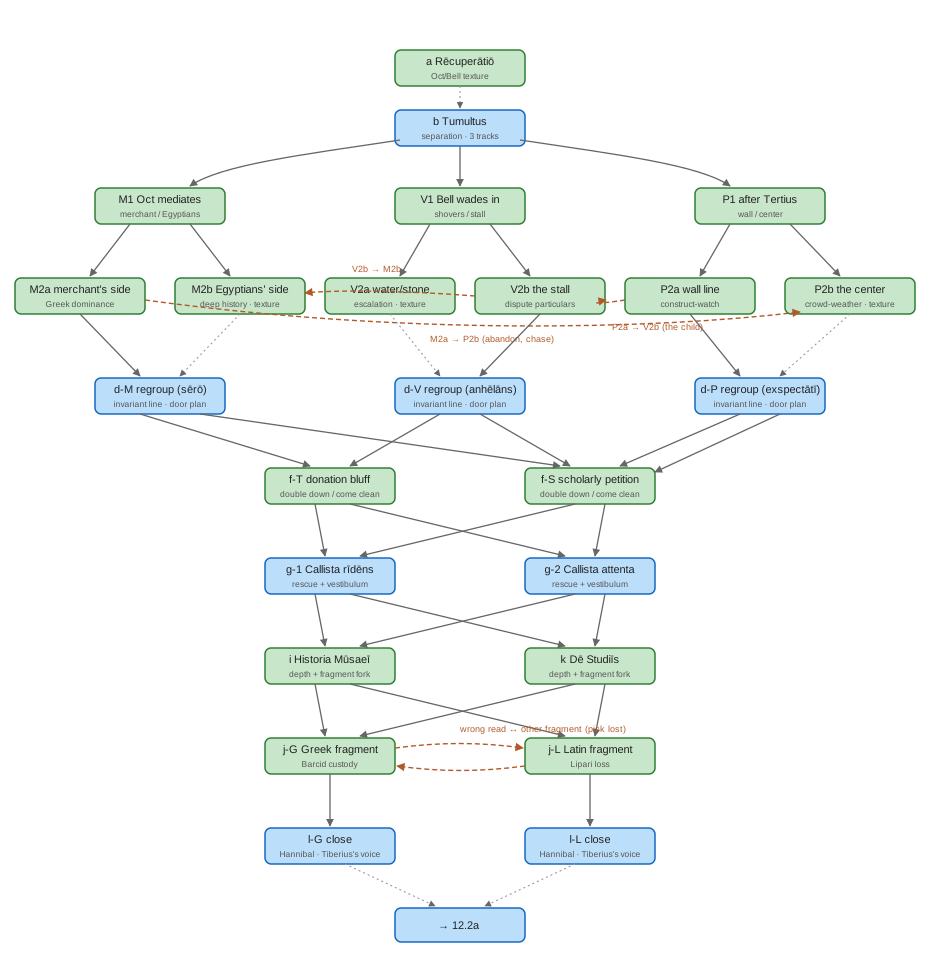
12.2 pathing map
25 scenes · 4 fail/redirect branches · 3 convergence nodes
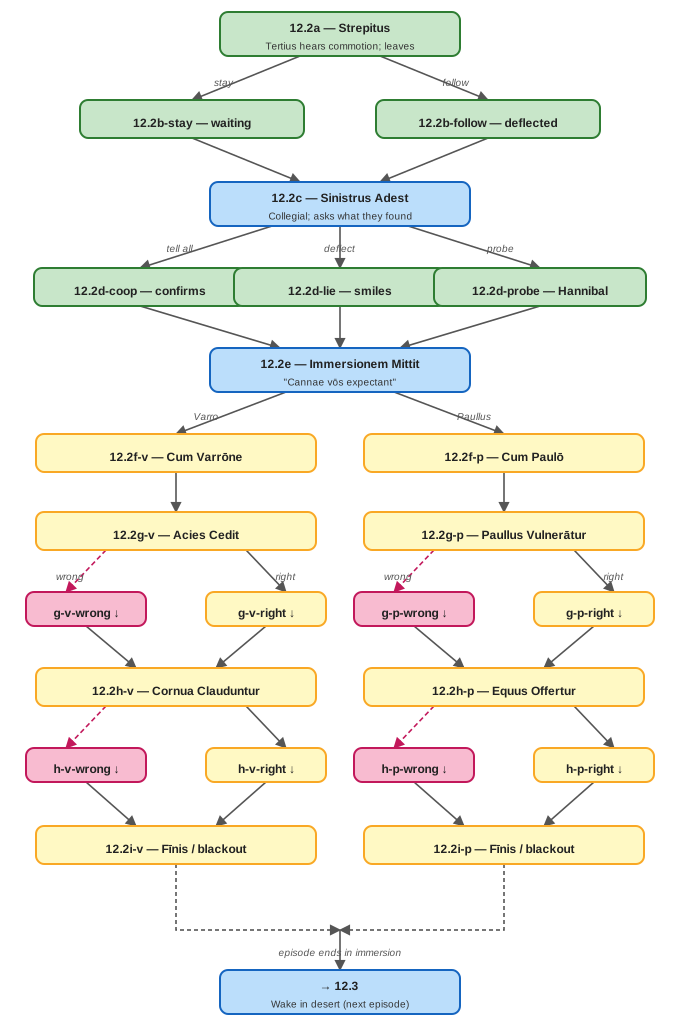
12.3 pathing map
17 scenes · 2 fail/redirect branches · 3 convergence nodes
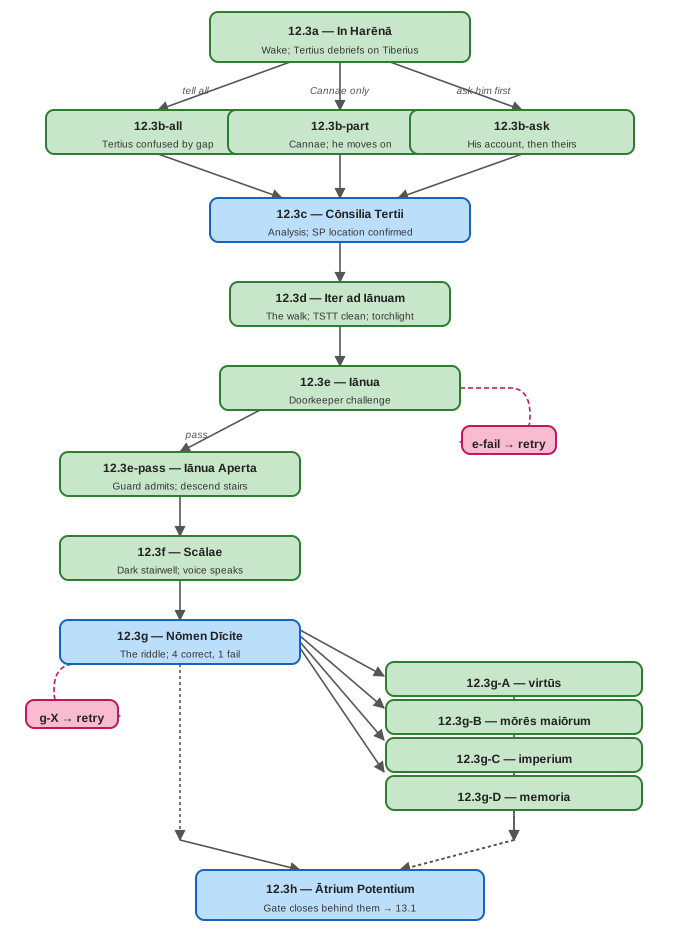
5. Agent Craft¶
Latin and English replies for all six prompts, 12.1.a through 12.3.b, are below, organised by anticipated student posture. At 12.1.b the librarian takes the lead, and at 12.3.b the only voice is the one in the rock. English replies support the English RPG approach.
Register. Mission 12 headlines fourth- and fifth-declension nouns in all cases (manus, vultus, domus, portus, exercitus, impetus, gradus, cornū; rēs, diēs, aciēs, fidēs); Mission 11's genitive with any common noun and volō, nōlō, eō, possum in four tenses carry in, with Mission 10's pluperfect, -ne, and the question words. Reply lines sit below the immersion text's ceiling rather than at it: short present-tense clauses that reach for the mission's headline structures, with past and future meaning carried in the English reply or an English stage direction. Not permitted in reply lines: future, subjunctive, comparatives, productive passives, and productive indirect statement or indirect question. The prompts' futures (perībunt, dabit, cōgitābimus, sinet, facient, fīniētur, dēbēbitis, and the riddle's refulgēbit), their subjunctives (sciātis, vēnerint, ut vērum dīcam, sit), their indirect statements (dare velle, Potentēs esse putō, habuisse, tulisse, abesse, dīxisse dēbent), and their plūs, pēius, meliōrem, and maiōra... quam are receptive set-pieces on the page, never models for a reply.
Cross-cutting techniques this mission:
- Mission Control reports effects and explains nothing. It speaks English in the team's ear: artifacts from Tiberius's suspicion at 12.1.a, a voice cut off mid-word at 12.2.a, and at the riddle as surprised as the team. It is silent at Cannae until Tertius arrives saying it sent him.
- Tiberius is heard, never met. He stays offstage, and no reply puts him face to face with the team. Tertius's rule from Mission 11 holds: duo tempora ūnum hominem sīc ferre nōn possunt.
- Sinistrus's cameo ends where the prompt ends. He sends the team to Cannae and is gone, and no reply brings him back. Named to Tertius, Sinistrus reaches him as Prometheus, most likely at 12.2.b, when he asks what dragged the team there. The consuls and the doorkeeper hear the name whole, and it means nothing to them.
- The CODEX texts are the team's tools. The rolls at 12.1.b are Lapis apud Poenōs, the elephant rumor at 12.2.a comes from Scipio's letter, and the doorkeeper at 12.3.a tests in the order of the Potentēs' own instructions. A team that has read them will hear the scene quoting the page.
- Any justified answer opens the riddle. The voice judges the reason, not the word: a bare word gets cūr?, a bare Lapis gets a laugh and another try, and every accepted answer ends with the light rising and the wall beginning to move.
- The grammar arrives in their mouths. Fourth- and fifth-declension nouns sit at the hinges of the replies (domus Mūsārum, rēs Poenōrum, in mediā aciē, gradibus), so point them out in the debrief and reward a team that builds its own.
Character notes:
- Tertius is brisk and openly delighted at the Lipara news, a guide who asks rather than tells inside the Mūsaeum, urgent with a sword in hand at Cannae, and elated in the sand. He never comments on the map he gave Tiberius, and his last counsel at 12.3.a is his exit: he does not go to the door.
- The librarian is the tired reader in the corner, a Greek scholar worn down by a place Rome keeps without care. He is polite to donors, faintly condescending about Latin books, knows his shelves cold, wakes at the word dōnum, and has never heard of the Lapis.
- Paullus and Varro are the prouder and the plainer of the two commanders, named only if a team asks. Paullus, the noble, is sure of the Lapis rumor and afraid of Hannibal, but the day's command is not his; Varro, the "new man," trusts numbers over stones and has the people behind him.
- The centurion at the door is a gray-bearded veteran, forty years in the Society's service and proud of it, who has heard every kind of story. He wants the signum, the sender, and the reason, in that order.
- The voice in the rock is grave and slow, never angry, amused by the obvious answer and stirred by a reasoned one. Its acceptances carry the Society's slant (hīc omnēs..., paucī et optimī), and the replies never remark on it.
Watch-fors. Hold back Sextus's fate, the mechanism of the map paradox, what the pyramids have to do with the Lapis, who nearly killed Tertius at Cannae and what became of Tiberius's men, what lies below the stair, and who or what the voice is. Nothing confirms that the covered thing near Hannibal is the Lapis, and Hannibal's exile with the Lapis stays a belief (crēdimus). Paullus never hears a prophecy of his own death, and Varro's flight and the senate's thanks stay unspoken. The consuls know the Lapis only as camp gossip and never link it to Lipara or Asina. Callista belongs to the CYOP and surfaces nowhere in the RPG. Lapis is capitalized whenever it names the artifact, and lowercase in the librarian's mouth, where it is only a stone.
Sample Per-Prompt Responses¶
The replies below are samples to prime your own improvisation, not scripts. They show one plausible way to handle each posture, never the only or required one.
12.1.a: Tiberius at the Cave
Scene context. Still weak from the Lipara training, the team hears Tertius outside the cave with a young man. Tertius insists he is Sextus's twin; the young man protests that they talk exactly alike; Tertius says he has never seen him before, and is glad he remembers his brother. It is Tiberius. Mission Control crackles in: stay calm, stay put; the TSTT is showing artifacts because of Tiberius's suspicion. The cave wall slides closer. Tertius gives Tiberius the charta, in memoriā Sextī, and the wall eases back; a low rumble the team had barely noticed stops. Tertius returns hard-faced: that was close; they must avoid Tiberius, because if he sees them everything falls apart. He asks about the training, and when they tell him the Carthaginians took the Lapis at the Lipari Islands his face fills with joy: they have found the trail; now, the Mūsaeum! The next training will help more, but they are too weak for it yet; meanwhile they should go to the old Mūsaeum. But first: what do they know about it?
Tertius's posture. Brisk, delighted, half-listening still at the cave mouth. He tests, he does not teach; he asks and waits.
Posture 1: What the Musaeum was, and is (canonical)
Example composition: Ptolemaeus Mūsaeum aedificāvit. domus Mūsārum erat. virī doctī ibi habitābant et librōs legēbant. Caesar nāvēs incendit, et multī librī periērunt.
Latin (Tertius): "multās rēs scītis. bene." (He checks the mouth of the cave once more, then turns back.) "Mūsaeum domus Mūsārum est, et ōlim virī doctī ex multīs terrīs ibi habitābant. ignis Caesaris multōs librōs dēlēvit, sed nōn omnēs. Mūsaeum adhūc stat."
"sed nunc Rōma Mūsaeum tenet, et nēmō id cūrat. venīte. ipsī vidēre dēbētis."
English (Tertius): "You know a good many things. Good." (He checks the mouth of the cave once more, then turns back.) "The Musaeum is the house of the Muses, and once learned men from many lands lived there. Caesar's fire destroyed a great many books, but not all of them. The Musaeum still stands."
"But now Rome holds the Musaeum, and nobody looks after it. Come. You need to see it for yourselves."
The answer key is 12.1 Informational Text A (bibliothēca Alexandrīae): Ptolemy, first king of Egypt after Alexander, built the house and gave it to the Muses; scholars from many lands lived there at the king's expense, ate at one table, read, wrote and argued daily; Eratosthenes measured the whole earth; the library's many thousands of rolls, ships in the harbor searched for books, copies made and the originals kept; counts from forty thousand to seven hundred thousand; Caesar's fire of 48 BCE, from the ships to buildings by the harbor; under Rome kept nōn magnā cūrā. The 12.1 CULTURALIA adds what the scholars did: they corrected old books, they did not train speakers. Any two or three grounded facts count. The last line hands straight into 12.1.b, where the team sees the fire-blackened flank and the patched wall. domus Mūsārum and multās rēs are the mission's fourth and fifth declension.
Posture 2: "It all burned"
Example composition: Caesar bibliothēcam incendit. omnēs librī periērunt. nihil restat.
Latin (Tertius): "nihil restat? minimē." (Almost a smile.) "ignis Caesaris in portū erat, et multōs librōs dēlēvit. sed Mūsaeum stat, et librī in eō sunt. virī doctī adhūc ibi legunt."
"multī hoc dīcunt, sed vērum nōn est. quid aliud scītis?"
English (Tertius): "Nothing left? Not at all." (Almost a smile.) "Caesar's fire was in the harbor, and it destroyed a great many books. But the Musaeum stands, and there are books in it. Learned men still read there."
"Plenty of people say that, but it isn't true. What else do you know?"
The famous single fire that took everything is the version the old live CODEX taught, retired for canon: in 80 CE the Mūsaeum stands. Informational Text A is careful here (multī scrīptōrēs Caesarem culpant, sed nōn omnēs; nōn omnēs librī periērunt) and ends on hodiē nihil restat… scrīptōrēs nōn cōnsentiunt. A team that says nothing is left is right about our time and wrong about Tertius's; reward a team that draws that line itself. A modern "museum," a gallery of objects, gets the same correction: this is a house of the Muses where scholars live and work.
Posture 3: Tiberius and the charta
Example composition: cūr Tiberiō chartam dedistī? Tiberium vidēre volumus! amīcus noster est.
Latin (Tertius): "nōlīte!" (Sharp and quiet, with a glance at the cave mouth.) "Tiberius vōs vidēre nōn dēbet. mūrum vīdistis: mūrus ad vōs vēnit. duo tempora ūnum hominem sīc ferre nōn possunt."
"et dē chartā nōlīte cōgitāre. chartam Tiberiō dedī, in memoriā Sextī. hoc satis est." (Back to it.) "Mūsaeum: quid scītis?"
English (Tertius): "Don't!" (Sharp and quiet, with a glance at the cave mouth.) "Tiberius must not see you. You saw the wall: the wall came at you. Two times cannot carry one man like that."
"And don't think about the map. I gave the map to Tiberius, in memory of Sextus. That's enough." (Back to it.) "The Musaeum: what do you know?"
The meeting rule is Tertius's from Mission 11 (duo tempora…), and the moving wall is its proof: Mission Control puts the artifacts down to Tiberius's suspicion. The map paradox stays unexplained, as at 11.2.a; he says nothing about why the hand-off had to happen or how the TSTT kept a copy. Released here: the "man in the Mūsaeum" whom Tiberius half-remembered in Mission 10 was Tertius. The team can work it out from eōdem modō dīcitis and from 12.1 KEY-TEXT B (vir doctus ex Mūsaeō eam mihi dedit, in memoriā Sextī); Tertius neither confirms nor remarks on it. If a team brings KEY-TEXT B's news that the Potentēs are using Tiberius, he answers fortasse. nesciō. and moves on; the men with Tiberius are 12.2.a's discovery.
Posture 4: The next trace, or the next training now
Example composition: Poenī Lapidem habent. quis nunc Lapidem habet? Hannibal? disciplīnam proximam nunc volumus!
Latin (Tertius): "Hannibal? nōmen magnum. sed sine librīs nihil sciō. Poenī Lapidem cēpērunt. sed quō Lapidem portāvērunt? et quis eum nunc habet? hanc rem quaerimus."
(If they ask for the training now.) "nōndum. īnfirmī estis, et vultūs vestrī albī sunt."
"itaque Mūsaeum. ibi multī librī dē bellīs Pūnicīs sunt. sed prīmum dīcite mihi: quid dē Mūsaeō scītis?"
English (Tertius): "Hannibal? A great name. But without books I know nothing. The Carthaginians took the Lapis. But where did they carry it? And who has it now? That's what we're looking for."
(If they ask for the training now.) "Not yet. You're weak, and your faces are white."
"So: the Musaeum. There are many books about the Punic Wars there. But first tell me: what do you know about the Musaeum?"
The chain past Lipara is 12.1 KEY-TEXT A (Lapis apud Poenōs), which the team reads at 12.1.b: the temple, Hamilcar Barca, his house, Spain, and Hannibal as his eldest son. Tertius does not get ahead of the books, so he neither confirms nor dismisses Hannibal; a team may bring the name from 11.2.b, where Tertius set Hannibal in the second war. Held until 12.3.a: Hannibal's exile, the road east, and the praetorium. vultūs vestrī is the fourth-declension plural at work.
Posture 5: The wall, the rumble, the voice in the ear
Example composition: cūr mūrus sē mōvit? et quis in aure nostrā dīcit?
Latin (Tertius): "mūrus? ita. ego quoque vīdī." (He lays a hand on the wet rock.) "hic cavus parvus est, et mundus meus nōn firmus est. ubi Tiberius adest, mundus tremit. nunc quiētus est."
"sed tempus nōn habēmus. Mūsaeum: quid scītis?"
English (Tertius): "The wall? Yes. I saw it too." (He lays a hand on the wet rock.) "This cave is small, and my world isn't solid. When Tiberius is near, the world shakes. Now it's quiet."
"But we haven't got time. The Musaeum: what do you know?"
Mission Control has already said the most anyone will: artifacts, from Tiberius's suspicion. If a team asks MC directly, one line in English: "Artifacts, Operatives. They've settled. Answer Tertius." Tertius knows only that his world shakes when Tiberius is near; he never explains the mechanism. If a team blames the wall on Sinistrus, Tertius cannot perceive him and hears Prometheus (Prometheus? cūr dē Prometheō dīcitis?), played bare.
12.1.b: The Musaeum
Scene context. Tertius leads the team through the streets to a great building, old and half in ruins: one side black from fire, a section that fell long ago badly patched. He speaks Greek to a tired guard by the gate, who is suspicious, then laughs and waves them into a huge atrium, Roman in plan but with no Roman signs; where the lararium should stand there is a true altar, dark with old blood. Through the doorways, shelves of books, all papyrus rolls, and in a corner a tired-looking man reading. Tertius explains: he told the guard their family wants to make a great gift to the Muses. Since the empire began the place has been poor; the fire destroyed many books, but worse, no one cares, and the scholars left here are not the best. So they must ask the librarian for the books that show where the Lapis went after the Carthaginians took it. If they choose well, the next TSTT training will be a better one.
Who answers. The bibliothēcārius, the tired reader in the corner, with Tertius at the team's shoulder.
The librarian's posture. Polite to donors, sour about Rome, expert on his own shelves. He has never heard of the Lapis.
Posture 1: The books about Lipara (canonical)
Example composition: librum dē bellō Pūnicō prīmō quaerimus, dē proeliō apud Liparam.
Latin (the librarian): (He looks up slowly, one finger keeping his place.) "dē Liparā? duōs librōs habeō. alter Latīnus est, alter Graecus. sed ignis partēs eōrum tetigit."
(He goes to a shelf without looking and comes back with two scorched rolls.) "in librō Latīnō rēs Rōmānōrum est. in librō Graecō rēs Poenōrum. legite, sed nōlīte eōs manibus dūrīs tangere."
English (the librarian): (He looks up slowly, one finger keeping his place.) "About Lipara? I have two books. One is Latin, the other Greek. But the fire got at parts of them."
(He goes to a shelf without looking and comes back with two scorched rolls.) "In the Latin book is the Roman story. In the Greek book, the Carthaginian one. Read them, but don't handle them roughly."
The two rolls are 12.1 KEY-TEXT A (Lapis apud Poenōs); send the team there to read. The Latin record: Asina with seventeen ships, the harbor closed at night, the sailors fled, everything taken, and the Lapis never named. The Greek record: the Lapis among the spoils to Carthage, old letters no Carthaginian could read, a temple; Hamilcar Barca asks the senate for it, takes it to his house, then to Spain; three sons, the first Hannibal; and there the book ends. Reward a team that asks for both, or that asks for the Carthaginian side on purpose. The reading hands into 12.2.a's opening (quamquam intentē legitis). rēs Rōmānōrum / rēs Poenōrum and manibus carry the mission's declensions.
Posture 2: A writer from Hannibal's camp
Example composition: librum Sīlēnī habēs? Sīlēnus cum Hannibale erat.
Latin (the librarian, then Tertius): (For the first time, he is interested.) "Sīlēnum? paucī Rōmānī eum rogant. Sīlēnus in castrīs Hannibalis habitābat, et multa vīdit. sed amīcus Hannibalis erat, et Hannibalem semper laudat."
"sed Sīlēnus dē bellō secundō scrībit. Lipara in bellō prīmō erat. et cūr Rōmānī librum amīcī Hannibalis legere volunt?"
(Tertius, quietly.) "bona quaestiō. respondēte eī. deinde librōs dē Liparā rogāte."
English (the librarian, then Tertius): (For the first time, he is interested.) "Silenus? Few Romans ask for him. Silenus lived in Hannibal's camp, and he saw a great deal. But he was Hannibal's friend, and he praises Hannibal all the time."
"But Silenus writes about the second war. Lipara was in the first. And why would Romans want to read a book by Hannibal's friend?"
(Tertius, quietly.) "A good question. Answer him. Then ask for the books about Lipara."
This is the 12.1 CULTURALIA's closing question in a librarian's mouth: which writer knew Hannibal's camp best, and why doubt him? Silenus of Caleacte and Sosylus of Sparta both lived in the camp (Sosylus taught Hannibal Greek; Polybius called his history the gossip of a barber's shop); both books are lost today, but in 80 CE a library like this could hold them. A strong team names the bias: on his side, dependent on him. Silenus adds nothing to the KEY-TEXT A chain about the Lapis; the librarian's date correction (Lipara is the first war) is the funnel back to Posture 1. Sosylus gets the same treatment, with Polybius's verdict.
Posture 3: The great Roman histories
Example composition: librōs Līviī quaerimus. Līvius dē bellō Pūnicō scrīpsit.
Latin (the librarian, then Tertius): (A small, tired sigh.) "Līvius. Latīnus est, et novus. Rōmānī semper Līvium rogant."
(He points with his chin at a shelf.) "Līvium habēmus, decem librōs dē bellō Hannibalis. et Polybium, quī Graecus erat, et Fabium Pictōrem, quī Rōmānus erat sed Graecē scrīpsit. sed hī omnēs rem Rōmānōrum nārrant. quid quaeritis?"
(Tertius, low.) "rem Poenōrum quaerimus, nōn rem Rōmānōrum. quis rem Poenōrum nārrat?"
English (the librarian, then Tertius): (A small, tired sigh.) "Livy. He's Latin, and new. Romans always ask for Livy."
(He points with his chin at a shelf.) "We have Livy, ten books on Hannibal's war. And Polybius, who was Greek, and Fabius Pictor, who was Roman but wrote in Greek. But all of them tell the Romans' story. What are you looking for?"
(Tertius, low.) "We're looking for the Carthaginians' story, not the Romans'. Who tells the Carthaginians' story?"
The 12.1 CULTURALIA gives these: Fabius Pictor, a senator who lived through the war, wrote Rome's first history, in Greek; Polybius survives in part and describes Cannae; Livy, under Augustus, gave ten books to the war, and all ten survive. To a scholar here Livy is barely sixty years old, hence novus. The Roman histories are the right genre and the wrong side: the Roman record never names the Lapis, which is KEY-TEXT A's own point about the Latin roll. Tertius's question funnels to the Greek roll and Posture 1.
Posture 4: "A book about the Lapis"
Example composition: librum dē Lapide habēs?
Latin (the librarian, then Tertius): (He blinks.) "dē lapidibus? multōs librōs habēmus. Theophrastus dē lapidibus scrīpsit: dē gemmīs, dē marmore." (He is already reaching for a shelf.)
(Tertius, a hand on your arm.) "nōlīte. ille Lapidem nōn nōvit. ubi Poenī Lapidem cēpērunt? in bellō. itaque librum dē bellō rogāte, nōn dē lapide."
English (the librarian, then Tertius): (He blinks.) "About stones? We have plenty of books. Theophrastus wrote about stones: about gems, about marble." (He is already reaching for a shelf.)
(Tertius, a hand on your arm.) "Don't. He doesn't know the Lapis. Where did the Carthaginians take the Lapis? In a war. So ask for a book about the war, not about a stone."
The librarian has never heard of the artifact, so lapis is lowercase in his mouth: a stone is a mineral, and Theophrastus's On Stones is a real book of the kind the library held. The comedy costs nothing, and Tertius's funnel is the method: search by the war, not by the stone. Naming it aloud is careless, since 12.1 KEY-TEXT B sends the Potentēs' recruits to this very building, but nothing comes of it here; Tiberius's arrival at 12.2.a happens regardless.
Posture 5: Playing the donors
Example composition: familia nostra Mūsīs magnum dōnum dat. sed prīmum librōs optimōs vidēre volumus.
Latin (the librarian, then Tertius): (He sets the roll down at once. The tired face is awake.) "dōnum? Mūsīs? multōs annōs nēmō Mūsīs dōnum dedit. imperātor hominēs mittit, nōn pecūniam."
"quid vultis? omnēs librōs vōbīs mōnstrō."
(Tertius, dry.) "bene. sed nunc librum ēligite."
English (the librarian, then Tertius): (He sets the roll down at once. The tired face is awake.) "A gift? To the Muses? For years nobody has given the Muses a gift. The emperor sends people, not money."
"What do you want? I'll show you every book we have."
(Tertius, dry.) "Good. But now choose a book."
Tertius's cover is the patronage the Mūsaeum has always lived on: the kings paid its scholars, and under Rome imperātor hominēs in Mūsaeum mittēbat, et nōn semper virōs doctōs (Informational Text A). Played well, it wins the librarian's full attention; the team still has to name a book. If a team asks about the altar: the Mūsaeum is a sanctuary of the Muses, and Greek rite puts an altar where a Roman house keeps its lararium; the librarian adds Mūsīs sacrificāmus, sed rārō. A promised sum is believed, and no one ever has to pay: the earthquake at 12.2.a ends the visit.
12.2.a: The Earthquake, and the Fields of Italy
Scene context. The team is deep in the rolls when shouting breaks out at the gate: Tiberius, demanding to know whether "they" came here. Tertius pushes them against the wall and goes; he comes back whispering. He has paid the guard, who will let no one in, but Tiberius has not come alone: men are with him, and they sent him; Potentēs, he thinks; they want to know where the map came from. The ground begins to shake. "We have to get out, and…" Tertius is gone. Mission Control's voice breaks off mid-word. Part of the Mūsaeum wall comes down, the air goes black, and a man's shape stands in the dark; a voice in their heads says they must flee: Sinistrus. In English, he says the TSTT has lost track of them, so he can risk some off-limits code. Behind them, Tiberius and his men are coming closer through the dust. "Your next training. Enjoy! And don't forget what's really important about this LAPIS nonsense!" Then: Italy, 216 BCE, a hot day in the fields. The team stands beside two armored Romans whose crested helmets mark them as commanders. The haughtier: "Look! He had the Lapis on the back of an elephant!" The plainer: "They say he had it on an elephant, in the battle at the Ticinus."
Who answers. The two consuls: Paullus (the haughtier) and Varro (the plainer), unnamed unless the team asks directly. Tertius, Mission Control and Sinistrus are all absent.
The consuls' posture. Two men on the morning of a battle, mid-argument, too busy to be very suspicious of odd young people at their elbows. They take the team for staff hangers-on.
Posture 1: Where, when, who (canonical)
Example composition: ubi sumus? quis es? quid hodiē agitis?
Latin (Varro, then Paullus): (The plainer one jerks a thumb at the plain.) "in Āpūliā estis, prope oppidum Cannās. ibi flūmen Aufidus est, et prope flūmen castra Hannibalis."
(The haughtier one looks you up and down.) "sed vōs? quī estis? vestem Rōmānam nōn geritis."
(The plainer one, already turning away.) "hodiē imperium meum est. crās imperium illīus est. sīc cōnsulēs Rōmānī faciunt."
English (Varro, then Paullus): (The plainer one jerks a thumb at the plain.) "You're in Apulia, near the town of Cannae. That's the river Aufidus, and by the river is Hannibal's camp."
(The haughtier one looks you up and down.) "But you? Who are you? You're not in Roman dress."
(The plainer one, already turning away.) "Today the command is mine. Tomorrow it's his. That's how Roman consuls do it."
The plain by the Aufidus in Apulia, the morning of 2 August 216 BCE (12.2.b's tag). The facts come from 12.2 Informational Text B (victōriae Hannibalis) and the CULTURALIA's "Two consuls, one army": the consuls command on alternate days, and today belongs to Varro; Varro is the "new man," a butcher's son by Livy's account, Paullus from an old noble family and consul once before; about 80,000 against Hannibal's 50,000. The prompts never name them. A direct quis es? gets cōnsul sum, and a pressed question gets the name (Varrō sum, Paullus sum); a keen-eyed team can tell them apart without asking. Whatever cover the team gives (scribes, messengers, young men of good family attached to the staff) passes, because the battle matters more than they do.
Posture 2: The Lapis and the elephant
Example composition: quis Lapidem vīdit? ubi est Lapis nunc?
Latin (Paullus, then Varro): (The haughtier one, fiercely.) "Gallī eum vīdērunt! Lapis in tergō elephantī erat, prope Hannibalem."
(The plainer one shrugs.) "Gallī multa dīcunt. elephantōs vīdī. Lapidem nōn vīdī."
"sī Lapidem capimus, bellum fīnīmus." "mīlitēs bella fīniunt, nōn Lapis."
English (Paullus, then Varro): (The haughtier one, fiercely.) "The Gauls saw it! The Lapis was on an elephant's back, near Hannibal."
(The plainer one shrugs.) "The Gauls say a lot of things. I've seen elephants. I haven't seen the Lapis."
"If we take the Lapis, we finish the war." "Soldiers finish wars, not the Lapis."
The rumor's source is 12.2 KEY-TEXT A, the elder Scipio's letter to his brother after the Ticinus: Gauls who crossed the Alps with Hannibal say he always keeps a small stone with old letters near him, and in the fight it rode on an elephant's back. The Ticinus was a cavalry fight, so the elephant is hearsay, and Varro's shrug is the historian's. The consuls have camp gossip, not the letter (Scipio wrote nothing to the Senate), and neither links the stone to Lipara or Asina; that is Scipio's private guess, and it is held. Lapis is capitalized in both mouths. A team that ties the rumor to Surus, the great elephant Hannibal often rode (12.2 Informational Text A), is reading well. The exchange previews Paullus's scripted line at 12.2.b (rēctā ad Lapidem…); Varro's answer is Duilius's thesis from 11.3.b.
Posture 3: Warning them, or talking them out of it
Example composition: nōlīte pugnāre! Hannibal vōs circumvenit! hodiē Rōmānī perdunt!
Latin (Varro, then Paullus, then Varro): (The plainer one laughs.) "octōgintā mīlia mīlitum habēmus! Hannibal vix quīnquāgintā habet."
(The haughtier one does not laugh.) "et tamen ad Trebiam et ad lacum Trasimēnum Hannibal nōs vīcit. ego hodiē pugnāre nōlō."
"populus pugnam vult. et hodiē imperium meum est."
English (Varro, then Paullus, then Varro): (The plainer one laughs.) "We have eighty thousand men! Hannibal has barely fifty."
(The haughtier one does not laugh.) "And yet at the Trebia and at Lake Trasimene, Hannibal beat us. I don't want to fight today."
"The people want a battle. And today the command is mine."
The true-answer trap. Varro hears a warning as cowardice; Paullus hears his own fear said aloud and can do nothing with it, because today's command is not his. That is the alternating-command problem from the CULTURALIA, playing out in front of the team. Informational Text B has the background: Rome gave up Fabius's delay because the people no longer wanted it, and Trebia and Trasimene were both traps. Nothing changes the exemplum; the battle is 12.2.b. A prophecy aimed at one man's death gets only a look: Paullus does not hear his own end, and Varro's flight and the Senate's thanks stay unspoken.
Posture 4: Going for the Lapis themselves
Example composition: ad castra Hannibalis currimus et Lapidem capimus!
Latin (Varro, then Paullus): (The plainer one looks at your empty hands.) "vōs? sine armīs? ad castra Hannibalis? ibi multa mīlia hostium sunt, et equitēs Numidae, quī celerrimī sunt."
(The haughtier one, a hand on your shoulder.) "manēte hīc. hodiē exercitus noster Lapidem quaerit."
English (Varro, then Paullus): (The plainer one looks at your empty hands.) "You? With no weapons? To Hannibal's camp? There are thousands of the enemy there, and Numidian horsemen, the fastest there are."
(The haughtier one, a hand on your shoulder.) "Stay here. Today our army goes looking for the Lapis."
Force and heroics fail gently: the plain is open and the Numidian cavalry is famous. Paullus turns the impulse back into the scene, since the whole army is about to do what the team wants to do alone, and that sets up his scripted line at 12.2.b. exercitus noster puts the fourth declension in his mouth. If a team actually runs, two soldiers of the guard catch them, unhurt, and bring them back before they have gone fifty paces.
Posture 5: Calling for Mission Control, Tertius, or Sinistrus
Example composition: Mission Control! Tertī! Sinistre, ubi es?
Latin (narration, then the consuls): in aure vestrā nihil est: nūlla vōx, nūllus crepitus. Tertius abest. Sinistrus quoque abest. sōlī estis, in agrīs Ītaliae, et sōl ārdet.
(The plainer one, puzzled.) "Sinistrus? quis est? nōmen nōn nōvī." (The haughtier one.) "et quis est Tertius? cum quō dīcitis?"
procul tubae sonant. (The plainer one.) "audīte! tempus est."
English (narration, then the consuls): There is nothing in your ear: no voice, no crackle. Tertius is gone. Sinistrus is gone too. You are alone, in the fields of Italy, and the sun is blazing.
(The plainer one, puzzled.) "Sinistrus? Who's that? I don't know the name." (The haughtier one.) "And who's Tertius? Who are you talking to?"
Far off, trumpets sound. (The plainer one.) "Listen! It's time."
Sinistrus's cameo ends on "Enjoy!", and no reply extends it: no voice, no English line, no return. Mission Control is cut off until Tertius arrives at 12.2.b saying MC sent him. The consuls are mortals outside the Aemiliani's block, so the name Sinistrus reaches them whole and means nothing. The trumpets are the funnel into 12.2.b.
12.2.b: The Plains of Cannae
Scene context. The team stands to one side. One commander confers with a military tribune while the team talks with the other; then the first comes back. "This is the hour," he says flatly. "I'm going to my place." He mounts and rides into the battle. The other looks at the team: they have the numbers at least; if their soldiers drive straight at the Lapis, this will be over; but, to tell the truth, Hannibal frightens him. He too mounts and rides off. The army is staggering in size and beautiful in its discipline: tribunes shouting, centurions running orders, the sound of an army the team knows from games and films. Suddenly Tertius is beside them, sword in hand. They nearly killed him. What happened? Mission Control worked out that the team was in a training and sent him. They have to act; the Demiurge is still anxious. What dragged them here? No one knows. So Mission Control wants to hear the whole battle through their eyes: pick a place in the Roman army, and narrate. Watch Hannibal above all: they believe he keeps the Lapis close.
Who answers. Narration of the battle at the team's chosen station, with Tertius beside them. Each Recentius may take a different station; a reply can pick up one or several.
Tertius's posture. Urgent, keyed up, sword out. He wants eyes, not a summary, and he points them back at Hannibal.
Posture 1: In the packed center (canonical)
Example composition: in mediā aciē stō, inter hastātōs. ante nōs Gallī et Hispānī sunt. hostēs cēdunt, et nōs prōcēdimus. Hannibalem spectō.
Latin (narration and Tertius): ita est. mediī hostēs lentē cēdunt, et aciēs nostra in medium prōcēdit. post vōs mīlitēs premunt, et manūs movēre vix potestis.
(Tertius, at your shoulder.) "vidēte! nōn fugiunt. vōs dūcunt!"
tum ā dextrā et ā sinistrā Āfrī veniunt, et post vōs equitēs Hannibalis. Āfrī et equitēs aciem Rōmānam undique claudunt.
(If they are watching Hannibal.) post Gallōs Hannibal in equō sedet. prope eum servus aliquid parvum tenet, et id cēlat. quid est? vidēre nōn potestis.
āēr āter fit, et sonus armōrum ingēns est. deinde omnia ātra sunt.
English (narration and Tertius): That's how it goes. The enemy's center falls back slowly, and our line pushes into the middle. The soldiers behind you press forward, and you can barely move your hands.
(Tertius, at your shoulder.) "Look! They're not running. They're leading you in!"
Then the Africans come from the right and the left, and Hannibal's horsemen come from behind. The Africans and the horsemen close the Roman line in on every side.
(If they are watching Hannibal.) Behind the Gauls, Hannibal sits on his horse. Near him a servant holds something small, and keeps it covered. What is it? You can't see.
The air goes black, and the noise of weapons is enormous. Then everything is dark.
The answer key is the 12.2 CULTURALIA, "The Roman army at Cannae" and "Hannibal's trap": velitēs out in front, then hastātī, prīncipēs and triāriī, the infantry packed deeper than usual to punch through the center; Hannibal's crescent bulging toward them, Gauls and Spaniards in its middle, his African infantry held back at both ends; the center giving way, the Africans turning inward, the cavalry coming round behind: the double envelopment. Reward narration that sees the trap from inside (the bulge going backward, the press, hands too crowded to use). Hannibal himself was with the center, so this station sees him. Behind him there seems to be something small and covered: never uncovered, never named, never confirmed as the Lapis (Tertius at 12.3.a says only crēdimus). aciēs, manūs and impetus are the mission's declensions at the hinge of the battle (12.2 GRAMMATICA is anchored on aciēs). Every station closes the same way: the circle shuts, the air goes black, and the TSTT pulls the team out the instant before any Recentius could fall, so they wake in the sand at 12.3.a.
Posture 2: On a wing, with the cavalry
Example composition: in dextrō cornū sum, cum equitibus Rōmānīs, prope flūmen.
Latin (narration, Paullus, Tertius): (The right wing, by the river.) equitēs nostrī inter flūmen et hostēs pugnant. locus angustus est, et equī locum nōn habent. mox equitēs nostrī cadunt. (The haughtier consul, on foot now, sword up.) "ad mīlitēs in mediā aciē eō!"
(The left wing.) equitēs sociōrum contrā Numidās pugnant. Numidae celerēs sunt, et equitēs nostrī fugiunt. imperātor quoque cum paucīs equitibus abit.
(Tertius.) "equitēs Hannibalis nunc līberī sunt. quō eunt? spectāte!"
āēr āter fit, et sonus armōrum ingēns est. deinde omnia ātra sunt.
English (narration, Paullus, Tertius): (The right wing, by the river.) Our horsemen are fighting between the river and the enemy. The ground is narrow, and the horses have no room. Soon our horsemen are falling. (The haughtier consul, on foot now, sword up.) "I'm going to the men in the center!"
(The left wing.) The allied horsemen are fighting the Numidians. The Numidians are fast, and our horsemen run. The commander too leaves the field, with a few riders.
(Tertius.) "Hannibal's horsemen are free now. Where are they going? Watch!"
The air goes black, and the noise of weapons is enormous. Then everything is dark.
The CULTURALIA puts the Roman cavalry on the right by the river and the allied cavalry on the left, and both are beaten. Livy has Paullus on the right and Varro on the left: Paullus goes to fight with the infantry and dies there (Informational Text B: Paullus quoque periit), and Varro gets away cum paucīs equitibus. The team sees each man's last moment on stage, never the end; the reply never says periit in the moment and never shows the death. Livy and Polybius both blame Varro and praise Paullus, and Polybius was a close friend of Paullus's grandson; a team that notices it is watching the very scene the historians argued over has earned an LP. Tertius's question sends their eyes to the cavalry closing in behind the infantry. in dextrō cornū is the fourth declension's odd neuter.
Posture 3: A summary instead of a station
Example composition: pugnāmus. Rōmānī perdunt. fīnis.
Latin (Tertius, then narration): "hoc nōn satis est. Mission Control oculōs vestrōs vult, nōn fīnem. ubi statis? quid vidētis? quid audītis?"
diēs calidus est. ventus pulverem in oculōs vestrōs fert, et clāmor ingēns est.
English (Tertius, then narration): "That's not enough. Mission Control wants your eyes, not the ending. Where are you standing? What do you see? What do you hear?"
The day is hot. The wind drives dust into your eyes, and the shouting is enormous.
The prompt asks for a station and a perspective; a verdict does not answer it. Hand back the senses, then a station. Livy has a hot wind, the Volturnus, blowing dust into Roman faces that day; a team that uses it, or the sun, the noise, the press, writes the battle Mission Control asked for. diēs is fifth declension in the most ordinary sentence of the mission.
Posture 4: Changing the battle, or reaching Hannibal
Example composition: ad Hannibalem currimus et Lapidem capimus!" or "clāmāmus: 'cavēte! circumvenīmur!'
Latin (narration, then Tertius): currere temptātis, sed impetus mīlitum vōs retinet. manūs, scūta, gladiī undique sunt. nēmō vōs audit.
(Tertius, catching your arm.) "nōlīte! exemplum est. hunc diem nōn mūtātis. hōc diē Rōma pugnam perdit, et nēmō hoc mūtat. spectāte et nārrāte."
English (narration, then Tertius): You try to run, but the surge of soldiers holds you back. Hands, shields, swords on every side. No one hears you.
(Tertius, catching your arm.) "Don't! It's an exemplum. You don't change this day. On this day Rome loses the battle, and nobody changes that. Watch, and tell it."
Exempla do not bend. The press itself is the gentle failure, with no injury; a shouted warning is lost in the noise, and the covered thing behind Hannibal stays out of reach. Funnel back to narration: what does the press feel like from inside? impetus, manūs and hunc diem carry the declensions.
Posture 5: Answering Tertius ("Sinistrus sent us")
Example composition: Sinistrus nōs hūc mīsit! in Mūsaeō erat.
Latin (Tertius): (He frowns, as if he has missed a word.) "Prometheus? cūr dē Prometheō dīcitis?"
"nōn intellegō. terra sē mōvit, et deinde nihil vīdī. sed nunc proelium spectāte. Mission Control exspectat."
English (Tertius): (He frowns, as if he has missed a word.) "Prometheus? Why are you talking about Prometheus?"
"I don't understand. The ground moved, and then I saw nothing. But now, watch the battle. Mission Control is waiting."
Tertius has just asked quid vōs hūc trāxit?, so this is the likeliest first answer of the session, and it is the one place this mission puts Tertius's blind spot on stage. The prompt keeps Tertius out of Sinistrus's scene, but the rule still holds: Sinistrus reaches him as Prometheus, and he is tripped up without suspecting anything. Play it bare. He does not say who nearly killed him (mē paene necāvērunt) or what became of Tiberius and his men; asked, nōn nunc. proelium! The debrief is held for the sand at 12.3.a.
12.3.a: The Door in the Rock
Scene context. The team opens its eyes lying in the sand. Tertius sits nearby; the sun has set and night is close. Far off, the shapes of the pyramids, and near them the shapes of men. Tertius gets up, delighted: they have done more than they understand. From their account of the battle, and from the Mūsaeum's books, the TSTT has found the site of the Potentēs' praetorium and set them down near it. And they believe Hannibal took the Lapis with him into exile after the second Punic War; so the Potentēs are searching for it here, just as the team is, unless they have already found it! Perhaps the team is near the end of the training. He points past the pyramids: the gate is about two miles that way. An hour later they see it, a stone door in the rock that they would never have seen by day, with firelight under it. Tertius's last counsel: even with the signum, they will have to make something up; good luck. They walk to the door as if they belong there. Enemy eyes are on them, but they are brave, and no weapon can touch them. One Recentius knocks on the hard door. A voice inside: quī estis?
Who answers. The doorkeeper, behind the door; he is the centurion of 12.3.b. Tertius is not at the door.
The doorkeeper's posture. Unhurried and professional. He wants three things in order: the mark, the sender, the reason.
Posture 1: Mark, sender, reason (canonical)
Example composition: tīrōnēs sumus, et signum in bracchiō habēmus. Salvius nōs mīsit, ex Britanniā. ad praetōrium venīmus, quod Lapis movētur.
Latin (the doorkeeper, behind the door): (A long pause. Something heavy shifts on the other side.) "Salvius? Salvius longē abest, et rārō hominēs mittit. sed nōmen eius bene nōvī."
"et signum? signum mox videō. manēte."
English (the doorkeeper): (A long pause. Something heavy shifts on the other side.) "Salvius? Salvius is a long way off, and he rarely sends anyone. But I know his name well."
"And the mark? I'll see the mark soon enough. Wait."
12.3 KEY-TEXT B (praecepta Potentium) is the team's manual: show the signum, say who sent you and why you come; the guard is a veteran who has heard many stories, and a bad one keeps the door shut. Credible senders: Salvius, to whom every team swore at 10.3.b (so the lie is mostly true), or the house in the city where the Potentēs meet (KEY-TEXT B). Credible reasons: news that the Lapis is moving (Lapis hīc nōn diū manet, overheard at 11.1.b), a message, reporting as tīrōnēs. Any answer that carries sender, reason and the mark passes, whether or not it matches these. The door opening is 12.3.b's first line. Held: everything below the door.
Posture 2: Only the mark, or only a story
Example composition: signum habēmus! aperī portam!
Latin (the doorkeeper): "signum nōn satis est. multī signum habent. quis vōs mīsit? cūr venītis?"
(If they gave a story and no mark.) "et signum? sine signō nēmō hanc portam intrat."
English (the doorkeeper): "The mark isn't enough. Plenty of people have the mark. Who sent you? Why have you come?"
(If they gave a story and no mark.) "And the mark? Without the mark, nobody comes through this door."
He is quoting his own orders back at them almost word for word (KEY-TEXT B: sed signum nōn satis est. custōs etiam rogat: 'quis vōs mīsit? cūr venītis?'). A team that read the KEY-TEXT will hear it and smile. One more try with the missing piece gets Posture 1.
Posture 3: The wrong cover, or the truth
Example composition: doctī sumus, ex Mūsaeō. Lapidem quaerimus.
Latin (the doorkeeper, then narration): "doctī? hīc nūllī librī sunt. abīte."
(If they told the truth: Recentiī, Mīlitēs Lapidis.) (A short laugh through the stone.) "et ego rēx Aegyptī sum. abīte."
lūmen sub portā abit. ventus frīgidus per saxa it. diū nihil accidit. tandem lūmen redit.
"iterum vōs? quī estis? et nunc cavēte."
English (the doorkeeper, then narration): "Scholars? There are no books here. Go away."
(If they told the truth.) (A short laugh through the stone.) "And I'm the king of Egypt. Go away."
The light under the door goes out. A cold wind runs through the rocks. For a long time nothing happens. At last the light comes back.
"You again? Who are you? And this time, be careful."
The CYOP's two door fails (the scholars, the lost travellers): one cold refusal, then a second chance, never a dead end, since the door opens at 12.3.b on every path. The scholar cover fails because the mark says "we are Potentēs" while the story says "we are strangers looking for your Lapis," and a veteran hears the mismatch. The truth fails for the funniest possible reason: he does not believe it. Funnel to Posture 1. A third failure gets a third return of the light and the same question; nothing worse.
Posture 4: Force, or another way in
Example composition: portam manibus pellimus!" or "circum saxum ambulāmus et aliam portam quaerimus.
Latin (narration, then the doorkeeper): porta saxea est, et ingēns. manūs vestrae nihil faciunt. post vōs, in tenebrīs, oculī vōs spectant.
"quis portam pulsat et nihil dīcit? quī estis?"
English (narration, then the doorkeeper): The door is stone, and huge. Your hands do nothing to it. Behind you, in the dark, eyes are watching you.
"Who's that knocking and saying nothing? Who are you?"
The immersion has already said that no weapon can touch them (nūlla tēla vōs percutere possunt), and the eyes in the dark are watchers, not attackers, so force costs nothing and gains nothing. There is no other door (KEY-TEXT B: the door is in the rock, seen only at night). Bribery and silence fail the same way. The only way in is an answer, and his question repeats until they give one.
Posture 5: Big names
Example composition: Marcus Maecēnās nōs mīsit!
Latin (the doorkeeper): "Maecēnās? Maecēnās Rōmae est, et nōmen eius in ōre omnium est. nōmen magnum fābulam nōn facit. cūr venītis?"
(If they name Sinistrus.) "quis est ille? nōmen nōn nōvī. quī estis?"
English (the doorkeeper): "Maecenas? Maecenas is in Rome, and his name is in everyone's mouth. A big name doesn't make a story. Why have you come?"
(If they name Sinistrus.) "Who's he? I don't know the name. Who are you?"
Marcus Maecēnās leads the Societās, as the team has known since CODEX 1.2, so every member knows the name, which is exactly why it proves nothing; a team that adds a reason gets Posture 1. Sinistrus reaches him whole and passes him by, as it did Salvius. If a team names Tertius or an Aemiliānus, the voice sharpens at once (Aemiliānus? ubi est ille?): the Potentēs have hunted that face a long time (11.1.b; 12.1 KEY-TEXT B). The door stays shut until the team gives a clean story. Tertius is long gone into the dark, and nothing comes of it beyond the scare.
12.3.b: The Riddle in the Dark
Scene context. The stone door swings inward without a sound; huge as it is, the guard moves it with one hand. He is middle-aged and grey-bearded, plainly a Roman veteran, and says so at once: a centurion of the emperor's legion, forty years in the service of the great Society. He studies them long enough to make their hearts shake. Do they know the way? Of course they do; their leaders must have told them. He jerks a thumb at the steps going down behind him. The team descends, trying to look as if they live here, in the Potentēs' own praetorium. At once something goes wrong: the guard's friendly light behind them fades fast, and the steps grow steeper. A heavy voice seems to sound from the rock all around them: "What is my name? Say my name, and the light will shine again!" A pause. Mission Control, in their ear: "Ah, this is a bit unexpected, frankly, Operatives…" Then the voice again: "I am that which made Rome strong. I am what was there in the beginning. Do you think I am the Lapis? I laugh! What is my name?" Behind them the door closes with a heavy sound, and everything goes black.
Who answers. The voice in the rock. Mission Control can be heard, in English, but has nothing to offer.
The voice's posture. Grave and slow, never angry. Amused by the obvious answer, stirred by a reasoned one. It wants a name and a reason, and it judges the reason.
Posture 1: mōs maiōrum (canonical)
Example composition: mōs maiōrum est nōmen tuum. Rōmānī maiōrēs suōs semper in memoriā tenent. mōs maiōrum in prīncipiō erat, et Rōmam fortem fēcit.
Latin (the voice, then narration): "mōs maiōrum. ita. Rōma manet, quod Rōmānī maiōrēs suōs in memoriā tenent. et hīc omnēs eōs in memoriā tenent."
tum lūx ab īmīs gradibus surgit, alba et quiēta. in īmō gradū mūrus est, sine portā. et mūrus sē movēre incipit.
English (the voice, then narration): "The ways of the ancestors. Yes. Rome lasts, because Romans keep their ancestors in memory. And here, everyone keeps them in memory."
Then light rises from the bottom of the stairs, white and still. At the bottom step there is a wall, with no door. And the wall begins to move.
The thread carried from Duilius at 11.3.b to the 12.3 CULTURALIA, "Polybius on Rome's strength": the wax masks of the ancestors at a great man's funeral, the speech of their deeds, the young men who wanted that glory; Romans called it mōs maiōrum. The voice says hīc, not Rōmae: an attentive team hears this place claiming the ancestors for itself, which is the Societās speaking, as in the CYOP, and the reply never points it out. Every accepted answer ends on this same light-and-wall line, which hands to 13.1.a (mūrus quī viam claudēbat in latus movētur). gradibus and gradū are the fourth declension on the stair.
Posture 2: A virtue (virtūs, fidēs, pietās)
Example composition: virtūs est nōmen tuum. ad Cannās mīlitēs nostrī nōn fūgērunt. virtūs Rōmam fortem fēcit.
Latin (the voice, then the light): (For virtūs.) "virtūs. ita. virtūs Rōmam fēcit, et virtūs manet."
(For fidēs.) "fidēs. ita. sine fidē nūlla rēs pūblica est."
(For pietās.) "pietās. ita. Aenēās patrem et deōs ex Trōiā portāvit. ita Rōma incipit."
(Then, for any of them, the light and the wall, as in Posture 1.)
English (the voice): (For virtus.) "Virtus. Yes. Virtus made Rome, and virtus lasts."
(For fides.) "Fides. Yes. Without good faith there is no Republic."
(For pietas.) "Pietas. Yes. Aeneas carried his father and his gods out of Troy. That is how Rome begins."
virtūs is the CULTURALIA's other Roman word for Polybius's answer, and the strongest reasons come from this mission: Cannae's survivors, Rome refusing to ransom its prisoners, Varro thanked for not despairing of the Republic (12.2 CULTURALIA, "How Rome answered Cannae"). fidēs is fifth declension and a natural reading of quod fuit in prīncipiō. pietās earns Aeneas, whom the team met in Missions 4 to 6. The voice judges the reason, not the word: a well-argued virtue not on this list is accepted the same way, since any answer the team can justify is correct.
Posture 3: Power (imperium, the army, Senate and people)
Example composition: imperium est nōmen tuum. legiōnēs et cōnsulēs Rōmam fortem fēcērunt.
Latin (the voice, then the light): (For imperium or the army.) "imperium. ita. sed audīte: imperium sine virtūte cadit. paucī et optimī imperium tenēre dēbent."
(For the Senate and people.) "senātus populusque. ita. sed populus multa vult, et paucī bene cōgitant."
(Then the light and the wall.)
English (the voice): (For imperium.) "Imperium. Yes. But listen: power without virtus falls. The few and the best ought to hold power."
(For the Senate and people.) "The Senate and the people. Yes. But the people want many things, and few think well."
Accepted, with an edge. Polybius's first answer was the shared power of consuls, Senate and people (12.3 CULTURALIA), so the Senate-and-people answer is well grounded. The edge is the Societās's creed: paucī et optimī is Asina's motto from 11.3 KEY-TEXT A, and it opens the Potentēs' own orders in 12.3 KEY-TEXT B. A team that catches paucī has heard the praetorium speak. The light comes all the same.
Posture 4: "Lapis"
Example composition: Lapis est nōmen tuum!
Latin (the voice, then narration): "rīdeō iterum! Lapis rēs est. ego nōn sum rēs. iterum respondēte."
tenebrae manent, et frīgidae. nūlla lūx venit.
(If they argue for it: not the stone, but the story of the stone, or what it stands for.) "nōn Lapis, sed fābula Lapidis? hoc aliud est. ita." (Then the light and the wall.)
English (the voice, then narration): "I laugh again! The Lapis is a thing. I am not a thing. Answer again."
The darkness stays, and it is cold. No light comes.
(If they argue for it.) "Not the Lapis, but the story of the Lapis? That is something else. Yes."
The riddle rules out the bare Lapis in its own words (putāsne mē Lapidem? rīdeō!), so a bare answer earns the laugh and a retry, as in the CYOP. A team that makes it more than the object (the story told about the stone, Rōmulus's stone in the foundation in Mission 7, what Romans believed it meant) has justified an answer, and it is accepted. rēs carries the fifth declension in the correction.
Posture 5: An answer no one planned, or a bare word
Example composition: Rōmulus!" or "memoria est nōmen tuum.
Latin (the voice): (For Rōmulus, or another surprise.) "Rōmulus? hoc nōn exspectābam. cūr?" (Given a reason, then the light and the wall.)
(For memoria.) "memoria? hoc nōn exspectābam. quī memoriam tenet, nihil perdit. bene dīxistis." (Then the light and the wall.)
(For any bare word with no reason.) "cūr? dīc mihi cūr."
English (the voice): (For Romulus.) "Romulus? I did not expect that. Why?"
(For memoria.) "Memory? I did not expect that. Whoever keeps memory loses nothing. Well said."
(For any bare word.) "Why? Tell me why."
There is no answer key: any answer the team can justify is correct, so the voice's real test is the reason. A bare word always gets cūr? first, and the reason decides. Rōmulus (in the beginning; the founder who set the stone in the wall in Mission 7), Aeneas, Troy, the wolf are all justifiable; memoria is the CYOP's answer that most surprises the voice, and it fits Polybius's masks. If a team asks Mission Control for help, it has none, in one line of English: "We're as surprised as you are, Operatives. Answer it." Held indefinitely: who or what the voice is. It speaks again in the ātrium at 13.1.a, and the replies never name it.
Not applicable. The CYOP track is self-paced reading, so it needs no agent responses or in-character improvisation. The corrections the agent would handle in the RPG are built into the story's branches: Tertius's two-sentence correction when Bellātor answers for the siblings, the sharp new guard who unravels both door plans, and Callista withdrawing a fragment read wrongly, in 12.1; Tertius turning back the siblings who follow him, and on both battle tracks the veteran, the centurion, or Paullus himself correcting a wrong reading of the battle, in 12.2; and in 12.3 the doorkeeper who sends away the lost travellers and the Mūsaeum scholars, and the voice that laughs at Lapis and asks again.