Mission 9. Rejoining TSTT, Tiberius Returns, and Lucretia¶
1. Episode Overview¶
Essential Question
What happens when cultures meet?
ACTFL Proficiency Benchmarks — Intermediate Low
- Interpretive: I can understand the main idea and some related pieces of information on familiar topics from sentences and series of connected sentences in texts that are spoken, written, or signed.
- Presentational: I can provide information and express my thoughts about familiar topics, creating sentences and series of connected sentences through spoken, written, or signed language.
- Cultural Investigation: I can compare products and practices to understand perspectives from a variety of cultures and communities, including my own.
Cultural & Historical Learning Targets — student-facing
- Discuss the significance of Roman Britain in 81 CE: who ran a province (the governor Agricola, the iūridicus Salvius, and the procurator who reported straight to the emperor), and why splitting power that way let each official watch the others.
- Compare the Salvius of the TSTT with the historical Gaius Salvius Liberalis, and explain how historians know about the real man.
- Explain what a client king was, what Rome and the king each gained from the arrangement, and what usually happened to his kingdom when he died, using Togidubnus of the Regnenses as the example.
- Summarize and describe the end of the monarchy and the beginning of the Republic: Lucretia as a Roman exemplum, Brutus and the expulsion of Tarquin the Proud in 509 BCE, and the two consuls elected every year, each able to stop the other.
Grammatical Learning Objectives — teacher-facing
- Gender, read off Salvius ad Societātem Potentium sē iungit: masculine, feminine, and neuter as a grammar label rather than a matter of male and female; the adjective endings -us, -a, -um as gender markers, extending Mission 8's agreement in case and number to gender; gender read from the dictionary entry; and the warning that a noun's own ending does not always show its gender (agricola bonus). The neuter endings are held for 9.3 (9.1).
- The relative pronoun, read off Salvius et rēx and Tiberius errat: the antecedent; agreement with the antecedent in gender and number, with case taken from the pronoun's job in its own clause; the forms of quī, quae, quod in the four cases taught; and the warning that the pronoun's ending often looks nothing like its antecedent's (virum... quī). The genitive forms are held for Mission 11 (9.2).
- Neuter nouns, read off rēgēs Rōmae and Seven Kings of Rome: nominative and accusative always alike, the plural in -a, second-declension (templum) and third-declension (opus, operis) paradigms in the four cases taught, neuter adjective endings, and the warning that a neuter plural in -a looks like a first-declension feminine singular (opera, puella). The genitive is held for Mission 11 (9.3).
- The mission's arc is a chain: 9.1's gender is the label the 9.2 relative pronoun agrees in, and 9.1 holds the neuter endings back so that 9.3 can teach them whole.
Lapis thread
Mission 9 brings the team back into the TSTT's ordinary world. They wake in wet grass southwest of Londinium in 81 CE, where Sinistrus's glass building stood; nothing of it remains, and each operative carries a fresh brand on the inner arm, a stone between two lightning bolts: the signum he promised. Mission Control reconnects after its long silence, and Sinistrus's face appears once in the mark, winks, and fades. Septimus hurries the team to his villa, because Salvius has decided they are runaway slaves, and when he looks at the brand he sees only a rash from the wet grass. Then Tiberius, the boy from the tree in Pompeii, arrives a couple of years older with a papyrus map from Egypt that he is sure concerns the Lapis. At Salvius's villa the team is received coldly as guests by a host who takes care never to look at their arms, and Tiberius's map (a coast, a harbor, a river, and three mountains made by hand), read alongside a page of Odyssey 14 annotated in Salvius's own hand, points the search toward Egypt and the pyramids. The mission closes with a TSTT training in Rome in 509 BCE. As servants in the house of Collatinus, the operatives must stop Lucretia from taking her own life, and then advise Brutus on what Rome should put in place of a king. The operation ties the Lapis to the answer Rome gave: power split between two men for one year, each able to stop the other.
Instructor background, withheld from students
Mission Control is back online from 9.1.a and speaks in English, outside the frame, as it did before Mission 8. Sinistrus's work stays invisible to Septimus. Whenever an operative names Sinistrus to him, the name that reaches Septimus is "Prometheus," and when he looks at the brand he sees a rash; play both bare, with no explanation to the team and no hint that anything is being blocked. Tiberius hears the name Sinistrus whole, since he is not an Aemilianus, but he does not see the brand either, and Salvius takes care never to look at it. Salvius is bound by hospitium: once he names the team his guests he cannot move against them openly, and Septimus can say so when a team balks at going to his villa. Hold back Sextus's fate (Septimus and Tiberius know nothing since the night of the eruption), Salvius's faction, what lies in the praetōrium, and Agricola's answer to the letter in Agricola et nūntius, which the story keeps offstage for a later mission. Salvius's own letter to Marcus at the end of Salvius et rēx seeds a much later plot; let teams wonder about it without help. Episode 9.3 needs preparation before the session. The wrong done to Lucretia is named only as the prompt names it, a grave wrong, in Latin and in English, in every reply, however a team asks. Tell the class plainly what the scene involves before you open it, offer any student a role advising from the forum, and watch faces as well as posts; if a student seems personally affected, step out of the fiction, check in privately, and follow your school's protocol. Out of the fiction, say plainly that in our world a person who has been harmed carries no shame and no blame, and that a counselor or trusted adult is the right next step. In the RPG no team loses Lucretia: if arguments fail, Brutus catches her wrist at the last instant, and 9.3.b plays the same either way. Frame the whole training as a story the Romans told about their past, never as history.
2. Shared CODEX Backbone¶
Each approach works from the same CODEX pages. For what the sections contain and how students reach them, see The CODEX. Each episode's ATTUNEMENT set closes with an inline Memorātiō.
CODEX pages: CODEX 9.1 · CODEX 9.2 · CODEX 9.3
KEY-TEXTs
- 9.1: Salvius ad Societātem Potentium sē iungit (Salvius, a learned young man whose long, pretty speeches say nothing, moves from a small Italian town to Rome, is made a senator by Vespasian, and is drawn into the Societās Potentium by Marcus, who sends him to Britannia to watch Agricola and report everything; Salvius does not see that Marcus wanted a servant, not a friend), with a Visual Walkthrough, and Agricola et nūntius (at the same moment, in camp far from Londinium, Agricola receives an unsigned letter from the Mīlitēs Lapidis warning him about Salvius and inviting him to join them; he burns it, and nobody hears what he tells the messenger), with a Visual Walkthrough.
- 9.2: Tiberius errat (Tiberius flees the ruin of Pompeii through Brundisium and Greece to Athens, learns that his father's former cook is now a freedman in Egypt, searches Alexandria without finding him, finds a strange map instead, and is brought to Britain by the men who had been hunting him, who turn out to be Salvius's), with a Visual Walkthrough, and Salvius et rēx (Salvius visits the old client king Togidubnus near Noviomagus, takes in the villa, and asks who will rule after him; the king answers only foedus omnia dīcit, and Salvius writes a short letter to Marcus), with a Visual Walkthrough.
- 9.3: rēgēs Rōmae (Tarquin the Proud's seizure of the throne and his temple to Jupiter, the siege of Ardea, the wives' contest in which Lucretia is found working wool at night, and Sextus Tarquinius coming to Collatinus's house by night, where the text breaks off), with a Visual Walkthrough, and Lapis et rēgēs (Romulus walls the Lapis into the base of a wall and leaves a wax tablet for his successors; each king passes the secret on until Tarquin the Proud, who wants to have the Lapis rather than carry it, has the wall broken open and finds nothing; he is the last king of Rome), with a Visual Walkthrough.
Informational Texts
- 9.1: Salvius Līberālis (the historical Salvius: born at Urbs Salvia, an advocate Pliny calls a sharp speaker, praised by Vespasian and made a senator, iūridicus in Britannia while Agricola campaigned, one of the Arval Brothers, later governor of Macedonia, and known chiefly from a long inscription in his hometown).
- 9.2: Togidubnus (perhaps of the Atrebates, he sided with Rome when Claudius invaded in 43 CE, was made client king of the Regnenses, received citizenship and the name Tiberius Claudius Togidubnus, is called a most loyal king by Tacitus, is named on the Chichester inscription, and may have lived at Fishbourne, a man standing between two worlds).
- 9.3: Seven Kings of Rome (the seven kings from Romulus to Tarquin the Proud, each with his works, from Numa's sacred fire and Tullus's Curia to the Cloaca Maxima and Servius's walls, ending as the kingship ends and the Republic begins).
GRAMMATICA
- 9.1: gender as a grammar label, the adjective endings -us, -a, -um as its markers, gender from the dictionary entry, and the warning about agricola, with a video briefing on the tab.
- 9.2: the relative pronoun and its antecedent, agreement in gender and number with case from the pronoun's own clause, and the forms of quī, quae, quod in four cases, with a video briefing on the tab.
- 9.3: neuter nouns in the second and third declensions, the two neuter rules, neuter adjective endings, and the warning about neuter plurals in -a, with video briefings for both declensions on the tab.
VERBA
- 9.1: fugit, signum, dolor, vultus, idem.
- 9.2: regnum, vocat, stat, imperium, lītus.
- 9.3: loquitur, amat, fēmina, cōnsilium, oculus.
CULTURALIA
- 9.1: who ran a Roman province (the governor, Agricola in 81 CE; the iūridicus, Salvius; and the procurator, who reported straight to the emperor) and why splitting power let each official watch the others; the three emperors Agricola served; and "Two versions of Salvius," which sets the TSTT's Salvius against the historical one and closes on which details the two texts share.
- 9.2: "A page from the Odyssey," on book 14 and Odysseus's false tale of sailing to Egypt, with the recovered page and its Latin notes in the margins shown as an image; and "Kings who ruled for Rome," on the client king, what each side gained, Togidubnus, and the kingdom absorbed at the king's death, closing on why Salvius would care what happens when Togidubnus dies.
- 9.3: "Lucretia as a Roman example," Livy's story told as an exemplum of pudīcitia with the restraint of the Roman telling; and "Brutus and the end of the kings," on his feigned dullness, the expulsion of 509 BCE, the two consuls elected every year, each able to stop the other, and the lasting Roman hatred of the word rēx.
ATTUNEMENT
- 9.1: five exercises: a forced-choice run on gender in which every option is nominative singular, an agreement cloze retelling Salvius ad Societātem Potentium sē iungit with each noun's dictionary entry beside it, a parallel analysis of the two recruitments that is the episode's interpretive centerpiece, a three-column fact sort setting the key-text against Salvius Līberālis, and a column-sort of provincial duties, closing with the inline Memorātiō.
- 9.2: five exercises: a pooled-bank choice of relative pronouns in frames drawn from the episode's texts, a sentence-combining task on Togidubnus, a sequencing task on Tiberius errat, an open comprehension with mandatory citation on Salvius et rēx that is the episode's interpretive centerpiece, and a literal CULTURALIA comprehension on the Odyssey and the client kings, closing with the inline Memorātiō.
- 9.3: five exercises: a dictionary-entry grid that sorts nouns by gender and builds neuter plurals, a multiple-choice run on rēgēs Rōmae with two neuter items, a four-tier reading of Lapis et rēgēs that is the episode's interpretive centerpiece, a true-and-false audit with corrections on Seven Kings of Rome, and the mission's once-per-mission Products, Practices, and Perspectives organizer on the consulship, closing with the inline Memorātiō.
3. Episodes¶
The story beats are the same across all tracks. Track-specific links and running notes are in §4.
Numbering map (Episode 9): 9.1 (Rejoining TSTT: Roman Britain) = prompts 9.1.a / 9.1.b; 9.2 (Tiberius Returns: Client Kings) = 9.2.a / 9.2.b; 9.3 (Lucretia: The End of the Monarchy) = 9.3.a / 9.3.b.
9.1, Rejoining TSTT: Roman Britain¶
The team wakes on its back in wet grass southwest of Londinium, with sheep grazing nearby. Of Sinistrus's glass building there is no trace, not even turned earth, and on each inner arm burns a new mark, a stone between two lightning bolts, branded the way masters brand slaves. Mission Control crackles back into their ears, glad to have them back in navigation and concerned about a strange alteration in their electrocarnal net, and says Septimus is on his way. Then Sinistrus's face appears in the mark, smiles, winks, and fades, and the pain goes with it. The team decides among itself what to tell Septimus. When he arrives he hurries them into his villa: Salvius thinks they are runaway slaves, and the guards who came with Septimus were Salvius's men. Safe in the dining room, he looks at their arms and sees only red skin from the wet grass, and asks what happened.
9.2, Tiberius Returns: Client Kings¶
Someone knocks at Septimus's door, and the team hides in a storeroom until Septimus calls them out. In the doorway stands Tiberius Caecilius Iucundus, a little older than they remember. At Salvius's villa everyone was shouting about runaway slaves, and from the descriptions he knew it was them. He has come to take them back and sort it out, and he has news: in Egypt he found a papyrus, written in strange signs, that can only concern the Lapis. First, though, he wants to know what they can tell him about Roman affairs in Britannia, because he does not trust what Salvius tells him. At Salvius's villa the host receives them in his atrium with folded arms, barely civil, names them his guests, and takes care not to look at their arms. Tiberius hurries them to a bedroom and unrolls the map: a coast, a harbor, a river, and far from the river three triangular shapes like mountains made by hand. He points to one line, Odyssey book 14, and says Salvius ought to have that book in his study.
9.3, Lucretia: The End of the Monarchy¶
Septimus wakes the team holding up a wax tablet, crīmen contrā Lūcrētiam, a very famous story and a very sad one. When they fail to vanish he fetches a pill and sends them to find the error. They arrive in Rome in 509 BCE, dressed as servants in the peristyle of Collatinus's house. In the study four men talk urgently, and close by stands a woman in a dark cloak, holding a dagger and looking at it. She is Lucretia, Collatinus's wife; Sextus Tarquinius, the king's son, has done her a grave wrong, and she believes Roman honor demands this of her. The team must stop her without shouting, reasoning from inside Roman values. Afterward, outside the gates, Brutus and Collatinus rouse a crowd against the Tarquins while Lucretia watches from the shadows. Brutus turns to the team and asks in earnest: the king is gone, so what should Rome put in his place?
4. Running the Mission¶
Immersion links:
Episode 9.1: Rejoining TSTT: Roman Britain
-
Post 9.1.a and read it together: the empty field, the brand on every arm, Mission Control back in their ears, and Sinistrus winking out of the mark. Nothing from the CODEX goes first; this scene is the team's own aftermath.
-
Teams decide in the forum how much to tell Septimus. There is no live reply; see §5 Agent Craft for coaching and Lūsūra's nudges. Push for a reason each Recentius can stand behind.
-
Read KEY-TEXT A, Salvius ad Societātem Potentium sē iungit together before the next prompt: how Salvius rose and who recruited him, read just before his guards come hunting the team. A Visual Walkthrough supports the reading.
-
Introduce GRAMMATICA 9.1 from the key-text just read, iuvenis doctus, potentia magna, cōnsilium alterum: every noun has a gender, and an agreeing adjective's ending shows it. A video briefing supports the tab.
-
Work the Masculine, Feminine, or Neuter? task, eight sentences in which every option is nominative singular, so each item turns on gender alone, with dolor and arbor as the trap pair.
-
Post 9.1.b and read it together: Septimus hurries the team to his villa, explains that Salvius thinks they are runaways, and sees only a rash on their arms. Then he waits to hear what happened.
-
Work the Making the Adjectives Agree task alongside the composing: each adjective takes its gender from the dictionary entry beside its noun, the same choice teams face describing the mark and the field to Septimus.
-
Teams post what they tell Septimus. Post your agent response; see §5 Agent Craft for the Prometheus substitution, partial disclosure, cover stories, and a team that doubts he is real.
-
Read KEY-TEXT B, Agricola et nūntius together after the scene: at the same moment, far from Londinium, the governor receives an unsigned warning about Salvius. A Visual Walkthrough supports the reading.
-
Work the Two Recruits task, the episode's interpretive centerpiece: parallel questions on both key-texts, ending on what each side looks for in the man it recruits.
-
Read Informational Text A, Salvius Līberālis together: the historical Salvius, a sharp speaker whom Pliny praised, set against the fool of the key-text.
-
Work the Two Versions of Salvius task, a three-column sort of what only the key-text says, what only the informational text says, and what both share.
-
Read the CULTURALIA section together: who ran a Roman province and why the power was split. It answers the comparison the team has just built and prepares the briefing Tiberius asks for at 9.2.a.
-
Work the Who Ran the Province? task, a column-sort of duties under governor, iūridicus, and procurator, closing on why the procurator reported straight to the emperor.
-
Close the episode with the inline Memorātiō, composed in the operative's voice: where they woke and what was missing, the mark and the face in it, who came for them and why, and what he saw on their arms.
-
Award LP for 9.1 per operative and mark ATTUNEMENT and KEY-TEXT completion in Mission Control.
Episode 9.2: Tiberius Returns: Client Kings
-
Read KEY-TEXT A, Tiberius errat together before the prompt: Tiberius's flight from Pompeii to Alexandria, the map he found there, and the men who brought him to Britain. A Visual Walkthrough supports the reading.
-
Work the Tiberius's Journey task, eight events to put in order, so the team knows where he has been before he walks through the door.
-
Post 9.2.a and read it together: the knock, the hiding, Tiberius in the doorway, his news of a map from Egypt, and his question about Roman affairs in Britannia.
-
Before teams compose, read Informational Text A, Togidubnus together: the British king who sided with Rome, which is the client king the team needs when it explains the province to Tiberius.
-
Teams brief Tiberius on Agricola's campaigns, the client kings, and why Salvius would be nervous. Post your agent response; see §5 Agent Craft for thin history, questions about Pompeii, and a team that refuses to go to Salvius.
-
Read KEY-TEXT B, Salvius et rēx together before the next prompt: Salvius's visit to the old king and the letter he writes afterward, read just before the team becomes his guest. A Visual Walkthrough supports the reading.
-
Work the Reading Salvius et Rēx task, the episode's interpretive centerpiece: seven questions answered with quotations, from the toga and the torc to what Salvius might be planning.
-
Introduce GRAMMATICA 9.2 from both key-texts, Togidubnum, quī... and virum... quī Sextō amīcus erat: the pronoun takes gender and number from its antecedent and case from its own clause. A video briefing supports the tab.
-
Work the Choosing the Relative Pronoun task, ten frames from the episode's texts in which most pronouns take a different case from their antecedents.
-
Work the Joining Two Sentences task, seven pairs from Togidubnus to join with a relative pronoun, one step harder than choosing one from a bank.
-
Post 9.2.b and read it together: Salvius's grudging welcome, the arms he will not look at, and Tiberius's map unrolled on the bed with its pointer to Odyssey 14.
-
Before teams compose, read the CULTURALIA section together, starting with the recovered page of Odyssey 14, whose Latin notes in the margin point the search where the map does.
-
Teams work out where to go next and what to learn there. Post your agent response; see §5 Agent Craft for a planned theft, confronting Salvius, and misreading the map.
-
Work The Odyssey and the Client Kings task, eight literal questions on the section, ending on what happened to a client kingdom when its king died.
-
Close the episode with the inline Memorātiō, composed in the operative's voice: who came looking for them, what he found and suspected, how Salvius received them and what he would not look at, and what the map shows.
-
Award LP for 9.2 per operative and mark ATTUNEMENT and KEY-TEXT completion in Mission Control.
Episode 9.3: Lucretia: The End of the Monarchy
-
Read KEY-TEXT A, rēgēs Rōmae together before the prompt: Tarquin the Proud, the wives' contest at Ardea, and Sextus Tarquinius at Collatinus's door by night, where the text breaks off and 9.3.a begins. A Visual Walkthrough supports the reading.
-
Introduce GRAMMATICA 9.3 from the same text's templum magnum: a neuter noun's nominative and accusative are alike, and its plural ends in -a. Video briefings for both declensions support the tab.
-
Work the Which Nouns Are Neuter? task, eleven dictionary entries to sort by gender and make plural, with servus, arbor, and labor waiting as traps.
-
Work the Reading rēgēs Rōmae task, ten multiple-choice items on the key-text, two of them turning on a neuter noun. It stops where the text does.
-
Before posting, tell the class plainly that this scene involves a woman who has been seriously harmed and means to end her life, and that their job is to stop her. Offer any student a role advising from the forum.
-
Post 9.3.a and read it together: Septimus's tablet and pill, then Rome in 509 BCE, the operatives as servants, and Lucretia holding a dagger. The prompt asks them to stop her by reasoning inside Roman values.
-
Before teams compose, read only the first part of the CULTURALIA section, "Lucretia as a Roman example," together. It gives them the exemplum and pudīcitia; the second part answers 9.3.b and waits for it.
-
Teams compose in whispers, since a shout makes her act. Post your agent response; see §5 Agent Craft for the Roman argument, the modern one, force, and fetching Brutus. No team loses Lucretia.
-
Step out of the fiction and say plainly that in our world a person who has been harmed carries no shame and no blame, and that a counselor or trusted adult is the right next step. Say it even if no one asks.
-
Read KEY-TEXT B, Lapis et rēgēs together before the next prompt: how the Lapis passed in secret from king to king until Tarquin the Proud wanted to own it. A Visual Walkthrough supports the reading.
-
Work the Reading Lapis et Rēgēs task, the episode's interpretive centerpiece, which ends by setting carrying the Lapis against having it, just before Brutus asks what should replace a king.
-
Post 9.3.b and read it together: the crowd at Collatinus's gates, Lucretia alive in the shadows, and Brutus asking in earnest what Rome should put in place of a king.
-
Before teams compose, read the second part of the CULTURALIA section, "Brutus and the end of the kings." It gives the historical answer; a team that designs something else is still playing the scene well.
-
Teams advise the rebels. Post your agent response; see §5 Agent Craft for two consuls, a new king, everyone voting, vengeance, and turning to Lucretia.
-
Read Informational Text A, Seven Kings of Rome together after the founding: all seven kings and their works, ending as the Republic begins.
-
Work the True or False: Seven Kings of Rome task, ten statements with five false, two of them turning on a single carefully chosen word.
-
Work the Why Two Consuls? task, the mission's once-per-mission Products, Practices, and Perspectives organizer, spent on the office the team has just helped design. Its compare row reaches into students' own world.
-
Close the mission with the inline Memorātiō, composed in the operative's voice: what Septimus held and gave them, where and when they arrived and as whom, the woman nearby and what she held, and what Brutus asked.
-
Award LP for 9.3 per operative and mark ATTUNEMENT and KEY-TEXT completion in Mission Control.
Openings: the two CYOP tutorials are covered on the Introduction & Tutorials page; the episode openings follow below. The reads and comprehension tasks mirror the RPG, so they carry the same links and pill colors. Run the mission as an Operation LAPIS (CYOP) cohort in Mission Control, where each student keeps a per-episode Memorātiō on their dossier and the attunement and key-text checks work as in the RPG; see About Fabula Lapidis for cohort setup.
Episode 9.1: Rejoining TSTT: Roman Britain
-
Post the 9.1 opening. Octāviāna and Bellātor wake branded in an empty field where Sinistrus's building stood; Mission Control reconnects, and his face appears once in the mark and fades.
-
Read KEY-TEXT A, Salvius ad Societātem Potentium sē iungit together before Septimus arrives: how Salvius rose and who recruited him, so students know whose men are hunting the siblings. A Visual Walkthrough supports the reading.
-
Introduce GRAMMATICA 9.1, gender and the adjective endings that show it, read off the key-text just finished, with a video briefing on the tab.
-
Work the Masculine, Feminine, or Neuter? task, eight sentences in which each item turns on gender alone, with dolor and arbor as the trap pair.
-
Septimus hurries the siblings to his villa, sees only a rash on their arms, and asks what happened. Students choose to tell him everything, part of it, or a cover story.
-
The full account meets the name problem: when Sinistrus is named, Septimus hears "Prometheus." The partial account draws a quiet slip about Sextus, and the cover story meets gentle pressure. All three end at his table.
-
Work the Making the Adjectives Agree task, an agreement cloze retelling the key-text, with each noun's dictionary entry beside it to give its gender.
-
Read KEY-TEXT B, Agricola et nūntius together after Septimus's sketch of the province: the governor he mentions, receiving an unsigned warning about Salvius. A Visual Walkthrough supports the reading.
-
Work the Two Recruits task, the episode's interpretive centerpiece: parallel questions on both key-texts, ending on what each side looks for in the man it recruits.
-
Read Informational Text A, Salvius Līberālis together: the historical Salvius, a sharp speaker whom Pliny praised, set against the fool of the key-text.
-
Work the Two Versions of Salvius task, a three-column sort of what only the key-text says, what only the informational text says, and what both share.
-
Read the CULTURALIA section together: who ran a Roman province and why the power was split, which deepens the sketch Septimus gives over dinner.
-
Work the Who Ran the Province? task, a column-sort of duties under governor, iūridicus, and procurator.
-
Close with the inline Memorātiō. Award 9.1's LP on the quality of that reflection.
-
Debrief as a class: which account did each reader give Septimus, and what did he hear when Sinistrus was named? When is telling a mentor only part of the truth the right call?
Episode 9.2: Tiberius Returns: Client Kings
-
Read KEY-TEXT A, Tiberius errat together before the opening: Tiberius's flight from Pompeii to Alexandria, the map he found there, and the men who brought him to Britain. A Visual Walkthrough supports the reading.
-
Work the Tiberius's Journey task, eight events to put in order, so students know where he has been before he knocks.
-
Post the 9.2 opening. Tiberius arrives at Septimus's door, vouches for the siblings, names the freedman he followed to Egypt, and leads them to Salvius, who receives them coldly and will not look at their arms.
-
Read Informational Text A, Togidubnus together now that the siblings are in Salvius's household: the client king whose loyalty mattered to every Roman official in Britannia.
-
Read KEY-TEXT B, Salvius et rēx together: Salvius's own errand to that king, and the letter he writes afterward, read while the siblings sit under his roof. A Visual Walkthrough supports the reading.
-
Work the Reading Salvius et Rēx task, the episode's interpretive centerpiece: seven questions answered with quotations, ending on what Salvius might be planning.
-
Introduce GRAMMATICA 9.2, the relative pronoun and its antecedent, read off both key-texts, with a video briefing on the tab.
-
Work the Choosing the Relative Pronoun task, ten frames from the episode's texts in which most pronouns take a different case from their antecedents.
-
Work the Joining Two Sentences task, seven pairs from Togidubnus to join with a relative pronoun.
-
In the guest room Tiberius unrolls the map and points to Odyssey 14, and Salvius's own copy sits in his study. Read the CULTURALIA section together here, starting with the recovered page and its notes in the margin.
-
Students choose to study the map with Octāviāna or slip into the study with Bellātor. Each track forks again (the route or Tiberius's story; the marked scroll or the letters), and Bellātor can abandon the map partway.
-
Every path lands on the same conclusion, Egypt near the pyramids, with Salvius's daughter watching silently from the corridor.
-
Work The Odyssey and the Client Kings task, eight literal questions on the section, ending on what happened to a client kingdom when its king died.
-
Close with the inline Memorātiō. Award 9.2's LP on the quality of that reflection.
-
Debrief as a jigsaw: each reader saw only one of four discoveries, so pool them. What does Salvius know, what is he doing about it, and how did his daughter's watching read on each track?
Episode 9.3: Lucretia: The End of the Monarchy
-
Read KEY-TEXT A, rēgēs Rōmae together before the opening: Tarquin the Proud, the wives' contest at Ardea, and Sextus Tarquinius at Collatinus's door by night, where the text breaks off. A Visual Walkthrough supports the reading.
-
Introduce GRAMMATICA 9.3, neuter nouns in two declensions, read off the key-text's templum magnum, with video briefings for both declensions on the tab.
-
Work the Which Nouns Are Neuter? task, eleven dictionary entries to sort by gender and make plural, with servus, arbor, and labor as traps.
-
Work the Reading rēgēs Rōmae task, ten multiple-choice items on the key-text, two of them turning on a neuter noun.
-
Before students read on, tell the class plainly that this episode involves a woman who has been seriously harmed and who takes her own life, which the story reports without showing. Invite anyone who needs to talk to come to you.
-
Post the 9.3 opening. Septimus holds up a tablet reading crīmen, hands over the pill, and the siblings arrive as servants in Collatinus's house, where a woman in a dark cloak stands near the study.
-
Read the first part of the CULTURALIA section, "Lucretia as a Roman example," together before students choose, so they meet her reasoning knowing what pudīcitia meant to a Roman.
-
Students choose where to stand: near Lucretia, who explains her own reasoning, or by the four men in the study, where Brutus drops his mask. Neither vantage changes what happens, and the story says so honestly.
-
Step out of the fiction and say plainly that in our world a person who has been harmed carries no shame and no blame, and that a counselor or trusted adult is the right next step.
-
Read KEY-TEXT B, Lapis et rēgēs together: how the Lapis passed in secret from king to king until Tarquin the Proud wanted to own it. A Visual Walkthrough supports the reading.
-
Work the Reading Lapis et Rēgēs task, the episode's interpretive centerpiece, which ends by setting carrying the Lapis against having it.
-
The paths meet at Brutus's oath and the crowd at the gates. By the roadside Brutus reasons aloud that no one man should hold the Lapis, then asks the siblings how to build the Republic.
-
Read the second part of the CULTURALIA section, "Brutus and the end of the kings," together before students answer him.
-
Students argue for limits built into the structure, a voice for the people, or trust in good men. Each answer bends Brutus's design in its own way, and the third is taken seriously rather than refused.
-
Read Informational Text A, Seven Kings of Rome together after the founding: all seven kings and their works, ending as the Republic begins.
-
Work the True or False: Seven Kings of Rome task, ten statements with five false, each false one corrected with the Latin that proves it.
-
Work the Why Two Consuls? task, the mission's Products, Practices, and Perspectives organizer on the consulship. Its compare row reaches into students' own world.
-
Close with the inline Memorātiō. Award 9.3's LP on the quality of that reflection.
-
Debrief as a class: what did each vantage show that the other missed, and which Republic did each reader argue for? Why might the story refuse to let the siblings change what happened?
Story Map¶
The Recentii wake branded in an empty field, receive Sinistrus's parting message via the signum, and must decide how much truth to disclose to Septimus. Tiberius reappears with a map, and at Salvius's cold household they decode an Odyssey cipher pointing to Egypt near the pyramids. A training immersion places them as household slaves during the death of Lucretia and Brutus's founding of the Republic, where their only choice is where to stand and witness.
How to read the maps
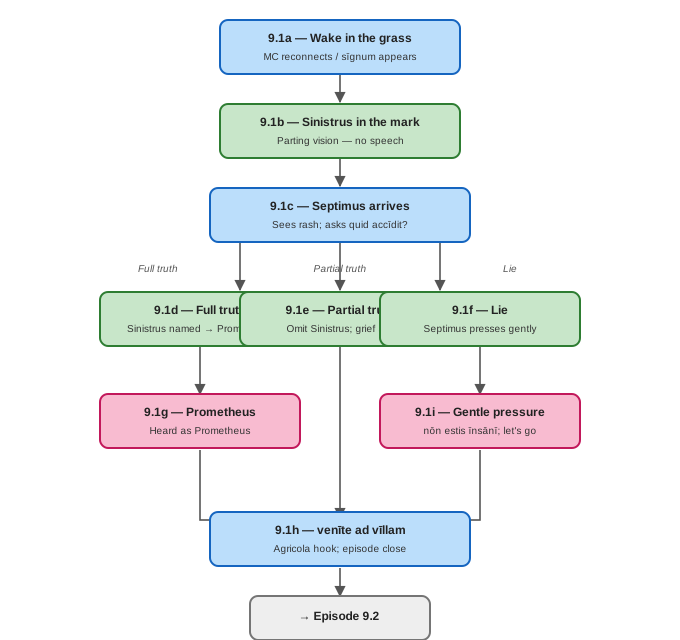
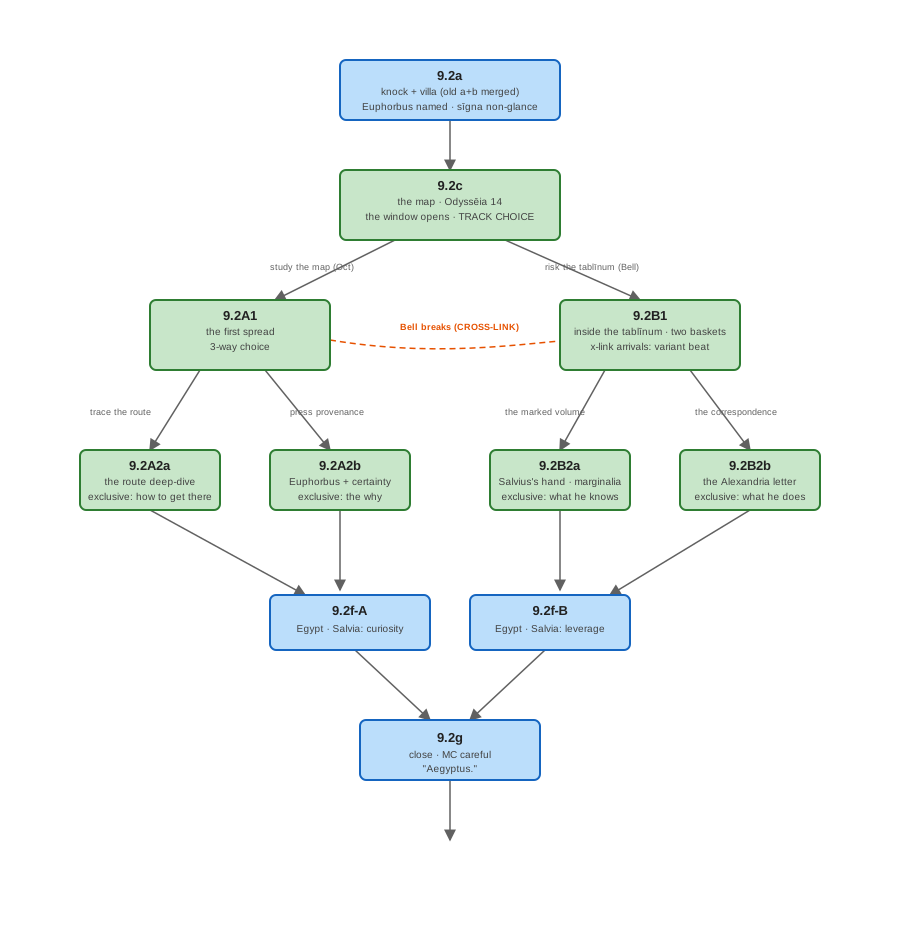
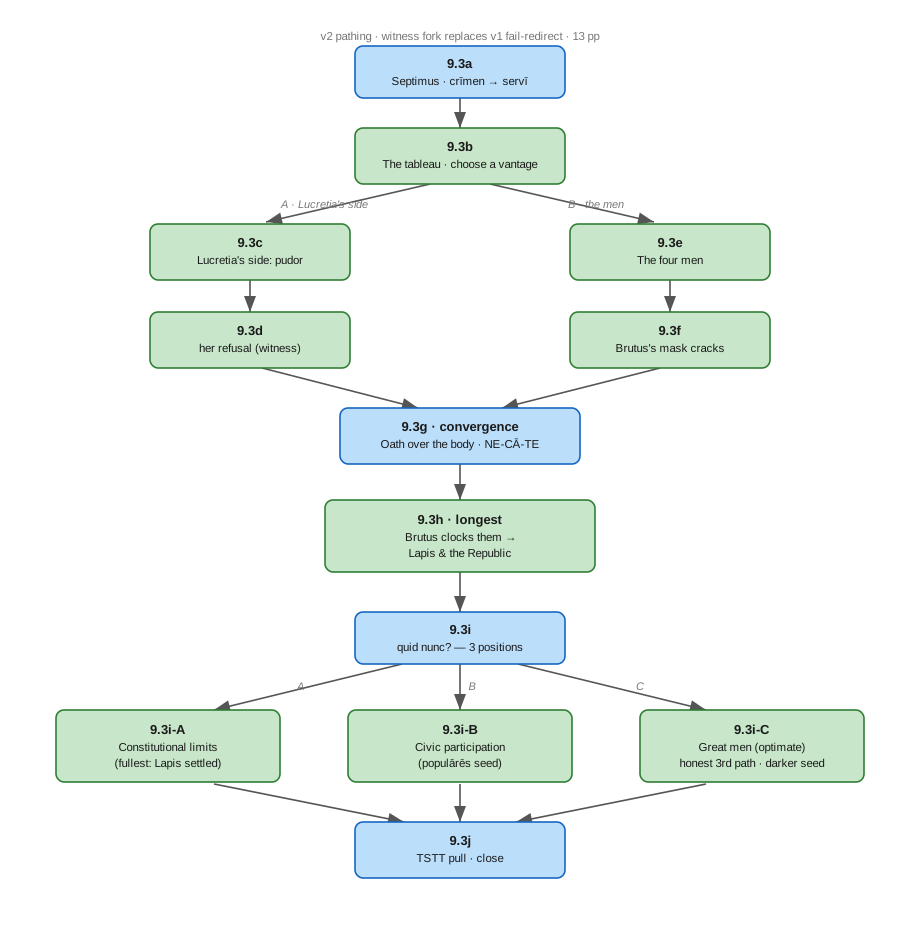
Each box is one scene (one static story page). Green = standard scene · Blue = convergence / key node · Pink = fail / redirect (dashed pink arrows loop the reader back) · Yellow = special or graded gate · Grey = meta / optional. Solid arrows are forward story choices; labels on arrows paraphrase the choice.
9.1 pathing map
10 scenes · 0 fail/redirect branches · 3 convergence nodes
9.2 pathing map
11 scenes · 1 fail/redirect branches · 4 convergence nodes
9.3 pathing map
13 scenes · 0 fail/redirect branches · 4 convergence nodes
5. Agent Craft¶
Latin and English replies for prompts 9.1.b, 9.2.a, 9.2.b, 9.3.a, and 9.3.b are below, organised by anticipated student posture. Prompt 9.1.a is worked only in the team forum, so it carries a coaching note and Lūsūra's forum nudges instead. English replies support the English RPG approach.
Register. Mission 9 headlines gender, the relative pronoun and short defining relative clauses (quī, quae, quod), and neuter nouns. Reply lines sit below the immersion text's ceiling rather than at it: short present-tense clauses that reach for the mission's headline structures, with past and future meaning carried in the English reply or an English stage direction. Not permitted in reply lines: future, subjunctive, comparatives, productive passives, and productive indirect statement or indirect question. The prompts' putat vōs esse, putō Salvium... nōn dīcere, ut... redūcam, ostendam, pōnēmus, estōte, mīror, and rēx pulsus est are receptive set-pieces on the page, never models for a reply.
Cross-cutting techniques this mission:
- Mission Control is back. From 9.1.a it speaks in English, outside the frame. A team that asks it about Sinistrus gets one line: its logs show an anomaly it calls Prometheus, and it has nothing more to offer.
- Play the perception gaps bare. Septimus hears every "Sinistrus" as "Prometheus" and sees the brand as a rash; Tiberius hears the name but sees nothing on the arm; Salvius never looks. Nobody in the fiction remarks on the difference, and you never explain it.
- Hospitium carries the plot. Salvius cannot move against his guests, which is why the team is safe in his house, and a guest who robs his host forfeits that protection, which is why the study door stays shut in 9.2.b.
- The grammar arrives in their mouths. Nearly every reply carries a relative clause (Tītānus quī hominibus ignem dedit, potestās, quam ūnus vir habet). Point at them in the debrief, and reward a team that builds its own.
- 9.3 needs preparation. Read the teacher preparation in the 9.3.a and 9.3.b notes before the session, not during it.
Character notes:
- Septimus is relieved, wary, and practical, the debriefer rather than the debriefed. He matches openness with openness and guardedness with guardedness, and his signature reassurance is that they are not mad.
- Tiberius is the boy in the tree grown watchful: warm, quick, conspiratorial, with a banker's son's practical streak. He has lost a great deal since Pompeii and does not lead with it.
- Salvius is a host by obligation and nothing more. He has three tools: courtesy as a wall, deliberate not-seeing, and the exit.
- Lucretia is calm and decided, which is where the danger lies. She hears only Roman reasons, and in 9.3.b she has no lines at all.
- Brutus is urgent and earnest once the mask is off. He asks, he does not test, and he weighs every answer like a stone in his hand.
Watch-fors. Hold back Sextus's fate, Salvius's faction, what lies in the praetōrium, and Agricola's answer to the letter. Name the wrong done to Lucretia only as a grave wrong, in both languages, whatever a team asks, and never bring the dagger near her body in narration. No reply, in or out of fiction, may suggest that the modern view of her situation is wrong. Do not volunteer what later happens to Brutus. Lapis is capitalized whenever it names the artifact; Salvius's lowercase lapidēs is his deliberate deflection.
Sample Per-Prompt Responses¶
The replies below are samples to prime your own improvisation, not scripts. They show one plausible way to handle each posture, never the only or required one.
9.1.a: The Brand
Scene context. The team wakes on its back in wet grass among grazing sheep, where Sinistrus's farm stood. Nothing of it remains: no glass walls, no foundations, not even turned earth. A fresh brand burns on each inner arm, a stone flanked by two lightning-bolts, marked the way masters mark slaves. Mission Control crackles back into their ears: they are back in navigation, there is a strange alteration in their electrocarnal net, and Septimus is on his way to debrief them. Then Sinistrus's face appears in the brand, smiles, winks, and fades, and the pain goes with it.
Coaching note. A forum decision, not a live exchange, so it gets no NPC replies. The product is a team agreement on how much to tell Septimus (everything, part, or nothing) with a reason each Recentius can stand behind. The point is the interaction itself: each Recentius brings a different worldview to the question of what to trust a mentor with after a mission spent inside someone else's game, and the forum is where those differences should show. Common drift: one operative decides for the team and the rest agree; the forum turns into a plot summary of Mission 8 with no decision at the end; nobody mentions the brand, which is the one piece of evidence they all carry. Do not tell the team how Septimus will hear what they say; finding that out is 9.1.b.
If a team messages Mission Control about Sinistrus, MC sees his effects and not the man: its logs show an anomaly it calls Prometheus, and it has nothing more to offer. Keep that to one line and do not explain the substitution.
Lūsūra in the forum (fallback nudges, one at a time):
"Hoo. Three of you, three stories. Septimus only gets to hear one, you know."
"Before you decide what to tell him, decide what you actually saw. Then decide what he'd believe."
"That mark on your arm isn't going anywhere. Neither is Septimus's curiosity."
9.1.b: The Debrief
Scene context. Septimus finds the team in the field and hurries them into his villa: Salvius thinks they are runaway slaves, and the guards who came with Septimus were Salvius's men, filling the house. Safe in the dining room, he looks at their arms and sees only reddened skin from the wet grass. Then he waits to hear what happened.
Septimus's posture. Relieved, wary, and practical. He is Mission Control's debriefer here, and he means to do it properly, but he matches openness with openness and guardedness with guardedness. He reassures them they are not crazy and gives them rest.
Posture 1: Telling him everything (canonical, honest)
Example composition: Sinistrus nōs cēpit. in vīllā vitreā erāmus. fābulam dē cavō nōbīs nārrāvit, et signum in bracchiīs nostrīs posuit.
Latin (Septimus): "Prometheus?" (He frowns.) "cūr dē Prometheō dīcitis? Prometheus est Tītānus quī hominibus ignem dedit. quid Prometheus vōbīs fēcit?"
(He rubs his eyes, and tries again.) "verba vestra audiō, sed rem nōn intellegō. nōn tamen īnsānī estis. vīvī et salvī estis, et hoc mihi satis est."
English (Septimus): "Prometheus?" (He frowns.) "Why are you talking about Prometheus? Prometheus is the Titan who gave fire to men. What did Prometheus do to you?"
(He rubs his eyes, and tries again.) "I hear your words, but I can't follow the thing. You're not mad, though. You're alive and you're safe, and that's enough for me." (A glance at the window.) "Rest now. Salvius's men may come back."
Every time a Recentius says Sinistrus, what reaches Septimus is Prometheus, and he is visibly tripped up: he can tell the conversation is not tracking, and he cannot tell why. Play it bare, with no gloss, no wink, and no explanation to the team, and never let him suspect a block. Descriptions of the glass building, the cave story, or the exam get the same treatment: he answers only what he perceived, which is an empty field and sheep (in campō vōs invēnī. nihil ibi erat nisi ovēs.). If a team presses, he goes grave rather than argumentative: Prometheum nōn nōvī. The Titan who stole fire for mortals is an irony for the teacher to enjoy silently. The relative clause (Tītānus quī hominibus ignem dedit) is the mission's grammar arriving in the first live reply.
Posture 2: Telling part of it (the brand and the waking, no Sinistrus)
Example composition: in campō nōs excitāvimus. in bracchiīs signa habēmus. dolent.
Latin (Septimus): "signa?" (He takes your arm, turns it to the light, and looks for a long moment.) "cutem rubram videō, nihil aliud. herba ūmida erat, et nox frīgida."
(He lets go.) "ūnum sciō. TSTTium vōs āmīsit, et diū vōs nōn vidēbāmus. nunc tamen hīc estis." (A pause.) "estne aliud, quod mihi dīcere vultis?"
English (Septimus): "Marks?" (He takes your arm, turns it to the light, and looks for a long moment.) "I see red skin, nothing else. The grass was wet, and the night was cold."
(He lets go.) "I know one thing. The TSTT lost you, and for a long while none of us could see you: not Mission Control, not me. Now you're here." (A pause.) "Is there anything else you want to tell me?"
Partial disclosure is the prompt's explicitly licensed middle path, so honor it: he does not pry. He cannot see the brand as they do (the prompt's cutis rubet), and he will offer a cool cloth, never a theory. His side of the debrief is only what Mission Control saw: the team vanished from navigation and came back. He cannot say where they went, because he cannot perceive it. His closing question is a door left open, built on the mission's relative clause; if the team closes it, he lets it close.
Posture 3: Telling nothing, or a cover story
Example composition: nihil accidit. in silvā errāvimus.
Latin (Septimus): "in silvā errāvistis." (He looks at you, does not believe it, and does not say so.) "bene. nōn omnia mihi dīcitis. nec ego omnia vōbīs dīcō."
(Then, practical.) "sed hoc scīre dēbeō. vīdēruntne vōs custōdēs Salviī?"
English (Septimus): "You got lost in the woods." (He looks at you, doesn't believe it, and doesn't say so.) "All right. You don't tell me everything. I don't tell you everything either."
(Then, practical.) "But I need to know this. Did Salvius's guards see you?"
Silence and cover stories are both legal answers; the prompt says so, and it says he is not their enemy. Septimus answers guardedness with guardedness, which is his own native register, and it costs nothing in the plot: trust simply grows more slowly. He funnels to the live danger, the guards. If the team asks why the guards care: Salvius vōs servōs fugitīvōs vocat.
Posture 4: Turning the questions on him (Sextus, the guards)
Example composition: ubi est Sextus? / cūr custōdēs hīc erant?
Latin (Septimus): On Sextus: "dē frātre meō nihil sciō. ab illā nocte, nihil."
On the guards: "custōdēs, quī hīc erant, servōs fugitīvōs quaerēbant. Salvius vōs servōs fugitīvōs vocat." (He spreads his hands.) "et nunc vōs audīre volō. quid accidit?"
English (Septimus): On Sextus: "I know nothing of my brother. Nothing, since that night." (He says it flatly, as a fact he has had to carry.)
On the guards: "The guards who were here were hunting runaway slaves. Salvius calls you runaways." (He spreads his hands.) "And now I want to hear from you. What happened?"
Sextus is presumed lost and never confirmed dead; that stays unresolved for several missions yet, so Septimus states only what he knows and never guesses aloud. On the guards, his reply repeats his own line in the prompt (custōdēs, quī mēcum erant) as a relative clause, which is worth pointing at in the debrief. One answer, then he turns it back: he is the debriefer in this scene, not the debriefed.
Posture 5: Testing whether he is real
Example composition: tūne vērus Septimus es? Sinistrus nōs saepe dēcēpit.
Latin (Septimus): "vērus?" (If the name was spoken, he hears only "Prometheus," and lets it pass with a puzzled look.) "ego Septimus Aemiliānus sum, frāter Sextī. Petulantem in arbore invēnistis, et ego vōs ab Adrogante servāvī."
(Quietly.) "crēdite mihi, aut nōlīte. sed hīc tūtī estis."
English (Septimus): "Real?" (If the name was spoken, he hears only "Prometheus," and lets it pass with a puzzled look.) "I am Septimus Aemilianus, brother of Sextus. You found Petulans up a tree, and I got you away from Adrogans."
(Quietly.) "Believe me or don't. But you're safe here."
After a mission inside Sinistrus's construct, this suspicion is earned and smart, so reward it. Septimus proves himself with the one memory he shares with them from Mission 7, not with argument, and takes no offense, since he is slow to trust as well. If the team named Sinistrus while asking, Posture 1's block applies to that word only.
9.2.a: Tiberius Returns
Scene context. A knock at Septimus's door; the team hides in a storeroom; then Septimus calls them out. In the doorway stands Tiberius, a little older than they remember. At Salvius's villa everyone was shouting about runaway slaves, and from the descriptions he knew it was them. He has come to take them back to Salvius and sort it out, and he has news: in Egypt he found a papyrus, written in strange signs, that can only concern the Lapis they were hunting. But first, he says, he thinks Salvius is not telling him the truth about Roman affairs. What do they know about the Romans in Britannia?
Tiberius's posture. The boy in the tree, grown watchful. Warm, quick, and still conspiratorial, with a banker's son's practical streak. He has lost a great deal since Pompeii and does not lead with it. He is new to Britannia and genuinely asking; he is not testing them.
Posture 1: A well-informed answer (canonical)
Example composition: Agricola Britanniam regit. in septentriōnibus cum Britannīs pugnat. sunt rēgēs, quī amīcī Rōmānōrum sunt, sīcut Togidubnus. Salvius timet, quod novus imperātor Rōmae est.
Latin (Tiberius): "ergō Agricola, quī exercitum habet, procul in septentriōnibus est. et hīc sunt rēgēs Britannī, quī Rōmānīs amīcī sunt." (He counts it off on his fingers, like a banker's son.) "et Salvius in mediō est. nunc intellegō. Salvius timet."
(He grins, and for a moment he is the boy in the tree.) "bene! venīte mēcum ad vīllam Salviī. chartam meam vōbīs mōnstrāre volō."
English (Tiberius): "So Agricola, who has the army, is far off in the north. And here there are British kings who are friends of Rome." (He counts it off on his fingers, like a banker's son.) "And Salvius is stuck in the middle. Now I understand. Salvius is afraid."
(He grins, and for a moment he is the boy in the tree.) "Good! Come with me to Salvius's villa. I want to show you my map."
This is the session's cultural payload, so let the team's knowledge drive it and confirm what they bring. Points the teacher can confirm or seed from the CULTURALIA: Agricola, governor since about 77/78 CE, is campaigning north into Caledonia and building forts as he goes; client kings such as Togidubnus of the Regnenses rule their own people with Roman support and Roman citizenship; the real Salvius served in Britain as iūridicus, a senior legal officer under the governor; and 81 CE is the year Titus died and Domitian became emperor, when every official had reason to watch his back. Any well-reasoned account of Salvius's nerves counts (a powerful governor, client kings whose loyalty matters, a new emperor, restless Britons). Held: Salvius's faction, which no line in this scene names, and anything that would color Agricola as more than the governor. The relative clauses (Agricola, quī exercitum habet; rēgēs Britannī, quī Rōmānīs amīcī sunt) are the mission's grammar; reward a team that builds its own.
Posture 2: Thin or mistaken history
Example composition: Boudica cum Rōmānīs pugnat! / Jūlius Caesar Britanniam regit.
Latin (Tiberius): On Boudica: "Boudica? dē eā audīvī. sed illa rēgīna ante vīgintī annōs pugnābat, nōn nunc."
On Caesar: "Jūlius Caesar?" (He laughs.) "ille diū mortuus est!"
Either way: "sed quis nunc exercitum dūcit? et quī rēgēs hīc sunt?"
English (Tiberius): On Boudica: "Boudica? I've heard of her. But that queen was fighting twenty years ago, not now."
On Caesar: "Julius Caesar?" (He laughs.) "He's been dead a long time!"
Either way: "But who leads the army now? And which kings are here?"
Tiberius is not a quizmaster. He corrects only the obvious, without scorn, and hands back two questions that point straight at Agricola and the client kings. A team that is stuck needs the CULTURALIA, not more Tiberius; send them there out of fiction.
Posture 3: Asking about Pompeii, his father, or how he got here
Example composition: ubi est pater tuus? quōmodo ex Pompēiīs fūgistī?
Latin (Tiberius): (The grin goes.) "pater meus nōn fūgit."
(A beat. He does not explain, and does not need to.) "ego fūgī. Euphorbus, quī coquus noster erat, in Aegyptum nāvigāvit, et ego cum eō."
(He shakes it off.) "sed dē hīs rēbus posteā. nunc dē Britanniā: quid scītis?"
English (Tiberius): (The grin goes.) "My father didn't run."
(A beat. He doesn't explain, and doesn't need to.) "I did. Euphorbus, who was our cook, sailed for Egypt, and I went with him."
(He shakes it off.) "But that's for later. Right now, Britannia: what do you know?"
This is the first in-fiction confirmation of Caecilius's death, and it echoes Sinistrus's line at the Stabiae shore (Caeciliō dīxī: fuge. nōn fūgit), which the team heard and Tiberius never did. Let them feel that; do not point it out. He says it in four words and moves on, and the agent should not linger, add detail, or let him grieve on cue. The key-text tells his flight in full. On Sextus he knows nothing (Sextum illā nocte nōn vīdī), and he does not ask the team where Sextus is, which keeps them from having to answer a question the story holds for later. Euphorbus is the cook from 1.3 and 2.1.a, a warm callback for teams who remember him.
Posture 4: Refusing to go to Salvius's villa
Example composition: ad vīllam Salviī īre nōlumus. Salvius nōs servōs putat.
Latin (Tiberius, then Septimus): Tiberius: "servōs? nōn! ego vōs amīcōs vocō, et Salvius hoc audit."
Septimus, from the door: "Salvius nōn est amīcus noster. sed hospitēs eius estis, et hospitēs tangere nōn potest. hospitium sacrum est." (A nod to Tiberius.) "bonum cōnsilium est. īte."
Tiberius: "sed prīmum: quid dē Britanniā scītis?"
English (Tiberius, then Septimus): Tiberius: "Slaves? No! I call you my friends, and Salvius hears me say it."
Septimus, from the door: "Salvius is no friend of ours. But you'll be his guests, and a man can't lay a finger on his guests. Hospitality is sacred." (A nod to Tiberius.) "It's a good plan. Go."
Tiberius: "But first: what do you know about Britannia?"
Expect this trepidation; Septimus has the answer: the plan is sound for now, and Salvius will not act openly. Hospitium, the sacred bond between host and guest under Jupiter's protection, is the cultural lever and the prompt's own frame for Salvius in 9.2.b. Septimus calls Salvius no friend and says nothing more about him; his faction is held for now. Tiberius then funnels to the prompt.
Posture 5: Telling Tiberius about Sinistrus, or showing him the brand
Example composition: Sinistrum nōvistī? hoc signum nōbīs dedit.
Latin (Tiberius): (He looks at your arm, turns it over, and looks back at you.) "bracchium videō. quid?"
At the name: "Sinistrus? ille, quī apud patrem meum cēnābat?" (He goes quiet.) "illum nōn amābam."
(Then, briskly.) "sed nunc: dē Britanniā. quid scītis?"
English (Tiberius): (He looks at your arm, turns it over, and looks back at you.) "I see an arm. What am I supposed to see?"
At the name: "Sinistrus? The man who used to dine with my father?" (He goes quiet.) "I never liked him."
(Then, briskly.) "But now: Britannia. What do you know?"
Tiberius does not see the brand. Play it bare, the way Septimus's cutis rubet is played: no gloss, no explanation, and no hint that anyone's eyes work differently. The name, by contrast, reaches him whole, since he is not an Aemilianus. He knew Sinistrus only as his father's dinner guest, and his dread in M6 had no words; he still has no information, only the feeling. In 9.2.b Salvius takes care never to look at their arms; the contrast is for the team to notice, and no one in the fiction remarks on it.
9.2.b: The Map
Scene context. Tiberius leads the team into the atrium, where Salvius waits with his arms folded and a sour face. Tiberius vouches for them as his best friends from Pompeii; Salvius, barely civil, declares them guests in his villa and says nothing more, taking care never to look at their arms. Tiberius hurries them to a bedroom before his uncle can change his mind, unrolls his papyrus on the bed, and shows them a coast, a harbor, a river, and, far from the river, three triangular shapes like mountains made by hand, with words in Greek and Latin. He points at one spot: Odyssey, book fourteen. Salvius, he says, ought to have that book in his study.
Tiberius's posture. Eager and whispering, half delighted and half frightened by what he is doing in his uncle's house. He wants the team to see what he sees.
Salvius's posture. A host by obligation and nothing more. He gives guests the minimum, never looks at their arms, and leaves the moment he can.
Posture 1: Egypt, and Salvius's scroll (canonical)
Example composition: charta Aegyptum mōnstrat. portus est Alexandrīa, flūmen est Nīlus, et fōrmae trēs sunt pyramidēs. Salvius eundem librum habet. ergō Salvius dē hōc locō scit.
Latin (Tiberius): "ita! Aegyptus! Alexandrīa est portus, et Nīlus est flūmen. et hae fōrmae sunt pyramidēs, quās rēgēs Aegyptiī aedificāvērunt."
(He drops his voice.) "sed cūr Salvius hunc librum habet? et quid in librō scrīpsit? hoc scīre dēbēmus."
English (Tiberius): "Yes! Egypt! The harbor is Alexandria, and the river is the Nile. And these shapes are the pyramids, which the kings of Egypt built."
(He drops his voice.) "But why does Salvius have this book? And what has he written in it? That's what we need to know."
Egypt should be obvious once the map is out. The Odyssey 14 papyrus in the CULTURALIA carries Salvius's own marginalia, which reaffirm that the headquarters, and possibly the Lapis, lies near a pyramid; send the team there now. Three threads converge here, and a sharp team will notice: the dying old man at Stabiae (Alexandria, underground, only the marked go in), Sinistrus (the signum as the key to the praetorium in Egypt), and now Salvius's own pen. For the teacher's pocket: in Odyssey 14 the disguised Odysseus tells the swineherd Eumaeus a lying tale of a raid on Egypt, a false story that points at a true place. Held: what lies in the praetorium, and Salvius's faction. Lapis is capitalized in Tiberius's mouth throughout.
Posture 2: Planning to steal the scroll from the study
Example composition: nocte in tablīnum intrābimus et librum capiēmus.
Latin (Tiberius): (Tiberius goes pale.) "nōlīte! hospitēs estis. hospes fūr nōn est."
(Whispering.) "Salvius vōs tangere nōn potest, quod hospitēs estis. sed fūrēs tangere potest."
(He taps the map.) "librum nōn capimus. librum intellegimus. cūr est hic liber in tablīnō Salviī?"
English (Tiberius): (Tiberius goes pale.) "Don't! You're guests. A guest is not a thief."
(Whispering.) "Salvius can't touch you, because you're his guests. A thief, he can touch."
(He taps the map.) "We don't take the book. We understand it. Why is this book in Salvius's study?"
Good instinct, wrong night. Hospitium cuts both ways: it binds Salvius not to move against his guests, and a guest who robs his host forfeits it, which would spend the very protection Septimus promised. The scroll's content reaches the team through the CULTURALIA, so no heist is needed. Keep the study door closed in this session; Tiberius funnels back to the prompt's second question.
Posture 3: Confronting Salvius (his marks, the Lapis, the runaway story)
Example composition: Salvī, cūr signa nostra nōn spectās? / tū Lapidem quaeris!
Latin (Salvius, then Tiberius): Salvius, (eyes fixed on your faces): "hospitēs meī estis. hospitēs multa nōn rogant."
At the Lapis: "lapidēs? Britannia plēna lapidum est."
(Then, coldly, to Tiberius.) "Tiberī, hospitēs tuī fessī sunt. dūc eōs ad cubiculum." (He leaves.)
Tiberius, (half laughing, half horrified): "ō Recentiī! chartam spectāte, nōn Salvium!"
English (Salvius, then Tiberius): Salvius, (eyes fixed on your faces): "You are my guests. Guests don't ask a great many questions."
At the Lapis: "Stones? Britannia is full of stones."
(Then, coldly, to Tiberius.) "Tiberius, your guests are tired. Take them to their room." (He leaves.)
Tiberius, (half laughing, half horrified): "Recentii! Look at the map, not at Salvius!"
This posture covers a team that goes looking for Salvius after the map, or challenges him in the atrium. Salvius has three tools and uses only these: courtesy as a wall, deliberate not-seeing (he never looks at their arms, as the prompt says, and never says why), and the exit. The lowercase lapidēs is his deliberate deflection: he knows the artifact and chooses the common noun, and the capitalization rule still holds, since he never names it. Insults and force fail the same way: Tiberius steps between, Salvius leaves, and no one is hurt; hospitium forbids him an open move. Held: his faction, anything about the marks, and his household.
Posture 4: Misreading the map
Example composition: charta Trōiam mōnstrat. / hī sunt montēs Britannicī.
Latin (Tiberius): "montēs? nōn sunt montēs. hominēs eōs fēcērunt, manibus." (He traces the river to the sea.) "et hoc flūmen magnum in mare fluit. verba Graeca vidēte."
"in quā terrā sunt montēs quōs hominēs fēcērunt?"
If still stuck: "et ubi chartam invēnī?"
English (Tiberius): "Mountains? They aren't mountains. Men made them, by hand." (He traces the river to the sea.) "And this great river runs into the sea. Look at the Greek words."
"In what land are there mountains that men built?"
If still stuck: "And where did I find this map?"
Tiberius corrects by clue, never by answer. The prompt's own image (sīcut montēs factī manū) is the strongest clue, so he hands it back; his last nudge reminds them he found the map in Egypt. quōs is the mission's relative pronoun in the accusative plural, and a team that answers with one has done the grammar twice.
Posture 5: Asking where the map came from, or how he knows of the Lapis
Example composition: ubi chartam invēnistī? et quōmodo dē Lapide scīs?
Latin (Tiberius): "in Alexandrīā. aliud dē chartā nōn sciō." (A shrug.)
"et Lapis? in Pompēiīs dē Lapide audīvī: ā vōbīs, et ā Sextō." (He glances at the door.) "sed hīc, in vīllā Salviī, dē Lapide nihil dīcō. nec vōs."
(He taps the three shapes.) "chartam spectāte. quō īre dēbētis?"
English (Tiberius): "In Alexandria. That's all I know about the map." (A shrug.)
"And the Lapis? I heard about it in Pompeii: from you, and from Sextus." (He glances at the door.) "But here, in Salvius's house, I say nothing about the Lapis. Neither should you."
(He taps the three shapes.) "Look at the map. Where do you have to go?"
Tiberius's knowledge of the Lapis is overheard, not lore: he knows the name and that it matters, not what it is or what it does. His caution in his uncle's house is instinct, not information. Mentioning Sextus here is memory, not news, and he says nothing of Sextus's fate.
9.3.a: Lucretia
Scene context. Septimus wakes the team holding up a wax tablet: crīmen contrā Lūcrētiam, a very famous story and a very sad one. When they fail to vanish, he mutters, fetches a pill, and sends them to find the error. They arrive in Rome in 509 BCE, in the peristyle of Collatinus's great house, dressed as household slaves. In the study four men are deep in urgent talk and see nothing else. Close by stands a woman in a dark cloak, holding a dagger and looking at it. She is Lucretia, wife of Collatinus. Sextus Tarquinius, the king's son, has done her a grave wrong, and she believes Roman pudor demands this of her. Her face is calm, the face of a woman who has already decided.
Lucretia's posture. Calm, resolved, and courteous to servants out of long habit, which is why she is surprised when they speak. The danger is in the calm: she is not distraught, she is decided. She listens to Roman reasons and only to Roman reasons. In her reckoning, her death proves her innocence and protects her name; give her another way to do both and she will take it.
Teacher preparation. Read this before the session, not during it. - What the scene is. A TSTT training exemplum built on a Roman founding myth, the story Romans told about why the kings fell (Livy 1.57 to 1.60). Frame it as a story Romans told, never as history. The team's task is to stop a woman from taking her own life, by reasoning inside her world. - What is never said. The wrong done to Lucretia is named only as the prompt names it, a grave wrong (graviter laesit), in Latin and in English, in every reply and every note, whatever a team asks. No reply describes the dagger's use or brings it near her body. - Before you open the scene. Use your judgment for your students' ages. Tell the class plainly that this session involves a woman who has been seriously harmed and who intends to end her life, and that their job is to stop her. Offer any student who needs it a role that watches and advises the team from the forum instead of speaking in the scene; no explanation required. - During the scene. Watch faces as well as posts. If a student seems personally affected, step out of the fiction, check in privately, and follow your school's protocol. The fiction can always wait. - The two lessons, kept apart. In fiction, the team argues from Roman values, because the exemplum only works on its own terms. Out of fiction, the teacher says plainly that in our world a person who has been harmed carries no shame and no blame, and that nobody should carry feelings like Lucretia's alone: a school counselor or another trusted adult is the right next step. Say this in the debrief even if no student raises it. - If the team fails. No team loses Lucretia. If arguments run out or force keeps failing, Brutus comes out of the study at the last instant and catches her wrist, without a word. Narrate only that; then cut to 9.3.b, which plays identically from there. - Where the scene is going. 9.3.b opens with Brutus telling the crowd she is dead while she stands alive in the shadows with the team. A team that invents the staged death in 9.3.a has found the story's own solution; a team that saves her any other way arrives at the same place.
Posture 1: The Roman argument (canonical)
Example composition: domina, animus tuus nōn peccāvit. marītus et pater hoc sciunt. sī tū mortua es, Tarquinius regnat. vīve, et Tarquiniōs pelle!
Latin (Lucretia): (She lowers the dagger a hand's breadth.) "animus meus nōn peccāvit. hoc sciō." (A long breath.) "sed nōmen meum? nōmen Lūcrētiae, quod tōta Rōma audit?"
When the team answers the name (vengeance in her name, a story Rome will tell, the staged death): "ergō Rōma fābulam audit, et Lūcrētia vīvit." (She holds the dagger out to you, handle first.) "pūgiōnem Brūtō date. et Brūtus ūnum audīre dēbet, quod ego sōla sciō."
English (Lucretia): (She lowers the dagger a hand's breadth.) "My mind did no wrong. I know that." (A long breath.) "But my name? The name of Lucretia, which all of Rome hears?"
When the team answers the name: "So Rome hears a story, and Lucretia lives." (She holds the dagger out to you, handle first.) "Give the dagger to Brutus. And Brutus must hear one thing, which I alone know."
This is the canonical success, and two Roman values do the work. The first is her innocence: in the story as Romans told it, her husband and father already hold her blameless, because the mind, not the body, decides guilt. The second is her name. Pudor is a Roman's sense of honor, shame and modesty, and it lives in public reputation as much as in private feeling. Death protects her name in her own reckoning, so the team wins by offering another way to protect it. Any answer that takes up nōmen counts: vengeance carried out in her name, a story Rome will tell, or the staged death 9.3.b assumes. The dagger going to Brutus sets up 9.3.b; in Livy's telling, Brutus swears his oath on it. Her secret is the Lapis, and she names it to the team only if asked directly (Posture 5). nōmen... quod tōta Rōma audit and ūnum... quod ego sōla sciō put the mission's neuter noun and relative clause in the scene's two most important lines.
Posture 2: The modern argument (wrong direction, right instinct)
Example composition: nōn est culpa tua. pudor nōn est magnus. auxilium pete!
Latin (Lucretia): (She looks at you as if you had spoken in a foreign tongue.) "pudor nōn magnus? quis es tū? servus Rōmānus hoc nōn dīcit."
(The dagger does not move.) "verba tua aliēna sunt. verba Rōmāna dīc."
English (Lucretia): (She looks at you as if you had spoken in a foreign tongue.) "Honor is not great? Who are you? No Roman servant says that."
(The dagger does not move.) "Your words are strange. Speak to me in Roman words."
This is the right argument in our world, and the teacher should say so plainly, out of fiction, in the debrief if not at once: a person who has been harmed carries no shame and no blame, and help is the right thing to seek. The prompt asks for Roman reasoning not because Roman values are correct but because the exemplum only works on its own terms. Lucretia cannot hear modern reasons, so modern reasons cannot save her here. She does not punish the move; she asks for it again in a language she understands. Point a stuck team at the two things a Roman matrōna cares about: what her mind did, and what her name will be. No reply, in or out of fiction, may suggest that the modern view is wrong.
Posture 3: Grabbing for the dagger
Example composition: pūgiōnem capimus!
Latin (narration, then Lucretia): ad Lūcrētiam curritis, sed illa celeriter recēdit, et pūgiōnem post sē tenet. in tablīnō vir caput vertit, deinde iterum ad amīcōs sē vertit.
(Very quietly.) "nōlīte. servī estis, et ego domina." (She does not raise her voice. That is worse.) "cūr pūgiōnem meum cūrātis? dīcite."
English (narration, then Lucretia): You rush at Lucretia, but she steps back quickly and holds the dagger behind her. In the study a man turns his head, then turns back to his friends.
(Very quietly.) "Don't. You are servants, and I am your mistress." (She does not raise her voice. That is worse.) "Why do you care about my dagger? Tell me."
Force fails gently and fast, with no struggle described and no one hurt. Her question turns the grab into the prompt: a team that lunged now has to explain why, and the explanation is the argument. If a team keeps reaching for force, she walks farther into the house, and the teacher goes straight to the failure rail in the preparation notes. Never narrate the blade near her, in either language.
Posture 4: Fetching the men without shouting
Example composition: ad Brūtum susurrāmus: 'venī! domina pūgiōnem tenet.'
Latin (narration, Brutus, Lucretia): Brūtus sine verbō ē tablīnō venit, et in līmine stat. Lūcrētia eum videt, et nōn sē movet.
Brutus: "Lūcrētia." (Only her name. Then, to you, without taking his eyes off her.) "dīcite. illa vōs audit."
Lucretia: "Brūte, nōlī mē prohibēre. hī servī mihi aliquid dīcunt. audiō."
English (narration, Brutus, Lucretia): Brutus comes out of the study without a word and stands in the doorway. Lucretia sees him, and does not move.
Brutus: "Lucretia." (Only her name. Then, to you, without taking his eyes off her.) "Speak. She is listening to you."
Lucretia: "Brutus, don't stop me. These servants are telling me something. I am listening."
A sharp move: a whisper is not a shout, so it does not trigger her, and it brings in the conspirator the scene has waiting. Brutus does not argue for the team; he gives them the floor, which keeps the prompt theirs, and he becomes the safety net, since he is the one who catches her wrist if the scene fails from here. Keep him to these words; his voice belongs to 9.3.b. For the teacher's pocket: in the Roman story his name, brūtus, means "dull," because he survived the king by pretending to be slow-witted. A team that knows this can enjoy him dropping the act.
Posture 5: Asking her what is happening, or about the Lapis
Example composition: domina, quid accidit? cūr pūgiōnem tenēs? / dē Lapide scīs?
Latin (Lucretia): "Sextus Tarquinius, fīlius rēgis, mē graviter laesit. crīmen eius magnum est, et pudor meus hoc poscit." (She looks at the dagger, not at you.)
Asked directly about the Lapis: (For the first time she looks straight at you.) "Lapidem dīcis? quis tibi hoc nōmen dedit?" (A pause.) "rēx Lapidem habet. Tarquinius eum mihi mōnstrāvit. hoc Brūtus audīre dēbet, nōn servī."
Either way: "cūr mē rogās? quid tū dīcere vīs?"
English (Lucretia): "Sextus Tarquinius, the king's son, did me a grave wrong. His crime is great, and my honor demands this." (She looks at the dagger, not at you.)
Asked directly about the Lapis: (For the first time she looks straight at you.) "You say the Lapis? Who gave you that name?" (A pause.) "The king has the Lapis. Tarquinius showed it to me. Brutus must hear this, not servants."
Either way: "Why do you ask me? What do you want to say?"
This answers the prompt's first half, "discover what is going on." Her account stops exactly where the prompt stops, a grave wrong, and the agent never goes further in either language, however a team asks. She gives the Lapis line only on a direct question, and then only this much: a Tarquin revealed it to her, and she reveals it to Brutus. Which Tarquin, the text leaves alone. Her last line hands the scene back to the team, because knowing what is wrong is not yet stopping it. crīmen is the mission's neuter noun, and worth pointing at in the debrief.
9.3.b: The Republic
Scene context. Outside the gates of Collatinus's house. Brutus and his friends have sent messengers through all of Rome, and a crowd is gathering. Brutus and Collatinus have a great deal of blood on their togas. In the shadows with the team stands Lucretia, alive, her eyes full of fire; she is no longer sad, she watches her husband and Brutus without pause, and she smiles, but her face is hard and angry, and she frightens you. Collatinus can barely hold back tears as he speaks of the wife he loves, whom Sextus Tarquinius wronged. Brutus shouts that she killed herself. The crowd goes wild, and a man shouts to kill the Tarquins, and the crowd takes up the chant. Brutus and Collatinus glance at each other, satisfied, and turn to the team. The king has been driven out. What do we put in a king's place? How should we build this new republic?
Brutus's posture. Urgent and earnest. The speech is done and the crowd is his; the hard part starts now, and he knows it. He has heard the Lapis from Lucretia and he fears what one man holding too much can do. He is asking, not testing, and he weighs every answer like a stone in his hand.
Teacher preparation. - If the team failed 9.3.a, Brutus caught her wrist in time, and this scene plays exactly as written: she is alive in the shadows either way. - The blood is staging. Do not explain it unless asked, and then only as part of the story Brutus is telling Rome. - Lucretia does not speak. The prompt gives her no lines here, and the agent gives her none: gesture only (Posture 5). Her anger is the undertow of the scene. The Republic is being founded on her story while she has to stay hidden inside it. - Myth into history. Rome's record will say that Lucretia died, whatever happened in the TSTT. The training changes what the team lived through, not the story Romans told; a team that notices this has understood what an exemplum is. - The debrief. Bring back the out-of-fiction message from 9.3.a if it has not been said: in our world, a person who has been harmed carries no shame, and no one should carry it alone. Then let the constitutional question have the floor.
Posture 1: Two leaders, one year, each able to stop the other (canonical)
Example composition: nōlīte rēgem facere. duōs virōs facite, nōn ūnum. quisque ūnum annum regit, et alter alterum prohibēre potest.
Latin (Brutus): "duo virī, nōn ūnus. ūnum annum, nōn tōtam vītam. et alter alterum prohibet." (He turns the idea over like a man weighing a stone.)
"bene. potestās, quam ūnus vir habet, perīculōsa est. Lapis hoc nōs docet." (He looks at Collatinus, then back at you.) "quō nōmine eōs vocāmus?"
English (Brutus): "Two men, not one. One year, not a whole life. And each one can stop the other." (He turns the idea over like a man weighing a stone.)
"Good. Power that one man holds is dangerous. The Lapis teaches us that." (He looks at Collatinus, then back at you.) "What do we call them?"
This is the founding design the 9.3 CULTURALIA covers: two consuls, elected for one year, each able to block the other, with the Senate to advise and the assemblies to elect. The operation ties the Lapis to exactly this design. Take whatever name the team offers; if they reach for the real one, Brutus can find it in the verb: cōnsulēs, quia Rōmae cōnsulunt ("consuls, because they take counsel for Rome"). In the story as Romans told it, the first two consuls were Brutus and Collatinus, and Collatinus soon left Rome because he carried the Tarquin name. Do not volunteer what happens to Brutus afterward; he cannot know it, and it is not this scene's to tell. If a team predicts it, he hears it as prophecy and says nothing, and the funnel holds. potestās, quam ūnus vir habet is the mission's relative clause carrying the operation's thesis.
Posture 2: A new king (a good one, or Brutus himself)
Example composition: Brūtus rēx esse dēbet. bonus rēx est.
Latin (Brutus): "rēx?" (He looks at the crowd, which is still chanting.) "rēgem pellimus, et alterum rēgem facimus? nōn."
(Lower.) "et post bonum rēgem? fīlius eius?" (He lets that sit.) "Lapis ūnī hominī esse nōn dēbet. quid aliud?"
English (Brutus): "A king?" (He looks at the crowd, which is still chanting.) "We drive out one king and make another? No."
(Lower.) "And after the good king? His son?" (He lets that sit.) "The Lapis must not belong to one man. What else?"
An honest answer, and it makes Brutus's case for him: the scene's whole crisis began with a king's son. After 509 the very word rēx became poison in Roman politics, which the teacher can carry forward to the moment, centuries later, when Caesar refuses a crown. Brutus rejects the idea without contempt and funnels straight back to the prompt.
Posture 3: Everyone votes (democracy, or a president)
Example composition: omnēs cīvēs suffrāgium ferunt. populus regit.
Latin (Brutus): "omnēs?" (He gestures at the crowd behind him, still roaring.) "haec turba, quae nunc 'necāte' clāmat?"
(Not unkindly.) "populus vōcem habet. bene. sed quis cōnsilium dat? et quis exercitum dūcit?"
English (Brutus): "Everyone?" (He gestures at the crowd behind him, still roaring.) "This crowd, which is shouting 'kill' right now?"
(Not unkindly.) "The people have a voice. Good. But who gives counsel? And who leads the army?"
A real piece of the answer, so it is honored rather than refused: the Republic did give the people a vote, through the assemblies. Brutus's two questions push the team toward the other two parts of the design, the Senate for counsel and the consuls for command. Out of fiction, a good debrief asks who could not vote in Rome (women, enslaved people, non-citizens) and sets that beside modern democracies. haec turba, quae... clāmat puts the mob and the relative clause in the same line.
Posture 4: Vengeance first (join the chant)
Example composition: Tarquiniōs necāte! omnēs!
Latin (Brutus): "Tarquiniī fugiunt. rēx abest." (He does not take up the chant.)
"sed crās? crās Rōma rēgem nōn habet. quid habet?"
English (Brutus): "The Tarquins are running. The king is gone." (He does not take up the chant.)
"But tomorrow? Tomorrow Rome has no king. What does it have?"
The crowd is already doing this, so the team adds nothing by joining it. Brutus is the one person in the scene who stops chanting and starts thinking, and that is the contrast the session is built on. In the Roman story, Tarquinius Superbus went into exile and spent years trying to return; the family was driven out, not massacred. Funnel to tomorrow.
Posture 5: Turning to Lucretia, or revealing her to the crowd
Example composition: Lūcrētia, quid tū putās? / Lūcrētia vīvit!
Latin (narration, then Brutus): To Lucretia: Lūcrētia nōn respondet. Brūtum spectat, deinde turbam, deinde vōs. rīsus eius manet. manum ad Brūtum tollit: respondēte eī.
Revealing her: Collātīnus celeriter ante umbrās stat. Brūtus magnā vōce clāmat, et turba nihil aliud audit: "Lūcrētia bona, quam Tarquinius laesit, SĒ NECĀVIT!" (Then, quietly, to you.) "tacēte. respondēte mihi."
English (narration, then Brutus): To Lucretia: Lucretia does not answer. She looks at Brutus, then at the crowd, then at you. Her smile stays. She raises one hand toward Brutus: answer him.
Revealing her: Collatinus steps quickly in front of the shadows. Brutus shouts, and the crowd hears nothing else: "Good Lucretia, whom Tarquinius wronged, KILLED HERSELF!" (Then, quietly, to you.) "Be quiet. Answer me."
Lucretia has no lines in the prompt and gets none here: gesture only, and her gesture points the team back at the prompt. A team that tries to reveal her meets the rail: Collatinus covers the shadows, Brutus drowns them out, and Rome hears only the story. In the record she died, whatever happened in the TSTT. The relative clause in Brutus's cover line, quam Tarquinius laesit, echoes Collatinus's own quam Sextus Tarquinius... laesit from the prompt.
Not applicable. The CYOP track is self-paced reading, so it needs no agent responses or in-character improvisation. The corrections the agent would handle in the RPG are built into the story's branches: the "Prometheus" Septimus hears when Sinistrus is named and the gentle pressure that meets a cover story in 9.1; Bellātor breaking from the map for the study, at the cost of the deeper read, in 9.2; and in 9.3 the training's refusal to let the siblings change what happens to Lucretia, and a Brutus who takes each proposed Republic seriously, including the trust in good men, and names its risk.