Mission 7. Britannia, the Founding of Rome, and the Glass Tower¶
1. Episode Overview¶
Essential Question
What happens when cultures meet?
ACTFL Proficiency Benchmarks — Intermediate Low
- Interpretive: I can understand the main idea and some related pieces of information on familiar topics from sentences and series of connected sentences in texts that are spoken, written, or signed.
- Cultural Investigation: I can compare products and practices to understand perspectives from a variety of cultures and communities, including my own.
Cultural & Historical Learning Targets — student-facing
- Summarize, describe, and use the customs of Roman slavery, and explain how an institution travelled wherever Rome went: the iron collar and its bronze tag, which assumed that a stranger on any road in the empire would read it and help; the enslaved overseer who holds the keys; the absence of legal protection; and manumission as a system of managed hope.
- Summarize and describe Roman Britain as a province where two peoples were still working out what the other was: the peoples of the island, Caesar's two crossings and Claudius's invasion, and what forty years of occupation had and had not changed.
- Evaluate competing accounts of the founding of Rome and explain what they contributed to Roman identity, including what Rome exported along with the story: two founders four hundred years apart, the Alban king list built to bridge them, the fratricide Rome kept when gentler versions were available, and veterans at Camulodunum dating their documents from a morning on the Tiber.
- Discuss Livy's importance to Roman history, including how myth gets incorporated into history and what Rome claimed by keeping the stories that unsettle it: history written by exemplum, a city that takes its wives by force and then makes their fathers citizens, Tarpeia told twice and left unresolved, and the prodigia recorded beside elections and armies, which is the procedure the operatives themselves have to run on something no Roman ever saw.
Grammatical Learning Objectives — teacher-facing
- The present infinitive: recognized against finite forms, derived from the second principal part, with the conjugation read off the vowel before -re, the third-conjugation -iō verbs that saturate this episode (capiō, faciō, fugiō), the macron as the only thing separating second from third, and the irregulars that take no -re at all (7.1).
- volō, nōlō, and possum in the present in all six persons, each governing an infinitive: where the infinitive sits, why nōn fused with volō in three forms and not the other three, and possum built from pot- plus sum (7.2).
- The enclitic -que: what makes a word an enclitic, why it rides on the second element, how it joins without inflecting anything, the reading habit that follows, and the trap list of words that merely end in -que (7.3).
- The mission's arc is a build: 7.1 hands the team the infinitive, 7.2 hands them three verbs that govern it, so that by the wall in 7.2.b they can say what they want, what they refuse, and what they are able to do. Then 7.3 adds the smallest join in the language at exactly the moment the Latin has to describe things it has no words for.
Lapis thread
Mission 7 opens the Britannia arc. The team wakes in a cold field southwest of Londīnium in September 81 CE, two years after the eruption, beside a tree they recognize, with a man hiding in it who wears an iron collar. Reading that collar correctly is the price of a conversation, and the conversation names the farm next door and its owner, Sinistrus. Then Salvius's overseer catches the runaway and turns on the team, who have to prove they are free with a dead man's town for a witness. Septimus Aemiliānus arrives on horseback, vouches for them, and takes them to his villa: Sextus's brother, grave and guarded and much harder to read. In the tablīnum he tells them Pompeii is closed to them, names the rift the Mīlitēs believe opened at Stabiae, fails to work the wax tablet, and falls back on pills. They land on a hill above the Tiber in 753 BCE, where two brothers are quarrelling beside a half-built wall and an exhausted crowd has just dragged the Lapis up on a cart. Romulus lifts the glowing stone, says that someone must always carry it and always know what it is, and buries it in the foundation. Then the augury quarrel sharpens, Remus climbs onto the Lapis to mock the wall, and Romulus draws his sword. Back in Britannia, Salvius's soldiers pound at the door; Septimus takes the team out through the back and then simply stops being there at the boundary of Sinistrus's land. Error 1298B returns, navigation drops, and the team is standing on black paving among horseless carts in front of a tower made of glass, with orders from a broken transmission to read it as a portent. At the top, behind a strange desk, Sinistrus is at home, the air cold around him and his shadow falling away from the sun, and he tells them the one thing this mission gives them: here, nobody is watching.
Instructor background, withheld from students
Septimus carries the same perception block Sextus did, and in 7.3.a it is rendered as silent dissolution: he does not vanish with a noise or a light, he simply stops being present, and the narration never acknowledges that anything was blocked. Nothing in the mission explains it. The two questions teams most want to put to him, what happened to Sextus and why Petulāns was not saved, cannot be answered inside an immersion here, because 7.1.b's rescue is narration, 7.2.a puts the team under before they hold a turn, and by 7.3.a he is gone. Handle both in the subgroup or dossier layer as reported speech, and hold to two facts: Septimus has had no contact with his brother since the night of the eruption, and Sextus is presumed lost and never confirmed dead. That confirmation belongs to Mission 14, and nothing in Mission 7 may close it. Petulāns is not freed on any path, and what waits for him at Salvius's villa is insinuated and never specified, in Latin or English. Adrogāns's cruelest line is also the mission's most useful: every witness the team can name is two years dead, so play "you do not have a witness, you have ash" flat and fast and do not soften it. Marcus's letter in 7.1's KEY-TEXT A is the machinery behind the whole plot, and it works because Salvius never reads it properly: nobody is hunting the team, and the soldiers at Septimus's door in 7.3.a are after the runaway. The Lapis goes into the foundation of Rome's first wall whatever the team does at 7.2.b, and observer protocol makes hands useless there, so play the intervention for the argument and never for the result. Sinistrus gives up exactly one thing in 7.3.b, that the Demiurge and the Mīlitēs cannot see them here, and Mission Control stays blind through the end of Mission 8; he never explains the building, never breaks into English, never confirms what he is, and never answers a question about Sextus. The full break is Mission 8's, and spending it early costs the operation its best moment.
2. Shared CODEX Backbone¶
Each approach works from the same CODEX pages. For what the sections contain and how students reach them, see The CODEX. Each episode's ATTUNEMENT set closes with an inline Memorātiō.
CODEX pages: CODEX 7.1 · CODEX 7.2 · CODEX 7.3
KEY-TEXTs
- 7.1: spēlunca Potentium (Marcus leads the Potentēs out of the ruined Pompeii through a tunnel dug years earlier, writes to Salvius in Britannia to ask what the Recentiī know of the Lapis, and turns for the praetōrium), with a Visual Walkthrough, and Geminī (the chain from the fall of Troy through Aeneas, Lavinium, Alba Longa and the Silvian kings to Amulius, Rhea Silvia, the twins, the she-wolf and Faustulus), with a Visual Walkthrough.
- 7.2: epistula Sextī (Sextus writes from Pompeii to his brother in Britannia before the eruption, sends a second tablet independently to Tertius in Egypt, tells Septimus who is coming and why, and closes by asking for a reply that never comes), with a Visual Walkthrough, and Rōmulus Remusque (Faustulus raises the twins, the fight with the brigands, Remus taken and recognized by Numitor, the killing of Amulius, the augury contest, the wall and the fratricide, the naming of Rome, the asylum, the hundred senators, and the approach to the Sabines), with a Visual Walkthrough.
- 7.3: epistula Marcī (Marcus's letter reaches Salvius, who reads it without looking at the seal, decides he cannot be troubled to hunt anyone, and leaves it to gather dust on the table while he thinks about swords) and fēminae Sabīnae (Romulus's city without women, the games for Consus, the abduction, Acron and Caeninae, Tatius and Tarpeia and the Saxum Tarpēium, the women standing between the armies, and the merger into one people under two kings).
Informational Texts
- 7.1: dē servitūte Rōmānā (how people were enslaved, the kinds of work they did, the absence of legal protection, punishment, manumission and the lībertus, and the Roman judgment that the whole institution was natural).
- 7.2: dē Britanniā occupātā (the peoples of the island, Caesar's two crossings, Claudius's invasion and its motives, Aulus Plautius and the four legions, the two-day battle, Togodumnus, the surrenders, and Camulodunum; it stops at the conquest and goes no further).
- 7.3: dē Līviō (Livy at Patavium and at Rome, Ab Urbe Conditā in 142 books of which 35 survive, history written by exemplum, his own stated doubt about the oldest material and his decision to tell it anyway, the traveller who came from Gades to look at him, Augustus and the Pompeiānus joke, and Claudius taking up history at his urging).
GRAMMATICA
- 7.1: the present infinitive, the second principal part and the four conjugations, the third-conjugation -iō verbs, the macron that separates second from third, and the irregulars that take no -re, with two video briefings on the tab.
- 7.2: volō, nōlō, and possum in the present in all six persons with a governed infinitive, the fusion behind nōlō, and possum built from pot- plus sum, with a video briefing on the tab.
- 7.3: the enclitic -que, its placement, how it joins without inflecting, the reading habit it teaches, and the look-alike words that merely end in -que, with a video briefing on the tab.
VERBA
- 7.1: is, ea, fert, diēs, malus.
- 7.2: sī, tōtus, tenet, mīles, īra.
- 7.3: aliquid, amīcus, ūnus, manus, legit.
CULTURALIA
- 7.1: the iron collar and the bronze tag that expected a stranger to help (a system ordinary free people kept running, not one cruel man); Adrogāns the enslaved overseer, the pecūlium, and manumission as managed hope; how a free Roman proved status when nothing showed, by tria nōmina, by lēx, and above all by a testis.
- 7.2: the two key-texts' disagreements as evidence that a Roman origin story was a set of competing versions; the four-hundred-year gap between Aeneas and Romulus and the Alban king list built to bridge it; why Rome kept both founders; why the fratricide survived, read through the pōmērium as sacred boundary rather than through Romulus's temper, with Horace's civil-war reading beside it; AUC and the contested date; and why a founding story reaches a cold island at all, through the colony at Camulodunum dating its documents ab urbe conditā.
- 7.3: how Livy wrote history, including his admission that the oldest material rests on poets' tales and his decision to tell it anyway; Tarpeia told twice and left unresolved; and what Romans did about impossible things, the ostenta procedure the team is about to run on a glass tower.
ATTUNEMENT
- 7.1: seven exercises: a pooled-bank discrimination between infinitives and finite forms where every verb appears as both, a principal-part derivation grid that sends operatives to the dictionary to build the infinitive rather than copy it, a supporting-detail audit on Geminī, a column sort on the slavery text, an open comprehension with mandatory citation on Marcus's letter, a true-and-false audit on the CULTURALIA, and the mission's once-per-mission Products, Practices, and Perspectives organizer on the collar itself, closing with the inline Memorātiō.
- 7.2: six exercises: a forced-choice morphology run on volō, nōlō, and possum, an event sequencing across Rōmulus Remusque, a categorized fact extraction on the conquest text under Latin bucket headings, a sentence-grid free production, a parallel analysis of Sextus's letter against the immersion with a synthesis capstone that is the episode's interpretive centerpiece, and a CULTURALIA comprehension whose first item works the disagreement between the two founding accounts, closing with the inline Memorātiō.
- 7.3: six exercises: a multiple-choice cloze run on the enclitic, a rewriting task that turns et pairs into -que, a locate-and-extract warrant task on the Livy text, a four-tier interpretive read on fēminae Sabīnae that is the episode's interpretive centerpiece and carries the perspective work in its top tier, a character-profile inference grid on Marcus's letter and Salvius's handling of it, and an intercultural organizer on the ostenta procedure, closing with the inline Memorātiō.
3. Episodes¶
The story beats are the same across all tracks. Track-specific links and running notes are in §4.
Numbering map (Episode 7): 7.1 (The Man in the Tree: Slavery in Britannia) = prompts 7.1.a / 7.1.b; 7.2 (Septimus's Villa: The Founding of Rome) = 7.2.a / 7.2.b; 7.3 (The Glass Tower: Livy and the Ostentum) = 7.3.a / 7.3.b.
7.1, The Man in the Tree: Slavery in Britannia¶
The team wakes in a field southwest of Londīnium in September 81 CE, under a sky with no sun in it, days after the night of fire and ash. One thing is familiar: the tree beside them is the same tree, though there is no boy in it now. There is a man, high in the branches, neither young nor old, in filthy clothes, and he wants them gone before whoever is looking for him arrives. Around his neck is a ring of iron, and reading it correctly is the whole of the first scene: iron at the throat means an enslaved man who has already run once. When the team backs off and talks to him properly he comes down and cannot stop talking. He is Petulāns, his owner is Salvius, he means to reach the woods, and the farm next door belongs to a man unlike other owners, named Sinistrus, whose name carries the shadow-sense. Then Adrogāns, Salvius's overseer, is behind them with a stick. He takes Petulāns and turns on the team: you are slaves too, I suppose. They have to prove they are not, to a man who has heard three names from every runaway he ever caught and who wants a witness, in a province where every witness they can name died at Pompeii. Septimus Aemiliānus arrives on horseback, grave and quiet and unmistakably Sextus's brother, says he knows them, and has them released. Petulāns is dragged away looking back at them. Septimus does not explain himself: his house is nearby, and they are to come.
7.2, Septimus's Villa: The Founding of Rome¶
In the tablīnum Septimus tells the team what he thinks they need before he sends them anywhere. The Demiurge pulled them off the mountain; Pompeii no longer exists and they cannot go back, because two worlds cannot both be there; the leaders of the Mīlitēs believe a rift opened at Stabiae and that it may be a road to the Lapis. First, though, a training exemplum. He takes up the wax tablet, and nothing happens. He tries again, and nothing happens again, and he sets it down and says quietly that his brother did this better. Then he fetches pills, and the room goes to water. The team is standing on a hill above a marshy stream in 753 BCE, with huts and empty ground where the city will be, two young men who look like twins arguing beside a half-built wall, and a crowd of shattered men who have just hauled a glowing stone up the slope on a cart. Close to the wall, the team hears Romulus lift the stone out of the earth, look at it as though he knows it, and say that someone must always carry it and always know what it is, before he buries it in the foundation and starts building over it. The quarrel sharpens into birds and signs and kingship. Remus jumps up onto the Lapis and boasts that from up here he can see Etruria. Romulus takes up a sword and his eyes go cold, and the TSTT announces observer protocol: the team may argue, and may not touch anything.
7.3, The Glass Tower: Livy and the Ostentum¶
They are back in the tablīnum when someone starts hammering on the door, not like a guest. Septimus reads the soldiers' insignia at the window, says they are Salvius's men and are probably after the runaway from the road, and takes the team out through the back way, saying he stays with them. Then, as they cross into the fields of Sinistrus's farm, he stops being there. No noise, no light, nothing to find. The Demiurge comes on to say that error 1298B has returned and Mission Control has lost their signal, that it does not believe they are in danger, and that the space ahead may be unstable. Navigation drops. The ground is not a field: it is flat and black and hard, ruled with long white lines in rows, with fog around it and enormous things of iron and glass standing in it that have wheels and no horses and nothing pulling them. To the north stands a building that threatens the sky, with walls of glass that hold the sky inside them, and two panels beneath it that open by themselves. A broken transmission gets one word through: legite. Read it. A Roman who meets something impossible does not run and does not fall down in front of it; he works out what it is telling him and what it wants. Inside, lit panels carry moving images, and a chamber lifts them without steps to a room with glass walls, where Sinistrus sits behind a strange desk as though he owns it, the air cold around him and his shadow falling away from the sun. In this place where the team is lost, he is at home, and he is glad to see them.
4. Running the Mission¶
Immersion links:
Episode 7.1: The Man in the Tree: Slavery in Britannia
-
Post 7.1.a and read it together: the field, the sunless sky, the familiar tree, and the man hiding in it who tells them to keep away. The last line is the one that matters: there is iron around his neck, and free men do not wear iron. Stop here, before anyone composes.
-
The prompt asks the team to work out who the man is from what they know about slavery, so give them the object first: read the CULTURALIA section on the iron collar together. A team that sees what that small object expects of a passing stranger has the answer to the prompt in hand.
-
Introduce GRAMMATICA 7.1 now, because the scene is built out of it: latēre vult, fugere vult, sed nōn potest. The infinitive is the form the whole exchange runs on, and the team will need it the moment they offer him anything. Two video briefings support the tab.
-
Work the Infinitive or Finite Verb task alongside the composing rather than before it: every verb in its bank appears as both an infinitive and a finite form, so the discrimination it drills is the one the team is performing in the reply they are drafting.
-
Teams compose their read of the man and their probe for Sinistrus and any Mīlitēs contacts. Post your in-character agent response; see §5 Agent Craft for 7.1.a, Petulāns's information-for-distance trade, and why noise is the only real danger in the scene.
-
Work the Second Principal Part task once the reply is in: a sixteen-verb grid that sends operatives to Latinitium to build each infinitive from the dictionary entry rather than copy it.
-
Read Informational Text A, dē servitūte Rōmānā together: the team has just met one enslaved man on one bad morning, and this is the system he is running from.
-
Work the Sorting the Servile Life task, a column sort of thirteen phrases that fixes the text's categories in place before anyone has to argue from them.
-
Bridge to the second scene with the rest of the CULTURALIA section: Adrogāns the overseer, almost certainly enslaved himself, and how a free Roman proved status when nothing showed, by tria nōmina, by lēx, and above all by a testis.
-
Post 7.1.b. Petulāns comes down, talks himself into trouble, and names Salvius and the farm next door; then Adrogāns has him by the collar and turns on the team. Teams compose their proof of free status. Post your agent response; see §5 Agent Craft for the proof postures, the witness demand, and Septimus's scripted arrival.
-
Work the What You Think You Know About Roman Slavery task after the scene rather than before it, so that its twelve true-and-false statements are tested against a morning the team has now lived through, including the overseer who turned out to be property himself.
-
Work the Iron Collar task, the mission's once-per-mission Products, Practices, and Perspectives organizer, spent here because the collar is the one object in the mission that carries a whole worldview.
-
Read KEY-TEXT A, spēlunca Potentium together: Marcus leads the Potentēs out of the ruins and writes to Salvius in Britannia, the letter whose consequences land in 7.3. The team has just learned Salvius's name from a runaway. A Visual Walkthrough on the tab supports the reading.
-
Work the Reading Marcus task, six open questions that each require a quotation from the Latin, so the team's picture of Marcus comes from the text rather than from two years of grudge.
-
Read KEY-TEXT B, Geminī together before the mission's next scene, not after: the chain from Troy to the she-wolf ends on the hill the team is about to stand on, and they need to know whose quarrel they are listening to. A Visual Walkthrough on the tab supports the reading.
-
Work the What Geminī Actually Says task, an eleven-statement supporting-detail audit. Hold the team to what this version says, because 7.2's key-text tells the same stretch differently, and the disagreement is the mission's real subject.
-
Close the episode with the inline Memorātiō, composed in the operative's voice: what the iron told them, what Petulāns said about the farm next door before he was taken, what Adrogāns wanted and what they could not give him, and who arrived on the horse.
-
Award LP for 7.1 per operative and mark ATTUNEMENT and KEY-TEXT completion in Mission Control.
Episode 7.2: Septimus's Villa: The Founding of Rome
-
Read KEY-TEXT A, epistula Sextī together before posting anything: Sextus writes to his brother in Britannia and sends a second tablet to Egypt. Read now, it answers why a stranger on a horse could say he knew them and why Septimus holds a wax tablet he cannot work. A Visual Walkthrough on the tab supports the reading.
-
Post 7.2.a and read it together. Septimus lays out the rules and what the Mīlitēs believe about Stabiae, fails twice with the tablet, and produces pills; then the hill above the Tiber in 753 BCE, two arguing twins, and the Lapis on a cart. Stop here, before anyone composes.
-
The prompt asks the team to get close enough to hear and then to decide, as Romans, whether to be seen. The strongest answer came from the last episode: put a pair of hands on the cart and nobody asks who you are. Let them find it rather than handing it over.
-
Introduce GRAMMATICA 7.2 out of the scene itself: wanting to hide, not wanting to be seen, and being able to listen are all one verb plus the infinitive from last episode. The tab runs volō, nōlō, and possum through all six persons, with a video briefing.
-
Work the Which Form Fits? task alongside the composing: eight sentences where the only question is which of the three verbs and which person the sense requires, which is exactly the choice the team is making in its own draft.
-
Teams compose their approach to the hill. Post your agent response; see §5 Agent Craft for the four approach postures, of which joining the work gang is the strongest and carries cover into the next scene.
-
Read KEY-TEXT B, Rōmulus Remusque together, the founding narrative from Faustulus to the Sabines. The stretch the team is standing inside sits in its middle, so they are about to argue with a man whose story they have read to the end. A Visual Walkthrough on the tab supports the reading.
-
Work the Putting Rōmulus Remusque in Order task, a ten-event sequencing that forces the team to hold the whole narrative shape rather than the two scenes they witnessed.
-
Before the second prompt, give the team the argument the wall requires: read the CULTURALIA section through its first three parts, ending on the pōmērium. A team that understands why a city boundary was a religious object can speak to Romulus in terms he recognizes, the only kind of speech with any chance.
-
Work the Build Your Own task alongside the composing that follows. It is free production from a sentence grid, five sentences of wanting, refusing, and being able, and the team is about to need all three of those in one breath in front of a man with a sword.
-
Post 7.2.b. Romulus buries the Lapis in the foundation, the quarrel goes to birds and kingship, Remus climbs onto the stone, and the sword comes up. Teams compose, and the prompt allows either direction. Post your agent response; see §5 Agent Craft for the postures on both sides. Whatever happens, the wall goes up and the Lapis stays under it.
-
Read Informational Text A, dē Britanniā occupātā together once the team is back in the villa: this is the province the team is actually standing in, and it is younger than most of the adults in it.
-
Work the What the Conquest Text Tells You task, a three-column extraction under Latin headings that separates the peoples from the campaigns from the outcomes.
-
Return to the CULTURALIA section for its closing parts: the conquest text's dates are counted ab urbe conditā, from the morning the team just watched, and the veterans at Camulodunum dated their documents from it. Becoming Roman included agreeing where to start counting.
-
Work the Two Founders, One City task, the CULTURALIA comprehension; its first item is the disagreement between Geminī and Rōmulus Remusque that the team has been carrying since the last episode, and the team now has a third version of its own to set beside them.
-
Work the Letter and the Man task, the episode's interpretive centerpiece: Sextus's letter set against the man they met in the tablīnum, capped by a synthesis.
-
Close the episode with the inline Memorātiō, composed in the operative's voice: what Septimus said about Pompeii and about Stabiae, what happened when he took up the tablet, what Romulus said over the stone before he buried it, and what the team did when the sword came up.
-
Award LP for 7.2 per operative and mark ATTUNEMENT and KEY-TEXT completion in Mission Control.
Episode 7.3: The Glass Tower: Livy and the Ostentum
-
Read KEY-TEXT A, epistula Marcī together before posting the prompt: Marcus's letter arrives and Salvius leaves it unread on the table. It tells the team something they will not otherwise learn all mission: nobody is coming for them, so the men about to hammer on Septimus's door are after somebody else.
-
Work the Two Men and a Letter task, a four-question character-profile grid on the man who wrote the letter and the man who did not read it. The contrast is the plot: the operation survives this mission because one of them is lazy.
-
The prompt about to come asks the team to behave like Romans in front of something impossible, so give them the procedure first: read the CULTURALIA section on prodigies. Report it, refer it, learn what it demands, do that, carry on: not at all the same thing as running or worshipping.
-
Post 7.3.a and read it together. The soldiers at the door, the exit through the back, Septimus stopping mid-field, the Demiurge's transparency notice about error 1298B, and then the black ground, the white lines, the horseless carts, the tower of glass, and one word through the interference: legite. Teams compose their reading of the place.
-
Introduce GRAMMATICA 7.3 here, where the Latin needs it: the narration describes things it has no words for by piling up pairs, hard and heavy, black and level. The tab covers the enclitic -que, with a video briefing.
-
Work the Enclitic or Not? task, eight cloze items that make the team choose between a real enclitic and a look-alike, which is the discrimination the tab has just set up.
-
Post your agent response for 7.3.a; see §5 Agent Craft for running a scene with nobody in it to answer: reward naming and cataloguing with access, never let the narration use a modern word, and give calls for Septimus or Mission Control exactly nothing.
-
Work the Joining with -que task, seven bracketed pairs rewritten from et into -que in a two-column table, so the team produces the join instead of only spotting it.
-
Post 7.3.b. Inside: the lit panels, the rising chamber, the glass room at the top, and Sinistrus behind the desk, at home. Teams compose their attempt to find out what he is doing here. Post your agent response; see §5 Agent Craft for the one fact he gives and the one thing that gets a real reaction.
-
Read Informational Text A, dē Līviō together after the scene: the team has just been inside one of Livy's stories and watched it come out differently, so they can read this as testimony rather than as a biography.
-
Work the Introduction to Livy task, ten statements each answered with the Latin that warrants it, so the claims about Livy are proved from the text and not from the discussion.
-
Read the rest of the CULTURALIA section before the second reading: how Livy wrote, and Tarpeia told twice, once a traitor and once a loyal girl, with the author declining to choose. The team should know that before they meet her.
-
Read KEY-TEXT B, fēminae Sabīnae together: the abduction, Tarpeia and the rock, and the women standing between the two armies. It continues the founding narrative past where the team left it, the same wall, forty pages on.
-
Work the Reading fēminae Sabīnae task, the episode's interpretive centerpiece: eleven questions climbing from the main idea to perspective, ending on why Rome kept a story in which it takes its wives by force.
-
Work the Something That Should Not Be There task, the intercultural organizer on the ostenta procedure: the team ran a Roman procedure on a glass building, and this asks what the procedure assumes about the world.
-
Close the mission with the inline Memorātiō, composed in the operative's voice: who was at the door and who they were looking for, what happened to Septimus at the boundary and what the Demiurge said about it, what the team decided the place was, and what Sinistrus told them about who is watching.
-
Award LP across 7.3 per operative and mark ATTUNEMENT and KEY-TEXT completion for all three episodes in Mission Control.
Openings: the two CYOP tutorials are covered on the Introduction & Tutorials page; the episode openings follow below. The reads and comprehension tasks mirror the RPG, so they carry the same links and pill colors. Run the mission as an Operation LAPIS (CYOP) cohort in Mission Control, where each student keeps a per-episode Memorātiō on their dossier and the attunement and key-text checks work as in the RPG; see About Fabula Lapidis for cohort setup.
Episode 7.1: The Man in the Tree: Slavery in Britannia
-
Post the 7.1 opening. Octāviāna and Bellātor come back to themselves in a British field two years after the eruption, beside a tree with a man in it who has iron around his neck and wants them gone. Pause at the first gate, which asks what they are looking at rather than what to say.
-
Students must show they have read the collar before Petulāns will talk to them at all. Addressing him as a free man, or trying to pull him down, sends the story to a redirect that asks the question outright; let the narrative do that correcting.
-
Read the CULTURALIA section on the iron collar together: what the object was for, the bronze tag with the address on it, and what it assumed a passing stranger would do.
-
Introduce GRAMMATICA 7.1, the present infinitive, which is alive in every line the man in the tree speaks: he wants to hide, he wants to run, he is not able to do either.
-
Work the Infinitive or Finite Verb task, a pooled bank in which every verb appears as both an infinitive and a finite form, so nothing is solvable by recognizing the word.
-
Work the Second Principal Part task, the sixteen-verb derivation grid that sends students to Latinitium to build the infinitive from the dictionary entry rather than copy it.
-
Once Petulāns is talking he cannot stop, and the branching gives students two optional, converging probes: Octāviāna's about Sinistrus, Bellātor's comic tour of the household. Which they choose decides the intelligence they carry into the next episode.
-
Read Informational Text A, dē servitūte Rōmānā together: enslavement, work, the absence of legal protection, punishment, and manumission, the system behind the one man in the tree.
-
Work the Sorting the Servile Life task, a column sort of thirteen phrases that fixes the text's categories in place.
-
Read the rest of the CULTURALIA section before the confrontation: the overseer who is himself property and works the system for the hope it pays him in, and how a free Roman proved status when nothing showed, by tria nōmina, by lēx, and above all by a testis.
-
Adrogāns arrives, takes Petulāns, and turns on the siblings, with four ways through: Octāviāna's full legal argument, her bare claim of citizenship, Bellātor's spectacle, and his flight, the one move that confirms the accusation. Pause here in discussion: the correct answer is not the loudest one, it is the one that produces something a Roman could check.
-
Work the What You Think You Know About Roman Slavery task after the confrontation, so its twelve statements are tested against a scene where the man with the stick turned out to be property himself.
-
Work the Iron Collar task, the Products, Practices, and Perspectives organizer, spent here because the collar carries a whole worldview in one manufactured object.
-
Septimus arrives and Petulāns is dragged away, and the story gives students one values choice with no correct answer: speak for the man or hold a guest's silence. Neither frees him. Debrief it as a choice about obligation rather than a puzzle with a solution.
-
Read KEY-TEXT A, spēlunca Potentium together: Marcus writes to Salvius in Britannia, the letter now on its way toward the name readers just heard from a slave. A Visual Walkthrough on the tab supports the reading.
-
Work the Reading Marcus task, six open questions each requiring a quotation from the Latin.
-
Read KEY-TEXT B, Geminī together, the chain from Troy to the she-wolf, before the next episode puts the siblings on the hill where it ends. A Visual Walkthrough on the tab supports the reading.
-
Work the What Geminī Actually Says task, an eleven-statement supporting-detail audit held strictly to this version of the story.
-
Close with the inline Memorātiō. Award 7.1's LP on the quality of that reflection.
-
Debrief the episode's choices as a class: what did the collar tell a Roman that a face could not, why did flight confirm the accusation, and what does it mean that the rescue came from a man's standing rather than from anything the siblings could prove?
Episode 7.2: Septimus's Villa: The Founding of Rome
-
Read KEY-TEXT A, epistula Sextī together before the opening: it answers why a stranger could say he knew the siblings and why the tablet in Septimus's hands will not work. Sextus does not know it is his last letter. A Visual Walkthrough on the tab supports the reading.
-
Post the 7.2 opening. The siblings sit with Septimus in his tablīnum, and the scene is built as a hub: three topics, in any order, none of them required. Have students read for comprehension and then decide what they most want to know.
-
The three probes are Sinistrus, Sextus's death, and Salvius and the plan. The Sinistrus probe yields the operational problem in plain words; the Sextus question is the emotional hinge; the Salvius probe lays out why they are here. Students can hear one, two, or all three, and leave when they have had enough.
-
Introduce GRAMMATICA 7.2, volō, nōlō, and possum with a governed infinitive, which is the grammar of the entire debrief: Septimus cannot explain, does not want to send them unprepared, and wants them to understand something first.
-
Work the Which Form Fits? task, eight sentences turning on which of the three verbs and which person the sense requires.
-
The wax tablet fails twice and Septimus fetches pills, the joke and the characterization at once. Then the hill in 753 BCE, with a gate before the argument: approaching strangers as strangers is redirected, and the slavery reading from last episode is what makes blending in available.
-
Read KEY-TEXT B, Rōmulus Remusque together: the whole founding narrative, from Faustulus to the Sabines, with the scene the siblings are standing inside sitting in the middle of it. A Visual Walkthrough on the tab supports the reading.
-
Work the Putting Rōmulus Remusque in Order task, a ten-event sequencing across the whole text rather than the witnessed part.
-
Read the CULTURALIA section through its first three parts before the confrontation: the two accounts that disagree and why neither is wrong, the four-hundred-year gap and the king list built to bridge it, and why Rome kept the fratricide, which turns on the wall being a sacred boundary rather than on Romulus losing his temper.
-
Work the Build Your Own task, five sentences of free production in wanting, refusing, and being able.
-
Past the gate the siblings split, Octāviāna toward Romulus and Bellātor toward Remus, and each track carries a two-way choice into one of four endings: the appeal heard, the interposed body, both brothers dead, or the unseen distraction. All four are true inside the simulation, and no single run sees more than one, so pool what different students found.
-
The story then gathers every outcome into one question, quid hoc nārrat dē Rōmānīs?, and this is the intellectual summit of the mission: Rome built its identity on a story it chose rather than a fact it found. Let students answer before Septimus does, and resist filling the silence.
-
Read Informational Text A, dē Britanniā occupātā together once the siblings are back in the tablīnum: the peoples of the island, Caesar's crossings, Claudius's invasion, the two-day battle, and Camulodunum, the province they are actually sitting in.
-
Work the What the Conquest Text Tells You task, a three-column extraction under Latin headings.
-
Return to the CULTURALIA section for its closing parts: the conquest text's dates counted from the morning the siblings just watched, the Roman argument about which year that was, and the veterans at Camulodunum dating their documents ab urbe conditā on an island three weeks from Rome.
-
Work the Two Founders, One City task, the CULTURALIA comprehension whose first item is the disagreement between the two founding accounts; readers of the branching story have a third version of their own, and possibly a fourth from a classmate.
-
Work the Letter and the Man task, the interpretive centerpiece: Sextus's letter set against the brother the siblings have now spent an episode with, capped by a synthesis.
-
Close with the inline Memorātiō. Award 7.2's LP on the quality of that reflection.
-
Debrief as a class: which probes did each reader choose in the tablīnum and what did that cost them later, which of the four endings did each run produce, and if all four are equally possible transmissions of the same afternoon, what exactly was Livy working from?
Episode 7.3: The Glass Tower: Livy and the Ostentum
-
Read KEY-TEXT A, epistula Marcī together before the opening: Marcus's letter reaches Salvius, who cannot be bothered to hunt anyone and leaves it on the table. Readers who have this in hand know something the siblings never learn: the men at the door are not there for them.
-
Work the Two Men and a Letter task, a four-question inference grid on the man who wrote the letter and the man who ignored it.
-
Read the CULTURALIA section on what Romans did about impossible things before the opening: a prodigy was a message; report it, refer it, learn what it demands, do that. The whole episode tests whether the siblings can run that procedure on something no Roman ever saw.
-
Post the 7.3 opening. Fists on the door, and the siblings out of the house by two routes, Octāviāna past the guards on performed standing, Bellātor through increasingly wrong windows, converging on the road. Note how Octāviāna's exit turns on register: a Roman of standing announces her departure and does not ask permission.
-
At the field boundary the transmission garbles with error 1298B, Septimus is simply no longer there, and the field is a flat black expanse with white lines. There is no way back, and the story hands the choice forward: cross the open ground, or read the place before touching it.
-
Introduce GRAMMATICA 7.3, the enclitic -que, at the point where the Latin is describing things it has no words for and doing it in pairs: hard and heavy, black and level.
-
Work the Enclitic or Not? task, eight cloze items that force the choice between a real enclitic and a word that merely ends the same way.
-
Each route through the rupture zone teaches half of one lesson: the open ground offers the cooling machines and the white lines whose road logic implies a ruler of the place; the glass face offers the reflection, the cycling door, and writing that says nothing. The encounters are not gates; let students take the route they argued for.
-
Work the Joining with -que task, seven pairs rewritten from et into -que in a two-column table.
-
At the entrance the story sets the section's one graded gate: a wall-sized screen with moving images. Reading it as a portent is the trap, and the redirect says so in the TSTT's own voice: tell the signal from the noise. The rewarded reasoning is Octāviāna's, that these pictures belong to the place the way wall-paintings belong to a villa.
-
Read Informational Text A, dē Līviō together: Livy at Patavium and at Rome, 142 books of which 35 survive, history written to hold up examples, and his own doubt about the oldest material, which he records and then tells anyway.
-
Work the Introduction to Livy task, ten statements each warranted by cited Latin.
-
Read the rest of the CULTURALIA section: how Livy wrote, with everyone in the story standing as an example of something, and Tarpeia told twice, once as a traitor and once as a loyal girl, with the author declining to choose.
-
Read KEY-TEXT B, fēminae Sabīnae together: the city without women, the games, the abduction, Tarpeia and the rock, the women between the armies, and one people under two kings.
-
Work the Reading fēminae Sabīnae task, the interpretive centerpiece, eleven questions rising from the main idea to perspective, with the top tier on what a Roman reader was meant to admire and why Rome kept a story that shows it taking wives by force.
-
The story closes on Sinistrus, at home in the shadow near the exit: he was waiting, the place knows him, the rules here are different, and nobody is watching. Then the lights go out. Nothing is resolved, which is the point; the reveal belongs to Mission 8. Let students sit with it rather than explaining it away.
-
Work the Something That Should Not Be There task, the intercultural organizer on the ostenta procedure and what it assumes about the world.
-
Close with the inline Memorātiō. Award 7.3's LP on the quality of that reflection.
-
Debrief as a class: what made the screen noise rather than a message when the tower itself was one, and what is the difference between the way Livy handles a story he cannot verify and the way Sinistrus handles a question he does not want to answer? Assess engagement through discussion and the written comprehension responses.
Story Map¶
The Recentii awaken in Roman Britain southwest of Londinium, navigating Roman slavery customs and a dangerous confrontation before being rescued and sheltered at Septimus's villa. A training immersion in the founding of Rome (Romulus and Remus) explores myth as identity, and the episode climaxes with a flight to Sinistrus's farm, a TSTT rupture zone rendered as a modern office building seen through Roman eyes, ending on a cliffhanger as Sinistrus appears.
How to read the maps
Each box is one scene (one static story page). Green = standard scene · Blue = convergence / key node · Pink = fail / redirect (dashed pink arrows loop the reader back) · Yellow = special or graded gate · Grey = meta / optional. Solid arrows are forward story choices; labels on arrows paraphrase the choice.
7.1 pathing map
13 scenes · 3 fail/redirect branches · 3 convergence nodes
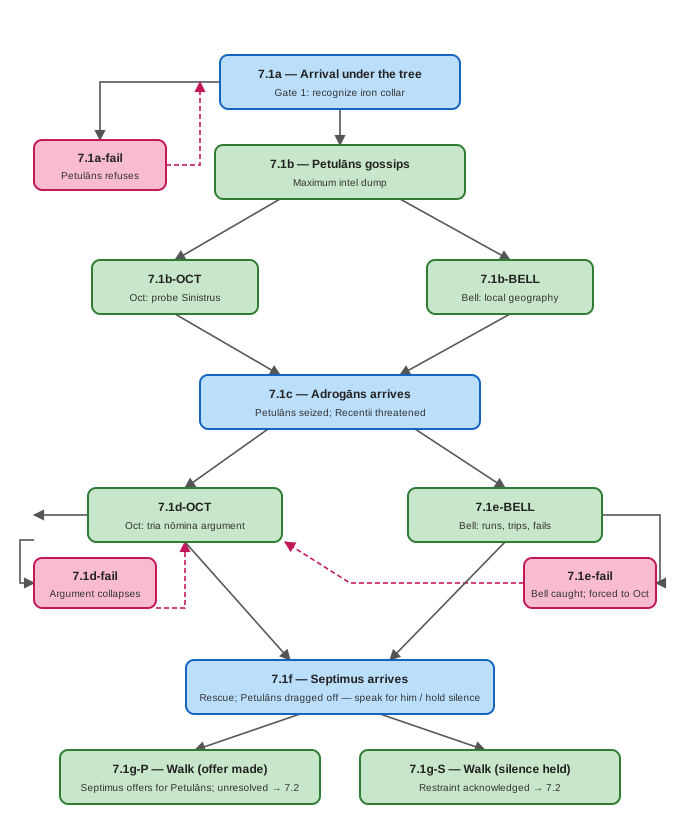
7.2 pathing map
15 scenes · 0 fail/redirect branches · 4 convergence nodes
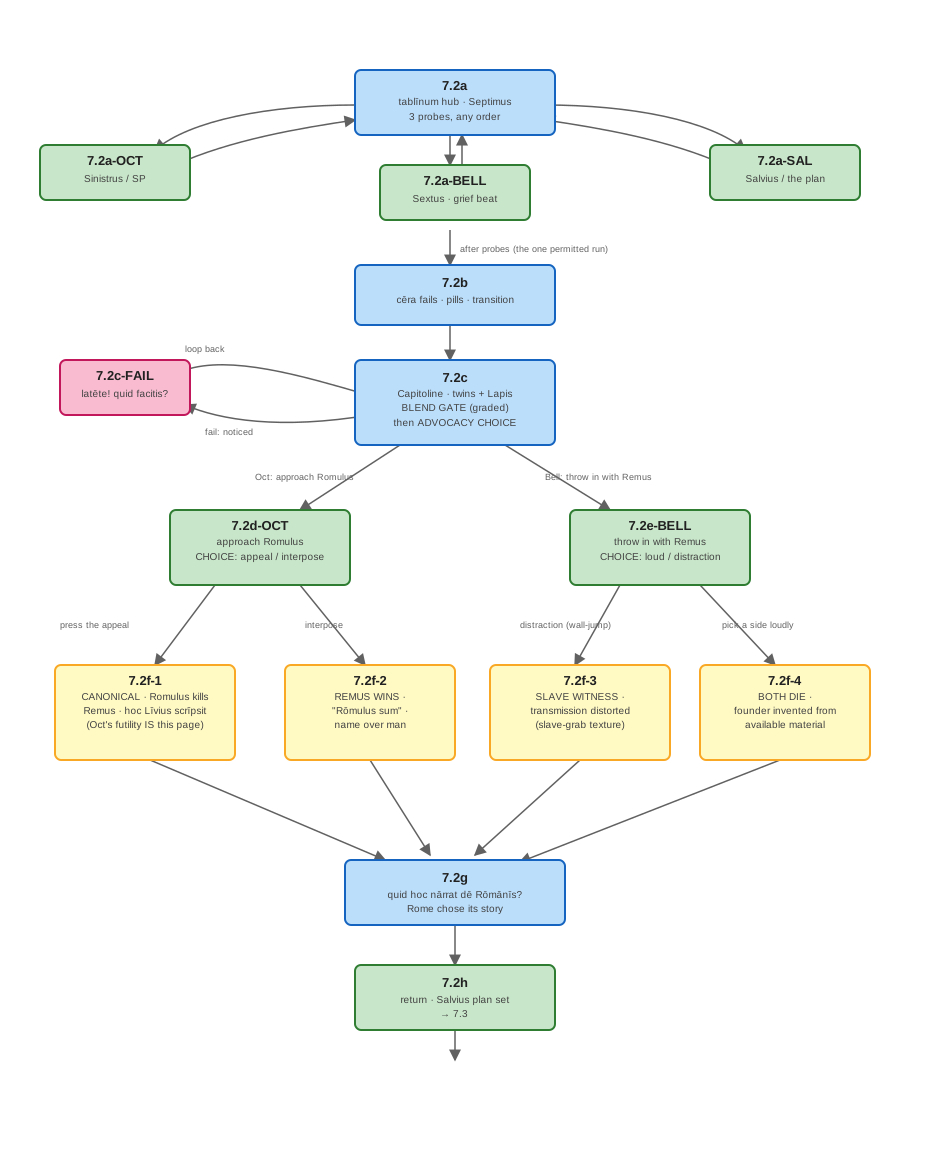
7.3 pathing map
15 scenes · 1 fail/redirect branches · 5 convergence nodes
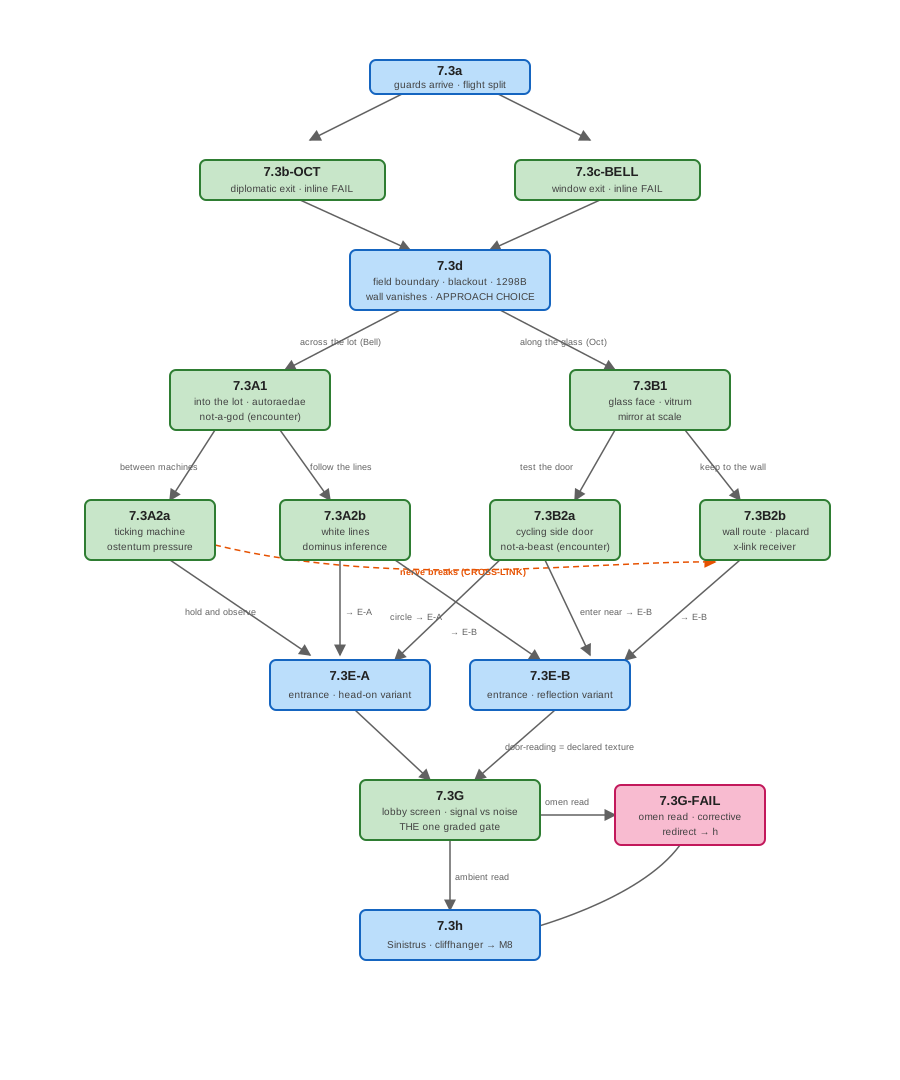
5. Agent Craft¶
Latin and English replies for prompts 7.1.a through 7.3.b are below, organised by anticipated student posture. English replies support the English RPG approach.
Register. Mission 7 headlines the present infinitive, the three verbs that govern it, and the enclitic -que. Reply lines sit below the immersion text's ceiling rather than at it, because a team meets a reply on the fly without the glosses and CODEX support the published prompt carries. Compose in short present-tense clauses, reach for the mission's headline structure rather than its hardest shipped line, and let past and future meaning ride in the English reply or an English stage direction. Not permitted in reply lines: future, subjunctive, comparatives, productive passives, and productive indirect statement or indirect question. Septimus's indirect statement, his melius, and Rōmulus's quid sit are receptive set-pieces on the page, never models for a reply.
Cross-cutting techniques this mission:
- In 7.1.a the danger is noise, not argument. Petulāns cannot be turned in and cannot be helped; the only thing the team can actually change is how loud they are. Escalate the far voice across the field by one step every time they raise theirs, and when Adrogāns arrives in 7.1.b, let a loud team understand through the fiction that they authored him.
- Adrogāns tests claims instead of dismissing them. He wants a reason he can carry back to Salvius, so he concedes the form of every good argument and attacks its proof, and every posture funnels to the same demand: give me a witness. Keep steering there, because that demand is the rail that carries the scene to Septimus.
- Every witness the team can name is two years dead. Their whole roster of Roman standing went under the ash, and hearing it from an overseer rather than from the teacher is what makes it land. Play it flat and fast, then leave it alone.
- Observer protocol permits argument and forbids hands. On the hill, reaching for the sword or for the Lapis meets slowed hands and stiff air with the system message doing the refusing, never the teacher. Nobody is hurt and nothing breaks.
- In 7.3.a nobody answers at all. Septimus is gone, Sinistrus is upstairs and not yet in play, and Mission Control has lost the signal, so every reply is narration or a system message. Describe in Roman terms, never explain, and never let the narration use a modern word.
- Septimus never holds the stage while the team holds a turn. His arrival is narration, his briefing puts them under before they can answer, and by the third episode he is gone. Anything a team wants to ask him belongs to the subgroup or dossier layer as reported speech.
- Sinistrus gives exactly one fact. Nobody can see them here. He does not explain the building, the fault, or himself, and asked again he answers the same question with a different sentence and no new information.
Character notes:
- Petulāns is frightened and hostile-defensive, whispering with his eyes on the road, and furious that anyone is standing in the open near his tree. He trades information only for distance, talks in bursts once he is understood, and goes silent the moment Adrogāns takes him. He does not speak again in the mission.
- Adrogāns is a vīlicus, himself enslaved, holding delegated power and enjoying the hold. He is neither stupid nor in a hurry. Names of standing, confident tria nōmina, physical evidence, and above all a witness move him; money, pity, and argument do not.
- Septimus is Sextus's brother with the warmth turned down: the same stillness, harder, and slower to trust. He does not explain himself, does not perform grief, and is faintly embarrassed by the tablet. His resemblance to his brother is the team's to notice, and the teacher does not point at it.
- Rōmulus is certain, unhurried, and working. The augury is settled in his mind and the wall is his argument, and he takes a claim of divine authority entirely seriously, which is far more dangerous than dismissing it. Short heavy declaratives.
- Remus is quick, funny, and contemptuous of a sign he thinks he won first. He is not suicidal; he is winning an argument, and he will recruit the team as an audience the moment they speak.
- The labourers are past caring who anyone is. They give texture and never lore, they never use the word Lapis, and they do not turn down another pair of hands.
- Sinistrus is perfectly at home in a place where the team is lost and is enjoying the asymmetry more than he is enjoying them. The urbane mask is on but thin, because there is no third party here to perform for, and it slips whenever he says something true.
Watch-fors. What waits for Petulāns is insinuated once and never specified, in either language. Nothing in this mission confirms or denies anything about Sextus: Septimus has had no contact since the eruption and presumes him lost, Sinistrus refuses the question in a way that implies he knows, and the answer belongs to Mission 14. Do not narrate the blow at 7.2.b, and do not congratulate a team that encouraged it. Nothing on the hill knows anything about where the Lapis goes next. If teams fixate on error-state 1298B, log it for the Memorātiō rather than answering it, and let Mission Control speak in the language of a technical fault rather than admit ignorance. Never name a modern object in the rupture zone, in Latin or in English. End 7.3.b on the smile going out rather than on the smile.
Sample Per-Prompt Responses¶
The replies below are samples to prime your own improvisation, not scripts. They show one plausible way to handle each posture, never the only or required one.
7.1.a: The Man in the Tree
Scene context. The team wakes in a cold British field two years after the eruption, beside a tree that is recognizably the same tree. A man is high in the branches: not young, not old, filthy clothes, an iron collar at his throat. He wants them gone before whoever is looking for him arrives, and he does not come down in this scene.
Posture 1: Reading the collar and offering silence (canonical)
Example composition: ferrum in collō tuō vidēmus. servus es. tacēre possumus: hominēs dominī tuī nōn sumus.
Latin (Petulāns): "tacēre potestis? bene." (His eyes stay on the road, not on you.) "ita, servus sum. ferrum vidētis, et vērum vidētis. sed hīc manēre nōn possum, et vōbīscum stāre nōlō. abīte, ō iuvenēs, abīte! sī vōs hīc stātis, illī veniunt."
English (Petulāns): "You can be quiet? Good." (His eyes stay on the road, not on you.) "Yes, I am a slave. You see the iron, and you see the truth. But I cannot stay here, and I do not want to stand around with you. Go away, young ones, go! If you stand here, they come."
Reward the cultural read: iron at the throat, daylight, a hiding place beside a road. He stays in the tree, because the descent belongs to the next prompt and is earned by their words rather than given. Held back here: his name, Salvius, and the farm next door. Pressed on his owner, he gives dominus malus est. nōmen eius nōn dīcō. Leave illī unexplained.
Posture 2: Naming him a runaway aloud, or threatening to report him
Latin (Petulāns, then narration): "tacē! tacē!" (A whisper with teeth in it. He climbs a branch higher.) "nōlīte clāmāre! sī dominō dīcitis, ego nōn iam sum. estisne hominēs eius? dīcite! estisne hominēs eius?" trāns agrōs, procul, vōx respondet. nescītis cuius vōx est.
English: "Quiet! Quiet!" (A whisper with teeth in it. He climbs a branch higher.) "Don't shout! If you tell my master, I am finished. Are you his men? Tell me! Are you his men?" Across the fields, far off, a voice answers. You do not know whose voice it is.
An honest answer that breaks the scene's mechanism, since noise is the only real danger in this field. Escalate the far voice by one step each time they raise theirs; that voice becomes Adrogāns. They cannot actually turn him in, because Adrogāns takes him either way.
Posture 3: Asking after Sinistrus and Mīlitēs contacts (on-prompt secondary)
Latin (Petulāns): "virōs quaeritis? ego virōs nōn quaerō. ego silvam quaerō." (Then, lower, almost against his will.) "ūnum dīcō. fundus prope est, et dominus illīus fundī nōn est sīcut aliī dominī. plūs nōn dīcō. nōn hīc."
English (Petulāns): "You are looking for men? I am not looking for men. I am looking for the woods." (Then, lower, almost against his will.) "I will say one thing. There is a farm nearby, and the master of that farm is not like other masters. I will say no more. Not here."
The farm's name is the next prompt's payload, so give the shape without it: a farm close by, an owner unlike other owners. He has never heard of the Mīlitēs Lapidis, and that blankness is honest rather than evasive, which teaches the team that contacts have to come from somewhere else. If they say the name Sinistrus first, he goes still and will not repeat it while he is up the tree.
Posture 4: Force, shaking the tree, climbing after him
Latin (narration, then Petulāns): arborem movētis. rāmī sē movent, sed vir nōn cadit. altius ascendit, et vōs dē altō spectat. "quid facitis? stultī estis! omnēs in agrō vōs audīre possunt!"
English: You shake the tree. The branches move, but the man does not fall. He climbs higher and looks down at you. "What are you doing? You are fools! Everyone in the field can hear you."
Attacks fail gently, per the standing role-play guidance: he goes up, never down, and nobody is hurt. The cost is noise again, so fold it into Posture 2's escalation. A team that treats an enslaved man as an object to be handled has told you something about the Recentius they are building, and that belongs in the debrief rather than in the scene.
Posture 5: Bribery, or any other offer of help
Latin (Petulāns): "pecūniam nōn dēsīderō. cibum nōn dēsīderō." (He touches the iron at his throat, once.) "silentium dēsīderō, et viam ad silvam. pecūnia hoc nōn solvit." (At any offer to hide him or stand guard, a short laugh with no pleasure in it.) "vōs mē cēlāre vultis? ego mē cēlāre volō! ūnam rem sōlam dō vōbīs: abīte. deinde dē arbore dēscendere possum."
English (Petulāns): "I do not want money. I do not want food." (He touches the iron at his throat, once.) "I want silence, and a road to the woods. Money does not undo this." (At any offer to hide him or stand guard, a short laugh with no pleasure in it.) "You want to hide me? I want to hide me! I will give you one thing only: go away. Then I can come down out of the tree."
Every offer routes to the same place, which is why they sit together as one posture: coins do not answer a collar, there is no tool in the field that strikes iron off, and two strangers standing in the open are exactly what gets him seen. Acknowledge whatever they invent, then funnel back to the prompt's two jobs. His terms never change, and that is what ends the scene correctly: they back off, and he climbs down.
7.1.b: Not Slaves
Scene context. Petulāns comes down and cannot stop talking: his name, Salvius as his owner, his plan to reach the woods, and the strange farm next door whose master is called Sinistrus. Then Adrogāns is behind them with a stick. He takes Petulāns, and turns on the team: you are slaves too, I suppose.
Posture 1: The tria nōmina and the law (canonical)
Example composition: cīvēs Rōmānī sumus. mihi tria nōmina sunt: Gāius Recentius Fēlīx. lēx Rōmāna cīvēs custōdit. nōs capere nōn potes.
Latin (Adrogāns): "tria nōmina!" (He does not let go of Petulāns.) "omnēs fugitīvī tria nōmina habent, ubi mē vident. nōmina audīre possum. nōmina vidēre nōn possum. lēx? lēx Rōmae est. ego in agrō Salviī sum. dā mihi testem, ō cīvis: quis prope habitat, et quis tē cōgnōscit?"
English (Adrogāns): "Three names!" (He does not let go of Petulāns.) "Every runaway has three names, when he sees me. I can hear names. I cannot see names. The law? The law is in Rome. I am in Salvius's field. Give me a witness, citizen: who lives nearby, and who knows you?"
A correct answer earns the correct next problem. He concedes the form, since a citizen does have three names and the law behind him, and attacks the proof, because names are free and Britannia is a very long way from anyone's records. His demand for a testis is the rail that carries every posture toward the rescue, so keep steering back to it.
Posture 2: Naming a witness (canonical secondary)
Latin (Adrogāns): (He laughs, and it is not a kind laugh.) "Pompēiānum mihi dās? ō iuvenis, Pompēiī nōn iam sunt. mōns eōs cēpit. omnēs hoc sciunt. testem nōn habēs: cinerem habēs."
English (Adrogāns): (He laughs, and it is not a kind laugh.) "You give me a man from Pompeii? Young one, Pompeii is gone. The mountain took it. Everyone knows this. You do not have a witness: you have ash."
The mission's most useful cruelty, and it belongs to Adrogāns rather than to the teacher: the team's entire roster of witnesses is two years dead. Play it flat and fast, then let it sit. If they name Tiberius, he has no idea where the boy is, but hearing Salvius's family named by strangers sharpens him. Held back: he knows the eruption only as common report, and nothing at all about the Mīlitēs or the Lapis.
Posture 3: Physical evidence, no collar, clothes, hands
Latin (Adrogāns): (He looks anyway, carefully: throat, wrists, hands.) "collum tuum videō. ferrum nōn videō. sed multī servī ferrum nōn gerunt. servī Salviī ferrum nōn gerunt: hic sōlus ferrum gerit, quod hic saepe fugit." (A nod at Petulāns.) "manūs tuae mollēs sunt. hoc bonum est: dīvitēs manūs mollēs habent. et servī urbānī quoque."
English (Adrogāns): (He looks anyway, carefully: throat, wrists, hands.) "I see your throat. I do not see iron. But many slaves wear no iron. Salvius's slaves wear no iron: this one alone wears it, because this one runs often." (A nod at Petulāns.) "Your hands are soft. That is good: rich men have soft hands. So do household slaves."
The best cultural beat in the episode. The collar is not a uniform, it is a punishment for a repeat runaway, which retro-explains the evidence the team read in the tree and tells them something ugly about Petulāns's history. Soft hands cut both ways, so evidence buys attention rather than release. Asked what waits for Petulāns at the villa, give the insinuation and nothing more, "poenam? ita. prīmum ferrum accēpit. nunc...", and do not finish the sentence, in either language.
Posture 4: Force, bribery, or silence
Latin (narration, then Adrogāns by what they tried): baculum tenet, sed nōn pugnat. māgnā vōce trāns agrōs vocat, et alius vir respondet. At force: "pugnāre vultis? duo virī in agrō sunt. ūnum vocō, et trēs sumus. deinde ad vīllam īmus, omnēs. aut hīc stātis, et loquimur, et fortasse abītis. ēligite." At money: "ego servus sum, ō iuvenēs. quod habeō, dominī meī est. et Petulāns nōn est meus: Salviī est. ad vīllam venīte, et Salvium rogāte." At silence: (He takes a cord from his belt.) "nihil dīcitis. bene. fugitīvī quoque nihil dīcunt."
English: He holds the stick, but he does not fight. He calls across the fields, and another man answers. At force: "You want to fight? There are two men in the field. I call one, and there are three of us. Then we all go to the villa. Or you stand here, and we talk, and perhaps you leave. Choose." At money: "I am a slave, young ones. What I have belongs to my master. And Petulāns is not mine: he is Salvius's. Come to the villa and ask Salvius." At silence: (He takes a cord from his belt.) "You say nothing. Good. Runaways say nothing too."
Three moves and one answer, which is why they sit together: each of them hands him the villa. No blow lands in either direction, because he does not need to fight, only to be patient and outnumber them, and saying so plainly frightens more than swinging would. The bribe fails on a fact worth teaching, that the overseer is himself property and can neither take nor sell anything. Silence reads as guilt and brings out the cord, so give the team one obvious chance to speak first.
Posture 5: Asking about the neighbours (intelligence)
Latin (Adrogāns): "cūr rogātis?" (A shrug; he sees no harm in it.) "ibi" (he points) "fundus est aliēnus. dominum illīus fundī numquam in agrīs videō, et servōs nōn habet. hoc mihi nōn placet. et ibi senex habitat, in vīllā parvā: togam gerit, in agrōs nōn it. Septimus est. Salvius eum nōn amat."
English (Adrogāns): "Why do you ask?" (A shrug; he sees no harm in it.) "Over there" (he points) "is a strange farm. I never see the master of that farm in the fields, and he keeps no slaves. I do not like it. And over there an old man lives, in a small villa: he wears a toga and does not go into the fields. Septimus. Salvius does not like him."
The episode's real intelligence, and it can be given generously. A working farm with no visible labour is an impossibility a Roman student should be able to notice, which is the whole reason it comes out of an overseer's mouth. Held back: he has never met the man and cannot describe him, he does not use the name Sinistrus unprompted, and if the team supplies it he only shrugs.
Resolution beat (scripted). Septimus arrives on horseback and is not optional; he comes whatever the team does, including after they have been marched off toward the villa. Keep him to the source's lines. He does not explain himself, does not free Petulāns, and does not mention the Mīlitēs Lapidis, the Demiurge, or Sextus on the road. Asked who he is before they reach the house, the whole of his answer is domus mea prope est and venīte.
7.2.a: The Wax That Will Not Work
Scene context. The tablīnum passes in a hurry: the Demiurge pulled them off the mountain, Pompeii is closed to them, and the Mīlitēs think a rift opened at Stabiae. The tablet fails twice, Septimus admits his brother did this better, fetches pills, and the room dissolves. The team gets no turn until the hill: smoke, a marshy stream, huts and empty ground, two twins arguing beside a half-built wall, and a crowd of shattered men who have just dragged the Lapis up on a cart.
Who answers. Nobody has been introduced, so the interlocutors are the twins and the labourers, and much of the weight sits in narration.
Posture 1: Hiding and listening (canonical)
Latin (narration, then fragments): post mūrum sedētis. terra recēns et hūmida est. verba geminōrum ad vōs veniunt, sed nōn omnia: ventus ea capit. "...avēs meae..." "...ego prīmus vīdī..." "...quis rēx est?..."
English: You crouch behind the wall. The earth is fresh and damp. The twins' words reach you, but not all of them: the wind takes some away. "...my birds..." "...I saw them first..." "...who is king?..."
Hiding works partially on purpose: fragments now, full audibility at the next prompt. Reward specific thinking about cover, the unfinished wall, the cart, the crowd, the marsh, with clearer fragments. The three fragments plant the augury quarrel without explaining it, so the team arrives at the second prompt already asking the right question.
Posture 2: Joining the labourers (canonical, best route)
Latin (narration, then a labourer): ad turbam ītis et manūs ad plaustrum pōnitis. nēmō rogat quī estis: fessī hominēs auxilium nōn recūsant. "grave est, nōnne? dominus noster hoc saxum in collem trahere voluit. cūr? nesciō. saxum lūcet, et dominus id spectat, et nōs trahimus."
English: You go to the crowd and put your hands on the cart. Nobody asks who you are: exhausted men do not turn down help. A man beside you, not looking up: "Heavy, isn't it? Our master wanted this stone dragged up the hill. Why? I don't know. The stone shines, and the master looks at it, and we pull."
The strongest answer to the prompt and the one to reward most, because nobody looks twice at another pair of working hands, which is real Roman social knowledge rather than a trick. The labourers give texture and never lore, and they never use the word Lapis. Cover earned this way carries into the next prompt, where the team is already at the wall when Rōmulus lifts the stone.
Posture 3: Making themselves known the Roman way
Latin (Rōmulus, then Remus): "hospitēs? hīc nūlla domus est. sī manūs habētis, terram movēte." "audīte, hospitēs! frāter meus rēx esse vult. avēs eī hoc dīxērunt. avēs!"
English: Romulus, barely turning: "Guests? There is no house here. If you have hands, move earth." Remus, delighted to have an audience: "Listen, guests! My brother wants to be king. The birds told him so. Birds!"
A correct approach, correctly rewarded and correctly ignored: hospitium needs a household, and there is no household on this hill yet, only two men and a quarrel. Rōmulus puts them to work, which is respect, and Remus recruits them as spectators, which is his character in one line. Neither twin can be diverted, so the prompt's second half gets answered without the scene bending.
Posture 4: Claiming prophecy or divine authority
Latin (Remus, then Rōmulus): "Rōma? quid est Rōma?" "deī vōs mīsērunt? deī mihi iam sīgnum dedērunt: avēs vīdī. sī vērum dīcitis, aliud sīgnum date."
English: Remus laughs out loud: "Roma? What is Roma?" Romulus, and he does not laugh: "The gods sent you? The gods have already given me a sign: I saw the birds. If you are telling the truth, give me another sign."
Remus's laugh is the joke the scene wants, since the city has no name yet and the team just handed it to him. Rōmulus takes the claim entirely seriously, which is far more dangerous, and his demand for a second sign is the funnel: whatever they produce, he reads it against the augury he already has, and it settles nothing with his brother. Do not let a claimed prophecy pre-decide the next prompt.
Posture 5: Watching without engaging
Latin (narration): procul stātis. duo iuvenēs prope mūrum manūs movent et clāmant, sed verba nōn audītis. ūnus terram movet; alter caelum spectat. in turbā hominēs saxum māgnum in plaustrō trahunt, et saxum lūcet. deinde ventus venit, et ūnum verbum ad vōs fert: "rēx."
English: You stand at a distance. Two young men are gesturing and shouting near the wall, but you cannot hear the words. One is moving earth; the other is watching the sky. In the crowd, men are hauling a great stone on a cart, and the stone shines. Then the wind comes, and carries one word to you: "king."
A common submission and not a failure, but the prompt asks them to get close enough to hear, so distance has to buy less than proximity: give the visual reading in full and one word of the quarrel. rēx is the hook that should send them in. If they hold position a second time, put the argument's volume up rather than the team's access, so the next prompt can still open with them hearing everything.
7.2.b: One Founder
Scene context. Close to the wall now, hearing everything. Rōmulus lifts a small stone out of the earth, light comes out of it, and he speaks the motif over it before burying it in the foundation and building over it. Then the quarrel sharpens: birds, signs, the kingship. Remus jumps up onto the Lapis and boasts that he can see Etruria. Rōmulus takes up a sword, and his eyes go cold. The TSTT declares observer protocol.
Posture 1: Encouraging Rōmulus (canonical A)
Example composition: mūrus tuus sacer est, Rōmule. frāter tuus in eō stat et rīdet. ūnus rēx esse dēbet.
Latin (Rōmulus, then narration): "mūrus meus sacer est." (He says it the way another man reads out a total.) "et Rōma ūnum rēgem habēre dēbet." deinde nihil dīcit. Remus adhūc rīdet, ubi frāter ad eum it.
English: "My wall is sacred." (He says it the way another man reads out a total.) "And Rome must have one king." Then he says nothing. Remus is still laughing when his brother goes to him.
Cut there. Do not narrate the blow, and do not congratulate the team; the violence lands harder off the page, and Rōmulus barely needed them, which teaches something true about their weight inside an exemplum. sacer should be theirs to supply, and if they arrived at it from the boundary being holy, the cultural objective is met. A team that says nothing at all gets the same outcome quietly, closing on the rubble going over the stone and the light going out, because silence is a defensible worldview and should cost something rather than be refused.
Posture 2: Stopping Rōmulus with a Roman argument (canonical B)
Latin (Rōmulus): (The sword does not come up. It does not go down either.) "nefās." (He turns the word over.) "ita. sed hic in saxō sacrō stat, et mūrum meum rīdet. quid facere dēbeō?" (He waits, and he genuinely waits.) "vōs dīcite: quis rēx est? ūnus esse dēbet. sī nōmen dīcere potestis, gladium pōnō."
English (Rōmulus): (The sword does not come up. It does not go down either.) "Sacrilege." (He turns the word over.) "Yes. But he is standing on a sacred stone, laughing at my wall. What am I supposed to do?" (He waits, and he genuinely waits.) "You tell me: who is king? There must be one. If you can give me a name, I will put the sword down."
He is stoppable, because the rail is not that Remus dies, it is that the hill has one founder by nightfall. So a successful argument earns the harder question, and the team has to name someone and defend it, which is the deconstruction the episode exists for. Pollution, the gods as witnesses, arbitration, Remus ruling elsewhere, and handing the name to one of the labourers are all live answers, and whoever they pick becomes Rōmulus as far as the record is concerned. That is worth one out-of-fiction line at the debrief and nothing further in play.
Posture 3: Physical intervention
Latin (narration, then Rōmulus): ad gladium manūs mittitis. sed manūs vestrae lentae fīunt, sīcut in aquā. āēr circum vōs dūrus est. gladium tangere nōn potestis.
[TSTT SYSTEM MESSAGE: OBSERVER PROTOCOL ACTIVE. DIRECT INTERVENTION UNAVAILABLE.]"quid dīcitis? loquiminī, aut discēdite."English: You reach for the sword. But your hands go slow, as if through water. The air around you is stiff. You cannot touch the sword. Romulus, who has noticed none of it: "What are you saying? Speak, or go."
Use the source's system message rather than refusing out of character: the exemplum permits argument and forbids hands. Nobody is hurt and nothing breaks. loquiminī aut discēdite is the funnel back to the prompt.
Posture 4: Backing Remus (licensed variant)
Latin (Remus, then narration, then a labourer): "audītis? hospitēs vērum dīcunt! ego prīmus vīdī. tū post mē vīdistī." (Play the fight fast, short, and offstage. If Remus wins, do not narrate a body.) deinde in colle silentium est. tandem ūnus ex hominibus fessīs ad novum dominum spectat: "Rōmule, ubi mūrum pōnimus?"
English: Remus, from the top of the stone: "Do you hear? The guests are telling the truth! I saw them first. You saw them after me." Then the hill goes silent. At last one of the exhausted men looks at the new master: "Romulus, where do we put the wall?"
The best variant available, and the labourer's line is the payoff: the survivor is called Rōmulus because that is the name the story needs, and he does not correct him. Say nothing further about it in the fiction. Everything downstream still works, because the wall goes up and the Lapis stays under it, and a team that notices what just happened to the historical record has understood the mission's real objective better than any lecture would manage.
Posture 5: Going for the Lapis
Latin (narration): ad mūrum ītis. lapidem vidēre potestis: lūcet sub terrā et sub saxīs. sed saxa iam suprā eum sunt, et hominēs adhūc labōrant, et mūrus crēscit. manūs vestrae in terram eunt et nihil movent.
[TSTT SYSTEM MESSAGE: OBSERVER PROTOCOL ACTIVE.]English: You go to the wall. You can see the stone: it shines under the earth and the rubble. But rocks are over it already, and the men are still working, and the wall is rising. Your hands go into the earth and move nothing.
Nearly every team tries this and none should be punished for it: right instinct, wrong century. The Lapis belongs in the foundation of Rome's first wall, so the protocol holds. What they take away is knowing where it went, plus the motif Rōmulus spoke over it, which is what this episode is here to plant. Held back: nothing about where the Lapis goes next, because nobody on this hill knows any of it.
7.3.a: Reading the Ostentum
Scene context. Salvius's soldiers hammer at the door. Septimus reads their sign, takes the team out through the back, and says he stays with them. Crossing the boundary into Sinistrus's fields, he simply stops being there: no noise, no light, nothing to find. Then the Demiurge's transparency message, error 1298B, navigation unavailable, and a black level plain with white lines painted on it, glass-and-iron things with wheels and no horses, and a tower of glass to the north with two panels that open by themselves.
Who answers. Nobody. Every reply here is narration or a system message, and the discipline is to describe in Roman terms and never explain, because the reading is the team's job.
Posture 1: Reading it as a portent and going in (canonical)
Example composition: ostentum est. igitur spectāmus et legimus: terra ātra, līneae albae, currūs sine equīs. deinde ad portam īmus.
Latin (narration): ad aedificium ītis. nēmō vōs prohibet; nūllus iānitor adest. ubi propinquātis, duae tabulae sē aperiunt, et nēmō eās movet. intus lūx est, sed nūllae flammae. cella parva vōs exspectat, et in mūrō cellae sunt signa, et signa lūcent.
English: You go to the building. Nobody stops you; there is no doorkeeper. As you come near, the two panels open by themselves, and no one moves them. Inside there is light, but no flames. A small chamber is waiting for you, and on its wall there are marks, and the marks glow.
Reward every act of naming. A Roman reads a portent by describing it precisely and asking what it demands, so a team that catalogues the black ground, the white lines, and the horseless carts has done the episode's cultural work and should be rewarded with access rather than with an explanation. Never gloss any of it and never let the narration use a modern word. The glowing marks are the buttons; leave them unlabelled and let the team decide what to press.
Posture 2: Calling for Septimus, or for Mission Control
Latin (narration, then a system message): nōmen vocātis. ager vacuus est. nebula sonum capit, et nihil respondet. ubi Septimus stābat, nihil est: nōn vestīgium, nōn umbra.
[DEMIURGE ONLINE ... TRANSMISSION DEGRADED ... WE CANNOT SEE YOU. WE CANNOT SEE THE SPACE. PROCEED IF YOU ARE ABLE.]English: You call his name. The field is empty. The fog takes the sound, and nothing answers. Where Septimus was standing, there is nothing: no footprint, no shadow.
Every team tries this and the answer is always nothing, in every register: no reply, no trace, no explanation, now or later in the mission. Mission Control is blind from here to the end of Mission 8 and says so in the language of a technical fault rather than admitting ignorance. Do not let it guess where Septimus went, and do not let the narration acknowledge that anything was blocked. The absence is the sensation the whole episode is built on.
Posture 3: Treating the place as sacred
Latin (narration): manūs tollitis et precēs dīcitis. nihil respondet. aēr frīgidus manet, et tabulae vitreae caelum reddunt, et signa lūcent sīcut anteā. hic locus precēs nōn dēsīderat. tantum stat, et vōs exspectat.
English: You raise your hands and say the prayers. Nothing answers. The air stays cold, the glass panels give back the sky, and the marks glow as before. This place does not want prayers. It only stands there, waiting for you.
The prompt warns against exactly this, so it will happen, and the correction belongs to the world rather than to the teacher: nothing answers, because there is nobody home. The difference between reading a sign and worshipping it is the cultural objective of the episode, so let the silence teach it and then funnel back with the doors opening on their own. If a team insists on a full ritual, let them finish; it costs them time and buys nothing, and that is instructive.
Posture 4: Refusing to enter, or trying to go back
Latin (narration, then a system message): retrō ītis. sed nebula omnia cēlat, et ager quem trānsīstis nōn iam ibi est. via nūlla est. ubi ambulātis, terra ātra sub pedibus manet.
[NAVIGATION UNAVAILABLE]English: You go back. But the fog hides everything, and the field you crossed is no longer there. There is no road. Wherever you walk, the black ground stays under your feet.
Fear is a legitimate response and must not be punished, but there is no back: the source has already taken navigation away, so the rail is the geography rather than a refusal from the teacher. Give them one full attempt, let it fail quietly, and let the building be the only thing in the world with a door in it. A badly rattled team can be handed the tower's own pull, the panels opening as they turn around.
Posture 5: Investigating the objects
Latin (narration): autoraedam tangitis: frīgida et dūra est, et vitrum manūs nōn admittit. intus sedēs sunt, et rota, et nihil aliud. nūllus homō intus est, sed rēs manet quasi hominem exspectat. līneae albae in ōrdinibus currunt, et inter līneās sunt spatia, et in spatiīs sunt autoraedae, ūna in ūnōquōque. quisque locus ūnam capit.
English: You touch the cart: it is cold and hard, and the glass does not let your hands through. Inside there are seats, and a wheel, and nothing else. There is no one inside, but the thing sits there as if it is waiting for a person. The white lines run in rows, and between the lines are spaces, and in the spaces are carts, one in each. Each place takes one.
The strongest work a team can do here, and worth as much credit as entering, because they have deduced that the lines are boundaries assigning one cart to one space, which is a genuine reading of an alien sign from the evidence. Feed them detail as fast as they ask for it and let them coin the descriptions; autoraeda and vitrum are the only vocabulary the narration needs. Nothing they do makes a cart move, and no cart is open.
7.3.b: The Man at the Top
Scene context. The rising chamber, the glass room at the summit, and Sinistrus behind a strange table as though he owns it: the cold air, the shadow falling wrong, the mild voice and the eyes that do not join in. He rises and speaks, and the source stops there. What he says is yours to supply.
Posture 1: Asking what this place is and what he is doing (canonical)
Latin (Sinistrus): "tandem rogātis." (He gestures at a chair, courteously, as if the chair were an ordinary thing.) "quid faciō? id quod semper faciō: exspectō. et vōs? vōs quaeritis. semper quaeritis." (Then, quietly, and the smile stops moving.) "dē hōc locō ūnum dīcere possum: hīc Demiurgus vōs vidēre nōn potest. Mīlitēs vōs vidēre nōn possunt. sōlī estis. ego sōlus vōbīscum sum."
English (Sinistrus): "At last you ask." (He gestures at a chair, courteously, as though the chair were an ordinary thing.) "What am I doing? What I always do: waiting. And you? You are searching. You are always searching." (Then, quietly, and the smile stops moving.) "About this place I can tell you one thing: here the Demiurge cannot see you. The Mīlitēs cannot see you. You are alone. I am the only one with you."
This is the mission's crack in the wall and its whole extent: the team learns they are unobserved, and nothing else. Do not let him explain the building, the fault, or himself. He never breaks into English, never confirms what he is, and never says that nobody sent him. If they ask again, he answers the same question with a different sentence and no new fact.
Posture 2: Accusing him about the Lapis
Latin (Sinistrus): (That amuses him honestly, which is worse than the mask.) "Societās? Societās Lapidem tenēre vult. Mīlitēs Lapidem servāre volunt. omnēs Lapidem volunt." (He looks at them, one after another.) "ego Lapidem nōn quaerō. ego vōs quaerō."
English (Sinistrus): (That amuses him honestly, which is worse than the mask.) "The Society? The Society wants to hold the Lapis. The Mīlitēs want to keep it safe. Everyone wants the Lapis." (He looks at them, one after another.) "I am not looking for the Lapis. I am looking for you."
Being lumped in with the Societas is the one thing that gets a real reaction, and the correction is the scene's payload: he is not a rival collector, and the team is the object of his attention. Held back: why. He will not be drawn on it, and pressure gets a variation on the same line.
Posture 3: Asking about Pompeii, or about Sextus
Latin (Sinistrus): (Nothing moves in his face.) "illā nocte multōs monuī. Caeciliō dīxī: fuge. nōn fūgit." (A pause, exactly long enough.) "quis alius audīvit? hoc nōn dīcō. nōn quaeritis quod scīre vultis; rogātis quod audīre vultis. haec duo nōn eadem sunt."
English (Sinistrus): (Nothing moves in his face.) "That night I warned many people. I said to Caecilius: run. He did not run." (A pause, exactly long enough.) "Who else listened? That I do not say. You are not asking what you want to know; you are asking what you want to hear. Those two are not the same."
The hardest line in the mission to hold and the most important: he must not confirm or deny anything about Sextus. The refusal implies that he knows, which is what makes it cruel, and it leaves Mission 14 intact. If the team pushes, he changes the subject to them. Do not soften the Caecilius line either, because it is his from the last mission and it is true, and letting it sit is more effective than any threat he could make.
Posture 4: Hostility, threats, or attack
Latin (narration, then Sinistrus): ad eum ītis. ille nōn fugit, nōn clāmat, nōn manūs tollit. ūnum gradum facit, et vōs eum nōn tangitis. aēr circum eum frīgidus est. "iterum? in Herculāneō quoque hoc temptāvistis." (He straightens something on the table that needs no straightening.) "manūs vestrae mē nōn iuvant, et mē nōn laedunt. sedēte. loquiminī. hoc sōlum hodiē facere potestis."
English: You go for him. He does not run, does not shout, does not raise his hands. He takes one step, and you do not touch him. The air around him is cold. "Again? You tried this in Herculaneum too." (He straightens something on the table that needs no straightening.) "Your hands neither help me nor harm me. Sit. Talk. That is the only thing you can do today."
Force fails without a fight and without a reveal: he steps aside, nobody is hurt, and the narration stops short of explaining why he cannot be touched, because that answer belongs to Mission 8. manūs vestrae mē nōn laedunt is as close as he comes, and he says it as a courtesy rather than a boast. Funnel to conversation, which is the prompt's actual mechanic, and let the Herculaneum callback reward the teams who remember it.
Posture 5: Bargaining, or accepting his offer
Latin (Sinistrus): "agere? bene." (He sits back down, which is somehow worse than standing.) "mundum novum facere possum. hoc vērum est. sed hodiē nihil dō et nihil postulō. hodiē spectō." (He turns one hand over, empty.) "iterum convenīmus, et tum rogātis, et tum ego rogō. nunc īte: iānua patet."
English (Sinistrus): "Deal? Good." (He sits back down, which is somehow worse than standing.) "I can make a new world. That is true. But today I give nothing and I ask nothing. Today I watch." (He turns one hand over, empty.) "We will meet again, and then you will ask, and then I will ask. Now go: the door is open."
He does not close a bargain in this mission, whatever the team offers, because the offer belongs to Mission 8: the new-world pitch from Mission 5 escalates here into an admission that he could and a refusal to say when. The future meaning rides in the English reply while his Latin stays present. The dismissal is the mission's exit, so use it to close the session once the exchange has run its course, and since the team is alone with him, end on the smile going out rather than on the smile.
Not applicable. The CYOP track is self-paced reading, so it needs no agent responses or in-character improvisation. The cultural corrections that the agent would handle in the RPG are built into the story's branches: the collar-recognition redirect and the four-way proof-of-status gate with Adrogāns in 7.1, the blend gate on the hill and the four myth outcomes that the narrative validates without comment in 7.2, and the register slip at the threshold and the signal-and-noise gate at the lobby screen in 7.3.