Mission 13. The Three Trials of the SP¶
1. Episode Overview¶
Essential Question
What happens when cultures meet?
ACTFL Proficiency Benchmarks — Intermediate Low
- Interpretive: I can understand the main idea and some related pieces of information on familiar topics from sentences and series of connected sentences in texts that are spoken, written, or signed.
- Presentational: I can provide information and express my thoughts about familiar topics, creating sentences and series of connected sentences through spoken, written, or signed language.
- Cultural Investigation: I can compare products and practices to understand perspectives from a variety of cultures and communities, including my own.
Cultural & Historical Learning Targets — student-facing
- Describe and evaluate the circumstances of the Third Punic War: Cato's campaign in the Senate, Carthage's war on Masinissa, the hostages and the surrender of arms, the order to move away from the sea, the three-year siege, and the fall of the city in 146 BCE.
- Explain the war's importance to Roman identity: Scipio Nasica's case that Rome needed an enemy to fear, Sallust's view that Rome began to go wrong in 146 BCE, and Scipio Aemilianus's tears over a city that, like Troy, would not stand forever.
- Explain what made a Roman a novus homō, and compare the different kinds of power held by new men such as Duilius, Cato, Marius, and Cicero.
- Identify and evaluate the Gracchi, their lives, and their legacies: Tiberius's land law and his death on the Capitol, Gaius's laws and his death in 121 BCE, and the land board and the memory of their mother that outlived them.
- Identify and evaluate Marius and Sulla, their lives, and their legacies: Marius's army of the poor and his seven consulships, Sulla's march on Rome, his proscriptions, and his resignation, and the example both men left to later Romans.
- Describe how a Roman advocate defended a man in court, and compare it with what a defense lawyer may ask a jury to consider today.
Grammatical Learning Objectives — teacher-facing
- The demonstratives hic, haec, hoc ("this," "these") and ille, illa, illud ("that," "those") in all cases, taught together as one step and read off Carthāgō dēlenda est! and novī hominēs: agreement in gender, number, and case (hās imāginēs); a demonstrative standing alone (hic sōlus sapit, hoc memoriā tenē); ille for what is farther away in place or time (ex illō tempore, ille quī Hannibalem vīcerat); endings shared with magnus, with the new genitive and dative singulars huius and huic, illīus and illī; and the warning that haec is three forms (haec fīcus against haec verba). The adverb hīc, "here," is noted as a different word (13.1).
- The imperative, positive and negative, read off Tiberius mātrī (quaerite, dīc, valē): the singular from the present stem, the plural in -te, the third-conjugation -ite, the short forms dīc, dūc, fac, fer; negative commands with nōlī or nōlīte and the infinitive, from Cato's nōlī dē Lapide in senātū dīcere; greetings as imperatives (salvē, valē); and the warning that a plural imperative in -te looks like a present in -tis (13.2).
- The vocative, read off Metelle in Sulla Metellō, with Tiberī and māter from 13.2 and mī amīce from 13.1: most nouns, and every plural, the same as the nominative (salvēte, ō Recentiī); second-declension -us to -e, -ius to -ī, meus to mī; and the warning that a vocative is never the subject, even when it looks like a nominative, and is set off by commas (13.3).
- The mission's arc follows the trial: 13.1 lets a speaker point (hic vir, illa urbs), 13.2 lets a speaker command, and 13.3 lets a speaker address, so that by the second speeches a team can open with all three (audīte, ō iūdicēs: hic vir Rōmam servāvit). The 13.3 attunement builds commands from all three forms at once.
Lapis thread
Mission 13 opens in 80 CE inside the Potentēs' praetōrium in the rock near the pyramids, where Mission 12 left the team in the dark below the stair. The wall slides aside on a great ātrium cut into the rock and closes behind them, and the voice that set the riddle welcomes them to the ātrium Potentium: they carry the signum, but every Potens must know the ways of power, so three trials wait. The first asks who defeated Carthage, and why; the second, which new man was the most powerful. Then the voice sends them into a peristyle under the earth, with a speakers' platform where the garden should be, and its owner walks in: the probātor Potentium. He divides the operatives into two manūs, hands each a tablet of three Romans it would not easily praise, and orders a defense of the first name, so that they learn to understand an enemy, since only those who can take and hold power may learn about the Lapis. Manus prīma defends Tiberius Gracchus and manus secunda Scipio Aemilianus. After the speeches he preaches the Society's creed, that only the manner of a death remains and only power gives honor, gives manus prīma the first swords of the Lapis and manus secunda its first spears, and calls for the second names, Marius and Sulla. The mission ends mid-trial, as the second speeches are given. Behind the trial, the CODEX texts follow the search for the Lapis through the Cornelii, the family that lost it at Lipara: Cato sends Scipio Aemilianus, a Cornelius by adoption, to look for it in Carthage; in 146 BCE Scipio searches the burning city and finds nothing; and about 106 BCE Sulla takes up the search again along Hannibal's road, while Marius, a new man, must know nothing.
Instructor background, withheld from students
Mission Control is dark for the whole mission, and nothing answers a team that calls it. Tertius stays outside the sealed wall, and Sinistrus does not appear. The voice in the ātrium is the riddle-voice of 12.3.b, and at 13.2.a the team recognizes it as the probātor's; his name is never given on any surface, and how the Potentēs know the team and its opinions is never explained. Marcus Maecēnās leads the Societās, and the voice places him in Rome, which keeps his arrival at 14.2.a a surprise. The purple curtain in the ātrium never opens, and force against it, the walls, or anyone in the praetōrium fails gently, with no one hurt. The swords and spears are given at 13.3.a and asked after at 14.2.a, and what more they are is never said. The probātor's claim that Scipio Aemilianus was shamefully killed is his own; the texts leave that death open. Hold back the verdict on the second speeches, the rings, and the third names, all of which open Mission 14, and everything about the Lapis and the door. The two approaches tell parts of the story differently, so describe whichever one your class follows. In the CYOP the wall seals with Tertius still on the stair; the voice knows the siblings' names, tells them that the Lapis is not in the praetōrium and once traveled with Hannibal, and a large shadow crosses the curtain; with only two siblings to divide, Octāviāna takes the side of Scipio, Sulla, and Caesar; the CYOP's second episode runs all three rounds of speeches, Caesar and Cicero included; and at its end Bellātor receives the sword and Octāviāna the spear, and the probātor admits that the Potentēs have never found the Lapis.
2. Shared CODEX Backbone¶
Each approach works from the same CODEX pages. For what the sections contain and how students reach them, see The CODEX. Each episode's ATTUNEMENT set closes with an inline Memorātiō.
CODEX pages: CODEX 13.1 · CODEX 13.2 · CODEX 13.3
KEY-TEXTs
- 13.1: Carthāgō dēlenda est! (Carthage rich again after the Second Punic War; Cato's visit in 153 BCE, the fig shown in the Senate, and Carthāgō dēlenda est! at the end of every speech while the senators laughed; in private, Cato tells Scipio Aemilianus, a Cornelius by adoption and Africanus's grandson, that some say the Lapis is in Carthage again, that the Cornelii lost it at Lipara, to take Carthage and look for it, and to speak only of figs in the Senate; war in 149 BCE, with Scipio a military tribune in Africa and Cato's verdict hic sōlus sapit; Cato dead the same year, with Carthage still standing), with a Visual Walkthrough.
- 13.2: Tiberius mātrī (the young Tiberius Gracchus to his mother Cornelia from Carthage in 146 BCE: first onto the wall, praised by Scipio and sleeping in his tent; six days of street fighting and the city burned; Scipio sends soldiers through the temples and the house of the Barca family and ignores the gold, while the soldiers think he wants richer plunder; at night Scipio tells him only Lapidem quaerō, Tiberī. sed Lapis hīc nōn est, and Tiberius asks his mother, Africanus's daughter, what this Lapis is; Scipio weeps on a hill over the burning city and speaks Homer's lines on Troy, nūlla urbs semper stat, nē Rōma quidem; tell no one about the Lapis, and greet his sister Sempronia), with a Visual Walkthrough.
- 13.3: Sulla Metellō (Sulla to Quintus Metellus from camp in Numidia during the war with Jugurtha, about 106 BCE: Marius now leads Metellus's army, having spoken against him in the Senate and the Forum, and Marius's poor soldiers fight for Marius, not for the Republic; the Cornelii lost the Lapis at Lipara, Scipio Aemilianus searched Carthage and found nothing, no one searched after him, and Sulla searches again, riding to the old Punic towns of the coast and asking old men about Hannibal; one old man says Hannibal once slept a night in his father's house, where Sulla finds nothing; Hannibal took the Lapis with him, so perhaps it lies along his road; Marius, a new man, must know nothing; read this and burn it), with a Visual Walkthrough.
Informational Texts
- 13.1: bellum Pūnicum tertium (Carthage forbidden to make war without Rome's leave, yet rich again by trade; Cato's cēterum cēnseō Carthāginem esse dēlendam and the senators who resisted him; Carthage's war with Masinissa in 150 BCE and Rome's declaration in 149; Cato's death the same year; three years of resistance; Scipio Aemilianus made consul under age in 147 BCE; the walls broken, six days of street fighting, the city burned, 50,000 enslaved, and Africa made a province in 146 BCE; the end of the Punic Wars after 118 years) and novī hominēs (the few noble families who gave Rome its consuls; the wax imāginēs maiōrum in the ātrium, each with its man's name and offices; the novus homō as the first of his family to be consul; Sallust on nobles passing the consulship from hand to hand; Duilius, Cato of Tusculum, Marius of Arpinum with his seven consulships, and Cicero of Arpinum, consul by speech alone; Pompey and Sulla as men who were not new; ending on which new man was the most powerful).
- 13.2: Gracchī (Cornelia, Africanus's daughter, and her sons as her jewels; Tiberius at Carthage, then the great estates of Etruria worked only by slaves; tribune of the plebs in 133 BCE, the law giving public land to the poor, and the tribune Octavius removed by the people; killed on the Capitol with 300 friends while seeking a second tribunate, the bodies thrown into the Tiber; Gaius tribune in 123 BCE, the grain law and new colonies, one near Carthage, and his death in 121 BCE with 3,000 others; statues and offerings after their deaths; ending on whether they were friends of the people or enemies of the state) and Scīpiō Aemiliānus (son of Aemilius Paullus, at Pydna at seventeen; adopted into the Cornelii and Africanus's grandson; Polybius as teacher and friend; Carthage in 146 BCE and the name Āfricānus, Numantia in 133 BCE and Numantīnus; married to Sempronia, the Gracchi's sister; his answer on Tiberius's death and tacēte, quibus Ītalia noverca est!; found dead in his bed in 129 BCE with no wound, and no one knows why).
- 13.3: Gāius Marius (Arpinum and the new man; at Numantia under Scipio Aemilianus; in Africa under Metellus, mocked for wanting the consulship, then consul in 107 BCE; the poor taken into the army, paid and promised land, and loyal to Marius, not the Senate; Jugurtha captured; Arausio and five consulships in a row; the victories of 102 and 101 BCE and the name "third founder of Rome"; driven out by Sulla in 88 BCE and sitting in the ruins of Carthage; back in 87 BCE with an army, killing his enemies; the seventh consulship and his death days later) and Sulla (a poor patrician Cornelius who lived among actors and poets; Marius's quaestor in Africa; Jugurtha handed to him while Marius took the triumph, and their enmity; consul in 88 BCE, the command against Mithridates moved to Marius by the people; the first Roman to take Rome with a Roman army; war in the East, civil war in Italy, and the Colline Gate; dictator, the proscription lists, and laws that strengthened the Senate; his resignation in 79 BCE, his death in 78 BCE, Fēlīx, and his epitaph).
GRAMMATICA
- 13.1: hic, haec, hoc and ille, illa, illud in all cases: agreement, the demonstrative standing alone, ille for what is farther away, the genitive and dative singulars huius, huic, illīus, illī, and the warning that haec is three forms.
- 13.2: the imperative, positive and negative, with the short forms dīc, dūc, fac, fer, negative commands with nōlī and nōlīte, and the warning that a plural in -te looks like a present in -tis, with a video briefing on the tab.
- 13.3: the vocative, with -us to -e, -ius to -ī, meus to mī, a table of the mission's vocatives, and the warning that a vocative is never the subject, with a video briefing on the tab.
VERBA
- 13.1: enim, vincit, cūr, tandem, redit.
- 13.2: nōs, hostis, tam, parat, dominus.
- 13.3: quam, modus, labor, trahit, ferrum.
CULTURALIA
- 13.1: "How the last war began," on the 300 child hostages, the armor and catapults handed over, the order to build a new city ten miles from the sea, and the three-year resistance; "Carthage must stand," on Scipio Nasica's case that Rome needed an enemy to fear and Sallust's later verdict on 146 BCE; and "Carthage after 146 BCE," on the curse on the site, the salt story invented in modern times, Gaius Gracchus's colony, and the rich Roman city of 80 CE, closing on who defeated Carthage.
- 13.2: "Scipio at burning Carthage," on Polybius's account and the lines from Homer's Iliad that Hector speaks to Andromache; "What the Gracchi left behind," on the land board and its boundary stones, the Senate's first emergency decree, and Cornelia's statue; and "How a Roman defended a man," on the patrōnus, the defense of a whole life, the appeal to pity, and Antonius baring Aquillius's scars, closing on the first speeches.
- 13.3: "What later Romans learned from Marius and Sulla," on the young Caesar spared, Marius's trophies set up again, Pompey's "Sulla could do it, so why can't I?", and Caesar on the resignation; "Sulla's own story," on his lost memoirs and Plutarch; and "Two burials," on Marius's remains scattered beside the Anio and Sulla, the first patrician Cornelius to be cremated, closing on the second speeches.
ATTUNEMENT
- 13.1: five exercises: a guided English-to-Latin build that chooses each demonstrative from three forms, a cloze retelling Cato and the young Scipio with hic or ille cued before each blank, a multiple-choice reading of Carthāgō dēlenda est!, a fact extraction on Cato and Scipio Aemilianus that prepares the first trial, and a supporting-detail audit on novī hominēs that prepares the second, closing with the inline Memorātiō.
- 13.2: five exercises: a forced choice between singular imperatives, plural imperatives, and present-tense look-alikes, reported orders rewritten as the words spoken, an open comprehension with mandatory citation on Tiberius mātrī that is the episode's interpretive centerpiece, a parallel analysis of the two first-round defendants, and the mission's once-per-mission Products, Practices, and Perspectives organizer on the Roman defense speech, closing with the inline Memorātiō.
- 13.3: five exercises: a vocative grid with the rule for each form, five commands built from a vocative, an imperative, and a demonstrative, a four-tier reading of Sulla Metellō that is the episode's interpretive centerpiece, character profiles of Marius and Sulla that prepare the second speeches, and seven questions on the CULTURALIA, closing with the inline Memorātiō.
3. Episodes¶
The story beats are the same across all tracks. Track-specific links and running notes are in §4.
Numbering map (Mission 13): 13.1 (The Ātrium of the Potentēs: Carthage and the New Men) = prompts 13.1.a / 13.1.b; 13.2 (The Probātor: Tiberius Gracchus and Scipio Aemilianus) = 13.2.a / 13.2.b; 13.3 (The Prizes of Power: Marius and Sulla) = 13.3.a / 13.3.b.
13.1, The Ātrium of the Potentēs: Carthage and the New Men¶
The wall that closed the stair slides aside on a great chamber cut into the rock and built like a Roman ātrium, with a larārium, a couch, a pool fed by a spring under the earth, doors to bedrooms, and a purple curtain that hides the tablīnum; once everyone is inside, the wall slides back into place. A voice welcomes the young people to the ātrium Potentium. They have the signum, but that settles nothing: do they know the ways of power? Three trials wait, and the first asks who defeated Carthage, and why. Each operative answers for themself, and no one may give reasons another has given, though two may reach the same verdict. When every team has answered, the voice declares the first trial done and asks the second: which new man was the most powerful?
13.2, The Probātor: Tiberius Gracchus and Scipio Aemilianus¶
The voice sends the team through an opening in the far wall into a peristyle under the earth, where columns rise into the dark with a lamp before each, and a tall wooden platform like a speakers' stage stands where the garden should be. A hard-faced, middle-aged man in a toga praetexta comes in, and when he speaks they know the voice: he is the probātor Potentium. He divides the operatives into two manūs and hands each a tablet of three names, men they would not easily praise, so that they learn to understand an enemy and to hold power over him. Manus prīma must defend Tiberius Sempronius Gracchus, and manus secunda Scipio Aemilianus. After the first two speeches, he promises, good speakers will receive honors of power and, with them, arms for the missions to come. The teams prepare, and at 13.2.b each delivers its speech from the platform.
13.3, The Prizes of Power: Marius and Sulla¶
The probātor praises the speeches, then tells the team to look at how foully the Gracchi died and how shamefully Scipio Aemilianus was killed: after death only deeds remain, and above all the manner of one's death, and for those who keep to the way of the Lapis only power gives honor and glory. From a long chest behind a column he gives manus prīma, whose task was harder, the first swords of the Lapis, and manus secunda, whose task was more glorious, its first spears. The second names follow, Gaius Marius for manus prīma and Sulla for manus secunda. The teams prepare and deliver their second speeches, and the mission ends there, in the middle of the trial.
4. Running the Mission¶
The declamation trial: dividing the class¶
In either RPG, the third trial runs over three rounds, at 13.2, 13.3 and 14.1. At 13.2.a the probātor divides the operatives into two manūs, handing each a tablet of three Romans to defend, one name per round. The prompt never says which team stands where, so make the split yourself before you post it, by persona (the personas are introduced in Character Mechanics):
- Manus prīma is the teams playing Bellātor, Prīscus, Agricola and Octāviāna. They defend Tiberius Gracchus, then Marius, then Cicero, and receive the gladius at 13.3.a.
- Manus secunda is the teams playing Amōrōsus, Clōdia, Horātiāna and Tulliāna. They defend Scipio Aemilianus, then Sulla, then Caesar, and receive the hasta at 13.3.a.
The split is deliberate: each side is handed men its personas would not naturally praise, because arguing well for a man you disagree with is the whole exercise, as the probātor says when he hands over the tablets (ita discētis hostem intellegere). Manus prīma speaks first in every round, in tablet order: Gracchus before Scipio at 13.2.b, Marius before Sulla at 13.3.b, Cicero before Caesar at 14.1.b. If your class's personas leave one side empty, move one team across so that both tablets are defended.
A class running a single team cannot split, so it takes both tablets. It plans both defenses in each preparation session, gives both speeches in each round (Gracchus then Scipio at 13.2.b, Marius then Sulla at 13.3.b, Cicero then Caesar at 14.1.b), and receives both the gladius and the hasta at 13.3.a.
The CYOP, which has only two siblings to divide, puts Octāviāna on the other side, with Scipio, Sulla, Caesar and the hasta; in the RPG she stays in manus prīma.
Immersion links:
Episode 13.1: The Ātrium of the Potentēs: Carthage and the New Men
-
Read KEY-TEXT A, Carthāgō dēlenda est! together before the prompt: Cato's figs in the Senate and his private charge to Scipio Aemilianus, the two men the first trial is likeliest to turn on. A Visual Walkthrough supports the reading.
-
Work the Reading Carthāgō dēlenda est! task, ten multiple-choice questions, two of which ask whom hic and ille point to.
-
Read Informational Text A, bellum Pūnicum tertium together. KEY-TEXT A ends with Cato dead and Carthage still standing; this text carries the war on to the fall of the city in 146 BCE.
-
Post 13.1.a and read it together: the ātrium cut into the rock, the wall closing behind the team, and an unseen voice setting the first of three trials, who defeated Carthage and why.
-
Before teams compose, read the CULTURALIA section together, "How the last war began," "Carthage must stand," and "Carthage after 146 BCE." Its closing question is the trial's own.
-
Work the Who Defeated Carthage? task alongside the composing: three facts each for Cato and Scipio, backed by the Latin, so every operative has a reason no one else has given.
-
Each operative answers for themself. Post your agent response; see §5 Agent Craft for Cato or Scipio, an unexpected name, "Carthage stands today," a repeated reason, and finding the voice.
-
Introduce GRAMMATICA 13.1 from the texts already read, hic iuvenis, haec fīcus, and ille quī Hannibalem vīcerat: hic for "this" and ille for "that," in all cases.
-
Work the This City, These Words task, ten English sentences to write in Latin, choosing each demonstrative from three forms, with haec urbs and haec verba set against each other as the GRAMMATICA warns.
-
Post 13.1.b and read it together: the voice declares the first trial done and asks the second, which new man was the most powerful.
-
Before teams compose, read Informational Text B, novī hominēs together. It defines the new man, names four, and rules out Pompey and Sulla, who were not new men.
-
Work the New Men task alongside the composing: ten statements to prove from the Latin or mark "not in the text," closing on one new man and the kind of power he held.
-
Teams answer. Post your agent response; see §5 Agent Craft for Marius, Cicero, Cato or Duilius, a man who was not new, and "the best, not the most powerful."
-
Work the Cato and the Young Scipio task, a cloze retelling all three of the episode's texts, from Cato's visit to the masks in a noble ātrium, with hic or ille cued before each blank.
-
Close the episode with the inline Memorātiō, composed in the operative's voice: the room inside the rock, the voice, what it said they had, the first trial in its exact words, their answer and reasons, and the second trial.
-
Award LP for 13.1 per operative and mark ATTUNEMENT and KEY-TEXT completion in Mission Control.
Episode 13.2: The Probātor: Tiberius Gracchus and Scipio Aemilianus
-
Read KEY-TEXT A, Tiberius mātrī together before the prompt: young Tiberius Gracchus writing home from burning Carthage, where Scipio Aemilianus searches for the Lapis and weeps: the two men of the first speeches. A Visual Walkthrough supports the reading.
-
Read the first part of the CULTURALIA section, "Scipio at burning Carthage," together: Polybius's account, and the lines from Homer that Scipio's simpler Latin echoes.
-
Work the Reading Tiberius mātrī task, the episode's interpretive centerpiece: six questions answered with the Latin, on Scipio's secret search and what his tears mean.
-
Introduce GRAMMATICA 13.2 from the letter's quaerite, dīc, and valē: the imperative, positive and negative. The probātor speaks almost entirely in commands, so this comes before his prompt. A video briefing supports the tab.
-
Work the One or Many? task, twelve sentences that name speaker and listener, so the choice between a singular imperative, a plural one, and a look-alike in -tis turns on who is being spoken to.
-
Divide the class into manus prīma and manus secunda by persona, as set out in the declamation trial above, because the prompt hands out the tablets without saying who stands where.
-
Post 13.2.a and read it together: the peristyle under the earth, the probātor whose voice they know, and the tablets, with Tiberius Gracchus first for manus prīma and Scipio Aemilianus first for manus secunda.
-
This prompt is a preparation session, so the reading is the preparation. Read Informational Text A, Gracchī together: manus prīma's brief, and the charges manus secunda's man would raise.
-
Read Informational Text B, Scīpiō Aemiliānus together: manus secunda's brief, including his verdict on Tiberius's death, the line that defense has to answer for.
-
Work the Two Men on Trial task as the planning itself: three questions on each man, then Capstones that ask for the deed to put first and the charge to answer.
-
Read the second and third parts of the CULTURALIA section, "What the Gracchi left behind" and "How a Roman defended a man," together: what outlived Tiberius, and the shape of a Roman speech for the defense.
-
Work the How a Roman Defended a Man task, the mission's once-per-mission Products, Practices, and Perspectives organizer, which ends by setting a Roman defense beside a defense in a court today.
-
Teams finish their plans: the deed to put first, the charge to answer, and the close. There is no live reply; see §5 Agent Craft for the probātor's fallback lines.
-
Post 13.2.b and read it together: the probātor asks whether they are ready and calls for the speeches.
-
Work the What Did They Say? task alongside the writing: eight reported orders to rewrite as the words spoken, the commands a speech can give its judges (audīte, nōlīte crēdere).
-
Manus prīma speaks for Tiberius Gracchus, then manus secunda for Scipio Aemilianus. Post your agent response; see §5 Agent Craft for each defense, a life story, praising the other man, and theatre or a speech aimed at the probātor.
-
Close the episode with the inline Memorātiō, composed in the operative's voice: the peristyle, the probātor and how he divided them, the three names in order, his reason in his exact words, and their first defense.
-
Award LP for 13.2 per operative and mark ATTUNEMENT and KEY-TEXT completion in Mission Control.
Episode 13.3: The Prizes of Power: Marius and Sulla
-
Read KEY-TEXT A, Sulla Metellō together before the prompt: Sulla in Numidia, before he and Marius were enemies, on Marius's soldiers and on his own search for the Lapis along Hannibal's road. A Visual Walkthrough supports the reading.
-
Work the Reading Sulla Metellō task, the episode's interpretive centerpiece: a four-tier reading that ends on why Sulla thinks the Lapis is no business of new men.
-
Introduce GRAMMATICA 13.3 from the letter's Metelle and the probātor's ō Recentiī: the vocative, the form for speaking to someone, which the second speeches will need for their judges. A video briefing supports the tab.
-
Work the Speaking to Someone task, twelve names and nouns to turn into vocatives, each with the rule that gives it.
-
Post 13.3.a and read it together: the probātor on how the Gracchi and Scipio died, the swords for manus prīma and the spears for manus secunda, and the next names, Marius and Sulla.
-
This prompt is again a preparation session. Read Informational Text A, Gāius Marius together: manus prīma's brief, from Arpinum to the seventh consulship, and the return of 87 BCE the other side will raise.
-
Read Informational Text B, Sulla together: manus secunda's brief, from Jugurtha to the resignation, with the march on Rome and the lists in the Forum.
-
Work the Marius and Sulla task as the planning itself: four questions on each life, then Capstones on the fact to put first and on which man marched on Rome first.
-
Read the CULTURALIA section together, "What later Romans learned from Marius and Sulla," "Sulla's own story," and "Two burials." Each part gives a speech a witness, and the burials answer the probātor's creed.
-
Work the What Later Romans Remembered task, seven questions in English on the CULTURALIA, closing on why Sulla chose fire for his own body.
-
Teams finish their plans for the second speeches. There is no live reply; see §5 Agent Craft for the probātor's fallback lines.
-
Post 13.3.b and read it together: the probātor asks again whether they are ready and calls for the second speeches.
-
Work the Commands for the Second Speech task alongside the writing: five commands, each built from a vocative, an imperative, and a demonstrative with its noun, the opening a speech to its judges can take.
-
Manus prīma speaks for Marius, then manus secunda for Sulla. Post your agent response; see §5 Agent Craft for each defense, winning as proof, denying the charge, and the last words. The verdict waits for Mission 14.
-
Close the mission with the inline Memorātiō, composed in the operative's voice: what the probātor said of the deaths, his words on what remains, each prize exactly as he named it, and their second defense.
-
Award LP for 13.3 per operative and mark ATTUNEMENT and KEY-TEXT completion in Mission Control.
Openings: the two CYOP tutorials are covered on the Introduction & Tutorials page; the episode openings follow below. The reads and comprehension tasks mirror the RPG, so they carry the same links and pill colors. Run the mission as an Operation LAPIS (CYOP) cohort in Mission Control, where each student keeps a per-episode Memorātiō on their dossier and the attunement and key-text checks work as in the RPG; see About Fabula Lapidis for cohort setup.
Episode 13.1: The Ātrium of the Potentēs: Carthage and the New Men
-
Read KEY-TEXT A, Carthāgō dēlenda est! together before the opening: Cato's figs and his private charge to Scipio Aemilianus. A Visual Walkthrough supports the reading.
-
Work the Reading Carthāgō dēlenda est! task, ten multiple-choice questions, two of which ask whom hic and ille point to.
-
Read Informational Text A, bellum Pūnicum tertium together: the war from Cato's campaign to the fall of the city in 146 BCE.
-
Post the 13.1 opening. The wall seals with Tertius still on the stair, the siblings find an ātrium in the rock, and a voice that knows their names asks who defeated Carthage, and why.
-
Read the CULTURALIA section together before students choose, since its closing question is the voice's.
-
Work the Who Defeated Carthage? task, three facts each for Cato and Scipio, so students can weigh each name against the evidence.
-
Students choose the name: Scipio, Octāviāna's answer; Cato, who never fought at Carthage; or Hannibal, Bellātor's. On each track they pick the ground to argue, and on some grounds the voice answers with a counter.
-
Against a counter, students hold their ground or concede to the stronger case, which crosses to another man's track. The voice respects either move, and every track reaches his verdict.
-
Introduce GRAMMATICA 13.1, the demonstratives, read off hic iuvenis, haec fīcus, and ille quī Hannibalem vīcerat in KEY-TEXT A.
-
Work the This City, These Words task, ten English sentences to write in Latin, choosing each demonstrative from three forms.
-
The voice asks the second trial and rules out Pompey and Sulla himself. Read Informational Text B, novī hominēs together before students choose, so they know why.
-
Work the New Men task, ten statements to prove from the Latin or mark "not in the text."
-
Students choose Marius, Bellātor's answer, or Cicero, Octāviāna's. Both are right, and both tracks end with the voice's word on the Lapis, a shadow behind the curtain, and a question for the third trial.
-
Work the Cato and the Young Scipio task, a cloze retelling the episode's three texts with hic or ille cued before each blank.
-
Close with the inline Memorātiō. Award 13.1's LP on the quality of that reflection.
-
Debrief as a class: which man did each reader name for Carthage, and did they hold their ground or concede? What do readers expect from the voice's question about strong men who grew stronger than Rome?
Episode 13.2: The Probātor: Tiberius Gracchus and Scipio Aemilianus
CYOP: Episodes 13.2 and 13.3 are one story
The CYOP runs Mission 13 as two episodes. Its second episode carries the story of both 13.2 and 13.3 from a single opening, and goes on to the third round of speeches, Caesar and Cicero, which the RPG gives in Mission 14. The workflow below covers 13.2 and 13.3, with the CODEX reading and tasks for each placed where the story uses them. The same workflow appears under Episode 13.2 and Episode 13.3; run it once.
-
Read KEY-TEXT A, Tiberius mātrī together before the opening: young Tiberius Gracchus at burning Carthage, where Scipio Aemilianus searches for the Lapis and weeps. They are the first two men the siblings defend. A Visual Walkthrough supports the reading.
-
Read the first part of the CULTURALIA section for 13.2, "Scipio at burning Carthage," together: Polybius's account, and the lines from Homer that Scipio's simpler Latin echoes.
-
Work the Reading Tiberius mātrī task, the interpretive centerpiece for 13.2: six questions answered with the Latin, on Scipio's secret search and what his tears mean.
-
Introduce GRAMMATICA 13.2, the imperative, read off quaerite, dīc, and valē in the letter, because the probātor speaks almost entirely in commands. A video briefing supports the tab.
-
Work the One or Many? task, twelve sentences that name speaker and listener, with present-tense look-alikes in -tis among the choices.
-
Post the 13.2 opening. In a peristyle under the earth the voice from the ātrium walks in as the probātor and hands Octāviāna the men who took power by the sword, and Bellātor the men who sought it other ways.
-
Read Informational Text A, Gracchī together before anyone climbs the platform: the life of Bellātor's first man.
-
Read Informational Text B, Scīpiō Aemiliānus together: the life of Octāviāna's first man, and his verdict on Tiberius's death.
-
Read the second and third parts of the CULTURALIA section for 13.2, "What the Gracchi left behind" and "How a Roman defended a man," together, so students know how a Roman defense was built.
-
Work the Two Men on Trial task, three questions on each man, then Capstones on the deed to put first and the charge to answer.
-
Students choose who climbs the platform first, Octāviāna for Scipio or Bellātor for Tiberius. The probātor rules out the weak defense before it is made, and students choose between two real grounds.
-
The ground chosen also sets the next round, because the probātor assigns Sulla or Marius from the argument just made. The man left undefended gets a few lines from the probātor himself.
-
Work the How a Roman Defended a Man task, the mission's once-per-mission Products, Practices, and Perspectives organizer, which ends by setting a Roman defense beside a defense in a court today.
-
Read KEY-TEXT A, Sulla Metellō together before the second round: Sulla in Numidia, on Marius's soldiers and on his own search for the Lapis along Hannibal's road. A Visual Walkthrough supports the reading.
-
Work the Reading Sulla Metellō task, the interpretive centerpiece for 13.3: a four-tier reading that ends on why Sulla thinks the Lapis is no business of new men.
-
Introduce GRAMMATICA 13.3, the vocative, read off the letter's Metelle and the probātor's ō Recentiī. A video briefing supports the tab.
-
Work the Speaking to Someone task, twelve names and nouns to turn into vocatives, each with the rule that gives it.
-
Read Informational Text A, Gāius Marius together: Bellātor's second man, from Arpinum to the seventh consulship.
-
Read Informational Text B, Sulla together: Octāviāna's second man, from Jugurtha to the resignation.
-
Work the Marius and Sulla task, four questions on each life, then Capstones on the fact to put first and on which man marched on Rome first.
-
Read the CULTURALIA section for 13.3 together, since each part gives the second round a witness, and the two burials bear on how a man is remembered.
-
Work the What Later Romans Remembered task, seven questions in English on the CULTURALIA.
-
Students choose the ground for Sulla, his resignation or fire answered with fire, or for Marius, the army that saved Italy or the new man. The choice sets the last round, Caesar or Cicero, whose readings come in Mission 14.
-
Work the Commands for the Second Speech task during the last round: five commands, each built from a vocative, an imperative, and a demonstrative, the way a speaker on the platform addresses the judges.
-
The probātor gives Bellātor the sword and Octāviāna the spear, answers the question the voice asked in the ātrium, and admits that the Potentēs have never found the Lapis.
-
Close with the inline Memorātiō for both CODEX pages, 13.2 and 13.3. Award LP for 13.2 and for 13.3 on the quality of each reflection.
-
Debrief as a class: which three men did each reader's walk defend, and which ground did they choose each time? The probātor says Rome devoured all six men, or was devoured by them. Which of the six fits each half?
Episode 13.3: The Prizes of Power: Marius and Sulla
CYOP: Episodes 13.2 and 13.3 are one story
The CYOP runs Mission 13 as two episodes. Its second episode carries the story of both 13.2 and 13.3 from a single opening, and goes on to the third round of speeches, Caesar and Cicero, which the RPG gives in Mission 14. The workflow below covers 13.2 and 13.3, with the CODEX reading and tasks for each placed where the story uses them. The same workflow appears under Episode 13.2 and Episode 13.3; run it once.
-
Read KEY-TEXT A, Tiberius mātrī together before the opening: young Tiberius Gracchus at burning Carthage, where Scipio Aemilianus searches for the Lapis and weeps. They are the first two men the siblings defend. A Visual Walkthrough supports the reading.
-
Read the first part of the CULTURALIA section for 13.2, "Scipio at burning Carthage," together: Polybius's account, and the lines from Homer that Scipio's simpler Latin echoes.
-
Work the Reading Tiberius mātrī task, the interpretive centerpiece for 13.2: six questions answered with the Latin, on Scipio's secret search and what his tears mean.
-
Introduce GRAMMATICA 13.2, the imperative, read off quaerite, dīc, and valē in the letter, because the probātor speaks almost entirely in commands. A video briefing supports the tab.
-
Work the One or Many? task, twelve sentences that name speaker and listener, with present-tense look-alikes in -tis among the choices.
-
Post the 13.2 opening. In a peristyle under the earth the voice from the ātrium walks in as the probātor and hands Octāviāna the men who took power by the sword, and Bellātor the men who sought it other ways.
-
Read Informational Text A, Gracchī together before anyone climbs the platform: the life of Bellātor's first man.
-
Read Informational Text B, Scīpiō Aemiliānus together: the life of Octāviāna's first man, and his verdict on Tiberius's death.
-
Read the second and third parts of the CULTURALIA section for 13.2, "What the Gracchi left behind" and "How a Roman defended a man," together, so students know how a Roman defense was built.
-
Work the Two Men on Trial task, three questions on each man, then Capstones on the deed to put first and the charge to answer.
-
Students choose who climbs the platform first, Octāviāna for Scipio or Bellātor for Tiberius. The probātor rules out the weak defense before it is made, and students choose between two real grounds.
-
The ground chosen also sets the next round, because the probātor assigns Sulla or Marius from the argument just made. The man left undefended gets a few lines from the probātor himself.
-
Work the How a Roman Defended a Man task, the mission's once-per-mission Products, Practices, and Perspectives organizer, which ends by setting a Roman defense beside a defense in a court today.
-
Read KEY-TEXT A, Sulla Metellō together before the second round: Sulla in Numidia, on Marius's soldiers and on his own search for the Lapis along Hannibal's road. A Visual Walkthrough supports the reading.
-
Work the Reading Sulla Metellō task, the interpretive centerpiece for 13.3: a four-tier reading that ends on why Sulla thinks the Lapis is no business of new men.
-
Introduce GRAMMATICA 13.3, the vocative, read off the letter's Metelle and the probātor's ō Recentiī. A video briefing supports the tab.
-
Work the Speaking to Someone task, twelve names and nouns to turn into vocatives, each with the rule that gives it.
-
Read Informational Text A, Gāius Marius together: Bellātor's second man, from Arpinum to the seventh consulship.
-
Read Informational Text B, Sulla together: Octāviāna's second man, from Jugurtha to the resignation.
-
Work the Marius and Sulla task, four questions on each life, then Capstones on the fact to put first and on which man marched on Rome first.
-
Read the CULTURALIA section for 13.3 together, since each part gives the second round a witness, and the two burials bear on how a man is remembered.
-
Work the What Later Romans Remembered task, seven questions in English on the CULTURALIA.
-
Students choose the ground for Sulla, his resignation or fire answered with fire, or for Marius, the army that saved Italy or the new man. The choice sets the last round, Caesar or Cicero, whose readings come in Mission 14.
-
Work the Commands for the Second Speech task during the last round: five commands, each built from a vocative, an imperative, and a demonstrative, the way a speaker on the platform addresses the judges.
-
The probātor gives Bellātor the sword and Octāviāna the spear, answers the question the voice asked in the ātrium, and admits that the Potentēs have never found the Lapis.
-
Close with the inline Memorātiō for both CODEX pages, 13.2 and 13.3. Award LP for 13.2 and for 13.3 on the quality of each reflection.
-
Debrief as a class: which three men did each reader's walk defend, and which ground did they choose each time? The probātor says Rome devoured all six men, or was devoured by them. Which of the six fits each half?
Story Map¶
Deep inside the SP praetorium, a disembodied voice administers three probationes in which the Recentii must build and defend arguments about figures from Roman history, including who truly conquered Carthage and the meaning of the novus homo. The final trial requires them to defend figures they would not naturally admire, arguing on a shifting rank lattice, and ends with the award of the gladius and hasta Lapidis. (Note: the CYOP runs Mission 13 as two episodes by design.)
How to read the maps
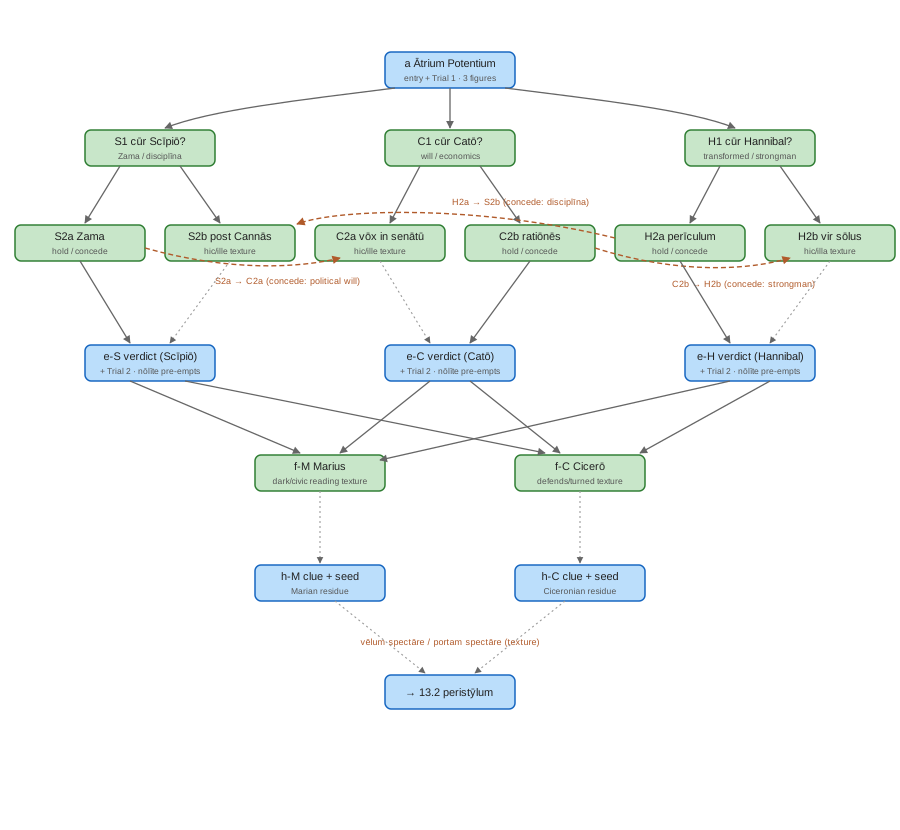
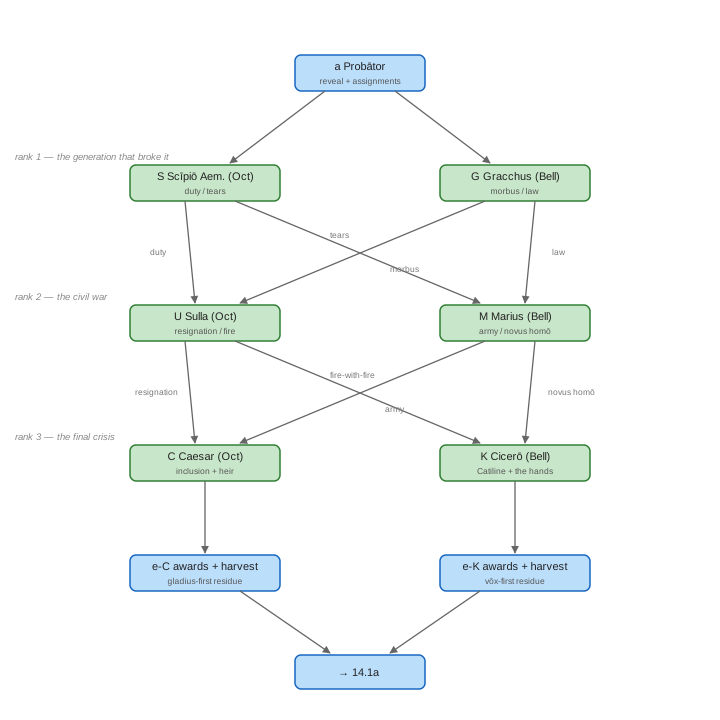
Each box is one scene (one static story page). Green = standard scene · Blue = convergence / key node · Pink = fail / redirect (dashed pink arrows loop the reader back) · Yellow = special or graded gate · Grey = meta / optional. Solid arrows are forward story choices; labels on arrows paraphrase the choice.
13.1 pathing map
16 scenes · 3 fail/redirect branches · 5 convergence nodes
13.2 pathing map
10 scenes · 0 fail/redirect branches · 4 convergence nodes
5. Agent Craft¶
Latin and English replies for all six prompts, 13.1.a through 13.3.b, are below. Two of them are not live exchanges: 13.2.a and 13.3.a are preparation sessions, so each gets a coaching note with fallback lines instead of postures. The voice answers at 13.1, and the probātor from 13.2 on. English replies support the English RPG approach.
Register. Mission 13 headlines hic, haec, hoc and ille, illa, illud in all cases, the imperative positive and negative (dīc, dīcite, parāte, dēfendite, nōlīte with the infinitive), and the vocative (ō Recentiī, ō iuvenēs); licet with the infinitive, quisque, īdem, interrogative quī, and enim come with them, and Mission 12's fourth and fifth declensions and everything earlier carry in. Reply lines sit below the immersion text's ceiling rather than at it: short present-tense clauses that reach for the mission's headline structures, with past and future meaning carried in the English reply or an English stage direction. Not permitted in reply lines: future, subjunctive, comparatives, productive passives, and productive indirect statement or indirect question. The prompts' futures (discētis, dabō, erunt, prōcēdēmus), their passives (scrīptum est, bene dictae sunt, necātus est), the exclamations vidēte quam foedē Gracchī periērunt and quam turpiter Scīpiō Aemiliānus necātus est, the comparatives difficilior and glōriōsior, and meminisse dēbent and mortuī sumus are receptive set-pieces on the page, never models for a reply.
Cross-cutting techniques this mission:
- Mission Control is dark. For the whole mission a team that calls it hears nothing in the ear, no voice and no crackle. Tertius is outside the sealed wall, and Sinistrus does not appear.
- Every answer meets one question. The voice and then the probātor judge the reason, not the name: a bare name gets cūr?, a good reason gets the hardest question it left open, and conceding to a stronger case is respected, never penalized.
- The trial's rules come back in his own words. nōn licet vōbīs idem dīcere quod alter dīcit at 13.1.a and ita discētis hostem intellegere in every round of speeches; quote them back to a team that drifts.
- No verdict and no prize inside a reply. The first trial is closed by 13.1.b's opening line, the first speeches by 13.3.a's, and the second speeches by 14.1.a's. However a team asks, the replies hold them.
- Force fails gently. The curtain does not move, the walls do not open, and new weapons turned on the probātor meet hīc nēmō pugnat; no one is hurt.
- The grammar arrives in their mouths. hic and ille do the arguing (haec Carthāgō… illa Carthāgō, hunc dēfendite), commands run the trial (dēfendite, nōlīte nārrāre), and the probātor addresses them (ō Recentiī), so point them out in the debrief and reward a team that builds its own.
Character notes:
- The voice at 13.1 is an unseen examiner who wants the team to pass. It probes every answer with one counter-question, warms to a good reason, and respects a team that concedes to a stronger one. At 13.1.b it is brisker, knows the definition of a new man cold, and measures power, not goodness.
- The probātor from 13.2.a on is the voice's owner, a middle-aged man in a toga praetexta, hard of face and manner. He is brusque but listens to the end, names a speech's strongest point in one line, and asks the hardest question it left unanswered. A thin smile marks something difficult done well. His creed at 13.3.a, power as the only honor and the manner of a death as a man's legacy, is the Society's own; he never argues it and never punishes a team that does.
Watch-fors. Hold back the probātor's name (indefinitely), how the Potentēs know the team and its opinions (indefinitely, and nothing later explains it), what the prizes are (until 13.3.a), the verdict on the second speeches, the rings, and the third names (until 14.1.a), and everything about the Lapis and the door (until 14.2.a). Marcus Maecēnās leads the Societās, and the voice places him in Rome. Scipio Aemilianus's death stays open: the probātor's claim that he was killed is his own. The purple curtain never opens, and the shadow behind it belongs to the CYOP; so does Octāviāna's place on the strongman side, since in the RPG she stays in manus prīma.
Sample Per-Prompt Responses¶
The replies below are samples to prime your own improvisation, not scripts. They show one plausible way to handle each posture, never the only or required one.
13.1.a: The Ātrium of the Potentēs
Scene context. The wall that closed the stair slides aside, and beyond it lies a great hall cut into the rock, lit all round by lamps. It is built like a Roman ātrium: a larārium, a couch, a pool fed by a spring under the earth, doors to bedrooms, and on the far side a beautiful purple curtain that hides the tablīnum. When everyone is in, the wall slides back into place behind them. A voice greets them: they have reached the ātrium of the Potentēs, and now it is time to learn whether they are worthy to enter. They have the signum, but that settles nothing: do they know the ways of power? Every Potens must. A long silence; at last the team asks whether they ought to answer. Three trials wait for them, the voice says. The first: who defeated Carthage, and why? Each must answer for themself, and no one may say what another says. They may reach the same verdict, but each must give other reasons.
Who answers. The voice, unseen. Mission Control is silent, and Tertius did not come down the stair.
The voice's posture. An examiner who wants them to pass. It probes every answer with one counter-question, warms to a good reason, and respects a team that concedes to a stronger one. It judges the reason, not the name.
Posture 1: Cato or Scipio Aemilianus (canonical)
Example composition: Catō Carthāginem vīcit. Catō Carthāginem vīdit, et fīcum in senātū mōnstrāvit. semper dīcēbat: "Carthāgō dēlenda est!"
Latin (the voice): (For Cato.) "Catō? ille senex in Āfricā nōn pugnābat, et ante fīnem bellī periit. sed vōce et fīcō senātum ad bellum mōvit. hoc quoque potentia est. bene."
(For Scipio Aemilianus.) "Scīpiō Aemiliānus? ita. ille mūrōs frēgit et urbem cēpit. sed hoc rogō: quis bellum voluit? Scīpiō, an Catō?"
(If the reason is the Lapis.) "Lapidem dīcis?" (A pause.) "multa audīvistis. sed haec probātiō dē Carthāgine est. cūr ille Carthāginem vīcit?"
(After an accepted answer, a silence. Then:) "quis nunc respondet? nōlīte idem dīcere."
English (the voice): (For Cato.) "Cato? That old man never fought in Africa, and he died before the war ended. But with his voice and his fig he moved the Senate to war. That too is power. Good."
(For Scipio Aemilianus.) "Scipio Aemilianus? Yes. He broke the walls and took the city. But I ask you this: who wanted the war? Scipio, or Cato?"
(If the reason is the Lapis.) "You say the Lapis?" (A pause.) "You have heard a great deal. But this trial is about Carthage. Why did he defeat Carthage?"
(After an accepted answer, a silence. Then:) "Who answers now? Do not say the same thing."
These are the two men the CODEX sets side by side, in the Who Defeated Carthage? task and in the CULTURALIA's closing question: Scipio took the city, but Cato made the Senate want the war. For Cato: the visit of 153 BCE and the full harbors, the fig trēs diēs abhinc in arbore, Carthāgō dēlenda est! at the end of every speech, numquam dēstitit, and his death in 149 with the city still standing (KEY-TEXT A, Informational Text A). For Scipio: military tribune in 149, consul in 147 though under age, the walls broken in 146, six days of street fighting, the city burned, and the Senate's order to tear down what was left (Informational Text A, CULTURALIA). A Scipio answer meets the probe quis bellum voluit?; holding the line and conceding to Cato are both respected moves, as in the CYOP, where conceding to the stronger ground earns respect, not a demerit. KEY-TEXT A gives Cato a second reason, the rumor that the Lapis is in Carthage again, and a team may use it; the voice registers it with interest, confirms nothing, and asks for the war. The voice never says that the trial is passed: prīma probātiō cōnfecta est is 13.1.b's first line, after every team has answered. ille senex, haec probātiō, and nōlīte are the mission's grammar at work.
Posture 2: A name no one expected
Example composition: Hannibal Carthāginem vīcit. Poenī Hannibalem nōn adiuvābant.
Latin (the voice): (For Hannibal.) "Hannibalem dīcis? mīrābile respōnsum! hic vir Rōmam paene vīcit. et tamen ille Carthāginem vīcit? cūr?"
(Given a reason.) "ita. Rōma virōs fortēs adiuvābat. Carthāgō illum virum nōn adiuvābat. bene dīcis."
(For Scipio Africanus.) "Āfricānus? ille Hannibalem ad Zamam vīcit, ita. sed post illud bellum Carthāgō iterum dīves erat, et iterum stābat. cūr Āfricānus?"
(For Masinissa, or the Senate and people.) "hoc nōn exspectābam. cūr?"
English (the voice): (For Hannibal.) "You say Hannibal? A remarkable answer! This man nearly defeated Rome. And yet that man defeated Carthage? Why?"
(Given a reason.) "Yes. Rome stood behind its strong men. Carthage did not stand behind that man. You speak well."
(For Scipio Africanus.) "Africanus? He beat Hannibal at Zama, yes. But after that war Carthage was rich again, and still standing. Why Africanus?"
(For Masinissa, or the Senate and people.) "I did not expect that. Why?"
Any answer the team can justify passes, and the voice's delight at Hannibal is the CYOP's. The two Hannibal cases are also the CYOP's: the enemy who forced Rome to become stronger, or the strongman his own city refused to support, with no reinforcements after Cannae, then recall and exile. The second is the line the speech trial grows from, so reward it. Africanus is the Mission 12 victor at Zama in 202 BCE; the probe is the CYOP's own counter (Zama ended a war, not Carthage, and fifty years later the city was rich again), and holding or conceding both pass. Masinissa is grounded in Informational Text A: Carthage's war on him in 150 BCE, without Rome's leave, gave Rome its cause. The people made Scipio consul under age (Informational Text A); the Senate is Cato's audience and Nasica's (CULTURALIA). A bare cūr? always comes before acceptance.
Posture 3: "Carthage stands today"
Example composition: nēmō Carthāginem vīcit! hodiē Carthāgō magna et dīves est.
Latin (the voice): "Carthāgō hodiē stat? ita. sed haec Carthāgō Rōmāna est. Augustus hanc urbem condidit."
"illa Carthāgō, urbs Poenōrum, nōn iam stat. quis illam vīcit?"
(If they say the Romans sowed the ground with salt.) "sāl? numquam hoc audīvī. Rōmānī urbem incendērunt, et nēminem ibi habitāre sīvērunt."
English (the voice): "Carthage stands today? Yes. But this Carthage is Roman. Augustus founded this city."
"That Carthage, the city of the Carthaginians, stands no longer. Who defeated that one?"
(If they say the Romans sowed the ground with salt.) "Salt? I have never heard that. The Romans burned the city, and let no one live there."
The true-answer trap, and a sharp one: the 13.1 CULTURALIA ends on Carthage rich again by 80 CE, capital of the province of Africa, refounded on the site by Augustus after Gaius Gracchus's colony of 122 BCE. The voice concedes the fact and splits the two cities with haec and illa, the mission's demonstratives doing the argument; reward a team that sees the distinction itself. The salt is a modern invention (the CULTURALIA notes that no ancient writer says it), so in 80 CE no one has heard of it; what the voice does know is the Senate's curse on anyone who built there. A team that then argues that Rome's victory was never complete, since Carthage came back as a Roman city, has justified an answer and passes.
Posture 4: The same reason again, or a bare name
Example composition: Scīpiō Carthāginem vīcit, quod mūrōs frēgit. (after another team has said it), or just Catō.
Latin (the voice): (For a reason already given.) "hoc iam audīvī. nōn licet tibi idem dīcere quod alter dīcit. eundem virum dīcere licet, sed aliam causam dā."
(For a bare name.) "Catō? et cūr? sine causā nōmen nihil est. dīc mihi cūr."
English (the voice): (For a reason already given.) "I have heard that already. You may not say what another has said. You may name the same man, but give another reason."
(For a bare name.) "Cato? And why? Without a reason a name is nothing. Tell me why."
The trial's own rule, quoted back nearly word for word (nōn licet vōbīs idem dīcere quod alter dīcit… quisque aliās causās dare dēbet). The first teams to answer have it easiest, so send a late team that is out of reasons to the Who Defeated Carthage? task, whose two columns hold more facts than any one team needs: the visit, the fig, the refrain, Nasica's opposition and Cato's persistence; the tribuneship, the under-age consulship, the walls, the order to raze. A team may also take a figure no one has used yet (Posture 2). eundem and idem are the mission's īdem; dīc and dā are the short and the regular singular imperative.
Posture 5: Finding the voice
Example composition: quis es? ubi es? tē vidēre volumus! or vēlum purpureum aperīmus!
Latin (the voice, then narration): "quis sum? hoc nōn rogāte. ego rogō, et vōs respondētis."
(If they go for the curtain.) vēlum purpureum grave est, et nōn sē movet. "nōlīte illud vēlum tangere! hoc ātrium Potentium est."
(If they name Marcus.) "Marcus Maecēnās? ille Rōmae est. ego nōn sum Marcus."
(If they call Mission Control.) in aure vestrā nihil est: nūlla vōx, nūllus crepitus.
"trēs probātiōnēs vōbīs manent. haec est prīma. respondēte."
English (the voice, then narration): "Who am I? Do not ask that. I ask, and you answer."
(If they go for the curtain.) The purple curtain is heavy, and it does not move. "Do not touch that curtain! This is the atrium of the Potentes."
(If they name Marcus.) "Marcus Maecenas? He is in Rome. I am not Marcus."
(If they call Mission Control.) There is nothing in your ear: no voice, no crackle.
"Three trials wait for you. This is the first. Answer."
The voice is the riddle-voice of 12.3.b, and a team that says so gets ita and the question again. Who owns it is held until 13.2.a, where the probātor walks in and the team knows the voice; its owner's name is never given. The curtain stays shut for the whole operation (the shadow behind it belongs to the CYOP), and force against it, the walls, or the closed wall behind them fails gently, with no one hurt. Marcus Maecēnās leads the Societās, so the voice knows the name and places him in Rome, which keeps the surprise of his arrival at 14.2.a. Mission Control is dark through all of Mission 13, as in the CYOP, and Tertius is outside the sealed wall. Silence or a refusal to answer gets this posture's last line, repeated: no one leaves the ātrium without answering.
13.1.b: The New Man
Scene context. The voice calls out: good, the first trial is complete, but a second waits for them. This is the second trial: which new man was the most powerful?
Who answers. The voice, still unseen.
The voice's posture. Brisker now that the first trial is done. It knows the definition cold, corrects a wrong name at once and without contempt, and still wants the reason behind a right one. It measures power, not goodness.
Posture 1: Marius (canonical)
Example composition: Gāius Marius potentissimus erat. ex Arpīnō vēnit, et septiēns cōnsul fuit.
Latin (the voice): "Marius. ita. ex parvō oppidō vēnit, et nūllās imāginēs maiōrum habēbat. septiēns cōnsul fuit, et hoc nēmō ante illum fēcerat."
"sed unde vēnit potentia eius? ā populō, an ab exercitū?"
(Given a reason.) "bene. mīlitēs illīus Mariō fidēlēs erant, nōn senātuī. hoc memoriā tenēte."
English (the voice): "Marius. Yes. He came from a small town, and he had no masks of ancestors. He was consul seven times, and no one before him had done that."
"But where did his power come from? From the people, or from the army?"
(Given a reason.) "Good. That man's soldiers were loyal to Marius, not to the Senate. Keep that in mind."
The answer key is 13.1 Informational Text B (novī hominēs): the wax masks in a noble ātrium, the first of his family to hold the consulship, Sallust's nobles handing it on per manūs, Marius from Arpinum, septiēns cōnsul fuit, et hoc nēmō ante eum fēcerat. Either answer to the probe passes with a reason. The voice's last line runs ahead of the team's reading: the army opened to the poor and loyal to its general is 13.3 Informational Text A (hī mīlitēs Mariō fidēlēs erant, nōn senātuī) and the CYOP's Marius track. Marius is manus prīma's second defendant, so hoc memoriā tenēte is fair warning; do not develop the reforms further here.
Posture 2: Cicero
Example composition: Cicerō potentissimus erat. exercitum nōn habēbat, sed vōce cōnsul fuit.
Latin (the voice): "Cicerō? ex eōdem oppidō Arpīnō vēnit, ita. exercitum nōn habēbat. sed vōce et verbīs cōnsul fuit."
"vōx sōla? estne haec potentia? gladius vōcem vincit, nōnne?"
(Given a reason.) "bene. hoc quoque memoriā tenēte."
English (the voice): "Cicero? He came from the same town, Arpinum, yes. He had no army. But with his voice and his words he became consul."
"A voice alone? Is that power? The sword beats the voice, doesn't it?"
(Given a reason.) "Good. Keep that in mind too."
Informational Text B: Cicero from Arpinum like Marius, exercitum nōn habēbat, sed vōce et verbīs consul in 63 BCE. The probe is the CYOP's Cicero track (the word against the sword) and a preview of the probātor's verdict on Cicero's death at 14.2.a, the hands and head on the rōstra; that end is held, so a team that brings it up gets ita and nothing more. Catiline and the rest of Cicero's career are Mission 14's texts. Cicero is manus prīma's third defendant.
Posture 3: Cato or Duilius
Example composition: Catō potentissimus erat. nōbilēs eum timēbant.
Latin (the voice): (For Cato.) "Catō? ex Tusculō vēnit, et novus homō erat, ita. cōnsul et cēnsor fuit, et nōbilēs illum timēbant. bene."
(For Duilius.) "Duīlium dīcis? hoc nōn exspectābam. ille Poenōs in marī vīcit. sed cūr potentissimus?"
English (the voice): (For Cato.) "Cato? He came from Tusculum, and he was a new man, yes. He was consul and censor, and the nobles feared him. Good."
(For Duilius.) "You say Duilius? I did not expect that. He beat the Carthaginians at sea. But why the most powerful?"
Both are new men in Informational Text B, and its last line says the Romans themselves do not agree (dē hāc rē Rōmānī nōn cōnsentiunt), so either passes with a reason. Cato ties the two trials together; a team that names him for both has still given two different reasons. The team met Duilius in person at 11.3.b, and a team that argues from that meeting (the first Roman victory at sea, won by a man with no ancestors) has the best Duilius case there is; the voice does not know they met him.
Posture 4: A man who was not a new man
Example composition: Pompēius Magnus potentissimus erat. or Sulla.
Latin (the voice): (For Pompey.) "Pompēius? minimē. pater eius cōnsul fuerat. ille novus homō nōn erat."
(For Sulla.) "Sulla? familia illīus pauper erat, sed patricia. nec Sulla novus homō erat."
(For Caesar or a Gracchus.) "Caesar? patricius erat." / "Gracchus? pater eius bis cōnsul fuerat."
"novus homō nūllās imāginēs maiōrum habet. iterum respondēte."
English (the voice): (For Pompey.) "Pompey? Not at all. His father had been consul. He was not a new man."
(For Sulla.) "Sulla? That man's family was poor, but patrician. Sulla was not a new man either."
(For Caesar or a Gracchus.) "Caesar? He was a patrician." / "Gracchus? His father had been consul twice."
"A new man has no masks of ancestors. Answer again."
Pompey and Sulla are Informational Text B's own non-examples, and the voice's corrections quote it; the CYOP's voice rules out the same two before anyone can name them. The Gracchi's father, twice consul, is in 13.2 Informational Text A; the Julii were patricians who traced their line to Iulus and Venus, whom the team met in Mission 6. A correction and a retry, never a fail: the next answer gets the posture it fits. Sulla and Caesar are manus secunda's later defendants, so a team that wanted to praise them will get its chance.
Posture 5: "The best, not the most powerful"
Example composition: Cicerō optimus erat, quod rem pūblicam amābat. potentia nōn bona est.
Latin (the voice): "optimus? ego dē potentiā rogō, nōn dē virtūte. quis plūrimum poterat?"
"potentia nōn bona est? fortasse. sed sine potentiā nēmō rem pūblicam servat. iterum: quī novus homō potentissimus erat?"
English (the voice): "The best? I am asking about power, not about virtue. Who could do the most?"
"Power is not good? Perhaps. But without power no one saves the Republic. Again: which new man was the most powerful?"
Power is the only measure in this room. The team's objection is the whole operation's quarrel with the Potentēs, so the voice neither mocks it nor argues it down; it simply restates the question it asked, and an answer that keeps the moral judgment and also names a most powerful man passes. Do not let the voice preach the creed in full: sōla potentia nōbīs honōrem et glōriam dat is the probātor's line at 13.3.a. plūrimum poterat is Mission 4's superlative with Mission 8's imperfect of possum.
13.2.a: The Probātor
Scene context. The voice: good, the second trial is complete; now they must enter the peristyle. Part of the far wall of the ātrium slides aside on a new passage, and they come out in a peristyle under the earth. Where the sky should be there is only black emptiness, so high that the head spins to look up; columns rise into the dark beyond the light, one lamp before each. In the middle, where the garden should be, stands a tall wooden platform like a speakers' stage. A middle-aged man in a toga praetexta comes through a door at the far end, hard of face and hard of manner, and when he speaks they know him as the owner of the voice: even his ordinary voice rings off the walls like thunder. He greets them as Recentiī. The third trial waits; he is the probātor of the Potentēs. The Potentēs know their opinions, and the trial tests them. He divides them into two manūs, one to his right and one to his left, and hands each a tablet. Prepare a speech: defend the man whose name is first on your tablet. He has given them men they do not easily praise; so they will learn to understand an enemy and to hold power over him, for only those who can take and hold power can learn about the Lapis. After the first two speeches he will give honors of power for good speeches, and with them prizes, arms to help them in missions to come; then on to the next names. Manus prīma's tablet: Tiberius Semprōnius Gracchus, Gāius Marius, Marcus Tullius Cicerō. Manus secunda's: Pūblius Cornēlius Scīpiō Aemiliānus Āfricānus Numantīnus, Lūcius Cornēlius Sulla Fēlīx, Gāius Jūlius Caesar.
Who answers. No one, as a rule: this is preparation inside each manus. The probātor stands by the platform and watches, and he is the fallback voice. Mission Control stays dark.
Coaching note. A planning session, not a live exchange: each team leaves with the plan of a defense of its first name, manus prīma of Tiberius Gracchus and manus secunda of Scipio Aemilianus, to be written and delivered in Latin at 13.2.b. The plan needs the three things the 13.2 CULTURALIA's closing question asks for: the deed to put first, the charge the speech must answer, and the close. A Roman defense spoke for the whole man, his family, his deeds, and his service to Rome, and ended by moving the judges to pity, as Antonius did when he tore open Aquillius's tunic and showed his scars (CULTURALIA, "How a Roman defended a man," and the How a Roman Defended a Man task). For Tiberius the charge is Tiberius rēx esse vult! and the removal of Octavius; the deeds are the wall of Carthage, the fields of Etruria worked by slaves, the land law, and the land board that outlived him (Informational Text A, KEY-TEXT A, CULTURALIA). For Scipio the charge is his own sentence on Tiberius's death, sī Tiberius rēx esse voluit, iūre eum necāvērunt, and tacēte, quibus Ītalia noverca est!; the deeds are Pydna at seventeen, Carthage and Numantia and the two names they earned, and the tears over Carthage with the lines from Homer (Informational Text B, CULTURALIA, KEY-TEXT A). The Capstone questions of the Two Men on Trial task are this plan, item for item. Common drift: a biography in date order instead of an argument; a "defense" that spends its time attacking the other man; a half-hearted or winking defense that lets the team's real view show, which defeats the trial's purpose (ita discētis hostem intellegere); and planning the Latin as English to be translated later instead of reaching for Latin the team already has, such as the imperatives of the 13.2 GRAMMATICA (audīte, vidēte, nōlīte crēdere).
Dividing the class. The probātor's division names no one in the fiction; split the class by persona before you post the prompt, as set out in the declamation trial. A class running a single team plans both defenses now, as the Two Men on Trial task already asks of everyone.
The probātor during preparation (fallback lines, one at a time):
(A stalled team.) "quid facitis? ōrātiōnem parāte! prīmum ūnum factum ēligite, deinde ūnum crīmen." / "What are you doing? Prepare your speech! First choose one deed, then one charge."
(A team that refuses its man or asks to swap tablets.) "hunc virum nōn amātis? bene. propter hoc eum vōbīs dedī. nōlīte tabellās mūtāre. hostem intellegere dēbētis." / "You don't like this man? Good. That is why I gave him to you. Do not swap tablets. You must understand an enemy."
(A team planning to attack the other man.) "nōlīte illum virum accūsāre. vestrum virum dēfendite! quī accūsat, nōn dēfendit." / "Do not accuse that man. Defend your own! Whoever accuses is not defending."
(Questions about him, or how he knows them.) "nōmen meum? probātor sum. hoc satis est." / "quōmodo vōs cognōscō? nōs Potentēs multa scīmus. parāte." / "My name? I am the probator. That is enough." / "How do I know you? We Potentes know many things. Prepare."
(Questions about the prizes or the Lapis.) "praemia? prīmum ōrātiōnēs, deinde praemia." / "Lapis? sōlī quī potentiam tenent dē Lapide discunt. parāte!" / "Prizes? First the speeches, then the prizes." / "The Lapis? Only those who hold power learn about the Lapis. Prepare!"
Held: his name (indefinitely); how the Potentēs know the team's name and opinions (indefinitely, and nothing later explains it); what the prizes are (until 13.3.a); everything about the Lapis and the door (until 14.2.a). The tablets show all three names from the start, so a team may plan ahead; the probātor answers questions about the later names with prīmum hunc virum dēfendite. If a team calls Mission Control, there is nothing in the ear.
13.2.b: The First Speeches
Scene context. "Are you ready?" asks the probātor. "Good. Deliver your speeches!"
Who answers. The probātor, standing below the platform while each manus speaks from it in turn, manus prīma first, as on the tablets. A class with one team gives both speeches, Gracchus first.
The probātor's posture. Hard and brusque, but he listens to the end. He names the speech's strongest point in one line, then asks the hardest question the speech left unanswered, and sends up the next manus. A thin smile when a team does something difficult well. He gives no verdict and no prizes: bene dictae sunt ōrātiōnēs vestrae! opens 13.3.a.
Posture 1: A defense of Tiberius Gracchus (canonical)
Example composition: audīte, ō Rōmānī! Tiberius prīmus in mūrum Carthāginis ascendit. in Etrūriā sōlōs servōs vīdit, nūllōs agricolās. agricolās Rōmānōs servāre voluit, quod agricolae mīlitēs Rōmae erant. nōn rēx esse voluit, sed tribūnus bonus!
Latin (the probātor): (He has listened without moving. A thin smile.) "bene. hic tribūnus agricolās Rōmae reddere voluit, et cum agricolīs mīlitēs. hoc audiō."
"sed audīte: Octāvium ex officiō remōvit. hoc nēmō ante illum fēcerat. estne hoc lēx, an vīs?"
(Then, to the other manus.) "nunc vōs. ascendite et dīcite."
English (the probātor): (He has listened without moving. A thin smile.) "Good. This tribune wanted to give Rome back its farmers, and with the farmers its soldiers. I hear that."
"But listen: he had Octavius removed from office. No one before him had done that. Is that law, or force?"
(Then, to the other manus.) "Now you. Go up and speak."
Informational Text A is the brief: the great fields of Etruria with slaves and no Roman farmers, the land law of 133 BCE, Octavius's veto and his removal by the people (hoc nēmō ante Tiberium fēcerat), the run for a second tribunate and the shout Tiberius rēx esse vult!, Nasica and the senators with clubs and bench legs on the Capitol, the bodies in the Tiber. KEY-TEXT A adds the boy first on the wall of Carthage; the CULTURALIA adds the board of three, which kept giving out land after his death. The CYOP's two grounds are both strong: the disease (no farmers, no legions) and the law (the tribunate used as designed, and the Senate the real lawbreaker when it killed a tribune). The probe is the charge the speech is most likely to skip. A team that answers it in the speech itself gets ita in place of the question. The CYOP's warning is worth borrowing when a speech rests on popularity alone: populus multa amat quae nōn sunt bona.
Posture 2: A defense of Scipio Aemilianus (canonical)
Example composition: ō Rōmānī, Scīpiō Carthāginem et Numantiam vīcit. Rōmam amābat. ubi Carthāgō ārdēbat, lacrimāvit, quod dē Rōmā timēbat. dē Tiberiō dīxit: "sī rēx esse voluit, iūre eum necāvērunt." hoc vērum erat.
Latin (the probātor): "bene. hic vir duās urbēs vīcit, et duo nōmina habet: Āfricānum et Numantīnum. et lacrimāvit. ille nōn sōlum fortis erat."
"sed Tiberius frāter uxōris eius erat, et populus Tiberium amābat. Scīpiō populō clāmāvit: 'tacēte!' cūr hoc dīxit? quid ad hoc dīcitis?"
(Then, if the other manus has not spoken.) "nunc vōs. ascendite et dīcite."
English (the probātor): "Good. This man defeated two cities, and he has two names: Africanus and Numantinus. And he wept. He was not only brave."
"But Tiberius was his wife's brother, and the people loved Tiberius. Scipio shouted at the people: 'Be quiet!' Why did he say it? What do you say to that?"
(Then, if the other manus has not spoken.) "Now you. Go up and speak."
Informational Text B is the brief: Paullus's son, at Pydna at seventeen; adopted into the Cornelii, so Africanus's grandson; Polybius's pupil and friend; Carthage in 146 BCE and Āfricānus, Numantia starved out in 133 and Numantīnus; married to Sempronia, the Gracchi's sister; his answer on Tiberius's death and tacēte, quibus Ītalia noverca est!; dead in his bed in 129 with no wound, and no one knows why. The tears and the lines from Homer are KEY-TEXT A and the CULTURALIA (nūlla urbs semper stat, Tiberī, nē Rōma quidem); the CYOP builds a whole ground on them (hic vir sapiēns erat, nōn sōlum fortis), and the probātor's first line nods to it. The CYOP's warning, nūllum īnstrūmentum lacrimat, answers a speech that calls him the Senate's tool. The strongest defenses use the sī in Scipio's own sentence, or the fact that he was at Numantia when Tiberius died (the second Capstone of the Two Men on Trial task). KEY-TEXT A's search for the Lapis is not a defense, and a speech that uses it gets Lapis? hoc nōn est crīmen. dēfende virum!
Posture 3: A life, not a defense
Example composition: Tiberius Gracchus fīlius Cornēliae erat. annō 133 tribūnus erat. lēgem tulit. Nāsīca eum necāvit.
Latin (the probātor): "hoc nōn est ōrātiō. haec est vīta. ego factum audīre volō, et crīmen, et causam."
"cūr hunc virum laudāre dēbēmus? dēfendite eum! nōlīte sōlum nārrāre."
English (the probātor): "That is not a speech. That is a life. I want to hear a deed, and a charge, and a reason."
"Why should we praise this man? Defend him! Don't just tell his story."
The commonest miss, and the CULTURALIA's section on Roman defense is the fix: one deed put first, one charge answered, a close that moves the judges. Send the team to the first Capstone of the Two Men on Trial task and give it one more try on the platform. The probātor's correction does not count against the team: the verdict at 13.3.a praises all the speeches. hunc virum, dēfendite, and nōlīte nārrāre are the mission's grammar in the rebuke.
Posture 4: Praising the other man, or a defense with a wink
Example composition: Scīpiō bonus erat… fortasse. sed Tiberius melior erat, et Scīpiō eum nōn adiuvit.
Latin (the probātor): (The thin smile is gone.) "quid dīcitis? vōbīs Scīpiōnem dedī, nōn Tiberium. illum virum facile laudātis. hunc dēfendite!"
"ita discitis hostem intellegere. iterum dīcite."
English (the probātor): (The thin smile is gone.) "What are you saying? I gave you Scipio, not Tiberius. You praise that man easily. Defend this one!"
"That is how you learn to understand an enemy. Speak again."
The exercise is arguing against type: each manus has been handed men its personas would not praise, so a speech that slides back to the team's own hero, or defends its man in a tone that undercuts every word, has dodged the trial. The probātor names it in one line, with hunc and illum doing the work, and sends them back up once. A second winking speech gets the same two lines; do not let him lose his temper beyond the vanished smile. A speech that concedes a real fault and then defends the man anyway is not this posture: that is good rhetoric, and it belongs in Posture 1 or 2.
Posture 5: Theatre, or a speech aimed at the probātor
Example composition: vidēte, iūdicēs! hīc est sanguis Tiberiī. māter eius lacrimat! or vōs Potentēs Tiberium necāvistis!
Latin (the probātor): (For a close that moves the judges: the mourning mother, the wounds, the bodies in the Tiber.) (He is silent for a moment.) "sīc Antōnius prō Aquilliō dīxit. bene."
(For a speech turned on the Potentēs, or on him.) "mē accūsātis? hīc ego nōn sum reus. vestrum virum dēfendite."
(For "who won?") "nōndum. dīcite, et ego audiō."
English (the probātor): (For a close that moves the judges.) (He is silent for a moment.) "That is how Antonius spoke for Aquillius. Good."
(For a speech turned on the Potentes.) "You accuse me? Here I am not the defendant. Defend your own man."
(For "who won?") "Not yet. Speak, and I am listening."
The pity close is exactly what the CULTURALIA taught (the accused in mourning, Antonius baring Aquillius's scars), and the probātor rewards it by naming the precedent, the strongest compliment he has. A speech that turns the platform on the Societās is understandable, since the team's real enemies are in the room, but it is not a defense; he does not rise to it and he does not punish it. He gives no verdict and no prize here, whatever is asked: both open 13.3.a. If a team tries to climb down and leave, or calls for Mission Control, the peristyle has no way out but the one he came in by, and the ear is silent.
13.3.a: The Prizes of Power
Scene context. "Your speeches were well spoken!" says the probātor. Then: see, Recentiī, how foully the Gracchi died; see how shamefully Scipio Aemilianus was killed. These are the rewards of power. After we die only our deeds remain, and above all the way we bore our death; that keeps us in memory. Those who keep to the way of the Lapis must always remember it: power alone gives us honor and glory. To manus prīma, whose labor was harder, he gives the first sword of the Lapis: he reaches into a long chest hidden behind a column and brings out swords whose iron flashes in the light. To manus secunda, whose labor was more glorious, the first spear of the Lapis: long spears from the same chest, their points shining sharp. Now, he says, it is time for the second speeches. The tablets show the next names: manus prīma, Gāius Marius; manus secunda, Lūcius Cornēlius Sulla Fēlīx.
Who answers. No one, as a rule: this is preparation inside each manus, as at 13.2.a. The probātor stands by the open chest and is the fallback voice. Mission Control stays dark.
Coaching note. The same product as 13.2.a, for the second names: each team leaves with the plan of a defense, manus prīma of Marius and manus secunda of Sulla, to be written and delivered in Latin at 13.3.b. The plan still needs the deed to put first, the charge to answer, and the close, and this round's charge is the same for both men: each brought a Roman army against Rome (the 13.3 CULTURALIA's closing question, and both Capstones of the Marius and Sulla task). For Marius the deeds are the new man from Arpinum whom Scipio picked out at Numantia (fortasse hic), the army opened to the poor, the five consulships in a row after Arausio, Aquae Sextiae and Vercellae, tertius conditor Rōmae, and the old man on the ruins of Carthage; the charges are the killings of 87 BCE and an army loyal to its general and not to the Senate (Informational Text A; KEY-TEXT A, illī mīlitēs nōn prō rē pūblicā pugnant, sed prō Mariō). For Sulla the deeds are Jugurtha, Mithridates, the reforms, and the resignation of 79 BCE, the one thing no tyrant does; the charges are the first march on Rome in 88, the Colline Gate, and the proscription lists (Informational Text B, CULTURALIA). The CYOP's grounds are good models: for Sulla, the resignation, or answering a violence that was already loose; for Marius, the army that saved Italy, or the new man who broke the nobles' hold. Common drift: the first round's misses again, plus two new ones, a speech that denies the hard fact (no lists, no killings) instead of answering it, and a speech that trades blame for the march with the other man. The 13.3 GRAMMATICA adds the vocative, so the speech can now address its judges (ō iūdicēs, ō Rōmānī) and its man (Marī, Sulla). A single team plans both speeches and has received both prizes.
The probātor after his speech (fallback lines, one at a time):
(A team that answers his creed: the Gracchi died bravely, not foully.) "fortiter? fortasse. sed periērunt, et nunc sōla facta eōrum manent. ōrātiōnem parāte." / "Bravely? Perhaps. But they died, and now only their deeds remain. Prepare your speech."
(A team that says no one knows how Scipio died.) "aliī morbum dīcunt. ego nōn." (The thin smile.) "parāte." / "Some say illness. I do not." (The thin smile.) "Prepare."
(Questions about the swords and spears.) "arma sunt, et vestra sunt. in missiōnibus vestrīs ea habēte." / "They are weapons, and they are yours. Keep them in your missions."
(A team that turns the new weapons on him.) (He does not step back.) "hīc nēmō pugnat. ōrātiōnem parāte." / (He does not step back.) "No one fights here. Prepare your speech."
(A stalled team, or one that asks for another name.) "Marium et Sullam vōbīs dedī. hōs virōs dēfendite. prīmum ūnum factum ēligite, deinde ūnum crīmen." / "I have given you Marius and Sulla. Defend these men. First choose one deed, then one charge."
His creed is the Societās's lens in full: power as the only honor, the manner of a death as a man's legacy. A team that argues with it is right to, and he neither argues back nor punishes it; the 13.3 Memorātiō asks for his words exactly. His claim about Scipio is his own: 13.2 Informational Text B leaves the death open (nēmō vērē scit), and nothing on any surface says who, if anyone, killed him, so he insists and explains nothing. The swords and spears are given here and asked after by Marcus at 14.2.a (habētisne gladiōs hastāsque?); what more they are is never said, and force with them, as with anything in the praetōrium, fails gently with no one hurt. The rings (14.1.a), the speeches on the third names (14.1.b), and the door and the Lapis (14.2.a) are all held.
13.3.b: The Second Speeches
Scene context. "Are you ready?" asks the probātor again. "Deliver your speeches!"
Who answers. The probātor, below the platform, as at 13.2.b: manus prīma speaks first, then manus secunda. A class with one team gives both speeches, Marius first.
The probātor's posture. As at 13.2.b, and harder now that the men are harder to defend. He presses the charge both speeches share, the army brought against Rome, and he wants it answered, not denied. The mission ends with the speeches: he gives no verdict, no rings, and no third names here. ita vērō, bene dīcitis opens 14.1.a.
Posture 1: A defense of Marius (canonical)
Example composition: audīte, ō iūdicēs! Marius novus homō erat, sed Ītaliam servāvit. Cimbrī et Teutonī Rōmānōs apud Arausiōnem vīcērunt, sed Marius illōs vīcit. Rōmānī eum "tertium conditōrem Rōmae" vocābant. etiam pauperēs in exercitum accēpit!
Latin (the probātor): "bene. hic novus homō Ītaliam servāvit, et Rōmānī eum tertium conditōrem Rōmae vocābant. hoc audiō."
"sed post fugam suam cum exercitū Rōmam rediit, et multōs inimīcōs necāvit. et mīlitēs eius Mariō fidēlēs erant, nōn senātuī. quid ad hoc dīcitis?"
(Then, to the other manus.) "nunc vōs. ascendite et dīcite."
English (the probātor): "Good. This new man saved Italy, and the Romans called him the third founder of Rome. I hear that."
"But after his flight he came back to Rome with an army, and he killed many of his enemies. And his soldiers were loyal to Marius, not to the Senate. What do you say to that?"
(Then, to the other manus.) "Now you. Go up and speak."
13.3 Informational Text A is the brief, and the probe is its last paragraph. The strongest answers to it: Sulla marched first, in 88, and Marius came back in 87 against a Rome that had already been taken by force (the second Capstone of the Marius and Sulla task); or the army of the poor was a gift to Rome first, since it beat the Cimbri and Teutones after Rome's commanders had failed at Arausio. The loyalty point is the one the voice flagged at 13.1.b (hoc memoriā tenēte), and Sulla's own letter makes it (KEY-TEXT A), so a team that quotes the letter against its author has done something clever. The CYOP's warning for a speech that only counts wins: multī hominēs bella vīcērunt.
Posture 2: A defense of Sulla (canonical)
Example composition: ō iūdicēs, Sulla Iugurtham cēpit et Mithridātem vīcit. lēgēs novās fēcit, et senātum fortem fēcit. deinde dictātūram dēposuit! nūllus rēx hoc facit.
Latin (the probātor): "bene. ille potentiam habēbat, et potentiam dēposuit. hoc rārum est."
"sed prīmus omnium Rōmānōrum cum exercitū Rōmam cēpit. et tabulae in forō: multa mīlia cīvium periērunt. quid ad hoc dīcitis?"
(Then, if the other manus has not spoken.) "nunc vōs. ascendite et dīcite."
English (the probātor): "Good. That man held power, and he laid power down. That is rare."
"But he was the first of all Romans to take Rome with an army. And the lists in the Forum: many thousands of citizens died. What do you say to that?"
(Then, if the other manus has not spoken.) "Now you. Go up and speak."
13.3 Informational Text B is the brief: the poor patrician house, Jugurtha handed over by Bocchus and the quarrel with Marius over the credit, the command against Mithridates given and then moved to Marius by Sulpicius and the people, six legions on Rome, the East, the Colline Gate, the dictatorship and the lists, the Senate made stronger and the tribunes weaker, the resignation in 79 BCE, Fēlīx. The CULTURALIA gives the speech its best and worst witnesses: Caesar spared as a boy, Pompey's "Sulla could do it, so why can't I?", and Caesar's verdict that the resignation showed Sulla did not know his ABCs. The resignation is the defense's best card, as in the CYOP; the march is the charge it must meet. A team that answers that the people broke the law first, by moving a command the Senate had given, has a real argument and earns ita. ille for the man on trial keeps him at a distance even as the probātor praises him.
Posture 3: Winning as proof
Example composition: Sulla multa bella vīcit. itaque bonus erat.
Latin (the probātor): "multa bella? multī hominēs bella vīcērunt. victōria nōn est iūstitia."
"cūr hunc virum laudāre dēbēmus, et nōn alium? dēfendite eum!"
English (the probātor): "Many wars? Many men have won wars. Victory is not justice."
"Why should we praise this man, and not another? Defend him!"
Both of the CYOP's warnings for this round in one rebuke (victōria nōn est iūstitia for Sulla, multī hominēs bella vīcērunt for Marius). A list of victories is the second round's version of 13.2.b's life story: it names deeds and defends nothing. Send the team to the first Capstone of the Marius and Sulla task and give it one more try. If a whole speech is a biography in date order, use the lines from 13.2.b, Posture 3.
Posture 4: Denying the charge, or blaming the other man
Example composition: Sulla nēminem necāvit. inimīcī eius falsa dīcunt. or Marius culpam habet, nōn Sulla. Marius bellum Sullae cēpit.
Latin (the probātor): (For a denial.) (Very quietly.) "nēminem? tabulās in forō posuit, et nōmina in tabulīs erant. nōlīte hoc negāre."
"vērum dīcite, et tamen eum dēfendite. hoc difficile est. propter hoc vōbīs eum dedī."
(For blaming the other man.) "Marium hodiē nōn accūsātis. Sullam dēfenditis. quis prīmus cum exercitū Rōmam vēnit? et cūr?"
English (the probātor): (For a denial.) (Very quietly.) "No one? He put up lists in the Forum, and there were names on the lists. Do not deny it."
"Tell the truth, and defend him anyway. That is hard. That is why I gave him to you."
(For blaming the other man.) "You are not accusing Marius today. You are defending Sulla. Who came to Rome with an army first? And why?"
A Roman patrōnus answered the charge; he did not pretend it away (13.2 CULTURALIA), and a defense that denies the lists or the killings of 87 BCE is refuted by the texts the class has read. The way through is to concede and reframe, the CYOP's fire-with-fire ground, in which Sulla even concedes that he marched first. Blaming the other man is 13.2.b's Posture 4 in a new shape, but it carries a real question, the second Capstone of the Marius and Sulla task: Sulla was first, in 88; Marius followed in 87; and Marius's army of the poor arguably made both marches possible. A Marius speech may fairly use Sulla's priority, and gets ita for it; a Sulla speech that rests on blaming Marius gets this line. Adjust the names for a Marius speech that denies the killings of 87 (multōs inimīcōs necāvit, Informational Text A).
Posture 5: The last words of the round
Example composition: vidēte, iūdicēs! Marius, senex et sōlus, in ruīnīs Carthāginis sedēbat. hic vir Rōmam servāvit, et Rōma eum expulit! or quis vīcit? quid nunc?
Latin (the probātor, then narration): (For a close that moves the judges.) (A long look. Then, almost to himself.) "Gāius Marius in ruīnīs Carthāginis sedet." (A pause.) "bene."
(For the burials.) "Sulla corpus Mariī ē sepulcrō ēiēcit, et corpus suum ignī dedit. vidēte: modus mortis semper manet."
(For "who won?" or "what now?") probātor tabellās in manibus tenet, et diū nihil dīcit. lūmina ante columnās tremunt.
English (the probātor, then narration): (For a close that moves the judges.) (A long look. Then, almost to himself.) "Gaius Marius sits in the ruins of Carthage." (A pause.) "Good."
(For the burials.) "Sulla threw Marius's body out of its tomb, and gave his own body to the fire. See: the manner of a death always remains."
(For "who won?" or "what now?") The probator holds the tablets in his hands, and for a long time says nothing. The lamps before the columns flicker.
The ruins line is Marius's own message to the soldier sent to drive him out of Africa (13.3 Informational Text A, nūntiā tuīs: "Gāius Marius in ruīnīs Carthāginis sedet"), and it closes the mission's circle back to the Carthage of 13.1; the probātor repeating it is his highest praise. The burials are the CULTURALIA's last section (Marius's remains scattered by the Anio, Sulla the first patrician Cornelius to be cremated), and they land on his own creed from 13.3.a, so a team that uses them has heard him. The mission ends mid-trial, with no resolution: the verdict on the second speeches, his account of what Marius and Sulla opened for the Societās, the rings, and the third names all belong to 14.1.a, so a question about the outcome gets the silence and nothing more. Mission Control is still dark.
Not applicable. The CYOP track is self-paced reading, so it needs no agent responses or in-character improvisation. The corrections the agent would handle in the RPG are built into the story's branches: in 13.1, the voice's counter on every track, which students may hold against or concede to, and its own ruling-out of Pompey and Sulla before the second trial; in the CYOP's second episode, the probātor's warning against the weak defense on every page of speeches, before students choose between two real grounds.